TL;DR:
- Documenting narcissistic abuse requires detailed, factual records of specific incidents over time.
- Starting early preserves credibility and helps build a strong case by showing a sustained pattern of behavior.
- What are the essential tools for documenting narcissistic abuse?
- How to create an incident log that holds up in court
- What types of objective evidence support claims in court?
- How to organize and present your evidence to show a pattern
- What I’ve learned about documenting abuse that most guides won’t tell you
- Key takeaways
- FAQ
Documenting narcissistic abuse for court means converting subjective, painful experiences into factual, verifiable records that a judge can evaluate. Courts do not rule on personality diagnoses. They rule on documented behavior patterns. The tools that matter most are contemporaneous incident logs, preserved digital communications, and statements from neutral third parties such as therapists, school counselors, and pediatricians. This guide explains exactly how to build that record, what evidence carries legal weight, and how to present it so it tells a coherent story.
What are the essential tools for documenting narcissistic abuse?
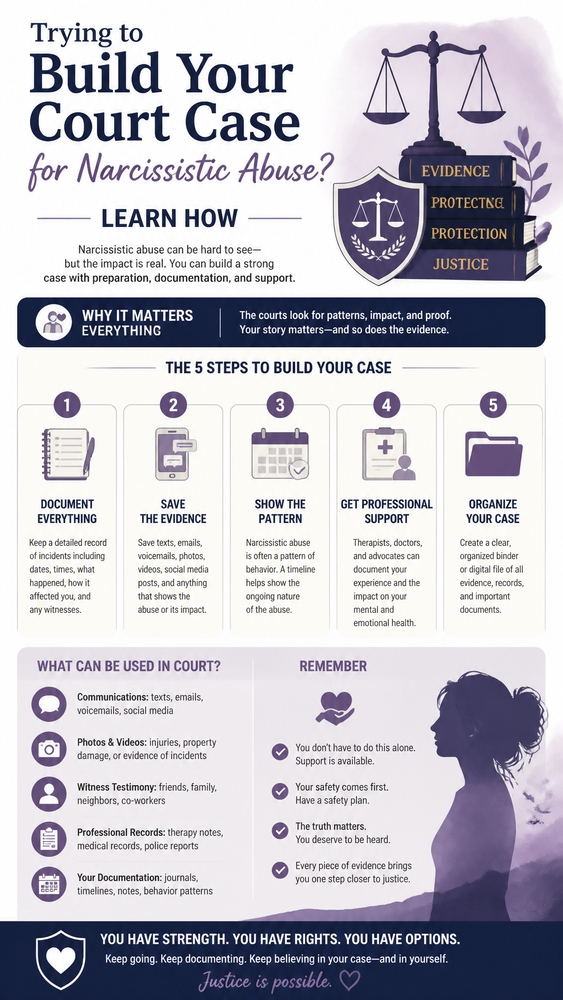
The foundation of any abuse case is a written incident log started as early as possible. Contemporaneous logs also provide psychological stability for victims, because gaslighting fragments memory over time. Recording events promptly counteracts that fragmentation and keeps your recollection credible.
Before you write a single entry, set up secure storage. Use a cloud account the abuser does not know exists. Decoy folders and hidden storage reduce the risk of tampering or destruction. Never store documentation on a shared device or a family account.
Shift as much communication as possible to written channels. Texts, emails, and app messages create automatic timestamps. Verbal conversations leave no trace. When the abuser insists on phone calls, follow up every call with a written summary sent by email so there is a record.
Key tools to have ready before you begin:
- A dedicated private journal or app (Google Docs in a new account, or a notes app with a passcode)
- Secure cloud backup (a personal Google Drive or iCloud account unknown to the abuser)
- A folder for digital evidence (screenshots, email exports, voicemail recordings)
- A contact list of potential witnesses (therapist, doctor, school counselor, trusted neighbors)
- Knowledge of your state’s recording laws (most U.S. states allow one-party consent recording)
Pro Tip: Set a daily five-minute alarm to review and update your log. Consistency in timestamps is one of the first things attorneys check.
How to create an incident log that holds up in court
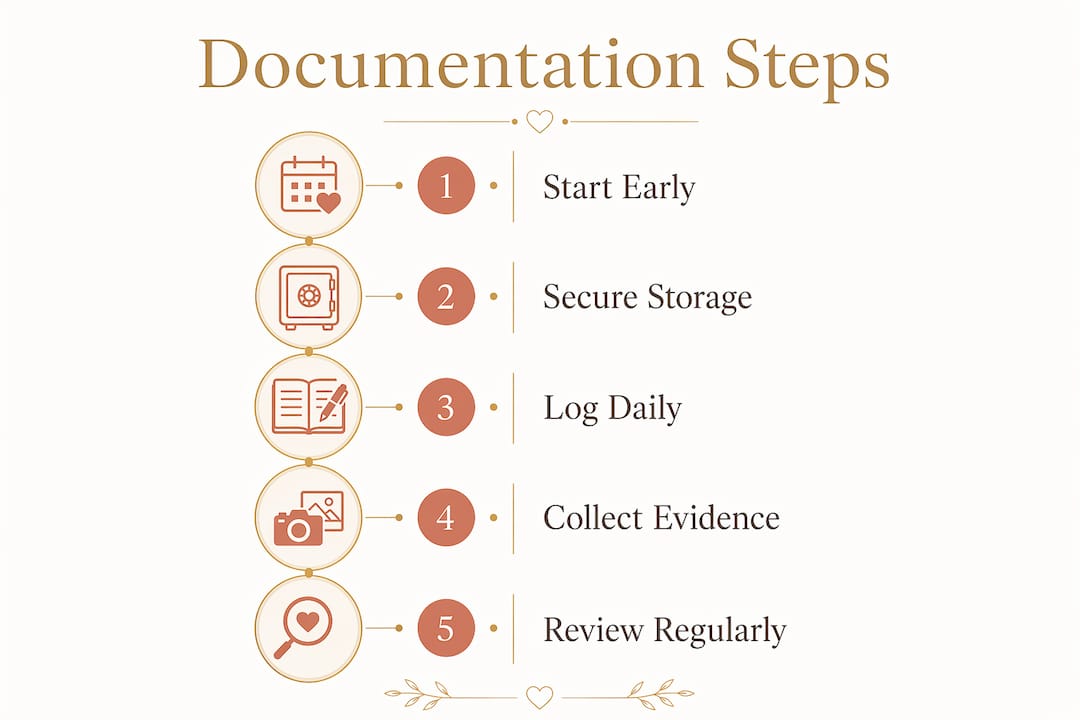
A detailed incident log with exact facts and direct quotes is stronger evidence than vague emotional descriptions. The difference is concrete. Writing “he was cruel” tells a judge nothing. Writing “on march 15, at 7:42 p.m. in the kitchen, he called me worthless in front of our two children” gives a judge a specific, verifiable event.
Follow these steps for every entry:
- Record the date, time, and location. Be exact. “Tuesday evening” is not enough. “Tuesday, april 8, at approximately 6:15 p.m. in the living room” is.
- Write direct quotes. Use quotation marks. Do not paraphrase. If you cannot remember exact words, write the closest approximation and note it is approximate.
- Name everyone present. Include children, visitors, or anyone who witnessed the incident. Their names may become witness contacts later.
- Describe your physical and emotional response. “I felt my hands shaking and began to cry” is factual. It documents impact without editorializing.
- Note any aftermath. Did you call a friend? Visit a doctor? Send a text about what happened? Cross-reference those records in the entry.
- Avoid labels. Do not write “he was being narcissistic” or “she gaslighted me.” Courts focus on documented facts, not psychological labels. Describe the behavior exactly as it happened.
Keep entries in strict chronological order. A judge reading your log should see a timeline, not a collection of complaints. The Aftertheaffair resource on preparing for custody court covers how to structure this timeline specifically for family court proceedings.
Pro Tip: After writing each entry, read it back and ask: “Could a stranger understand exactly what happened from this alone?” If not, add more specific detail.
What types of objective evidence support claims in court?
An incident log is your spine. Objective evidence is the muscle around it. Preserving all communications with visible timestamps strengthens the overall case, and backing up messages in multiple secure locations prevents loss.
Screenshots alone can be challenged as fabricated. Certified phone records or official platform archives provide stronger proof because they include metadata. Request your carrier’s certified call and message logs. For email, export the full thread with headers intact, not just a forwarded copy.
Financial records are often overlooked but carry significant weight. Patterns of financial coercion documented in bank and credit card statements are valuable evidence. Restricted account access, unexplained transfers, or a pattern of controlling spending all support claims of coercive control.
Third-party witnesses are the most persuasive category. Expert testimony from pediatricians, therapists, and school counselors carries more weight than statements from friends or family, because courts treat neutral professionals as objective sources.
| Evidence type | Strength in court | Key action |
|---|---|---|
| Certified phone records | High | Request directly from carrier |
| Platform-archived messages | High | Use official export tools (Gmail, iMessage) |
| Screenshots | Medium | Use as backup only; pair with certified records |
| Financial statements | High | Highlight restricted access and unusual transactions |
| Therapist or counselor statements | Very high | Ask provider to document observed impact in writing |
| Medical records | High | Request records noting stress, injury, or mental health impact |
| Friend or family testimony | Low to medium | Use to corroborate, not as primary evidence |
The Aftertheaffair guide on identifying coached behavior in children is particularly useful if custody is part of your case, as it outlines specific behaviors worth documenting.
How to organize and present your evidence to show a pattern
Courts are skeptical of individual accusations. A multi-month or multi-year record is far more credible than a handful of incidents. Your goal is to show a deliberate, sustained campaign of behavior, not a bad week.
Use this structure to organize your evidence before meeting with an attorney:
- Build a master timeline. List every documented incident in date order. Include the log entry, any corroborating message, and any witness who was present.
- Identify escalation points. Mark dates when behavior intensified. Courts respond to escalation patterns because they suggest deliberate control rather than random conflict.
- Group by behavior type. Separate financial control, verbal abuse, isolation tactics, and threats into categories. This shows breadth, not just frequency.
- Attach corroboration to each incident. Every log entry should link to at least one piece of supporting evidence, whether a text, a medical note, or a witness name.
- Prepare a one-page summary. Your attorney needs a clear overview. Write a factual, unemotional summary of the pattern. No labels, no diagnoses, just behavior and dates.
Legal professionals specializing in coercive control understand how to counter manipulation tactics like DARVO (Deny, Attack, Reverse Victim and Offender) and present evidence most persuasively by jurisdiction. Working with a specialist attorney is not optional if the other party is skilled at manipulation.
Maintaining a calm and factual demeanor in court enhances your credibility and can provoke the abuser to lose composure. Judges favor objective presentation. Emotional reactions, even understandable ones, can be used against you.
| Approach | Effect in court |
|---|---|
| Chronological pattern with corroboration | Demonstrates sustained abuse, high credibility |
| Isolated incidents without context | Appears as personal conflict, low credibility |
| Calm, factual testimony | Builds judicial trust |
| Emotional or reactive testimony | Risks appearing unstable, reduces impact |
| Psychological labels (“narcissist”) | Dismissed as lay diagnosis, weakens case |
| Specific behavior descriptions with dates | Treated as factual evidence, high impact |

What I’ve learned about documenting abuse that most guides won’t tell you
The biggest mistake I see people make is waiting. They wait until they feel ready, until things get worse, or until they have “enough.” By then, memory has been distorted by months of gaslighting, and the window for contemporaneous records has closed. Start the day you decide you might need this. You can always not use it.
The second mistake is writing for the wrong audience. People write their logs as if they are venting to a friend. They use words like “manipulative,” “controlling,” and “toxic.” Those words mean nothing to a judge. Write for a stranger who has never met either of you and needs to understand what happened from facts alone.
The psychological benefit of logging is real and often underestimated. The act of writing down what happened, in plain factual language, helps you trust your own perception again. After months of being told your reality is wrong, seeing it written clearly is grounding. The mindfulness and documentation practices that support healing after betrayal overlap directly with what makes a strong legal record.
One more thing: do not tell the abuser you are documenting. Do not tell mutual friends. Tell your therapist and your attorney. The element of surprise matters. Abusers who know they are being documented often escalate or destroy evidence. Protect your record the same way you protect yourself.
— S.J.Howe
How Aftertheaffair can support your next steps
Facing court while processing trauma is one of the hardest things a person can do. Aftertheaffair was built for exactly this intersection of legal preparation and emotional recovery.
The Pattern Archive Method is a structured guide that walks you through building a court-ready timeline of abusive incidents, step by step. For broader healing support alongside your legal process, the 7-step recovery checklist gives you a clear framework for managing both the emotional and practical demands of this period. You do not have to hold all of this alone. Aftertheaffair provides the structure so you can focus on what matters most.
Key takeaways
Documenting narcissistic abuse for court requires specific, dated, factual records that demonstrate a sustained pattern of behavior, not isolated incidents or psychological labels.
| Point | Details |
|---|---|
| Start immediately | Begin logging the day you consider legal action; gaslighting erodes memory fast. |
| Use facts, not labels | Replace “he was controlling” with exact quotes, dates, and locations every time. |
| Authenticate digital evidence | Request certified carrier records and platform archives; screenshots alone can be challenged. |
| Build a chronological pattern | Courts need to see escalation over time, not a handful of unconnected complaints. |
| Use neutral third parties | Therapist, counselor, and medical records carry more weight than family testimony. |
FAQ
What is the most important thing to include in an abuse log?
A contemporaneous log must include the date, time, location, direct quotes, names of witnesses, and your physical or emotional response. Specificity is what separates credible evidence from a personal complaint.
Can I record conversations as evidence of narcissistic abuse?
Most U.S. states allow one-party consent recording, meaning you can record a conversation you are part of without the other person’s knowledge. Check your specific state law before recording, as a small number of states require all-party consent.
Why shouldn’t I call someone a narcissist in court documents?
Courts rule on documented behavior, not psychological diagnoses. Calling someone a narcissist reads as a lay opinion and weakens your credibility. Describe the specific behavior with dates and quotes instead.
How do I protect my documentation from being destroyed?
Store evidence in hidden cloud accounts the abuser does not know exist, and use decoy folders on any shared devices. Back up everything in at least two separate locations.
How long should I document before going to court?
The longer the record, the stronger the case. A multi-month or multi-year timeline is far more persuasive than a few weeks of entries. Start now and document consistently until your legal matter is resolved.
Recommended
- How to Prepare for Custody Court with a Narcissist
- Gray Rock: Co-Parenting With a Narcissist or Toxic Ex-PR3 – After the Affair Series
- Parallel Parenting With a Narcissist – After the Affair Series
- Project 7- The Pattern Archive Method How to Document Invisible Abuse So Courts Finally See What You’ve Been Living – After the Affair Series