The reason you feel like you have lost your mind is that something real happened inside it.
TL;DR:
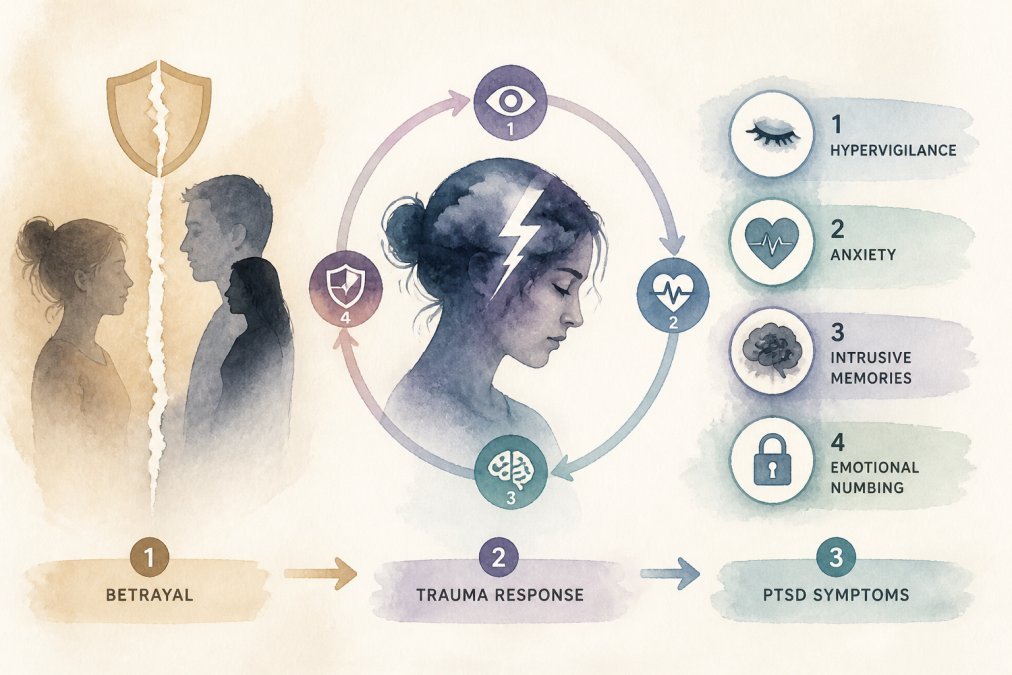
When people say infidelity changed them, they are describing something that is neurologically accurate. Betrayal trauma produces measurable changes in three specific brain systems: the amygdala, the hippocampus, and the HPA axis. These changes explain why intrusive thoughts feel uncontrollable, why the past feels present, why the body cannot relax even in safe situations, and why simple willpower produces nothing. This article explains the biology in plain language — not to replace the emotional reality of what you are going through, but to give it the accurate name it deserves.
Key Takeaways
| Point | What this means for you |
|---|---|
| Betrayal trauma produces measurable changes in brain architecture | These are not metaphors. They are documented neurological effects. |
| Three specific systems are affected | The amygdala, the hippocampus, and the HPA axis each play a distinct role in the symptoms you are experiencing. |
| The intrusive thoughts are not a choice | They are the product of a hippocampus that cannot file the threat memories as past. |
| The hypervigilance is not paranoia | It is an amygdala recalibrated to a lower threat threshold by a genuine threat experience. |
| The body’s inability to relax is not anxiety as a personality trait | It is an HPA axis running in chronic activation mode. |
| Recovery is neurological as well as emotional | The brain changes that trauma produces are responsive to appropriate, consistent input over time. |
Why Understanding the Biology Matters
There is a version of the betrayal trauma experience where the symptoms feel like evidence of personal weakness. The inability to stop thinking about the affair. The flinching at ordinary things. The body that refuses to relax even in objectively safe moments. The emotional floods that arrive without warning. These feel, to the person experiencing them, like failures of will, of resilience, of character.
They are not. They are the direct outputs of a brain that was exposed to a specific kind of threat and responded the way brains are designed to respond to threat. The symptoms are physiological. They are measurable. They are explicable. And understanding how they are produced changes the experience of having them — not by making them disappear, but by removing the secondary layer of shame that most survivors carry on top of the primary symptoms.
When you understand that the intrusive thoughts are a hippocampal processing failure rather than a personal obsession, something shifts. Not the thoughts, not immediately. But the relationship to them.
The Three Brain Systems Betrayal Trauma Disrupts
The Amygdala: The Threat Detection System
The amygdala is a small, almond-shaped structure deep in the brain whose primary function is threat detection. It operates faster than conscious thought — scanning the environment continuously, comparing incoming information against a database of known threats, and firing a danger signal when a match is found.
Under ordinary circumstances, the amygdala is reasonably well-calibrated. It fires in response to genuine threats and stays quiet in genuinely safe situations.
After betrayal trauma, the calibration changes.
The amygdala has learned something from the experience of the affair. It has learned that the relationship context — the domain of closest attachment — is a source of threat. And because the threat was concealed and sustained over time, the amygdala’s recalibration is thorough. It now flags things it previously treated as neutral: a phone notification, a slight change in the partner’s tone, a name that appears on a screen, a moment of silence that used to feel comfortable.
It does this not because the person experiencing it is paranoid, or irrational, or unable to let go. It does this because that is exactly what a well-functioning amygdala does after a genuine threat experience in a particular context. It increases its sensitivity in that context. The problem is not that the amygdala is malfunctioning. The problem is that it learned its lesson from a situation that no longer accurately represents reality — and it has not yet received sufficient consistent evidence to update.
This is the hypervigilance. Not a character trait. Not a choice. A recalibrated threat-detection system doing its job.
The Hippocampus: The Memory Filing System
The hippocampus is responsible for consolidating memories — taking the raw material of experience and filing it as integrated long-term memory with a timestamp attached. That timestamp is crucial. It is what tells the brain that an experience belongs to the past rather than the present.
Under sustained stress hormone exposure, hippocampal function is impaired. The consolidation process is disrupted. Memories that have not been properly processed and filed remain in a different state — vivid, uncontextualised, available to intrude on present experience without the dampening effect that proper filing would provide.
This is why the affair does not feel like it is in the past. It is not filed as past. The memories are not behaving the way properly consolidated memories behave, with their emotional charge reduced and their context clearly located in a different time. They are behaving like present-tense information. Like something that is still happening.
This is also why the intrusive thoughts are not a choice. They are the product of a hippocampus that is trying to process material it has not been able to consolidate, surfacing it in awareness in an attempt to complete a process that chronic stress keeps interrupting.
The HPA Axis: The Stress Hormone System
The hypothalamic-pituitary-adrenal axis is the body’s primary stress response system. It governs the release of cortisol and other stress hormones in response to perceived threat, and it is designed for acute activation followed by recovery — the system fires, the threat passes, the hormones return to baseline.
After betrayal trauma, particularly in cases where the disclosure happened in waves over time — where the full picture emerged slowly, with new information arriving periodically — the HPA axis does not get the signal that the threat has passed. It remains in a state of chronic activation. Cortisol levels stay elevated. The body stays in a state of readiness.
You may recognise this as the feeling of being unable to fully relax even in objectively safe situations. Even when nothing is actively wrong, there is a persistent background hum of alertness. A sense that rest is not fully available. That peace is provisional.
This is not anxiety as a personality trait. This is an HPA axis that has been running in emergency mode for an extended period and has not yet received enough consistent safety signals to return to baseline.
What Each Disruption Produces in Daily Life
The three systems interact, and their combined disruption produces the symptom picture that betrayal trauma survivors experience:
The hyperreactive amygdala produces: hypervigilance, scanning, monitoring, sudden activation in response to things that seem disproportionate to the outside observer.
The disrupted hippocampus produces: intrusive thoughts, memories that feel present-tense rather than past, difficulty constructing a coherent narrative of what happened, emotional flashbacks.
The chronically activated HPA axis produces: inability to relax, sleep disruption, physical symptoms including fatigue and gastrointestinal disturbance, immune system effects, a persistent background sense of threat even in safe moments.
None of these are produced by weakness. None of them are chosen. All of them are measurable physiological effects of a specific kind of threat experience.
The Emotional Flashback: The Most Misunderstood Symptom
The emotional flashback deserves specific attention because it is both one of the most common symptoms of betrayal trauma and one of the least recognised.
Unlike the visual or sensory flashbacks associated with standard PTSD — the vivid replaying of a scene in full sensory detail — emotional flashbacks carry no visual content, or very little. They arrive as sudden, overwhelming emotional states. You may be in the middle of an ordinary activity and without warning be flooded with the exact emotional state of the moment of discovery: the terror, the grief, the rage, the shame. Or a specific later moment. The denial. The realisation of the full timeline. The moment you understood what something meant.
These arrive without an obvious trigger, or with a trigger so small and apparently unrelated that the connection is not immediately clear. They are not chosen. They are not evidence that you are dwelling on the affair or refusing to move forward. They are the hippocampus failing to keep the threat memory in its proper temporal location — the past — and allowing it to surface in the present.
The reason emotional flashbacks are so often misidentified is that they do not look like what people imagine flashbacks look like. There is no visual replay. There is just an inexplicable crash into an overwhelming emotional state. Many survivors describe these as feeling “crazy” or “out of proportion.” They are neither. They are a specific, recognised trauma symptom — one that responds to treatment in the same way as other trauma symptoms, once it is correctly identified.

Why Willpower Does Not Work
This is worth stating plainly, because many survivors spend enormous energy trying to recover through willpower — trying to decide to think about it less, trying to force themselves to trust, trying to override the hypervigilance through determination.
Willpower operates in the prefrontal cortex: the brain’s executive function, the seat of conscious reasoning and decision-making.
The symptoms of betrayal trauma originate in the amygdala, the hippocampus, and the HPA axis — subcortical systems that operate beneath conscious control. They do not respond to executive instruction. The amygdala does not check with the prefrontal cortex before firing a threat alert. The hippocampus does not comply with a decision to stop surfacing intrusive thoughts. The HPA axis does not return to baseline because someone decided it should.
This is why survivors who are making every conscious effort to move forward are still experiencing the full weight of the symptoms. Not because they are not trying. Because they are using the wrong tool. Willpower is a prefrontal tool. Trauma recovery requires working directly with the subcortical systems — through approaches that speak the language of the nervous system rather than the language of conscious decision.
What the Biology Tells Us About Recovery
The neurological changes that betrayal trauma produces are real. They are also — and this is the part worth holding — not permanent.
The brain is plastic. It changes in response to experience, including the experience of sustained, appropriate support. The amygdala can recalibrate its threat threshold when it receives enough consistent evidence that the environment is safe. The hippocampus can complete the consolidation of traumatic memories when the stress hormone load is reduced enough to allow the process to finish. The HPA axis can find a new baseline when the nervous system receives sufficient safety signals over sufficient time.
These are not metaphors of hope. They are documented neurological outcomes that correspond to specific types of therapeutic input: approaches that work directly with the body’s threat response rather than relying on cognitive processing alone, that reduce the arousal level enough to allow the hippocampus to do its work, and that provide enough consistent safety to allow the amygdala to begin revising its calibration.
The biology does not make recovery automatic. It makes it possible. And understanding it is the beginning of pursuing it in the right direction.
FAQ
Will my brain ever go back to how it was before? The goal is not restoration to a pre-betrayal state — the brain that existed before had not been through this experience, and returning to it is neither possible nor necessary. The goal is a new, stable baseline: one where the amygdala is less reactive, the hippocampus has completed its processing, and the HPA axis is no longer in chronic activation. Most survivors who receive appropriate support describe reaching a state that feels, in important ways, more grounded than before — different, but not diminished.
How long does it take for the brain to recover? There is no universal answer, and the question of timeline is addressed more fully in the pillar article on this site. What the neuroscience does tell us is that recovery is measurable and real, and that it is significantly accelerated by therapeutic approaches that work directly with the nervous system — EMDR, somatic approaches, and related modalities — rather than relying on cognitive processing alone.
Why does my body feel physically affected if the trauma was relational? Because the threat response is a whole-body response, not a mind-only one. The cortisol and stress hormones released by the HPA axis have downstream effects on every system in the body: immune function, gastrointestinal function, cardiovascular function, sleep physiology. The physical symptoms are not psychosomatic in the dismissive sense of that word. They are genuine physiological effects of sustained stress hormone exposure.
My partner says I am choosing to dwell on it. How do I explain that I am not? This article exists partly to help with exactly that conversation. The intrusive thoughts are not chosen — they are produced by a hippocampus that cannot consolidate and file the traumatic memories as past. The hypervigilance is not chosen — it is an amygdala recalibrated by a genuine threat experience. Sharing this article, or the pillar article on this site, may be more useful than trying to explain it in the moment.