TL;DR:
- Protecting children from narcissistic manipulation requires structured communication and emotional literacy strategies. Implementing parallel parenting, using documented apps, and teaching children to recognize feelings help establish a stable environment. Limiting reactive communication and fostering emotional safety shield children from interference and harm.
- How do i stop my narcissistic ex from manipulating our kids
- How do you teach kids to recognize manipulation?
- What does a protective home environment look like?
- Effective vs. ineffective communication in high-conflict co-parenting
- Key takeaways
- What i’ve learned about protecting kids from narcissistic manipulation
- FAQ
Parental alienation and emotional manipulation by a narcissistic co-parent are defined as deliberate tactics used to undermine a child’s relationship with the other parent, causing measurable psychological harm. If you are asking how do I stop my narcissistic ex from manipulating our kids, the answer starts with one word: structure. Tools like Our Family Wizard, the BIFF communication framework, and parallel parenting give you a concrete system that removes the openings your ex needs to operate. This article breaks down each method so you can start protecting your children today.
How do i stop my narcissistic ex from manipulating our kids
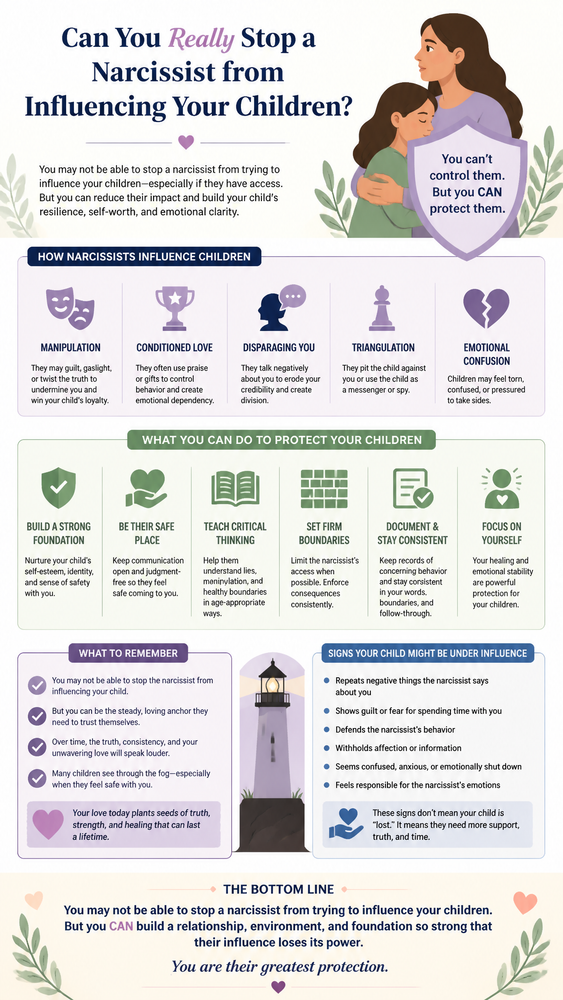
The most effective first step is cutting off unstructured communication entirely. When you respond to texts, answer unexpected calls, or engage in face-to-face arguments at handoffs, you give a manipulative ex exactly what they need: access, reaction, and drama. Removing that access is not passive. It is a deliberate strategy.
Parallel parenting replaces cooperation with total disengagement. You communicate only about logistical child details, and you do it exclusively through a documented platform. This approach works even without a court order. Parents can shift to written-only communication and structured handoffs independently, creating a protective shield immediately.
Here is how to set up structured communication in practice:
- Choose a dedicated co-parenting app. Our Family Wizard and TalkingParents both timestamp every message and store records that are admissible in court. This removes any “he said, she said” dynamic.
- Apply the BIFF framework. BIFF stands for Brief, Informative, Friendly, and Firm. Responses limited to 2–5 sentences, strictly logistical, eliminate openings for emotional escalation.
- Set a response window. Commit to replying within 24 hours, but never immediately. Waiting before responding lowers the emotional temperature and signals that you will not be baited.
- Block personal contact channels. Remove your ex from your personal phone contacts and social media. All communication routes through the app only.
- Standardize handoffs. Use a neutral location, keep exchanges under two minutes, and say nothing beyond what is necessary for the children.
Pro Tip: Never use informal texts or phone calls for co-parenting matters. Every message sent through a timestamped app is a legal record. That record is your best defense if custody disputes escalate.
How do you teach kids to recognize manipulation?
Children who can name their feelings are harder to manipulate. This is not a theory. Teaching children to name feelings like “drained” or “uneasy” helps them identify when something feels wrong, even when an adult is telling them everything is fine. Emotional literacy is the foundation of protection.
Your role is to validate without disparaging. When your child comes home upset after a visit, resist the urge to say anything negative about your ex. Instead, reflect the feeling back. “It sounds like that was really hard for you” is more powerful than any explanation you could offer about your ex’s behavior.
Here are specific strategies for building your child’s emotional defenses:
- Name the feeling, not the person. Teach your child words like “pressured,” “confused,” or “uncomfortable” so they can describe experiences without needing to assign blame.
- Reinforce no-obligation rules. Tell your child directly: “You never have to share what happens at Mom’s or Dad’s house with me. That’s your private life.” This removes the spy-and-messenger dynamic a narcissistic parent often creates.
- Distinguish healthy from manipulative behavior. Use age-appropriate language to explain that adults who love children do not ask them to keep secrets from the other parent or choose sides.
- Create a safe reporting space. Let your child know they can tell you anything without getting anyone in trouble. Children empowered with knowledge in a no-blame environment are measurably less vulnerable to manipulation.
Pro Tip: Build a “no-blame” family culture at home. When children feel safe talking without consequences, they bring problems to you instead of carrying them silently. That open channel is your early warning system.
What does a protective home environment look like?
A stable home is the most powerful counter to a narcissistic co-parent’s chaos. Emotional shields like structured pick-up times, consistent handoff locations, and short factual information exchanges block adult stress from reaching children. Structure is not rigidity. It is safety made visible.
Children develop accurate perceptions of emotional safety based on consistent behavior, not parental explanations. This means what you do every day matters more than what you say about the other parent. Your routines, your tone, and your reactions all communicate safety or danger to your child.
| Home Environment Practice | Why It Works |
|---|---|
| Consistent daily routines | Predictability reduces anxiety and signals safety |
| Explicit permission to love both parents | Removes loyalty conflict and guilt from children |
| No interrogation after visits | Prevents children from feeling like informants |
| Neutral language about the other parent | Helps children form their own accurate perceptions |
| Trauma-informed therapy access | Provides a professional space to process complex feelings |
Give your child explicit permission to love their other parent. Say it out loud: “It’s okay to love Dad. It’s okay to have fun there.” This single practice dismantles one of the most common manipulation tactics, which is making children feel guilty for enjoying time with you.
Effective vs. ineffective communication in high-conflict co-parenting
Your emotional reactions are the narcissist’s primary tool. Every time you justify, argue, defend, or explain, you hand them an opening. Therapists call this the JADE trap. Avoiding JADE responses removes the fuel that keeps conflict burning.
The shift required here is treating your ex’s behavior as a fixed variable, like weather. You do not argue with rain. You bring an umbrella. When you stop trying to correct, convince, or defend yourself, you reclaim the energy that manipulation is designed to drain from you.
| Communication Approach | Effective | Ineffective |
|---|---|---|
| Response length | 2–5 sentences, facts only | Long explanations or emotional appeals |
| Timing | Delayed, within set window | Immediate, reactive |
| Content | Child logistics only | Personal grievances or justifications |
| Tone | Neutral, businesslike | Defensive, emotional, or sarcastic |
| Channel | Documented app only | Phone calls, texts, or in-person arguments |
Responding only to factual schedule details and avoiding emotional bait maintains long-term stability. Short messages lower the emotional temperature over time. Your ex cannot escalate a conflict you refuse to enter.
Pro Tip: Before you send any message, ask yourself: “Does this contain anything beyond child logistics?” If the answer is yes, delete that part. Every extra word is an opening.
Key takeaways
Protecting your children from a narcissistic ex requires structured communication, parallel parenting, emotional literacy, and a stable home environment working together as a system.
| Point | Details |
|---|---|
| Use documented apps | Route all communication through Our Family Wizard or TalkingParents to create legal records. |
| Apply BIFF communication | Keep every message brief, informative, friendly, and firm to eliminate manipulation openings. |
| Build emotional literacy | Teach children to name feelings like “drained” or “pressured” so they can recognize manipulation. |
| Create a stable home | Consistent routines and explicit permission to love both parents anchor children emotionally. |
| Avoid the JADE trap | Never justify, argue, defend, or explain. Respond only to child-related facts. |

What i’ve learned about protecting kids from narcissistic manipulation
I want to be honest with you about something most articles skip over. The hardest part of parallel parenting is not the logistics. It is the guilt. When you stop engaging, stop explaining, stop trying to make your ex understand, it can feel like you are abandoning your children to someone harmful. That feeling is real. It is also wrong.
Disengagement is not abandonment. It is the most protective thing you can do. Every time you engage in a conflict in front of your children, or even within earshot, you are the one introducing instability into their world, regardless of who started it. Your ex is counting on that. The moment you stop reacting, you stop being useful to their tactics.
What I have seen work, again and again, is parents who shift their energy entirely inward. They build their home into a fortress of calm. They get into therapy, not because they are broken, but because managing complex trauma while raising children in a high-conflict situation is genuinely hard work that deserves professional support.
The narcissist’s accusations only work if you engage. Your stability, your routines, and your emotional availability to your children are the most powerful counter-strategy available. Children are perceptive. Over time, they will know the difference between the parent who created chaos and the parent who created safety. You do not need to tell them. You just need to keep showing up.
— S.J.Howe
How Aftertheaffair can support your co-parenting recovery
Co-parenting with a narcissistic ex is not just a parenting challenge. It is a trauma response that requires structured support and real tools.
Aftertheaffair offers resources built specifically for parents navigating betrayal, manipulation, and high-conflict separation. The parallel parenting plan guide walks you through creating a formal structure that limits conflict and protects your children. For parents dealing with the deeper emotional weight of this situation, the trauma recovery checklist provides a step-by-step framework for rebuilding stability. You are not managing this alone. Aftertheaffair’s evidence-informed guides are designed to meet you exactly where you are.
FAQ
What is parallel parenting and how does it help?
Parallel parenting is a co-parenting model that replaces direct cooperation with structured disengagement, routing all communication through documented apps like Our Family Wizard. It creates a protected home environment without requiring the narcissistic parent’s cooperation.
Can i start parallel parenting without a court order?
Yes. Parallel parenting can be implemented unilaterally by shifting to written-only communication and structured handoffs immediately. You do not need a court order to begin protecting your children through this method.
How do i respond when my child repeats negative things my ex said?
Maintain neutrality and reflect the child’s feeling without commenting on the other parent. Children develop accurate emotional perceptions over time based on consistent behavior, not explanations.
What is the BIFF method for co-parenting communication?
BIFF stands for Brief, Informative, Friendly, and Firm. Responses are limited to 2–5 sentences covering only child logistics, which removes emotional triggers and manipulation openings from every exchange.
When should i involve a therapist for my child?
Involve a trauma-informed therapist when your child shows signs of anxiety, loyalty conflict, or emotional withdrawal after visits. A therapist provides a neutral space for children to process complex feelings without placing them in the middle of parental conflict.
Recommended
- Parallel Parenting With a Narcissist – After the Affair Series
- Gray Rock: Co-Parenting With a Narcissist or Toxic Ex-PR3 – After the Affair Series
- How to tell if your children are being coached against you – After the Affair Series
- Stop Sinking in Guilt: How to Protect Your Kids with Boundaries, Not Overcompensation During Divorce – After the Affair Series