
- What Is Parallel Parenting With a Narcissist?
- Key Differences From Co-Parenting Models
- Essential Strategies for Minimizing Conflict
- Legal and Safety Considerations for Parents
- Risks, Mistakes, and Protecting Your Child’s Wellbeing
- Protect Your Child and Reclaim Your Peace Through Expert Guidance
- Frequently Asked Questions
- Recommended
Every parent facing custody with a narcissistic ex after betrayal knows how quickly ordinary disagreements can become emotional minefields. When traditional co-parenting leads to constant conflict and emotional exhaustion, finding an alternative is critical for your well-being and your child’s safety. Parallel parenting creates independent, structured boundaries that protect you from manipulation and safeguard your child’s development, offering you a real path toward emotional recovery and lasting stability.
Key Takeaways
| Point | Details |
|---|---|
| Parallel Parenting Defined | It is a structured approach that minimizes direct interaction between parents, focusing on independent parenting during scheduled times. |
| Benefits Over Co-Parenting | Parallel parenting limits manipulation opportunities from a narcissistic ex, allowing each parent to establish their own rules without conflict. |
| Communication Strategy | Essential and logistical messages are prioritized to avoid emotional triggers and prolonged interactions. |
| Child’s Well-Being | Consistent routines, emotional stability, and clear communication foster a safe environment for the child during challenging circumstances. |
What Is Parallel Parenting With a Narcissist?
Parallel parenting is a structured approach designed for situations where traditional co-parenting becomes impossible. It’s specifically created for parents who must share custody with someone displaying narcissistic traits, high-conflict behaviors, or an inability to work cooperatively.
Unlike co-parenting, which requires ongoing communication and mutual decision-making, parallel parenting minimizes direct parent-to-parent interaction. Instead of trying to coordinate every parenting choice, each parent independently manages the child during their time. This separation protects both you and your child from the chaos that comes with a narcissistic ex.
How It Differs From Co-Parenting
The core distinction lies in engagement and communication. Co-parenting assumes parents can collaborate. Parallel parenting abandons that assumption entirely.
Here’s what sets them apart:
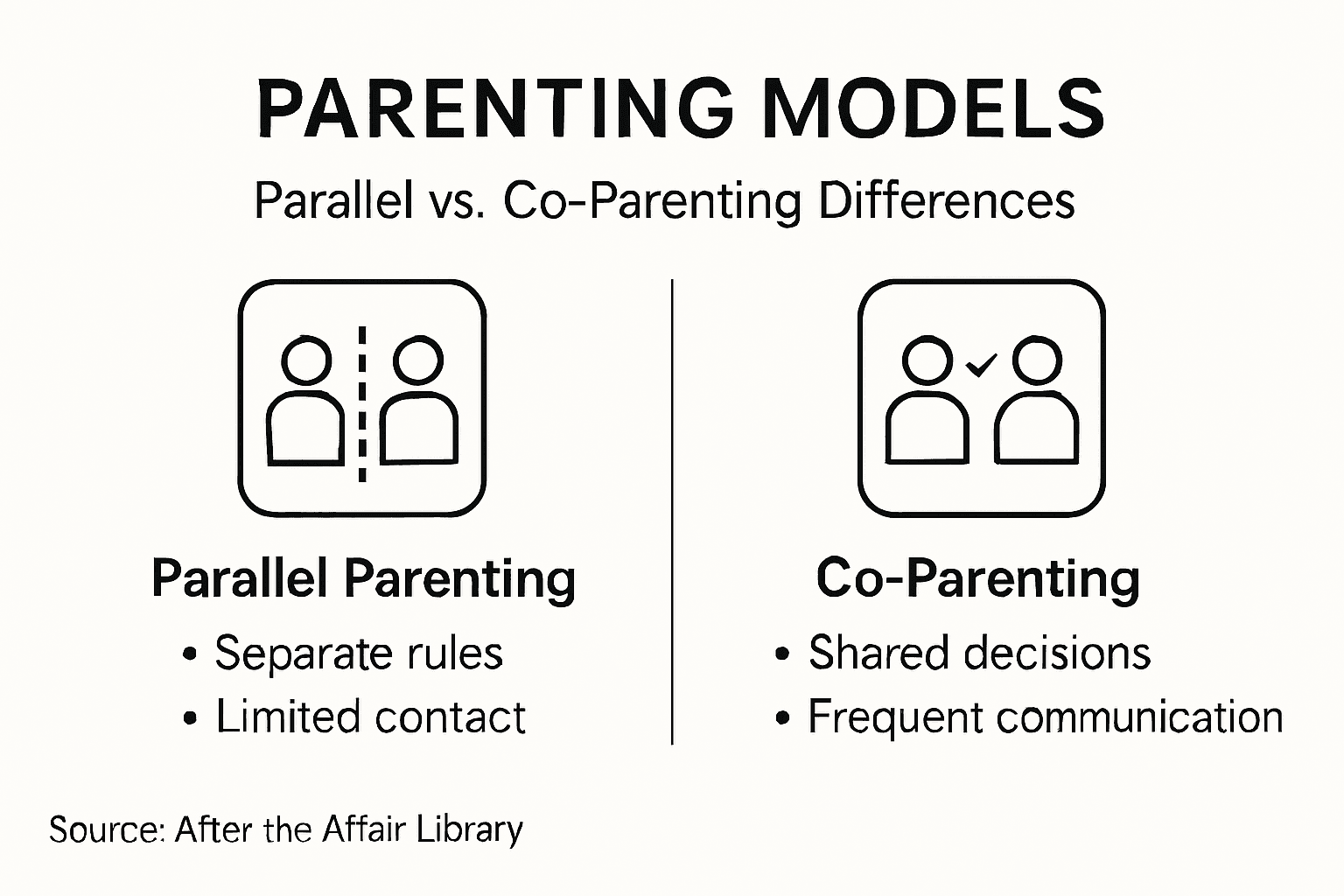
- Co-parenting: Requires regular communication, shared decision-making, and alignment on parenting approaches
- Parallel parenting: Each parent operates independently with minimal contact; child transitions between two separate parenting systems
- Conflict level: Co-parenting works best with cooperative exes; parallel parenting works when conflict is unavoidable
- Communication: Co-parenting relies on frequent dialogue; parallel parenting uses only essential, logistical messages
When you’re healing from infidelity-related trauma while managing a narcissistic co-parent, the reduced interaction in parallel parenting becomes emotionally protective. You’re not constantly triggered by attempts to manipulate or control you through parenting decisions.
Why Narcissists Make Parallel Parenting Necessary
Narcissists use parenting decisions as leverage. They weaponize disagreements to maintain control, create conflict, or punish you for perceived slights. Parallel parenting addresses this by removing opportunities for manipulation through clear boundaries on contact.
Key reasons parallel parenting becomes your best option:
- They reject compromise and demand their way or conflict follows
- They use child-related decisions to initiate contact and destabilize your recovery
- They gaslight you about prior agreements or what the child actually wants
- They leverage parenting disagreements to create drama involving the child
- They’re incapable of separating their ego from your child’s actual needs
Parallel parenting sidesteps these traps. Instead of fighting about screen time or bedtimes, you simply apply your own standards during your time. No debate. No negotiation. No narcissistic manipulation.
The Core Principle: Independent Parenting
Each parent becomes responsible only for their own household. Your rules, your routines, your consequences apply when your child is with you. Their rules apply in their home. The child learns to adapt to two different systems, which is developmentally healthy and realistic.
This approach protects your child from becoming a messenger, a spy, or a pawn in ongoing parental conflict. It also protects you from exhausting battles over parenting choices that you cannot control anyway.
Parallel parenting works because it removes the assumption that you and your ex can cooperate—and instead creates safety through separation and clear boundaries.
Pro tip: Document your own parenting plan in writing (rules, schedules, consequences) so you stay consistent and have a record if your ex later tries to claim you’re undermining them.
Key Differences From Co-Parenting Models
Co-parenting and parallel parenting sound similar, but they operate on completely different principles. Understanding these distinctions is crucial because choosing the wrong model with a narcissistic ex can trap you in endless conflict and trigger cycles throughout your healing journey.
Co-parenting assumes both parents are willing to collaborate, communicate regularly, and prioritize the child’s needs over their own. Parallel parenting makes no such assumption. It’s designed specifically for situations where collaboration is impossible or dangerous.
Here’s a quick reference for when each parenting approach is most effective:
| Situation | Best Model | Key Reason |
|---|---|---|
| Low conflict, mutual respect | Co-parenting | Collaboration benefits child |
| High conflict, narcissistic behaviors | Parallel parenting | Limits manipulation risk |
| Need for shared decisions | Co-parenting | Open discussion required |
| Trauma from past relationship | Parallel parenting | Emotional protection needed |
Communication: The Biggest Divide
This is where the two models diverge most sharply. Co-parenting requires ongoing dialogue about school, health, activities, and behavioral issues. You’re talking frequently, checking in regularly, and coordinating decisions.
Parallel parenting intentionally limits communication to only necessities, eliminating the constant back-and-forth that narcissists weaponize. You’re not debating your ex’s choices or defending yours.
Here’s how communication differs:
- Co-parenting: Frequent calls, texts, emails about shared decisions and child updates
- Parallel parenting: Essential logistical information only (schedules, medical appointments, school pickup times)
- Tone: Co-parenting maintains warmth and engagement; parallel parenting is professional and factual
- Decision-making: Co-parenting involves mutual agreement; parallel parenting involves independent choices
Parenting Autonomy and Boundaries
In co-parenting, parents align on rules, consequences, and values across both homes. You’re aiming for consistency in bedtimes, screen time, discipline, and expectations.
In parallel parenting, each parent sets their own rules in their own home. Your child may have different bedtimes at each house, different phone privileges, different consequences. This isn’t ideal in theory, but it’s realistic when one parent is unwilling to cooperate.
The autonomy in parallel parenting actually protects you. You’re not constantly defending your parenting choices or having your decisions undermined through the child.
Conflict Exposure and Child Protection
Co-parenting assumes minimal conflict. Parents disagree respectfully and resolve issues privately. The child doesn’t witness fights or become caught between competing demands.
Parallel parenting acknowledges that conflict is unavoidable, so it minimizes the child’s exposure by reducing the touchpoints where conflict occurs. Parallel parenting supports disengagement to protect the child and parents’ well-being by creating separate spheres where manipulation tactics have less opportunity to flourish.
Your child isn’t used as a messenger. They’re not triangulated into disagreements. They simply move between two homes with two sets of expectations.
The core difference isn’t philosophical—it’s structural. Co-parenting relies on cooperation. Parallel parenting builds protection through separation.
Emotional Labor and Recovery
Co-parenting with a narcissist is exhausting. You’re constantly negotiating, justifying, and managing their reactions to your parenting choices. This ongoing contact re-traumatizes you during recovery from infidelity.
Parallel parenting reduces your emotional labor significantly. You’re not defending decisions or seeking approval. You’re simply parenting during your time and letting them parent during theirs.
Pro tip: Use a dedicated parenting app for all communication (scheduling, expenses, school updates) so all conversations are documented, professional, and remove the need for direct contact.
Essential Strategies for Minimizing Conflict
Minimizing conflict with a narcissistic co-parent requires deliberate, strategic action. You can’t rely on goodwill or reasonable discussion. Instead, you need systems that remove opportunities for manipulation and protect both you and your child from escalating drama.
These strategies are not about being cold or unfriendly. They’re about survival and recovery during a vulnerable time in your healing journey.
Strategy 1: Document Everything in Writing
Successful parallel parenting involves strict documentation of communications to create an undeniable record of agreements and behaviors. Written communication forces clarity and removes the “he said, she said” dynamic that narcissists exploit.
Documentation protects you because:
- It creates an objective record if disputes arise later
- It prevents your ex from denying agreements or twisting what you said
- It removes opportunities for them to claim you’re being unreasonable
- It provides evidence if legal intervention becomes necessary
- It keeps you accountable, which strengthens your position
Every arrangement—schedule changes, expense splits, school decisions—goes in writing. No verbal agreements. No handshake deals.
Strategy 2: Use Third-Party Communication Tools
Direct texting or email with your ex becomes a minefield. They’ll twist your words, manufacture drama, or use casual messages against you later. Professional communication platforms create distance and documentation simultaneously.
Use dedicated parenting apps or email specifically for co-parenting communication. Keep conversations factual, brief, and child-focused. These platforms typically provide automatic records and remove the emotional tone that fuels conflict.
Benefits of third-party tools:
- Professional tone discourages manipulation
- Automatic timestamped records
- Built-in moderation features on some platforms
- Removes casual texting that escalates drama
- Creates psychological distance between you
Strategy 3: Adopt Rigid Boundaries
Narcissists test boundaries constantly. They push to see what they can get away with. Vague, flexible boundaries invite negotiation and conflict. Clear, firm boundaries eliminate the opportunity for argument.
Rigid boundaries mean:
- Set schedules with zero flexibility unless mutual emergency exists
- Defined rules in your home that don’t change based on their opinion
- No discussions about your parenting choices during their time
- No responding to manipulation attempts or emotional provocations
- No explaining or justifying your decisions
When they push, your answer is consistent: “That’s how it works in my home,” or “That’s not something we’re discussing.” No debate. No explanation.
Strategy 4: Prepare Emotionally for Manipulation
Your ex will test you. They’ll attempt guilt trips, threats, playing the victim, or promising change. Emotional preparation means expecting these tactics and having a response plan.
Anticipate manipulation by writing down your responses to common tactics in advance. Practice staying neutral when they attack. Remind yourself that their anger, blame, or disappointment is not your responsibility.
Successful parallel parenting requires treating conflict prevention like a security system—multiple layers of protection so no single tactic breaches your defenses.
Your emotional resilience is a tool. Each time you refuse to engage in their drama, you reinforce the boundary.
Strategy 5: Keep Communication Child-Focused
Narrow the scope of every conversation to the child’s actual needs. Not your opinions, not their parenting choices, not relationship history—only what directly affects your child’s health, safety, or education.
This eliminates opportunities for them to create conflict on tangential issues.
Pro tip: Create a communication template with bullet points (schedule, school updates, medical info) so every message follows the same format, remains consistently brief, and you never accidentally veer into emotional territory.
Legal and Safety Considerations for Parents
Parallel parenting isn’t just an emotional strategy—it’s a legal framework that protects your child and strengthens your position if disputes escalate. Understanding the legal and safety dimensions helps you build a defensible parenting structure that courts recognize and support.
This matters because narcissists often weaponize the legal system. Having clear documentation and court-approved arrangements removes their ability to claim confusion or rewrite history.
Creating a Legally Sound Parenting Agreement
Designing parenting agreements with clear, comprehensive guidelines limits interaction between parents and protects the child’s best interests. A well-drafted parallel parenting plan becomes your legal shield.
Your agreement should specify:
- Exact custody schedule with specific pickup and drop-off times
- Communication methods and acceptable contact frequency
- Decision-making authority for specific issues (education, health care, activities)
- How disagreements are resolved without direct negotiation
- Expense allocation and payment methods
- Consequences for violating the agreement
Work with a family law attorney familiar with high-conflict custody cases. They’ll ensure your agreement withstands legal scrutiny and protects your interests.
Documentation as Legal Evidence
Every conversation, agreement, and incident needs documentation. Using co-parenting apps or written communication ensures a documented history, which can be useful in court proceedings.
Documentation serves multiple purposes:
- Creates timestamped records of what was agreed and communicated
- Prevents false accusations about what you said or did
- Demonstrates your child-focused parenting approach to a judge
- Shows your ex’s manipulation attempts or violations
- Protects you if custody arrangements need modification
Keep copies of everything. Cloud storage is your friend. Never rely on a single copy of important records.
Safety Planning and Protective Measures
If your ex exhibits dangerous behavior, work with your attorney to request:
- Supervised visitation or exchanges
- Restraining orders to prevent harassment or contact
- GPS tracking agreements for the child’s location during handoffs
- Specific pickup locations (police stations, exchange centers) instead of direct contact
- Communication-only contact through third-party apps
Narcissistic abuse escalates under stress. Building legal protections now prevents crises later.
When to Seek Legal Intervention
Don’t wait until situations explode. Consult a family law attorney if your ex:
- Violates custody agreements repeatedly
- Attempts parental alienation or interference with your relationship
- Refuses to follow communication boundaries
- Threatens legal action to control your behavior
- Uses the child as a leverage point
A proactive attorney visit often costs less than reactive litigation. They can file contempt charges, modify custody, or establish protective orders.
Legal clarity removes narcissistic leverage. When the rules are court-ordered, your ex loses the ability to rewrite them through manipulation.
Pro tip: Request a “high-conflict custody” or “parallel parenting” designation in your court order specifically, making it clear the arrangement is intentional and legally recognized rather than accidental.
Risks, Mistakes, and Protecting Your Child’s Wellbeing
Your child’s emotional and psychological health depends on what you do during this transition. Parental narcissistic traits significantly impact child psychological outcomes, exposing them to emotional manipulation, inconsistent parenting, and potential mental health challenges.
Understanding the risks helps you avoid common pitfalls that inadvertently harm your child while managing your own recovery from infidelity.
Common Mistakes That Damage Children
Well-intentioned parents often make mistakes that undermine their protective efforts. Recognizing these errors lets you course-correct before they damage your child.
Mistakes to avoid:
- Trying to change the narcissistic parent: Your ex won’t change. Attempts to “fix” them drain your energy and model acceptance of dysfunction to your child.
- Engaging in arguments: When your ex provokes conflict, silence is protection. Arguments expose your child to toxicity even when they’re not physically present.
- Speaking negatively about their other parent: This backfires emotionally and legally. Your child already experiences their parent’s dysfunction directly.
- Failing to establish firm boundaries: Vague or flexible rules invite manipulation and send the message that boundaries don’t matter.
- Neglecting your own emotional recovery: Children sense your unhealed trauma. Your healing directly impacts their sense of safety.
Psychological Risks Your Child Faces
Mistakes such as trying to change the narcissistic parent, engaging in arguments, or exposing children to parental conflict can harm the child’s well-being. These aren’t theoretical risks—they’re documented outcomes of high-conflict parenting.
Specific psychological risks include:
- Anxiety about abandonment or rejection
- Depression stemming from emotional invalidation
- Difficulty trusting authority figures
- Development of narcissistic or people-pleasing behaviors
- Confusion about what healthy relationships look like
- Guilt about loving the narcissistic parent
Your role isn’t to shield them from knowing their other parent has problems. It’s to prevent them from internalizing those problems as their own fault.
Creating Safety Through Consistency
Protection requires three core elements: a structured schedule, emotional safety, and age-appropriate honesty.
Structured schedule protects because:
- Children know what to expect, reducing anxiety
- Predictability gives them control in an unstable situation
- They aren’t left wondering when they’ll see each parent
Emotional safety means:
- Your home is free from parental conflict or criticism
- You validate their feelings without burdening them with adult problems
- They know you’re stable and won’t disappear like the other parent might
Age-appropriate honesty means:
- Young children: “Your parent loves you even though they make different choices than I do.”
- Older children: Truthful acknowledgment without vilification
- Teenagers: Honest discussion about boundaries without asking them to choose sides
Children in parallel parenting situations need one thing above all: proof that your love for them is separate from your conflict with their other parent.
What Your Child Actually Needs From You
Your child needs you present, stable, and emotionally available. They need to know their feelings are valid even when those feelings involve loving someone who’s harmful.
They need you to:
- Stay calm when they report upsetting interactions with their other parent
- Avoid asking them to relay messages or gather information
- Let them process confusion without judgment
- Celebrate small victories in their wellbeing
- Demonstrate that healing is possible through your own recovery
Your healing journey directly protects them. When you model healthy boundary-setting, emotional processing, and refusal to engage in toxicity, you teach them what healthy adulthood looks like.
The following table summarizes child-focused priorities in parallel parenting:
| Priority | Parent’s Action | Child’s Benefit |
|---|---|---|
| Consistent routines | Maintain rules in your home | Provides predictability |
| Emotional stability | Regulate your own responses | Reduces child anxiety |
| Clear communication | Discuss only child needs | Avoids unnecessary stress |
| Safe support system | Build a list of trusted adults | Offers additional resources |
Pro tip: Create a “safe person” list with your child—trusted adults (therapist, teacher, coach, grandparent) they can talk to when things feel overwhelming, removing the burden of emotional processing from you alone.
Protect Your Child and Reclaim Your Peace Through Expert Guidance
When parallel parenting with a narcissist, protecting your child from emotional manipulation and high-conflict drama feels overwhelming. You face rigid boundaries, minimal communication, and the constant challenge of shielding your child while healing your own trauma. The key pain points in this journey include establishing firm routines, managing relentless manipulation, and maintaining your emotional stability to foster your child’s well-being. Terms like “parallel parenting,” “emotional labor reduction,” and “structured boundaries” are not just concepts but essential tools for survival and growth.

Discover comprehensive resources tailored to these exact challenges at After the Affair Resource Library where you will find evidence-informed strategies for setting boundaries, managing narcissistic co-parenting dynamics, and prioritizing your child’s emotional safety. Start transforming your parallel parenting experience with professional insights, practical tools, and compassionate support to guide you from crisis toward healing. Take action today to protect your child and yourself by exploring the parallel parenting guidance, understanding trauma recovery, and accessing effective communication techniques designed for high-conflict situations.
Frequently Asked Questions
What is parallel parenting and how is it different from co-parenting?
Parallel parenting is a method that allows parents to raise their children separately with minimal communication. Unlike co-parenting, which relies on cooperation and regular communication, parallel parenting enables each parent to manage their own household independently, reducing direct conflict and manipulation.
Why is parallel parenting necessary when dealing with a narcissistic co-parent?
Narcissistic co-parents often use parenting decisions as a means of control and manipulation. Parallel parenting minimizes these opportunities for conflict by establishing clear boundaries and reducing direct interaction, protecting both the child and the other parent from emotional turmoil.
What are some effective strategies for minimizing conflict with a narcissistic co-parent?
To minimize conflict, document everything in writing, use third-party communication tools, establish rigid boundaries, prepare emotionally for manipulation, and keep communication focused solely on the child’s needs. These strategies aim to protect both you and your child from unnecessary drama while ensuring clear lines of communication.
How can I create a legally sound parallel parenting agreement?
A legally sound parallel parenting agreement should include a clear custody schedule, decision-making authority for specific issues, communication methods, and consequences for violating the agreement. Consulting a family law attorney familiar with high-conflict custody cases can help ensure that your agreement is protective and enforceable.
Recommended
- Parallel Parenting Method – How It Supports Healing – After the Affair Series
- Parallel Parenting Plan – After the Affair Series
- Parallel Parenting Impact – After the Affair Series
- Parallel Parenting after infidelity – After the Affair Series