TL;DR:
- Shame in unfaithful spouses blocks relationship repair by causing withdrawal and emotional shutdown. Recognizing the difference between shame, guilt, and remorse is crucial to fostering accountability and healing. Therapy and boundaries support unfaithful partners in moving beyond shame while allowing betrayed partners to maintain their healing process.
- How does shame differ from guilt and remorse after infidelity?
- What are the signs that a spouse is drowning in shame after infidelity?
- What therapeutic strategies help the unfaithful spouse move beyond shame?
- How can the betrayed partner support without absorbing the shame?
- Key Takeaways
- What I’ve learned about shame that most articles get wrong
- FAQ
Shame in the unfaithful spouse is a paralyzing emotional state that actively blocks relationship repair. When the unfaithful spouse is drowning in shame, the weight of self-condemnation can cause withdrawal, emotional shutdown, and defensive behavior that looks, to the betrayed partner, like indifference. Clinicians who specialize in infidelity recovery draw a sharp line between shame, guilt, and remorse. That distinction is not academic. It determines whether a couple moves toward healing or stays locked in a cycle of pain. Understanding where shame ends and accountability begins is the first real step forward.
How does shame differ from guilt and remorse after infidelity?
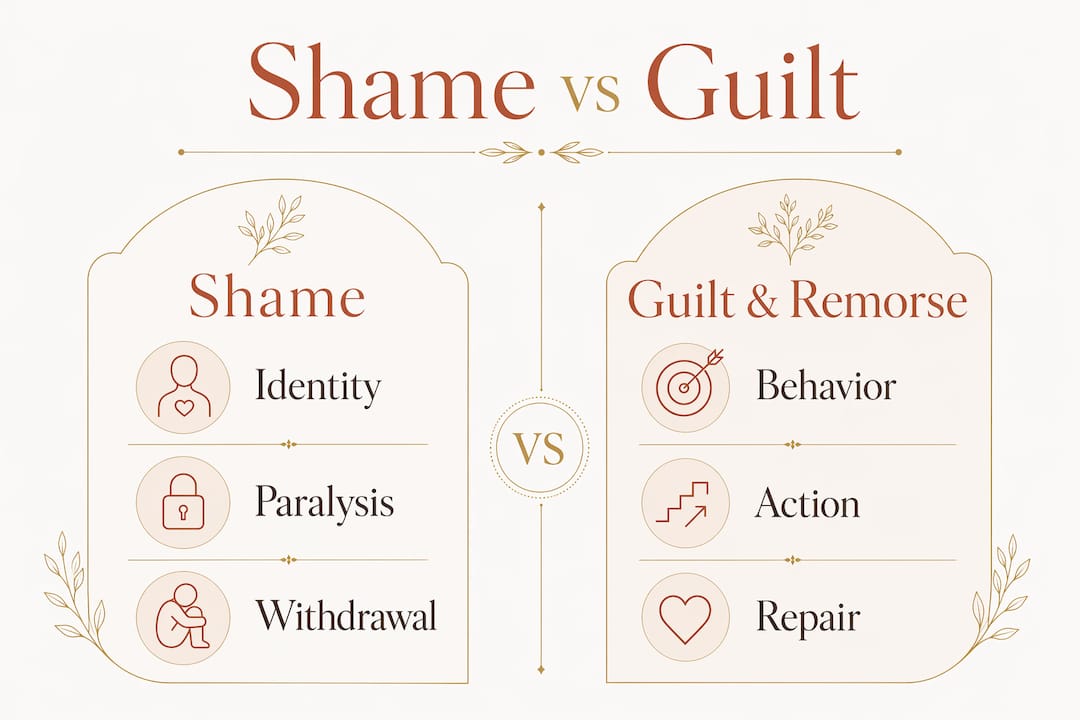
Shame, guilt, and remorse are three distinct emotional states, and confusing them costs couples months of recovery time. Guilt is self-focused discomfort rooted in personal regret. Shame attacks identity at its core. Remorse is the only one of the three that actually serves the relationship.
Shame attacks identity globally, producing thoughts like “I am a bad person,” while conviction targets specific behavior: “I made a painful mistake I need to fix.” That shift in framing is not just semantic. It determines whether the unfaithful spouse can become emotionally available for repair work or stays trapped in self-punishment.
Remorse involves relational validation of the betrayed partner’s pain and is the engine of long-term repair. Effective remorse shows up as specific, repeated apologies paired with long-term behavioral commitment. Guilt, by contrast, produces vague, defensive apologies that circle back to the unfaithful spouse’s own discomfort rather than the partner’s wound.
| Emotional state | Focus | Effect on recovery |
|---|---|---|
| Shame | Identity (“I am bad”) | Paralysis, withdrawal, emotional shutdown |
| Guilt | Self-regret (“I feel bad”) | Vague apologies, limited relational repair |
| Remorse | Partner’s pain (“You are hurting because of me”) | Accountability, specific apology, sustained repair |
Pro Tip: If the unfaithful spouse’s apologies keep returning to their own suffering rather than the betrayed partner’s experience, that is guilt talking, not remorse. Redirect the conversation toward the partner’s specific pain.
What are the signs that a spouse is drowning in shame after infidelity?
Recognizing shame overload is critical because its symptoms are routinely misread. The betrayed partner often interprets withdrawal and emotional flatness as proof that the unfaithful spouse does not care. The reality is almost always the opposite.
Avoidance and emotional numbing are protective responses to overwhelming shame and identity collapse. The nervous system shuts down when the emotional load exceeds its capacity. Clinicians call this “basement behavior,” a survival response that has nothing to do with the absence of remorse.
Watch for these specific indicators of shame overload:
- Emotional withdrawal. The unfaithful spouse goes quiet, avoids eye contact, and becomes hard to reach emotionally.
- Defensiveness under questioning. Questions about the affair trigger sharp, disproportionate reactions because shame reads every question as an attack on identity.
- Rapid mood cycling. Mood instability cycling through sadness, rage, fear, and shame, sometimes within a single hour, signals that the nervous system is overwhelmed and needs professional support.
- Excessive self-flagellation. Repeated statements like “I am a monster” or “I don’t deserve forgiveness” sound like accountability but actually prevent the unfaithful spouse from being present for the betrayed partner.
- Emotional numbing. A flat, disconnected affect that the betrayed partner experiences as coldness is often the nervous system’s circuit breaker, not a sign of indifference.
Endless self-hatred is mistakenly viewed as accountability but actually prevents the unfaithful partner from being emotionally available for repair work. Recognizing this pattern protects the betrayed partner from a damaging misreading of the situation.
What therapeutic strategies help the unfaithful spouse move beyond shame?
Moving beyond shame requires both clinical support and deliberate relational practice. Neither alone is sufficient. The goal is to shift from shame’s identity attack to behavior-specific conviction that enables real accountability.
Therapists who work in infidelity recovery use several evidence-based approaches:
EMDR therapy. EMDR aids individuals with intrusive, unmanaged shame by processing emotional trauma at a level that cognitive approaches cannot reach when the nervous system is overwhelmed. It is particularly useful when shame triggers flashbacks or physical panic responses.
Shifting from shame to conviction. The critical therapeutic milestone is moving from “I am broken” to “I did something that caused real harm and I will take specific steps to repair it.” This reframe does not minimize the offense. It makes repair possible.
Empathy squared. This clinical concept describes mutual acknowledgment of both partners’ pain as a tool that breaks shame’s isolation effect. When the unfaithful spouse regulates their shame enough to genuinely hold the betrayed partner’s pain, relational growth becomes possible. This requires emotional capacity that shame, at its peak, destroys.
Breaking isolation. Shame thrives in secrecy. Sharing the reality of what happened with one trusted, non-judgmental person, whether a therapist, a counselor, or a carefully chosen friend, begins to disrupt the shame cycle. Isolation feeds shame; connection weakens it.
Emotion regulation before difficult conversations. Therapists actively regulate intense emotions during recovery sessions so that the unfaithful spouse can move from defensive shame toward vulnerable accountability. Without that regulation, conversations about the affair collapse into either shutdown or conflict.
Pro Tip: Before any conversation about the affair, the unfaithful spouse should spend five minutes grounding themselves physically: slow breathing, feet flat on the floor, hands relaxed. This simple practice reduces nervous system activation enough to keep shame from hijacking the exchange.
Esther Perel’s work, including The State of Affairs, offers a broader framework for understanding why affairs happen and how both partners can begin to make meaning from the experience. That context does not excuse the betrayal, but it does reduce the shame-driven narrative that the unfaithful spouse is simply “a bad person.”
How can the betrayed partner support without absorbing the shame?
The betrayed partner carries their own enormous pain. Asking them to also manage the unfaithful spouse’s shame is not reasonable. Yet the most critical help the betrayed partner can offer is genuine validation without becoming responsible for that shame.
This balance is difficult but achievable with clear boundaries and deliberate practice:
- Acknowledge the shame without absorbing it. Saying “I can see you are in a lot of pain” is not the same as saying “It’s okay.” Validation does not mean minimizing the betrayal.
- Maintain separate emotional spaces. Separate conversations and clear boundaries protect both partners’ emotional well-being. The betrayed partner does not need to be the unfaithful spouse’s primary support for processing shame. That role belongs to a therapist.
- Avoid enabling endless self-punishment. When the unfaithful spouse spirals into repeated self-condemnation, gently redirecting toward specific accountability steps is more useful than offering reassurance. Reassurance feeds the shame cycle; accountability breaks it.
- Protect your own healing. The betrayed partner’s grief, anger, and trust issues after betrayal are primary. Their healing cannot be subordinated to managing the unfaithful spouse’s emotional state.
- Support vulnerability, not performance. Encourage the unfaithful spouse to be open about their shame in therapy rather than performing remorse at home. Authentic vulnerability in a clinical setting translates into more genuine repair in the relationship.
Understanding shame in betrayal trauma helps betrayed partners recognize that the unfaithful spouse’s emotional collapse is not a manipulation tactic. That recognition does not require the betrayed partner to carry the weight. It simply allows them to respond with clarity rather than confusion.
Key Takeaways
Recovering from cheating shame requires the unfaithful spouse to shift from identity-based shame to behavior-specific accountability, supported by clinical intervention and clear relational boundaries.
| Point | Details |
|---|---|
| Shame differs from remorse | Remorse focuses on the betrayed partner’s pain; shame collapses inward and blocks repair. |
| Withdrawal signals shame, not apathy | Emotional numbing and avoidance are nervous system responses to identity collapse, not indifference. |
| EMDR and therapy accelerate healing | Clinical support regulates overwhelming shame so the unfaithful spouse can engage in repair conversations. |
| Conviction replaces shame | Shifting from “I am bad” to “I did harm and will fix it” is the key psychological step in recovery. |
| Betrayed partners need boundaries | Validating the unfaithful spouse’s shame without absorbing it protects both partners’ healing. |

What I’ve learned about shame that most articles get wrong
After working with couples in infidelity recovery, the pattern I see most often is this: the betrayed partner believes the unfaithful spouse does not care because they have gone quiet and distant. The unfaithful spouse, meanwhile, is so consumed by shame that they cannot function. Both people are suffering. Neither can see the other clearly.
What most articles miss is that shame paralysis is not a character flaw. It is a predictable nervous system response to identity collapse. The unfaithful spouse does not need to be told they are a bad person. They already believe it, completely, and that belief is the problem, not the solution.
The couples I have seen make real progress are the ones where the unfaithful spouse finds a way to process guilt after infidelity with professional support, and then brings that processed emotion back into the relationship as accountability rather than self-pity. That transition is hard. It takes time. But it is the only path I have seen that actually works.
Shame is not the end of the story. It is a signal that something important has been broken and needs repair. The unfaithful spouse who can move through shame into genuine accountability, and the betrayed partner who can hold their own pain without absorbing their partner’s, are the ones who give the relationship a real chance.
— S.J.Howe
Structured support for infidelity recovery
Shame does not resolve on its own. It needs structure, guidance, and the right tools applied at the right time.
Aftertheaffair offers the 7-step infidelity recovery checklist as a concrete starting point for both unfaithful and betrayed partners who need a clear path through the emotional chaos. For couples focused on rebuilding connection, the relationship growth after infidelity resource addresses trust repair with the same evidence-informed approach that runs through all of Aftertheaffair’s work. Both resources are built for people who are ready to move from surviving to rebuilding, one deliberate step at a time.
FAQ
What does it mean when the unfaithful spouse is drowning in shame?
Shame overload in the unfaithful spouse means their nervous system has collapsed under the weight of identity-level self-condemnation, producing withdrawal, emotional numbing, and defensiveness. This state blocks relational repair and requires professional support to resolve.
Is shame the same as remorse after cheating?
Shame and remorse are opposite states. Shame focuses inward on identity (“I am bad”), while remorse focuses outward on the betrayed partner’s pain and drives specific, sustained accountability.
How does EMDR help with infidelity shame?
EMDR processes intrusive shame at a neurological level that talk therapy alone cannot reach, reducing the emotional intensity that causes shutdown and enabling the unfaithful spouse to engage in repair conversations.
Can the betrayed partner help the unfaithful spouse with shame?
The betrayed partner can offer validation without becoming responsible for the unfaithful spouse’s shame. Maintaining separate emotional spaces and encouraging therapy protects both partners during recovery.
How long does it take to recover from cheating shame?
Recovery timelines vary, but the intensity of shame decreases with consistent therapeutic support and deliberate accountability practices. The shift from shame to conviction is a milestone, not an endpoint, and most couples need months of sustained effort to reach stable ground.
Recommended
- Is Your Spouse in Affair Fog? 40 Red Flags Assessment – After the Affair Series
- Is Your Spouse in Affair Fog? The 25-Point Reality Check – After the Affair Series
- How to Cope When Your Spouse Works With Their Affair Partner
- Project 5- Stop Sinking in Guilt: How to Protect Your Kids with Boundaries, Not Overcompensation During Divorce – After the Affair Series