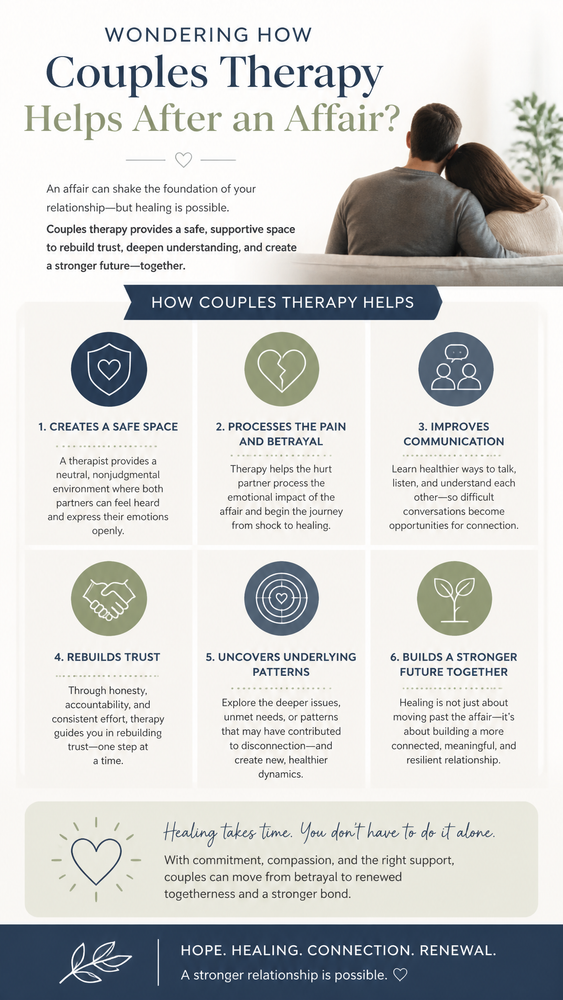
Discovering a partner’s affair doesn’t just damage a relationship, it rewires how the betrayed person experiences safety, trust, and reality itself. Couples therapy after infidelity is one of the most researched and clinically demanding areas of relationship work, and for good reason: the wound is profound, the stakes are high, and the path forward is rarely straight. Whether you want to rebuild or need help deciding what you want at all, understanding the therapeutic landscape is the most useful first step you can take.
Why Couples Therapy After Infidelity Is Different
Standard relationship counselling typically addresses communication patterns, conflict cycles, and emotional disconnection. Affair recovery requires all of that, plus something much harder.
The betrayed partner is dealing with genuine trauma. Intrusive thoughts, hypervigilance, grief, and rage can all be present simultaneously. The unfaithful partner, meanwhile, is often carrying shame, guilt, and their own unresolved feelings, sometimes about the affair itself, sometimes about what was missing in the relationship before it. Both people are in pain. Both need to be heard. But they are not in the same pain at the same time.
This asymmetry is what makes couples therapy after infidelity structurally different. A skilled affair-recovery therapist holds space for the betrayed partner’s trauma while also keeping the unfaithful partner engaged and accountable, without letting either dynamic derail the process. It requires specific training. General relationship counselling without that training can inadvertently make things worse by treating the affair as just another communication problem.
For couples navigating the earliest, most chaotic days, understanding managing the immediate aftermath of discovery can help stabilise things before the first therapy session even begins.
Therapeutic Approaches for Affairs: The Main Modalities
Three therapeutic models have the strongest evidence base and widest clinical use in affair recovery. They are not interchangeable, each suits different circumstances.
Emotionally Focused Therapy (EFT)
Emotionally Focused Therapy, developed by Dr Sue Johnson, works at the level of attachment. Its core premise is that affairs create a severe attachment injury: a moment when the betrayed partner reached out for safety and was fundamentally failed. EFT helps couples identify the negative interaction cycles that both preceded and followed the affair, and works to restructure how each partner responds to the other’s emotional needs.
EFT is one of the few couples therapy modalities with a substantial body of peer-reviewed outcome research behind it, including specific studies on attachment injuries, published through the International Centre for Excellence in Emotionally Focused Therapy (ICEEFT). For affair recovery, it is particularly effective when both partners are willing to remain in the relationship and do emotionally demanding work.
Alongside EFT, some betrayed partners benefit from individual sessions of EMDR (Eye Movement Desensitisation and Reprocessing) to process acute trauma symptoms. EMDR is not couples therapy, but it can reduce the hyperarousal and intrusive thoughts that make joint sessions feel impossible early on.
Gottman Method Couples Therapy
The Gottman Method approaches affair recovery through a more structured, skill-building framework. The Gottman Institute distinguishes between three broad types of affairs, conflict-avoidant, intimacy-avoidant, and those rooted in sex addiction, and tailors interventions accordingly, giving therapists a clear roadmap. This framing is drawn from John and Julie Gottman’s research and their book What Makes Love Last?.
In practice, Gottman-trained therapists focus on rebuilding what the Gottmans call “trust metrics”, observable, concrete behaviours that either erode or build trust over time. This makes the method appealing to couples who want structure and measurable progress, not open-ended emotional exploration.
Discernment Counselling
Discernment Counselling, developed by Dr William Doherty at the University of Minnesota, occupies a different category entirely. It was specifically designed for “mixed-agenda” couples, where one partner is leaning toward staying and the other toward leaving, or where neither is yet certain. In that situation, launching into standard couples therapy is premature and can feel coercive to the ambivalent partner.
Discernment Counselling is brief, typically two to five sessions, and its goal is not to repair the relationship but to help both partners reach clarity about what they actually want. From there, they can make an informed decision: commit to a structured reconciliation effort, pursue separation, or take more time. It is not a lesser option; for many couples in the immediate aftermath of discovery, it is exactly the right starting point.
Pairing any of these modalities with evidence-based strategies for rebuilding trust after infidelity gives couples practical tools to use between sessions.
How Long Does Couples Therapy Take After an Affair?
There is no honest short answer. Affair recovery is not a six-week course. Most couples who do the work meaningfully are looking at one to two years of regular sessions, sometimes longer. That timeline unfolds in roughly three phases.
Early Crisis Phase (0–3 Months)
The first three months are about stabilisation, not transformation. The betrayed partner needs safety, both emotional and, if the affair is ongoing, physical. The unfaithful partner needs to demonstrate consistent honesty and a genuine commitment to the process.
Sessions during this phase often feel raw and circular. That is normal. The goal is not to resolve anything yet; it is to prevent the couple from making irreversible decisions in a state of acute distress, to establish basic safety agreements, and to assess whether both partners are ready to commit to a recovery process. For couples who are unsure, this is the stage where Discernment Counselling fits best.
Rebuilding Phase (3–12 Months)
Once acute crisis has stabilised, the harder, and more meaningful, work begins. This phase addresses the underlying patterns that existed before the affair: the emotional disconnection, the unmet needs, the ways each partner avoided difficult conversations. It also addresses full accountability from the unfaithful partner.
This is not about blaming the betrayed partner for the affair. Accountability sits entirely with the person who chose to have it. But sustained rebuilding requires both partners to understand what was happening in the relationship and to make deliberate changes. Couples who skip this phase and focus only on forgiveness tend to relapse into the same dynamics.
How long therapy takes through this phase depends heavily on the nature of the affair, how long it lasted, whether it was disclosed or discovered, and how solid the relationship was before it happened.
Integration and Moving Forward (12 Months+)
Couples who reach this phase have typically done the heaviest lifting. The work shifts to consolidating a new shared identity, one that honestly incorporates what happened without being defined by it. Sessions may reduce in frequency, but continued contact with a therapist, even monthly, helps couples catch relapse signs early.
Some couples reach this stage and separate anyway. That is not a failure of therapy. A well-supported, conscious decision to separate is a genuinely healthy outcome, especially when children are involved and ongoing co-parenting requires a functional relationship.
When Couples Therapy Is Most Effective After an Affair
Therapy yields the best outcomes when several specific conditions are in place.
The most critical: the unfaithful partner has fully ended the affair, with no residual contact. Affair recovery specialists, including those drawing on the clinical frameworks of Shirley Glass (Not Just Friends), Esther Perel, and the Gottman Institute, consistently identify this as the single non-negotiable precondition. While the affair is ongoing, the betrayed partner remains in an active trauma state. No modality can gain traction in those conditions.
Beyond that, both partners need to be genuinely willing, not coerced or simply going through the motions to satisfy the other. Willingness does not mean certainty; uncertainty is fine. But minimal engagement kills progress.
Therapy is also unlikely to work effectively when active domestic abuse or untreated substance addiction is present. These issues require separate, specialist intervention before couples work can be productive or safe.
Research into couples therapy outcomes shows that a meaningful proportion of couples who complete a structured affair-recovery programme report significant improvement in relationship satisfaction, though results vary considerably depending on motivation, whether the affair has fully ended, and the skill of the therapist. Many couples do reconcile. The evidence suggests reconciliation is more likely when therapy is specific to affair recovery rather than generic relationship counselling.
Finding the Right Therapist After an Affair
Not every couples therapist is equipped for this work. When searching for affair recovery counselling in the UK, ask direct questions before committing to a therapist.
Specifically:
- Have you received training in affair recovery or betrayal trauma?
- Which modality do you primarily use with couples recovering from infidelity?
- Are you ICEEFT-certified (for EFT) or Gottman-certified?
- How do you handle the asymmetry between the betrayed and unfaithful partner in sessions?
In the UK, look for BACP (British Association for Counselling and Psychotherapy) or UKCP (United Kingdom Council for Psychotherapy) accreditation as a baseline. These bodies set minimum training and ethical standards. Accreditation alone does not guarantee affair-recovery expertise, but it provides a professional accountability framework.
Red flags to watch for: a therapist who moralises about the affair, who blames one partner exclusively without exploring the full picture, or who rushes toward forgiveness before the betrayed partner has been fully heard. Also be cautious of therapists who seem certain about which outcome, staying or leaving, is right. A good affair-recovery therapist holds the process, not the verdict.
Making the Most of the Therapeutic Process
Therapy is one to two hours a week. The other 166 hours are up to you.
Progress between sessions, journalling, completing agreed exercises, practising the communication tools the therapist introduces, matters as much as the sessions themselves. Couples who treat therapy as a space to process what they are already practising at home move faster than those who save everything for the session.
Individual therapy alongside couples work is often valuable for both partners. The betrayed partner may need space to process trauma without the unfaithful partner present. The unfaithful partner often needs to understand their own motivations, patterns, and blind spots without the pressure of their partner in the room.
Honesty is not optional at any stage, including honesty about whether the process is working. If, after a reasonable trial period, you feel the therapist is not the right fit, say so. Switching therapists is not failure; staying with an ineffective one costs time and emotional resources you cannot afford to waste.
If you are unsure where you currently are in the recovery process, taking a free assessment is a useful starting point. From there, you can explore structured affair recovery support designed to guide couples through each phase with clarity and specialist input.