- What factors should you weigh before deciding to change jobs?
- What U.S. employees should know about employment consequences
- When changing jobs is the right or necessary choice
- What are the alternatives to quitting your job?
- How should couples have the job-change conversation?
- If you do change jobs: practical steps to minimize damage
- Can couples recover without changing jobs? What the research shows
- Common mistakes to avoid when weighing a job change
- Key Takeaways
- The emotional weight behind this decision
- Aftertheaffair can help you make this decision clearly
- FAQ
Most people do not have to quit after a workplace affair, but a handful of situations make a job change genuinely necessary. The deciding factors are not guilt or embarrassment. They are safety, the power structure between you and the affair partner, whether contact continues despite agreements, and what your company policy actually says. If you’re wondering, Do I Need to Change Jobs If I Had an Affair at Work, consider these factors carefully.
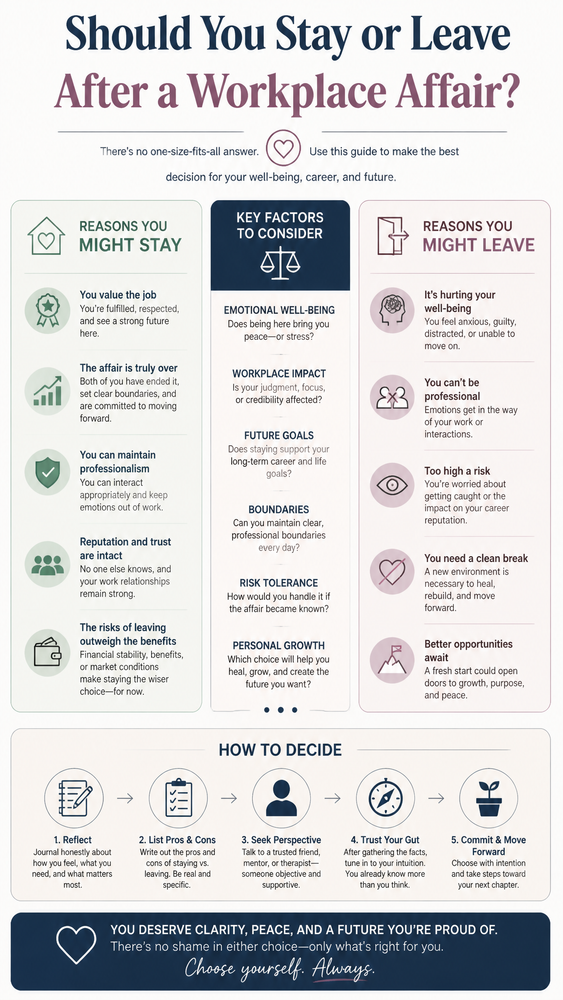
Quick decision test — consider changing jobs if any of these apply:
- You or the affair partner hold a direct manager/subordinate relationship with no realistic way to restructure it
- Physical safety is at risk (stalking, harassment, or threats after the affair ended)
- Ongoing daily contact continues despite a formal no-contact agreement
- Your role carries a moral-expectation clause (elected office, clergy, national security clearance)
- HR has documented a hostile work environment tied to the affair
Try alternatives first if all of these are true:
- You work in separate departments or teams with minimal overlap
- No power imbalance exists between you and the affair partner
- Your company has a disclosure or recusal policy you can use
- Your partner agrees to a structured boundary plan with regular check-ins
Pro Tip: Before any conversation about quitting, run through the safety check above. If none of the “change jobs” triggers apply, a negotiated boundary plan plus couples counseling resolves most situations without a resignation.
Research on workplace romance finds that roughly 47% of employees have changed jobs to pursue or escape a colleague. That number is high, but it does not mean quitting is always the right call. Many of those moves were reactive, not strategic. The goal here is to help you decide deliberately.
What factors should you weigh before deciding to change jobs?
The decision is not binary, and it rarely needs to be made in the first week. Six variables tend to drive the outcome.
1. Safety and harassment risk. This outweighs everything else. If the affair partner is contacting you against your wishes, showing up at your workspace uninvited, or making threats, document every incident and report it to HR and, if necessary, local law enforcement. A job change may be the fastest way to remove the risk, but it is not the only tool.
2. Power imbalance. Manager-subordinate affairs create structural problems that do not disappear when the relationship ends. Experimental research shows that third-party evaluators are less likely to promote or select lower-status participants in hierarchical workplace romances, even after the relationship ends. That perception sticks. If you are the subordinate, your promotion track is already compromised in the eyes of colleagues.
3. Frequency and unavoidability of contact. Working in the same open-plan office, on the same project team, or in a small company with no realistic transfer option is fundamentally different from sharing a building with someone you rarely see. Daily, unavoidable contact makes boundary enforcement nearly impossible and keeps the betrayed partner in a state of chronic anxiety.
4. Workplace culture and gossip. When the affair is widely known, every interaction becomes a retraumatizing event for the betrayed partner. That ongoing exposure can stall recovery more effectively than almost any other factor.
5. Career and financial impact. Quitting has real costs. Yale economics research found that subordinates who break up with a manager see an average 18% earnings decline in the year after the breakup. Leaving voluntarily on top of that compounds the financial hit. Map your budget runway before any decision.
6. Children, commute, and family stability. A job change that requires relocation, a longer commute, or a significant pay cut affects the whole household. Weigh those costs explicitly, not as an afterthought.
Understanding the question, Do I Need to Change Jobs If I Had an Affair at Work, can help clarify your next steps and options.
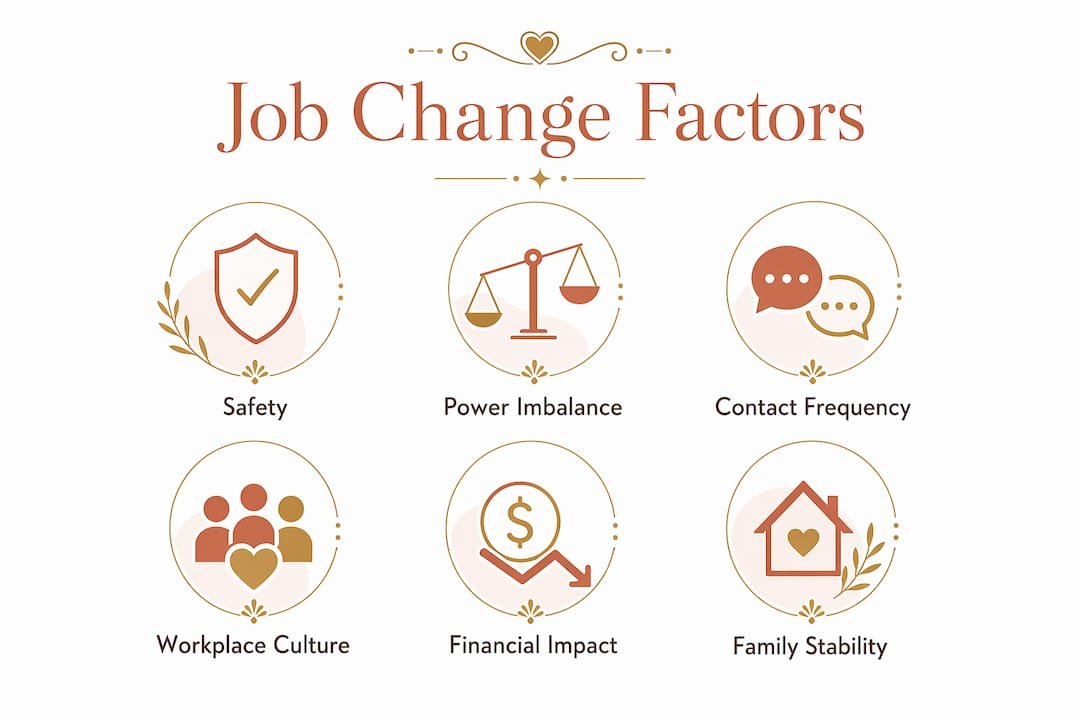
Pro Tip: Rank these six factors in writing before your first conversation with your partner. Knowing which ones apply to your situation turns an emotional argument into a solvable problem.
The financial cost of quitting is often underestimated. Beyond the immediate income gap, consider lost benefits, retirement contributions, and the time it takes to rebuild seniority and professional relationships at a new employer.
What U.S. employees should know about employment consequences
The United States is an at-will employment country. That means your employer can terminate you for a workplace affair unless a specific contract, union agreement, or anti-discrimination statute protects you. Most employees have no such protection.
When termination is likely:
- You violated a written company fraternization or conflict-of-interest policy
- The affair involved a direct report and created documented favoritism
- Your role is subject to a morality clause (common in executive contracts, public-facing nonprofit roles, and some media positions)
- The affair produced a hostile work environment claim from a third party
When termination is less likely:
- No written policy was violated
- Both parties were peers with no supervisory relationship
- The affair ended and no harassment or retaliation followed
- The company has no formal disclosure requirement
Survey data shows that a significant portion of employees in office relationships choose not to report the relationship to HR. That choice carries risk: undisclosed relationships in manager-subordinate pairs are the most common trigger for policy-based termination.
| Situation | Likely outcome | Recommended action |
|---|---|---|
| Peer-to-peer, no policy violation | Low termination risk | Voluntary disclosure if policy requires it |
| Manager-subordinate, undisclosed | Moderate-high termination risk | Disclose, request recusal or transfer |
| Harassment or retaliation after breakup | High termination or legal risk | Document, report to HR, consult an attorney |
| Public office, clergy, security clearance | Role-specific moral expectation | Seek legal or ethics counsel immediately |
| Hostile work environment claim filed | High risk for both parties | HR mediation, possible separation |
Public-role exceptions. Some roles carry expectations that go beyond standard employment law. Elected officials, clergy, and individuals holding national security clearances operate under codes of conduct where an affair can constitute a disqualifying breach of trust. One widely cited ethical argument holds that leaders in positions of public trust should face professional consequences because the affair signals a willingness to deceive those who depend on them. Whether you agree with that framing or not, the practical reality is that these roles often do require a job change.
Pro Tip: Before approaching HR, read your employee handbook cover to cover. The specific language in your company’s fraternization or conflict-of-interest policy determines your exposure far more than general employment law does.
When changing jobs is the right or necessary choice
There is a meaningful difference between “this would make things easier” and “this is genuinely necessary.” The following situations fall into the necessary column.
Clear triggers for a job change:
- The affair partner is your direct supervisor and no organizational restructuring is possible
- The affair partner continues to initiate personal contact despite a written no-contact agreement
- You have documented evidence of retaliation (negative performance reviews, exclusion from projects, public humiliation) following the affair’s end
- A hostile work environment complaint has been filed and HR has confirmed the finding
- Your role legally disqualifies you from continuing (security clearance revocation, ethics board finding)
Short case examples:
Scenario A. A project manager ends an affair with her direct report. He begins leaving notes on her desk and requesting one-on-one meetings under the guise of project updates. She documents each incident, reports to HR, and HR confirms a pattern of boundary violations. Transfer is not feasible in a 12-person company. A job change is the appropriate next step.
Scenario B. A sales associate had an affair with a colleague in a different regional office. They now interact only on quarterly calls. The betrayed spouse is anxious but the contact is genuinely minimal. A transfer to a different product line eliminates even that overlap. Quitting is not necessary.
Scenario C. A city council member’s affair becomes public. His role requires him to represent constituents who elected him based partly on his stated values. His party’s ethics committee opens a review. The career consequences here are driven by the role itself, not by a standard HR process.
Decision checklist:
| Trigger | Classification | Recommended action |
|---|---|---|
| Physical safety threat | Essential to change | Leave immediately; involve law enforcement if needed |
| Ongoing contact despite agreement | Essential to change | Document, escalate to HR, begin job search |
| Manager-subordinate, no restructure possible | Essential to change | Request transfer first; resign if denied |
| Workplace-wide knowledge, ongoing gossip | Optional | Boundary plan + therapy; reassess at 3 months |
| Peer affair, minimal contact | Not advised to quit | Structured no-contact agreement + counseling |
Pro Tip: Label each trigger as “essential,” “optional,” or “not advised” before you sit down with your partner. It removes the emotional charge from the conversation and gives you a shared starting point.
What are the alternatives to quitting your job?
Quitting is the most disruptive option, and for most couples it is not the first one to try. Several structural changes can reduce contact and protect the relationship without a resignation.
Practical alternatives:
- Request a team or department transfer, framing it to your manager as a professional development move
- Shift to remote work or a different schedule to eliminate daily in-person overlap
- Apply for an internal role in a different division or location
- Ask HR to formalize a no-contact or recusal arrangement
- Request a temporary leave of absence while the couple stabilizes
- Use an Employee Assistance Program (EAP) for confidential counseling and mediation support
A structured boundary agreement is often the most effective non-quitting tool. Here is a template couples can adapt:
Sample Workplace Boundary Agreement
“We agree that all contact between [name] and [affair partner] will be limited to work-related communication through official channels only. No private conversations, shared meals, or one-on-one meetings. [Name] will proactively report any unplanned contact to [partner] within 24 hours. This agreement will be reviewed at the 3-month mark and adjusted based on whether anxiety levels have decreased and boundaries have been consistently maintained.”
The agreement works best when it is written down, reviewed with a therapist, and treated as a living document rather than a one-time declaration.
Pro Tip: Set a calendar reminder for the 3-month review before you finalize the agreement. Couples who skip the review date tend to let the plan drift, which erodes trust faster than the original contact did.
For more on rebuilding trust when the affair partner is still a coworker, Aftertheaffair has a dedicated guide that walks through the specific dynamics of that situation.
How should couples have the job-change conversation?
The decision about whether to change jobs after a workplace affair should be made jointly, with a clear agenda and a time-bound plan. Unstructured conversations about this topic tend to spiral into blame or avoidance.
Suggested conversation sequence:
- Safety check first. Before anything else, confirm whether either partner feels physically unsafe at work. If yes, that answer drives everything else.
- Map the contact reality. How often do you actually interact with the affair partner? Daily, weekly, or rarely? Be specific.
- Review the six factors from the decision section above and agree on which ones apply.
- Identify the options. List every alternative to quitting (transfer, remote work, boundary agreement) before discussing resignation.
- Set a timeline. Agree on a decision deadline and a review checkpoint.
- Assign next steps. Who contacts HR? Who researches transfer options? Who schedules the therapist appointment?
Useful phrases for the conversation:
- “I need us to decide this together, not react to it.”
- “Can we agree on a 30-day plan before we make any permanent decisions?”
- “What would make you feel safe enough to give the alternatives a real try?”
Timeline template:
| Window | Focus | Key decisions |
|---|---|---|
| 0–14 days | Safety and immediate containment | Document incidents; report to HR if needed; agree on temporary contact rules |
| 2–6 weeks | Explore alternatives | Research transfer options; start couples counseling; draft boundary agreement |
| 6–12 weeks | Evaluate whether alternatives are working | Review anxiety levels; assess contact frequency; decide whether to escalate to job search |
| 3–6 months | Final decision point | Commit to staying with the plan or begin active job search with financial plan in place |
Pro Tip: The betrayed partner should not be the one driving the job-change conversation. The partner who had the affair carries the responsibility for proposing and pursuing structural changes. Asking the betrayed partner to manage this process adds to an already unfair burden.
For help managing the guilt and accountability side of this conversation, Aftertheaffair’s guide on processing guilt after infidelity offers specific scripts and frameworks.
If you do change jobs: practical steps to minimize damage
Deciding to leave is one thing. Leaving well is another. A poorly handled resignation can damage references, inflame workplace gossip, and create financial instability that undermines the recovery you are trying to protect.
Pre-resignation checklist:
- Build at least 3 months of living expenses in reserve before giving notice
- Identify two or three references who are not aware of the affair and can speak to your work
- Review your employment contract for non-compete clauses, confidentiality obligations, and notice requirements
- Confirm your health insurance transition plan (COBRA or a marketplace plan through Healthcare.gov)
- Check the vesting schedule on any retirement contributions or stock options before you set a last day
Financial considerations:
| Item | Action |
|---|---|
| Emergency fund | Target 3 months of expenses before resigning |
| Health insurance | Enroll in COBRA within 60 days or use a marketplace special enrollment period |
| Retirement plans | Do not cash out; roll over to an IRA or new employer plan |
| Severance | Negotiate if the company initiated the separation; less leverage if you resign voluntarily |
| Unemployment benefits | Generally not available if you resign voluntarily in most U.S. states |
Resignation etiquette:
Give standard notice (typically two weeks), keep the stated reason neutral (“I’m pursuing a new opportunity”), and do not discuss the affair in any exit interview. The goal is to leave with your professional reputation intact. Colleagues will speculate regardless; your job is to give them nothing concrete to work with.
Pro Tip: Tell your partner about the resignation before you tell anyone at work. Surprises in either direction erode the trust you are trying to rebuild.
Subordinates who break up with a manager are 13 percentage points more likely to leave the labor force entirely in the year after the breakup. That statistic is a reason to plan carefully, not to avoid leaving when leaving is right.
Can couples recover without changing jobs? What the research shows
For many couples, a negotiated boundary plan combined with therapy is sufficient. Job change becomes necessary primarily when safety is at stake or when contact continues despite genuine effort to stop it.
Therapeutic approaches that work without quitting:
- Emotionally focused therapy (EFT) addresses the attachment injury at the core of betrayal, regardless of whether the affair partner remains a coworker
- Structured transparency routines (daily check-ins, proactive contact reporting) rebuild trust incrementally
- EAP counseling provides confidential, employer-funded support that does not require disclosing the affair to HR
- Couples counseling with a therapist who specializes in infidelity recovery creates accountability structures that reduce the need for physical separation
A key clinical insight: For most couples, the question is not whether the affair partner is in the same building. It is whether the unfaithful partner is doing the active work of rebuilding trust. Proximity matters less than accountability.
Research on workplace romance outcomes found a decline in retention at establishments where manager-subordinate relationships exist, which reflects how much organizational disruption these situations create. That disruption affects everyone, not just the couple, which is why companies increasingly recommend formal disclosure and recusal policies as a first response rather than termination.
When therapy plus a boundary plan is sufficient:
- The affair partner is in a different department with minimal overlap
- The unfaithful partner is proactively reporting all contact without being asked
- Anxiety levels in the betrayed partner are decreasing over time
- The boundary agreement has been maintained consistently for at least 8 weeks
When a job change becomes necessary despite therapy:
- The affair partner is violating the boundary agreement repeatedly
- The betrayed partner’s anxiety is not decreasing after 3 months of consistent effort
- The power imbalance (manager-subordinate) makes boundary enforcement structurally impossible
- The workplace culture is actively hostile or gossipy in ways that retraumatize the betrayed partner
Pro Tip: Use the Aftertheaffair recovery checklist to track progress at each review point. Couples who measure specific signals (contact frequency, anxiety ratings, boundary compliance) make better decisions than those who rely on gut feeling alone.
Aftertheaffair’s online recovery program for couples includes structured exercises for exactly this scenario, including how to manage the emotional weight of ongoing workplace proximity.
Common mistakes to avoid when weighing a job change
The decision to quit or stay is vulnerable to several emotional traps that feel logical in the moment but create worse outcomes.
Pitfalls to watch for:
- Using a job change as punishment. Demanding that the unfaithful partner quit immediately, without a plan, is more about expressing anger than protecting the relationship. It can create financial instability that adds a second crisis on top of the first.
- Avoiding accountability by quitting. Some unfaithful partners push for a quick resignation to escape the discomfort of facing colleagues who know. That is avoidance, not repair. Leaving does not resolve the underlying breach of trust.
- Rushing a resignation without financial planning. Quitting without a budget runway or a new job lined up transfers the emotional crisis into a financial one.
- Letting resentment drive the timeline. Decisions made in the first two weeks after discovery are almost always reactive. The 0–14 day window is for safety and containment, not permanent career decisions.
- Sacrificing family stability unnecessarily. A job change that requires relocation or a 40% pay cut affects children, housing, and the couple’s baseline stress level. Those costs compound the recovery burden.
The trap most couples miss: A job change feels like proof of commitment. It is visible, dramatic, and concrete. But it is not a substitute for the internal work. Couples who relocate or resign without doing the therapeutic work tend to find that the same patterns resurface in the new environment.
Survey data indicates that 40% of workplace romances involve cheating on an existing partner. That figure is a reminder that the affair itself reflects a pattern of decision-making that a new job does not reset.
Pro Tip: If the primary motivation for quitting is “so I don’t have to think about it anymore,” that is avoidance. Avoidance delays recovery. Therapy addresses the pattern; a job change addresses the proximity.

Key Takeaways
Most couples do not need to change jobs after a workplace affair, but when safety, a power imbalance, or ongoing contact makes boundary enforcement impossible, a job change is the right and sometimes necessary choice.
| Point | Details |
|---|---|
| Safety comes first | If there is any physical threat or harassment, document it and act immediately regardless of financial cost. |
| Power imbalance changes the math | Manager-subordinate affairs carry a documented 18% earnings drop after breakup, and subordinates are about 13 percentage points more likely to leave the labor force after the breakup; lasting promotion risk for the subordinate also persists. |
| Try alternatives before quitting | Transfer, remote work, and a written boundary agreement resolve most situations without a resignation. |
| Set a review date | Evaluate whether alternatives are working at the 3-month mark; use measurable signals, not gut feeling. |
| Aftertheaffair resources | The 7-step recovery checklist and couples program provide structured frameworks for making this decision with clinical support. |
The emotional weight behind this decision
The job-change question is rarely just a career question. It sits at the intersection of betrayal, fear, and the very human need for proof that things are actually changing.
What I see repeatedly in infidelity recovery work is that the betrayed partner often fixates on the job because it is the one concrete, visible thing that can be changed. Everything else, the trust, the emotional repair, the slow rebuilding of intimacy, is invisible and slow. A resignation feels like evidence. That is understandable. But it is also where couples can go wrong.
The unfaithful partner who quits without doing the internal work has simply moved the problem to a new postcode. And the betrayed partner who demands an immediate resignation, without a financial plan or a therapeutic framework, is often expressing pain rather than making a strategic decision. Both responses are human. Neither is a recovery plan.
The research on manager-subordinate affairs is sobering: the career costs are real, the organizational disruption is real, and the power dynamics that made the affair possible do not disappear when the relationship ends. But the research also shows that structured transparency, accountability routines, and professional support can allow couples to heal without uprooting their financial lives, provided the contact is genuinely manageable and both partners are doing the work.
Safety is non-negotiable. Financial stability matters more than most couples admit in the acute phase. And a decision made in the first two weeks is almost always a reaction, not a plan. Give yourself the 30-day window. Use it well.
Aftertheaffair can help you make this decision clearly
Deciding whether to change jobs after an affair is one of the most practically complex questions couples face in early recovery. The emotional pressure is high, the financial stakes are real, and most generic advice misses the specific dynamics of a workplace situation.
Aftertheaffair’s structured resources are built for exactly this stage. The 7-step infidelity recovery checklist walks you through the decision criteria, financial planning steps, and boundary-setting frameworks in a sequence that clinicians have designed for couples in acute recovery. The Partner Accountability Conversation Guide gives you the specific scripts for the job-change conversation, including how to raise the topic without it becoming an ultimatum. Both resources are downloadable, confidential, and designed to be used alongside therapy or independently. If you are at the point where you need a clear framework rather than more general advice, the checklist is the right place to start.
Useful sources
- Workplace Relationships (Yale/NBER economics paper) — Research on earnings effects of manager-subordinate relationships, including the 6% earnings gain and 18% post-breakup decline.
- The perils of dating your boss (SAGE Journals) — Experimental study on promotion bias against lower-status participants in hierarchical workplace romances.
- Workplace romance: what the data reveals (Gulf News) — Survey data on reporting rates, job changes, and the share of workplace romances involving infidelity.
- Scientists put a price on office romance (National Post) — Accessible summary of the Yale/Finland research with specific euro figures for earnings impact.
- Power, love and paychecks (AOL/research summary) — Summary of retention effects at workplaces with manager-subordinate relationships.
- Should an Affair Cost Your Job? (Kevin A. Thompson) — Ethical argument for job consequences in public-trust and leadership roles.
- When the Affair Partners Work Together (Emotional Affair Journey) — Practical guidance on managing ongoing workplace proximity after an affair.
- My Partner’s Affair Was With a Coworker. Now What? (Bria Nuckols) — Therapist-authored guide on when a job change is and is not necessary.
- How to Rebuild Trust When the Affair Partner Is at Work (Aftertheaffair) — Clinician-guided resource for couples navigating ongoing workplace proximity.
- Online Affair Recovery for Couples (Aftertheaffair) — Structured couples program with exercises for boundary-setting and trust rebuilding.
FAQ
Can you be fired for having an affair with a coworker?
Yes, in most U.S. states. At-will employment means your employer can terminate you for a workplace affair if it violated a written fraternization or conflict-of-interest policy, created a hostile work environment, or involved a manager-subordinate relationship. No written policy violation generally means lower termination risk, but it is not a guarantee.
Should I quit my job after an affair, or try alternatives first?
Try alternatives first unless safety is at risk or the affair partner is your direct supervisor with no restructuring option. A team transfer, remote work arrangement, or written no-contact agreement resolves most situations without a resignation, and quitting without a financial plan adds a second crisis to an already difficult recovery.
How often do affairs start up again after a breakup when both people still work together?
There is no reliable U.S. population figure for affair recurrence in shared workplaces, but therapists consistently identify ongoing daily contact as the single strongest predictor of re-engagement. That is the core reason structured no-contact agreements and, when necessary, job changes are recommended: proximity is the primary risk factor.
What is the difference between an affair and adultery?
Adultery is a legal term referring to voluntary sexual intercourse between a married person and someone other than their spouse; it remains relevant in divorce proceedings in some U.S. states and in military law under the Uniform Code of Military Justice. An affair is a broader term that includes emotional, physical, or sexual involvement outside a committed relationship and does not require marriage.
What if my spouse refuses to change jobs or agree to a boundary plan?
A refusal to pursue any structural change, whether a transfer, a boundary agreement, or a job search, is itself important information about commitment to recovery. Aftertheaffair’s cope when your spouse works with their affair partner guide addresses this specific situation and outlines what the betrayed partner can do when the unfaithful partner is not taking initiative.
Recommended
- Should Your Cheating Spouse Change Jobs to Heal?
- Can My Marriage Survive When Your Spouse Works With Their Affair Partner
- How to Rebuild Trust When the Affair Partner Is at Work
- How to Cope When Your Spouse Works With Their Affair Partner