Last Updated: July 30, 2026
- Understanding Decision Paralysis After Infidelity
- The Nervous System's Role in Overthinking After Betrayal
- Grounding Techniques to Regulate Your Nervous System
- Breaking the Cycle: Practical Steps to Handle Infidelity Decision Paralysis
- Betrayal Trauma and the Path to Rebuilding Trust After Infidelity
- Should I Stay or Leave After Infidelity: A Decision Framework
- Infidelity Recovery Timeline: Realistic Expectations for Your Healing Journey
- When to Seek Professional Therapy for Infidelity Decision Paralysis
- Frequently Asked Questions
When you discover your partner’s infidelity, your nervous system enters crisis mode. The betrayal triggers conflicting emotions, rage, grief, confusion, disbelief, that make even basic decisions feel impossible. This is not weakness. This is trauma. Understanding how to handle infidelity decision paralysis is the first step toward reclaiming agency in a situation designed to strip it away. At After the Affair Series, we’ve worked with hundreds of individuals frozen in this exact moment, unable to decide whether to stay or leave.
Research shows that individuals processing betrayal trauma often experience analysis paralysis lasting weeks or months because their nervous system is dysregulated. American Psychological Association’s trauma response guidelines document how betrayal activates the brain’s threat-detection systems, flooding your body with cortisol and adrenaline. This physiological state makes clear thinking nearly impossible. You’re not overthinking because you’re indecisive by nature. You’re overthinking because your brain is in survival mode.
Below, we’ll walk you through a structured framework to interrupt the cycle of analysis paralysis, regulate your nervous system, and make decisions from a place of clarity rather than crisis.
Understanding Decision Paralysis After Infidelity
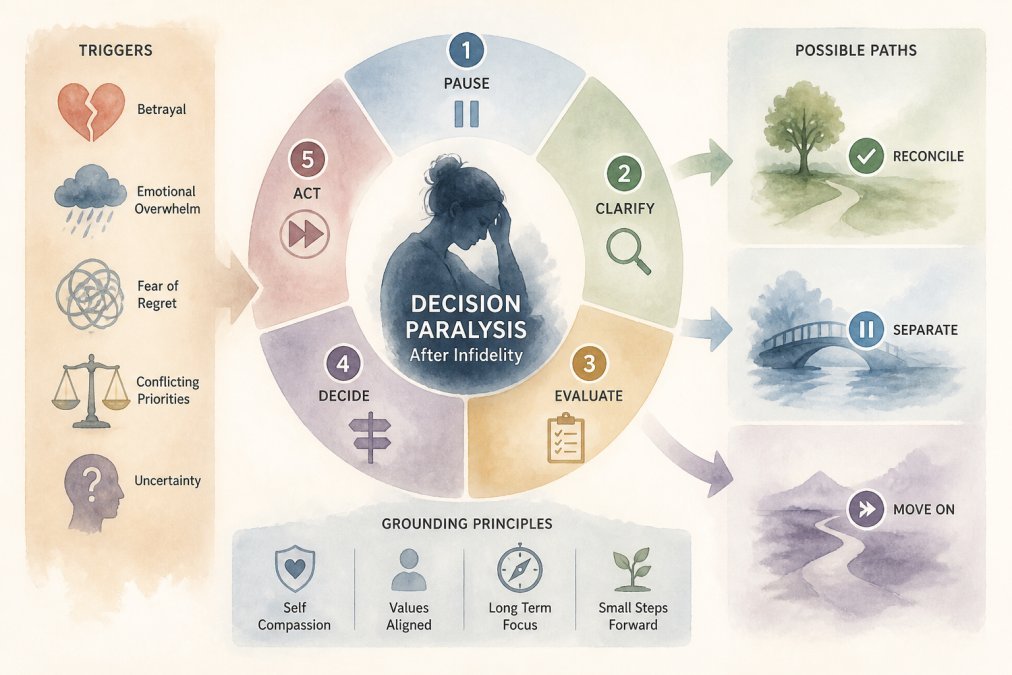
Decision paralysis after betrayal is not ordinary indecision. It’s a specific intersection of trauma response, emotional exhaustion, and cognitive overload that leaves you cycling through the same questions without reaching answers.
When infidelity is discovered, your entire worldview destabilizes. Your sense of safety, in the relationship, in your own judgment, in your ability to predict outcomes, collapses. Your mind attempts to regain control by analyzing every possible angle: What did I miss? Should I stay and rebuild? Should I leave? Each question spawns ten more. This isn’t overthinking in the traditional sense. It’s your nervous system demanding certainty in a situation where certainty doesn’t exist. And because certainty is impossible, the analysis never concludes. You loop.
The paralysis often intensifies when you try to force a decision. Pushing yourself to “just decide” while your nervous system is dysregulated typically backfires. The fix isn’t willpower; it’s regulation first, decision-making second.
Why Betrayal Triggers Analysis Paralysis
Betrayal trauma is distinct from other forms of trauma. It comes from someone you depended on, violating what psychologists call “relational safety”, the foundational belief that your intimate partner has your best interests in mind.
When relational safety is shattered, your brain recalibrates its threat assessment. If your partner could betray you, then your judgment itself is untrustworthy. This creates a second layer of trauma: not just the infidelity, but the loss of confidence in your own ability to evaluate situations and decisions.
Decision Fatigue vs. Trauma Response: The Critical Distinction
Decision fatigue is a cognitive phenomenon where making many choices depletes your mental resources. It’s reversible through rest.
Trauma response is a nervous system state where your body is in activation. Your prefrontal cortex (complex reasoning) is partially offline. Your amygdala (threat-detection) is running the show.
After infidelity, you’re experiencing both simultaneously. Your decision-making capacity is depleted because you’ve been in constant crisis mode, and your nervous system is dysregulated, making it impossible to access clarity.
Attempting to make a major decision while in acute trauma response often leads to choices you later regret. The most common mistake is deciding based on what feels relieving in the moment, not what you actually want. This typically happens within the first 48-72 hours after discovery.
The Nervous System’s Role in Overthinking After Betrayal
Your nervous system didn’t evolve to handle infidelity. When you discover betrayal, your nervous system perceives an existential threat: your safety, your future, your identity are suddenly uncertain.
This triggers the sympathetic nervous system. Your heart rate increases. Your breathing becomes shallow. Cortisol and adrenaline flood your bloodstream. Your body prepares for action: fight, flee, or freeze. This state is useful for physical threats. For psychological betrayal, it’s a liability. In this activated state, you can’t think clearly or access the parts of your brain responsible for nuanced decision-making.
Recognizing Trauma Response Patterns
Trauma responses after infidelity follow predictable patterns. Recognizing your own pattern is the first step toward interrupting it.
The Rumination Loop: You replay the discovery moment, the lies, the timeline. You construct narratives about what you “should have known,” analyzing conversations from months ago searching for clues you missed.
The Catastrophe Spiral: One moment you’re imagining reconciliation. The next, you’re imagining divorce, custody battles, and financial ruin. You swing between extremes because your nervous system searches for a scenario that feels safe.
The Hypervigilance Pattern: You monitor your partner obsessively, checking their phone, location, and social media. You need constant reassurance that they’re not lying again.
The Dissociation Response: You feel numb, disconnected from your body, unable to access emotions. Dissociation protects you from overwhelming pain but prevents healing.
How Emotional Exhaustion Blocks Clarity
Emotional exhaustion after infidelity is profound. You’re processing grief, rage, shame, and fear simultaneously. This emotional intensity consumes cognitive resources. Your brain is running at maximum capacity just managing feelings, leaving nothing for complex decision-making.
Additionally, emotional exhaustion creates a paradox: you’re desperate to decide to feel relief, but you’re too exhausted to make a good decision.
Clarity doesn’t come from thinking harder. It comes from regulating your nervous system enough that your prefrontal cortex can function. Until then, any decision is likely filtered through fear, not wisdom.
Grounding Techniques to Regulate Your Nervous System
Before you can make a clear decision about your relationship, you need to bring your nervous system out of crisis mode. Grounding techniques work by anchoring your attention to the present moment, signaling to your nervous system that the immediate threat has passed.
The 5-4-3-2-1 Sensory Anchor Method
This technique interrupts the rumination loop by redirecting your attention from the threat narrative in your head to the concrete reality of your immediate environment.
How to do it:
Name 5 things you can see. Look around and name five specific objects: a lamp, a coffee mug, a plant, a book, a wall.
Name 4 things you can physically feel. Notice the texture of the chair beneath you, the temperature of the air, the fabric of your clothing.
Name 3 things you can hear. Traffic outside, the hum of the refrigerator, birds, your own breathing.
Name 2 things you can smell. Coffee, soap, the outdoors, your clothing.
Name 1 thing you can taste. The lingering taste of food, toothpaste, or simply the inside of your mouth.
The entire exercise takes 2-3 minutes. When you complete it, your nervous system has shifted. Use this technique whenever analysis paralysis intensifies or you’re about to make a decision from panic.
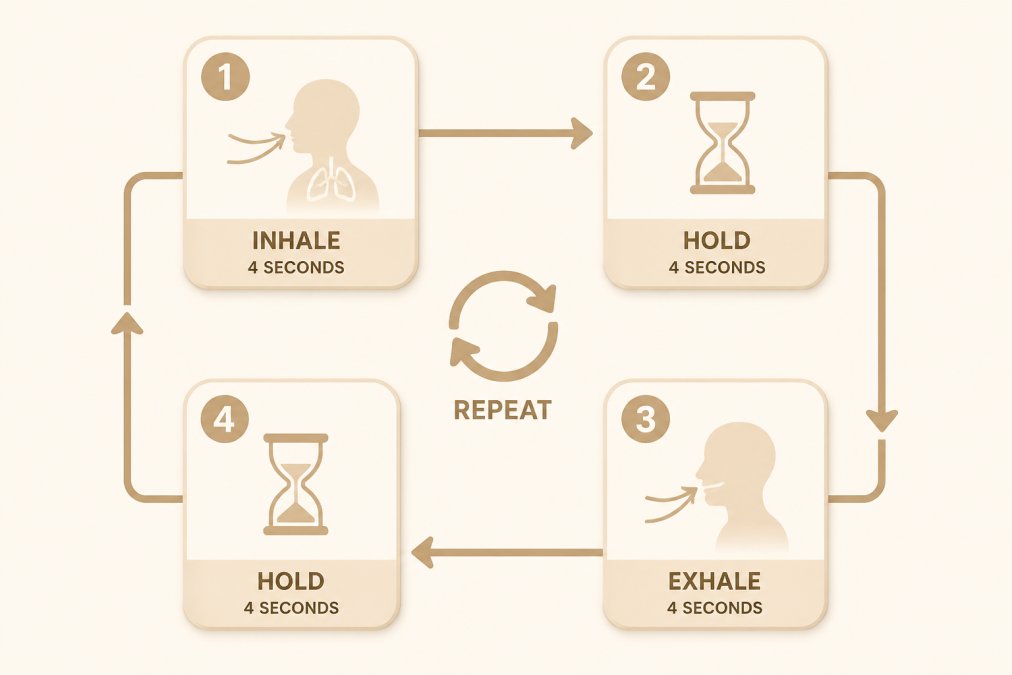
Box Breathing for Immediate Anxiety Relief
When anxiety spikes, box breathing provides immediate physiological relief.
How to do it:
Inhale for a count of 4. Breathe in through your nose slowly.
Hold for a count of 4. Keep the breath in your lungs.
Exhale for a count of 4. Release the breath through your mouth.
Hold for a count of 4. Pause before the next breath.
Repeat this cycle 5-10 times. The pattern signals your parasympathetic nervous system that it’s safe to calm down. Your heart rate will slow. Your breathing will deepen. The acute anxiety will diminish.
Box breathing is portable. You can do it in your car before walking into work, before a difficult conversation with your partner, or in the middle of the night when your mind is racing.
Breaking the Cycle: Practical Steps to Handle Infidelity Decision Paralysis
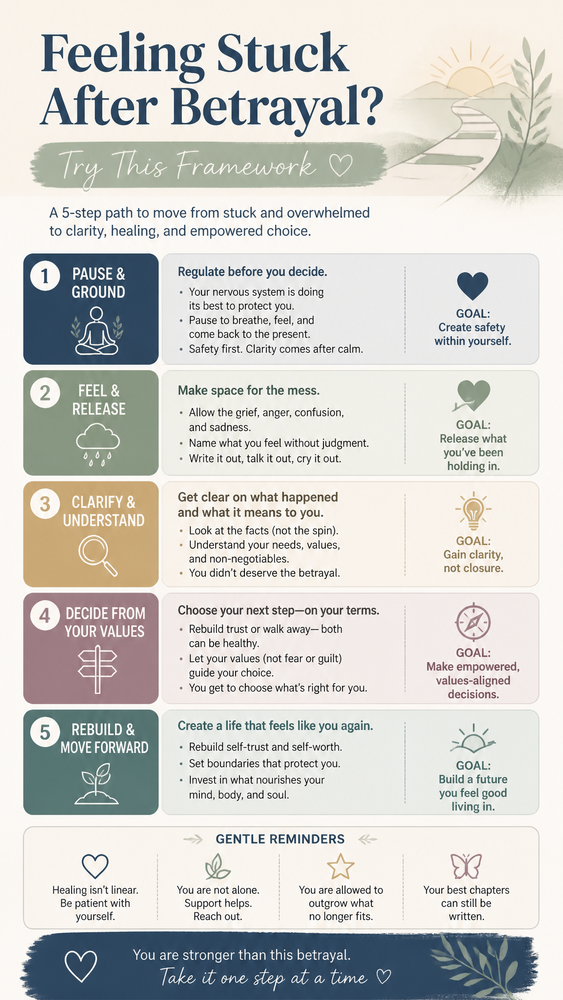
The framework below is designed to interrupt the analysis loop and move you toward clarity. It’s not a formula for deciding whether to stay or leave; that’s a deeply personal decision depending on your values, your partner’s willingness to change, and your capacity for rebuilding trust.
Step 1: Pause Before Deciding
The first instinct after discovering infidelity is often to make an immediate decision: leave immediately, demand answers, issue an ultimatum. This is your nervous system’s attempt to regain control through action.
Don’t. Not yet.
You need a minimum of 72 hours before making any major decision. In the first 72 hours, you’re in shock. Your judgment is compromised. Any decision will likely be either a panic response or a trauma-bonding response.
During these 72 hours:
- Use grounding techniques multiple times daily
- Don’t demand explanations you’re not in a state to process
- Don’t make threats or ultimatums you might not follow through on
- Don’t make any legal, financial, or logistical decisions
This pause is not passivity. It’s strategic regulation.
Step 2: Separate Emotional Urgency from Actual Urgency
One of the cruelest aspects of infidelity is that it creates a false sense of urgency. You feel like you need to decide now. The anxiety screams that you need resolution immediately.
This urgency is real, but it’s emotional urgency, not actual urgency.
Actual urgency exists in specific circumstances: if you’re in physical danger, if your partner is actively lying to cover tracks, if there are immediate legal or financial threats. In most cases, these don’t apply.
Emotional urgency is your nervous system’s distress signal. It feels like you’ll die if you don’t resolve this in 24 hours. You won’t. When you feel emotional urgency, pause and ask: What would actually change if I waited one more week? Usually, nothing. Your nervous system would have more time to settle. The decision you make after regulation will be far better than the decision you make in acute crisis.
Step 3: Build a Decision-Making Framework
Once you’ve paused and your nervous system has begun to regulate, you need a structure for making the actual decision.
Step 3A: Identify Your Non-Negotiables
Write down 3-5 non-negotiables, conditions that must be met for you to consider staying:
- My partner takes full responsibility without deflecting
- My partner is willing to engage in individual therapy and couples therapy
- My partner is willing to be transparent about their whereabouts and communications
- I feel genuine remorse, not just regret at being caught
- I see concrete behavioral change, not just promises
Step 3B: Assess Your Partner’s Willingness
Ask directly: Is your partner willing to do what’s required for reconciliation? Not “Do you want to stay together?” but “Are you willing to go to therapy, be transparent, take responsibility, and work on this for 12-24 months?”
If the answer is no or reluctant, the decision becomes clearer. You can’t rebuild trust alone.
Step 3C: Evaluate Your Own Capacity
Even if your partner is willing, can you do it? Reconciliation requires processing profound pain, rebuilding trust gradually over months or years, managing triggers, and tolerating uncertainty about whether it will work.
Ask yourself honestly: Do I have the emotional resources to attempt reconciliation? Or would I be better served by separating and rebuilding my life?
Step 4: Address Avoidance Without Rushing Action
One common pattern after infidelity is avoidance. You know you need to have a difficult conversation, but you don’t. Avoidance provides temporary relief but prevents healing and extends paralysis. At the same time, rushing into action before you’re ready is equally problematic.
Small steps forward:
- Have one honest conversation with your partner about what happened
- Schedule a therapy appointment for yourself
- Tell one trusted person what happened
- Write down your feelings in a journal
- Research what reconciliation or separation would actually look like logistically
- Consult with a lawyer about your options
These steps don’t commit you to any major decision. They’re information-gathering and support-building.
The goal is not to reach a final decision as quickly as possible. The goal is to gather enough information and regulate your nervous system enough that when you do decide, it’s from a grounded place, not a panicked one.
Betrayal Trauma and the Path to Rebuilding Trust After Infidelity
Whether you decide to stay or leave, you’re facing a trust-rebuilding challenge. If you stay, you’re rebuilding trust in your partner and the relationship. If you leave, you’re rebuilding trust in yourself and your ability to make good decisions about future partners.
Self-Trust as the Foundation
The most underestimated casualty of infidelity is your trust in yourself. You trusted your partner. You thought you knew them. And you were wrong. This creates a crisis of self-doubt: If I was so wrong about my partner, how can I trust my judgment about anything?
Rebuilding self-trust happens through experience. You rebuild trust in yourself by making small decisions, seeing them work out, and gradually expanding the scope of decisions you’re willing to make. Start small: trust yourself to recognize your own emotions, set a boundary and maintain it, ask for what you need, recognize when someone is being honest vs. defensive.
The Betrayer’s Role in Your Paralysis
Your partner’s response to being caught directly impacts how quickly you can move out of paralysis.
If your partner takes full responsibility, engages in genuine remorse, is willing to be transparent, answers your questions honestly, and shows no continued deception, then you have conditions necessary for rebuilding trust.
If your partner minimizes what happened, blames you or circumstances, refuses therapy, continues to lie, or shows no genuine remorse, then the paralysis often deepens. You’re stuck trying to decide whether to stay with someone unwilling to do the work required for reconciliation. In this scenario, the decision becomes clearer: You can’t rebuild trust alone.
Should I Stay or Leave After Infidelity: A Decision Framework
This is the central question, and there’s no universal answer. The framework below is designed to help you move toward your own answer.
Clarifying Your Values and Non-Negotiables
Before you can answer “Should I stay or leave?” you need to know what you actually value.
Many people make this decision based on what they think they should do, what their family expects, what they’re afraid of losing, or what feels like the path of least resistance. None of these are reliable guides.
Instead, clarify your actual values: What matters most to you in a relationship? What are your dealbreakers? What do you need to feel safe and valued? Once you’ve clarified these, you can evaluate whether your current relationship meets them.
Evaluating Reconciliation Readiness
Reconciliation after infidelity is possible. Many couples rebuild and create stronger relationships. But it requires specific conditions.
Ask yourself and your partner:
Is there genuine remorse? Not regret at being caught, but actual remorse for the harm caused.
Is there willingness to be transparent? Your partner should be willing to answer questions and understand that rebuilding trust requires temporary loss of privacy.
Is there commitment to change? This means individual therapy to understand why the infidelity happened, couples therapy to rebuild the relationship, and concrete behavioral changes.
Is there time and patience? Rebuilding trust takes 2-5 years minimum.
Is there willingness to address underlying issues? Often infidelity points to deeper relationship problems. Is your partner willing to address these?
If you can answer yes to most of these, reconciliation is possible. If you’re answering no to several, separation may be the more realistic path.
| Reconciliation Indicator | Present | Absent | Implication |
|---|---|---|---|
| Genuine remorse | ✓ | ✗ | Without remorse, rebuilding trust is nearly impossible |
| Willingness to be transparent | ✓ | ✗ | Transparency is required for trust to rebuild |
| Commitment to therapy | ✓ | ✗ | Individual and couples therapy significantly improve outcomes |
| Willingness to address root causes | ✓ | ✗ | Without addressing why it happened, patterns often repeat |
| Realistic timeline expectations | ✓ | ✗ | Expecting quick recovery leads to disappointment and failure |
Infidelity Recovery Timeline: Realistic Expectations for Your Healing Journey
One of the most damaging myths about infidelity recovery is that it should be “over” in a few months. Recovery is a long process with distinct phases. Understanding the timeline helps you recognize that the paralysis and confusion you’re experiencing is normal.
The First 30 Days: Crisis and Stabilization
The first month after discovery is crisis mode. You’re in acute shock. Your nervous system is in overdrive. Sleep is disrupted. Appetite is affected.
During this phase:
- Focus on basic functioning: eat, sleep, move your body
- Use grounding techniques multiple times daily
- Don’t make major decisions
- Build your support system (therapy, trusted friends, support groups)
- If there are children, prioritize their stability and reassurance
By the end of 30 days, the acute shock begins to wear off. You’ll still be in significant pain, but you’ll have slightly more access to your thinking brain.
Months 2-6: Processing and Clarity Emerges
In this phase, you move from crisis into processing. The paralysis often intensifies here because you have enough mental capacity to ask the hard questions, but not enough emotional distance to answer them clearly.
This is when many people seek therapy, have difficult conversations with their partner, and start to evaluate whether the relationship is salvageable. By month 6, if you’re working with a therapist and your partner is engaged, you’ll have enough information to decide whether to stay or leave.
Months 6-24: Rebuilding or Separating
If you’ve decided to reconcile, months 6-24 are about rebuilding. This is slow, difficult work. Trust rebuilds gradually through consistent, honest behavior over time.
If you’ve decided to separate, this is the phase where you’re managing logistics, processing grief about the relationship ending, and beginning to imagine a new future.
Either way, the paralysis that characterized the first months should begin to lift.
Many people experience a relapse around month 3-4, where the paralysis returns and they question their decision. This is normal. Your nervous system is still processing the trauma. Continue with therapy and grounding techniques. The relapse usually passes.
When to Seek Professional Therapy for Infidelity Decision Paralysis
Therapy is not a luxury after infidelity. It’s a necessity. The paralysis you’re experiencing is a trauma response, and trauma responds best to professional support.
Red Flags That Indicate You Need Immediate Support
Seek professional help immediately if you’re experiencing:
- Suicidal thoughts or self-harm urges
- Severe dissociation or inability to function
- Uncontrollable rage or violent impulses
- Complete inability to sleep or eat
- Substance abuse as a coping mechanism
- Severe panic attacks interfering with daily functioning
What Therapy Offers Beyond Self-Help Tools
Self-help tools like grounding techniques are valuable. But therapy offers something they can’t: a trained professional who can help you process the trauma, understand why the infidelity happened, rebuild self-trust, and make decisions from a grounded place.
A good therapist will help you understand your trauma response patterns, teach you nervous system regulation techniques tailored to your needs, help you process grief and anger without getting stuck, support you in making a decision aligned with your values, and if you choose reconciliation, help you rebuild trust. After the Affair Series offers structured frameworks and scripts for managing the practical aspects of infidelity and co-parenting, but individual therapy is the essential complement.
The paralysis you’re experiencing after discovering infidelity is real, and it’s a normal response to profound betrayal. But it doesn’t have to be permanent. By regulating your nervous system, building support, and moving through a structured decision-making process, you can move from paralysis to clarity. Whether you ultimately decide to stay or leave, that decision will be grounded in your values and wisdom, not in panic. After the Affair Series provides the specific frameworks and scripts you need to navigate difficult conversations and protect your peace while you’re processing this trauma. Combined with professional therapy and the grounding techniques outlined here, you have a path forward.
Frequently Asked Questions
Why do I feel so paralyzed after discovering infidelity?
Decision paralysis after infidelity stems from a combination of trauma response and emotional overload. Your nervous system enters a state of hypervigilance, flooding your body with stress hormones that impair rational thinking. Simultaneously, you’re experiencing cognitive load from obsessive thoughts about the betrayal, which depletes your mental resources for decision-making. This is not weakness, it’s a normal neurological response to betrayal trauma. Understanding this distinction between trauma response and simple overthinking is crucial for moving forward effectively.
How long does infidelity decision paralysis typically last?
Most people experience acute decision paralysis for 2-6 weeks after discovery, though the timeline varies significantly. The first 30 days are typically the most intense, characterized by crisis-level anxiety and inability to think clearly. By weeks 4-6, many people begin to experience moments of clarity as emotional intensity decreases. However, underlying uncertainty about whether to stay or leave can persist for months. The infidelity recovery timeline is not linear, you may feel clarity one day and paralysis the next. This is normal and does not mean you’re failing; it reflects the genuine complexity of your situation.
Should I make a decision about staying or leaving immediately after discovering infidelity?
No. One of the most damaging mistakes people make is rushing a decision while in acute trauma response. Your nervous system is dysregulated, your emotional exhaustion is high, and your cognitive clarity is compromised. Decisions made in this state often reflect panic rather than your true values. Instead, prioritize stabilization: use grounding techniques, regulate your nervous system, and give yourself at least 30 days before making any major commitment. This doesn’t mean avoiding the issue, it means approaching it from a place of psychological safety rather than crisis mode.
What’s the difference between decision fatigue and trauma response in infidelity situations?
Decision fatigue is mental exhaustion from making too many decisions or processing too much information, you’re tired and your judgment is cloudy. Trauma response, by contrast, is your nervous system’s protective reaction to betrayal: hypervigilance, intrusive thoughts, anxiety spikes, and emotional flooding. In infidelity, you typically experience both simultaneously, which compounds the paralysis. Trauma response requires nervous system regulation (grounding techniques, professional support); decision fatigue requires rest and cognitive breaks. Recognizing which is dominant in any given moment helps you choose the right intervention, regulating your nervous system won’t solve decision fatigue, and taking a nap won’t address trauma response.
How can I rebuild trust after infidelity when I can’t even trust my own judgment right now?
Self-trust is foundational to rebuilding trust after infidelity, in your relationship or in yourself as you move forward. Start by honoring small commitments to yourself: if you say you’ll use a grounding technique when anxiety spikes, do it. If you commit to not obsessing over affair details for one hour, keep that boundary. These micro-commitments rebuild your nervous system’s sense of safety and restore your confidence in your own decision-making. Your judgment isn’t broken; it’s temporarily compromised by trauma. As you regulate your nervous system and process the betrayal with support (therapy, structured frameworks), your clarity will return. This is a healing journey, not a failure.