
Last Updated: July 31, 2026
When you discover a partner’s infidelity, your nervous system enters crisis mode. The betrayal destabilizes everything: your sense of safety, your identity as a partner, your ability to trust. Add parenting to that equation, and you’re navigating betrayal trauma while parenting with a dysregulated nervous system, fractured focus, and a body flooded with stress chemicals. But here’s what most guides miss: coping with betrayal trauma while parenting isn’t about becoming perfect despite the crisis. It’s about becoming functional by addressing your own dysregulation first, then building sustainable boundaries and communication practices that protect both your peace and your children’s emotional security.
- Understanding Betrayal Trauma and Its Impact on Your Parenting
- How Nervous System Dysregulation Affects Your Capacity to Parent
- Parental Betrayal Trauma Effects on Daily Functioning
- Emotional Regulation After Betrayal for Parents: Foundational Techniques
- Physiological Regulation: Calming Your Nervous System in Real Time
- Recognizing and Managing Emotional Triggers While Parenting
- Setting Boundaries After Betrayal: Protecting Your Peace and Your Children
- Establishing Non-Negotiable Limits With Your Co-Parent
- Age-Appropriate Scripts for Difficult Conversations With Your Children
- Self-Care for Betrayed Parents: Reclaiming Your Emotional Availability
- Building a Sustainable Self-Care Practice During Crisis
- The 'Good Enough Parent' Framework: Releasing Perfectionism
- Seeking Professional Support and Breaking the Generational Cycle
- When and How to Access Therapeutic Support for Betrayal Trauma
- Legal and Custody Considerations During High-Conflict Co-Parenting
- Practical Strategies for Coping With Betrayal Trauma in Daily Parenting
- Communication Tools for High-Conflict Situations
- Building Resilience and Trust Restoration in Your Family
- Frequently Asked Questions
Understanding Betrayal Trauma and Its Impact on Your Parenting
Betrayal trauma is a nervous system injury. When someone you trust fundamentally violates that trust, your brain’s threat-detection system gets stuck in overdrive. You experience intrusive thoughts, hypervigilance, emotional flooding, and a constant sense of danger.
Your nervous system dysregulation directly shapes how you respond to your children. A child asks an innocent question and you snap. Your co-parent texts about pickup and your heart races. You find yourself emotionally unavailable during moments when your kids need you most, not because you don’t love them, but because your nervous system is consuming all your bandwidth just trying to survive.

The most dangerous pattern: using your children as [emotional regulation](/infidelity-recovery-workbook-exercises/) tools. Confiding too much detail about the betrayal, asking them to keep secrets, or leaning on them for emotional support reverses the parent-child hierarchy. Your kids internalize that their job is to manage your emotional state, compounding their own trauma from the family rupture.
Research shows that children of high-conflict separated parents experience measurable increases in anxiety, depression, and behavioral problems when exposed to ongoing parental conflict or emotional instability. Your healing directly impacts their resilience.
How Nervous System Dysregulation Affects Your Capacity to Parent
Betrayal trauma keeps you locked in threat mode. From that state, you cannot access the prefrontal cortex functions you need to parent effectively: patience, perspective-taking, creative problem-solving, emotional attunement. You’re running on survival instinct instead of wisdom.
This manifests predictably. You yell over small things. You withdraw emotionally when your kids need closeness. You oscillate between hypervigilance and dissociation. You make parenting decisions from fear rather than values.
Your amygdala is hyperactive. Your vagus nerve is stuck in fight-or-flight signaling. Your cortisol levels are chronically elevated. You’re not choosing these reactions; your body is responding to a genuine threat.
The window of tolerance explains why you can handle small frustrations one moment and explode over nothing the next. Your window, the zone where you can think clearly and respond intentionally, shrinks dramatically under betrayal trauma. The first step to expanding it is recognizing when you’re outside it, without judging yourself for being there.
Children need a regulated caregiver to develop their own emotional regulation. If you’re constantly dysregulated, they absorb that instability and develop their own hypervigilance.
Parental Betrayal Trauma Effects on Daily Functioning
The effects show up everywhere. Morning routines become minefields because you’re already depleted before the day starts. Emotional availability collapses, your kids want to share about their day and you’re physically present but mentally absent. Patience evaporates; small requests trigger disproportionate anger because your nervous system interprets even minor demands as threats.
Sleep deprivation compounds everything. Betrayal trauma creates intrusive thoughts and hyperarousal that make sleep nearly impossible. You’re exhausted, which shrinks your window of tolerance further, which makes you more reactive, which creates more conflict with your co-parent, which increases stress, which prevents sleep. The cycle feeds itself.
Your dysregulation is not a character flaw or parenting failure. It’s a predictable neurobiological response to genuine trauma. Recognizing this shifts you from shame to agency: “I need to regulate my nervous system so I can parent effectively.”
Emotional Regulation After Betrayal for Parents: Foundational Techniques
Emotional regulation means noticing your emotional state without being controlled by it, then choosing your response rather than reacting automatically. This isn’t about suppressing feelings. It’s about creating space between the trigger and your response so you can parent from intention instead of panic.
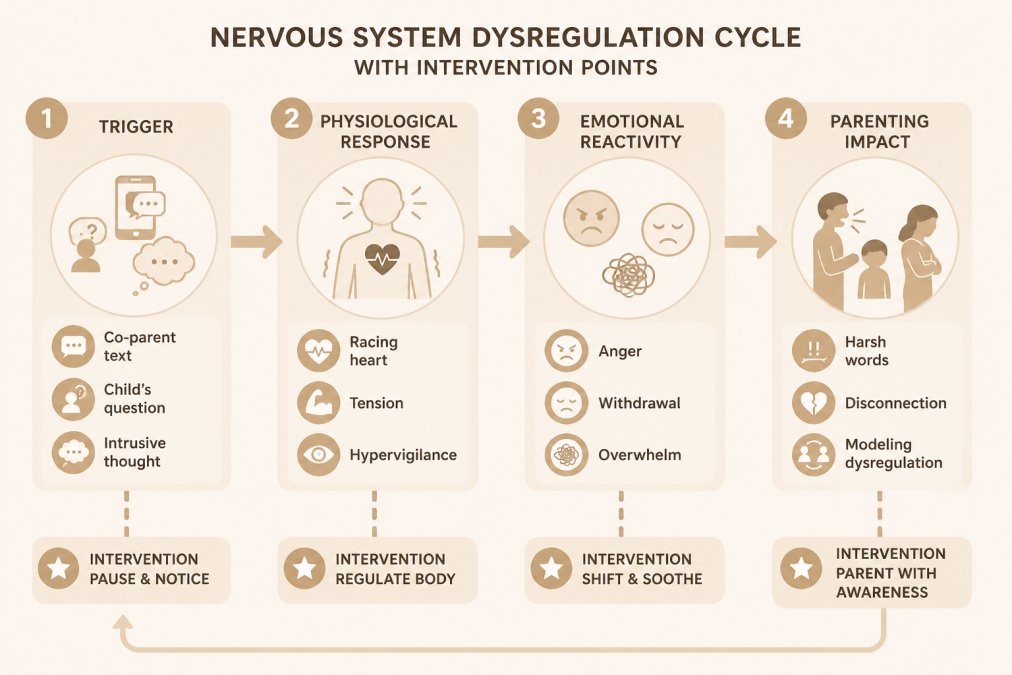
The foundation is somatic awareness: learning to notice what’s happening in your body before your mind spirals. When dysregulated, you feel it first, tightness in your chest, heat in your face, a knot in your stomach, shallow breathing. These are your early warning signals. If you catch dysregulation at this stage, you can intervene before you act in ways that harm your parenting.
Throughout the day, pause and scan your body. Where do you feel tension? What’s your breathing like? The second layer is naming what you’re experiencing without judgment. “I notice I’m angry right now” is different from “I am an angry person.” One is observation; the other is judgment. Observation creates space for choice.
Physiological Regulation: Calming Your Nervous System in Real Time
When triggered, you need tools that work in the moment, not theoretical concepts you’ll remember later.
The vagal reset uses your body’s own nervous system pathways to signal safety to your brain. Your vagus nerve controls whether you’re in fight-or-flight or rest-and-digest mode. You can activate it deliberately.
Cold water immersion: Splash cold water on your face or hold ice in your mouth for 10-15 seconds. This triggers a reflex that slows your heart rate and signals safety to your brain. It works within 30 seconds.
Extended exhale breathing: Breathe in for a count of 4, hold for 4, exhale for 6-8. The extended exhale activates your parasympathetic nervous system. Do this for 2-3 minutes when dysregulation rises.
Progressive muscle relaxation: Tense each muscle group for 5 seconds, then release, starting with your feet and moving upward. This creates a direct signal that it’s safe to relax.
Bilateral stimulation: Tap alternately on your knees while thinking about something neutral. This activates both sides of your brain and helps process emotional intensity.
The best regulation tool is the one you’ll actually use. Experiment and find your go-to technique, then practice it when calm so it’s automatic when triggered.
Recognizing and Managing Emotional Triggers While Parenting
A trigger is any situation that activates your trauma response because it connects to the betrayal. Your co-parent mentions their new partner and your nervous system floods. Your child asks to stay longer at their other parent’s house and you interpret it as rejection.
Identify your specific triggers before they control your parenting. Common ones include: anything related to the affair partner, questions about why the separation happened, your co-parent appearing happy or moving forward, your children bonding with the other parent, situations where you feel loss of control.
Separate the trigger from the present moment. When your child asks “Why did you and Dad break up?” your nervous system might interpret this as blame or failure. But they asked a factual question. The “Good Enough Parent” framework is essential here: you don’t need to respond perfectly. You need to respond from your values rather than your trauma. If your value is honesty, you might say: “Dad and I had serious problems we couldn’t fix. It’s not your fault. We both love you.”
Setting Boundaries After Betrayal: Protecting Your Peace and Your Children
Boundaries are the lines that define what you will and won’t tolerate. After betrayal, you need boundaries with your co-parent, with your children, and with yourself.
Boundaries with your co-parent protect your peace while maintaining functional co-parenting. The Gray Rock Method works with high-conflict co-parents: you become as uninteresting as a gray rock, neutral, brief, factual. When your co-parent tries to engage you emotionally, you respond with minimal engagement: “Okay,” “Got it,” “I’ll handle that.” No elaboration. No defending yourself.
Boundaries with your children are about age-appropriate honesty without emotional dumping. Your children deserve to understand what’s happening in their lives. They don’t deserve to become your emotional support system or hear details about the affair, the other parent’s behavior, or your financial struggles.
Boundaries with yourself mean: not obsessively checking your co-parent’s social media, not interrogating your children about the other parent’s life, not making major decisions while dysregulated, not using substances to numb pain.
Establishing Non-Negotiable Limits With Your Co-Parent
Non-negotiable limits are specific, concrete boundaries that protect your peace.
Examples: Communication about parenting happens only through a co-parenting app or email. Pickup and drop-off happen at a neutral location or at set times. Personal topics are off-limits. If your co-parent becomes hostile, you end the conversation: “I’m not continuing this if you’re going to speak to me that way. I’ll email you instead.” You will not engage with attempts to make you jealous, guilty, or defensive about your co-parent’s new life.
These limits only work if you enforce them consistently. If you set a limit and then violate it yourself, your co-parent learns the limit doesn’t exist.

Age-Appropriate Scripts for Difficult Conversations With Your Children
The biggest mistake: setting boundaries but not following through with consequences. Consistency is everything.
When your child asks why you’re separating:
“Mom and Dad have decided to live in separate houses. We both love you very much, and that’s not changing. Sometimes grown-ups realize they’re not happy together, and the best thing is to live separately. This is not your fault.”
When your child doesn’t want to go to the other parent’s house:
“I understand you’re feeling sad/angry/scared right now. Those feelings make sense. And you still need to go to Dad’s house because we both love you and want to spend time with you. Your feelings are okay. The plan doesn’t change.”
When your child asks about the other parent’s new partner:
“Your dad/mom has a new person in their life. That doesn’t change anything about your relationship with them or with me. You don’t have to like them or spend a lot of time with them. But you do need to be respectful.”
When your child tries to tell you negative things about the other parent:
“I appreciate you telling me. I’m not going to say bad things about your other parent, even if they do things that hurt me. You don’t have to choose sides. You can love both of us, and that’s healthy.”
When your child expresses guilt about the separation:
“This is 100% not your fault. Parents have adult problems that kids can’t fix. There’s nothing you did, nothing you could have done, and nothing you could do now that would have changed this.”
Self-Care for Betrayed Parents: Reclaiming Your Emotional Availability
Self-care for betrayed parents isn’t about bubble baths. It’s about practices that stabilize your nervous system so you can show up for your children. The non-negotiables are sleep, movement, and connection.
Sleep is when your brain consolidates emotional memories and processes trauma. Without adequate sleep, your nervous system can’t heal. If insomnia is severe, talk to a doctor. Short-term sleep support isn’t weakness; it’s necessary medicine while you’re in crisis.
Movement regulates your nervous system directly. Exercise isn’t about fitness right now. It’s about burning off cortisol and adrenaline your body is producing constantly. Twenty minutes of walking, yoga, or dancing is more valuable than an hour of something you hate.
Connection with safe people is essential: a therapist, a trusted friend, a support group for people navigating separation and betrayal. Not your children. Not your co-parent.
The paradox: taking care of yourself feels selfish when your children need you. But self-care isn’t selfish; it’s the foundation that allows you to parent effectively. When you’re regulated, your children feel safe. Your healing is parenting.
Building a Sustainable Self-Care Practice During Crisis
Start with one non-negotiable. Not three. One. Maybe it’s a 20-minute walk every morning or one therapy session per week. Pick something small enough that you’ll actually do it even on your worst days.
Protect that practice fiercely. It’s not optional. Schedule it. Treat it like an appointment you can’t miss. Remove barriers. If childcare is the obstacle, figure that out first. If cost is the barrier, look into sliding-scale therapists or community mental health services.
Accept “good enough.” Your practice doesn’t have to be perfect. You won’t do it every single day. The goal is consistency over time, not perfection.
The ‘Good Enough Parent’ Framework: Releasing Perfectionism
A good enough parent is attuned to their child most of the time, but not always. They mess up, acknowledge it, and repair it. They have limits and enforce them. Their children feel secure not because the parent is flawless, but because the parent is reliably themselves.
For betrayed parents, this framework is liberating. You don’t have to hide your pain from your children or be the perfect parent who never gets upset. You need to be the parent who gets dysregulated, recognizes it, repairs it, and teaches your child that emotions are manageable and that people can make mistakes and fix them.
When you snap at your child, you can say: “I’m sorry I spoke to you that way. I was upset about something that has nothing to do with you. That wasn’t okay, and I’m going to do better. I love you.” That’s good enough parenting. Your parenting right now is not your best parenting. You’re parenting from a dysregulated nervous system in crisis. Your parenting will improve as you heal.
Seeking Professional Support and Breaking the Generational Cycle
Professional support isn’t optional when navigating betrayal trauma and high-conflict co-parenting. Therapy is essential medicine for your nervous system.
The specific type of therapy matters. Trauma-informed approaches like EMDR, Somatic Experiencing, or Internal Family Systems (IFS) work directly with nervous system dysregulation. Cognitive-behavioral therapy helps with intrusive thoughts and rumination.
When looking for a therapist, ask specifically about their experience with betrayal trauma and high-conflict co-parenting. Ask about their approach to nervous system regulation.
If you can’t afford traditional therapy, many therapists offer sliding-scale fees. Community mental health centers often provide lower-cost services. Some therapists offer group therapy, which is more affordable than individual sessions.
When and How to Access Therapeutic Support for Betrayal Trauma
The right time to seek therapy is now, not when things get worse. Early intervention prevents escalation. If you’re experiencing intrusive thoughts about the betrayal, hypervigilance, emotional flooding, or dysregulation affecting your parenting, those are clear signals that you need professional support.
Start with your primary care doctor for a referral. Check your insurance for in-network therapists specializing in trauma. Search Psychology Today’s therapist finder with filters for “trauma,” “infidelity,” and “separation/divorce.” Call your local community mental health center.
When you call a therapist, be direct: “I’m dealing with betrayal trauma from infidelity, navigating separation and co-parenting, and I need help regulating my nervous system so I can be more present for my children.” A good therapist will tell you quickly whether they’re a good fit.
Legal and Custody Considerations During High-Conflict Co-Parenting
Your emotional state and parenting capacity directly affect custody arrangements and legal outcomes. Courts consider each parent’s ability to meet the child’s emotional and physical needs. A parent who is clearly dysregulated, using children as emotional support, or involving children in conflict is at a disadvantage. A parent actively working to stabilize themselves, protecting children from conflict, and facilitating the child’s relationship with the other parent is viewed more favorably.
Document everything. If your co-parent is being hostile, abusive, or using your children inappropriately, document it with dates, times, and specific behaviors. Use a co-parenting app like OurFamilyWizard that creates a documented record of communication, keeping it focused on logistics rather than emotional arguments.
Consult with a family law attorney, even if you think you don’t need one. Many offer free consultations. Understanding your rights and responsibilities protects you and your children.
Practical Strategies for Coping With Betrayal Trauma in Daily Parenting
| Strategy | When to Use | Expected Outcome |
|---|---|---|
| Cold water face splash | When anger rises before speaking to your child | 30-second nervous system reset |
| Extended exhale breathing | Morning routine, before difficult conversations | Calmer nervous system, clearer thinking |
| Gray Rock Method | Communication with co-parent | Reduced emotional escalation |
| Bilateral stimulation (knee tapping) | When intrusive thoughts are intense | Reduced emotional intensity |
| Age-appropriate scripts | When child asks about separation or the other parent | Honest, protective communication |
| One non-negotiable self-care practice | Daily | Sustained nervous system regulation |
| Therapy or support group | Weekly or as needed | Professional processing of trauma |
| Boundary enforcement | Consistently | Protected peace and modeling healthy limits |
Communication Tools for High-Conflict Situations
High-conflict situations are inevitable when co-parenting after betrayal. You need tools that keep you from escalating and protect your children from witnessing intense conflict.
The STOP tool is simple: Stop, Take a breath, Observe (what’s happening, what you’re feeling, what your nervous system needs), Proceed (with intention, not reaction).
The “I” statement structure keeps communication focused on your experience rather than blame: “I feel [emotion] when [situation] because [reason]. I need [specific request].” This differs from “You always [accusation],” which escalates conflict.
The pause-and-respond practice means: when your co-parent says something triggering, you pause, take a breath, notice your nervous system’s response, then respond. This creates space between trigger and behavior. Space is where choice lives.
Written communication (email, co-parenting app) is preferable to in-person or phone conversations when dysregulated. It gives you time to regulate and respond from your values rather than your trauma.
Building Resilience and Trust Restoration in Your Family
Resilience isn’t about bouncing back to how things were. It’s about developing the capacity to navigate difficulty and grow through it. Your children can develop resilience if you model it, if they see you struggling, getting support, using tools to regulate, and continuing to show up for them.
Trust restoration happens slowly through thousands of small moments of reliability. You say you’ll call at 6 and you call at 6. You say you’re going to work on your dysregulation and you show up to therapy. You say you won’t bad-mouth the other parent and you don’t. Over time, your child’s nervous system learns that you’re safe, even though the family structure has changed.
Navigating betrayal trauma while parenting is one of the hardest things you’ll ever do. Your nervous system is injured. Your family structure is fractured. Your identity as a partner has been shattered. Yet your children still need you to be the regulated, present adult in the room.
The good news: this is learnable. Your nervous system can heal. You can develop tools to regulate yourself so you can parent from intention rather than trauma. You can set boundaries that protect your peace and your children’s wellbeing. You can be the good enough parent your children need.
After the Affair Series provides a structured toolkit designed to help individuals navigate the complexities of betrayal, separation, and high-conflict co-parenting. By offering specific frameworks and actionable scripts, the platform empowers users to manage difficult interactions, protect their peace, and support their children’s emotional wellbeing. Rather than offering general advice, the service delivers immediate, practical solutions for those facing the most challenging moments of infidelity and relationship breakdown. The free 23-point assessment helps you identify where you are in the healing process and what your next steps should be. Start there, and begin building the stability your family needs.
Frequently Asked Questions
How does parental betrayal trauma affect my ability to parent effectively?
Betrayal trauma activates your nervous system into a state of hypervigilance and dysregulation, which reduces your emotional availability and patience with your children. You may experience intrusive thoughts, emotional flooding, or difficulty staying present during parenting moments. These are normal trauma responses, not character flaws. Understanding this connection helps you recognize when you need to pause, regulate, and return to your children with intentionality rather than reactivity. Self-compassion and physiological regulation techniques can restore your capacity to parent from a calmer, more connected place.
What age-appropriate scripts can I use to talk to my children about betrayal and family changes?
Scripts should be honest but developmentally appropriate. For young children (ages 4-7): ‘Mommy and Daddy love you very much. We’re making some changes to our family, but that’s never your fault.’ For school-age children (8-12): ‘Sometimes adults make choices that hurt each other. We’re working through that, and we’re both going to be here for you.’ For teens: Acknowledge the betrayal without oversharing details, ‘Something happened in our relationship that broke my trust. I’m working through this with professional help.’ Avoid blaming language and always emphasize that the child is not responsible for the adult’s choices or emotions.
How can I set boundaries after betrayal without escalating conflict with my co-parent?
Use structured communication methods like the Gray Rock approach, keep messages brief, factual, and emotionally neutral. Set clear limits on communication channels (email only for scheduling, no late-night calls) and stick to them consistently. Define non-negotiable boundaries around your children’s safety and emotional wellbeing, then communicate these calmly and without justification. Document everything in writing. Boundaries are not punitive; they’re protective. Consistency matters more than perfection. If your co-parent escalates, that’s their nervous system response, not a sign your boundary was wrong.
What self-care practices actually work when I’m in crisis and still parenting full-time?
Realistic self-care during active betrayal trauma doesn’t require hours away. Micro-practices work: five minutes of box breathing before school pickup, a 10-minute walk alone, one meal eaten without multitasking, or 15 minutes journaling after bedtime. Prioritize sleep and hydration as non-negotiable foundations. Build a support network, friends, therapists, or support groups, to share the mental load. The ‘Good Enough Parent’ framework acknowledges that perfect self-care isn’t possible right now; small, consistent acts of self-compassion sustain you through crisis better than sporadic grand gestures. Focus on what’s sustainable, not what’s ideal.
Should I stay in my relationship after discovering betrayal, or is separation the better choice for my children?
This is a deeply personal decision with no universal right answer. Coping with betrayal trauma while parenting doesn’t require you to decide immediately. Many parents benefit from working with a therapist to process the betrayal, clarify their own values, and assess whether trust can be rebuilt or whether separation is necessary. Research shows children’s wellbeing depends more on the quality of parenting and reduction of conflict than on whether parents stay together. What matters most is your decision-making clarity and your ability to parent from a regulated, intentional place, whether that’s within or outside the relationship. Professional support can help you gain that clarity without pressure.