Table of Contents
- Why Setting Boundaries With a Cheating Ex Partner Matters
- Define Your Non-Negotiables Before Contact
- Scripts for Setting Boundaries With Your Ex
- Co-Parenting Boundaries After Infidelity
- The No-Contact Rule After Cheating
- Enforce Your Boundaries Consistently
- Digital Boundaries and Social Media
- Protect Your Emotional Safety During Recovery
Why Setting Boundaries With a Cheating Ex Partner Matters
Infidelity shatters trust. When the relationship ends, you’re processing betrayal trauma while navigating ongoing contact, often due to children, finances, or logistics. Without clear boundaries, your ex can continue patterns of manipulation and control.
Setting boundaries isn’t about being punitive; it’s about psychological safety. Research shows that individuals who establish firm, consistent boundaries during separation recover faster and experience fewer symptoms of betrayal trauma. Your nervous system needs to know you’re no longer accessible to the same patterns of harm.
Most people fail here: they set a boundary once, then waffle when their ex pushes back. Boundaries without enforcement are suggestions. After the Affair Series provides structured toolkits for individuals navigating betrayal, separation, and high-conflict co-parenting, and emphasizes boundary-setting as a skill to practice, not a one-time conversation.
The stakes are higher with children. Kids absorb the emotional climate of co-parenting interactions, and firm, consistent boundaries protect their emotional environment.
Define Your Non-Negotiables Before Contact
Before you write a script or send a message, know what you will and won’t tolerate. Write it down.
Common non-negotiables include:
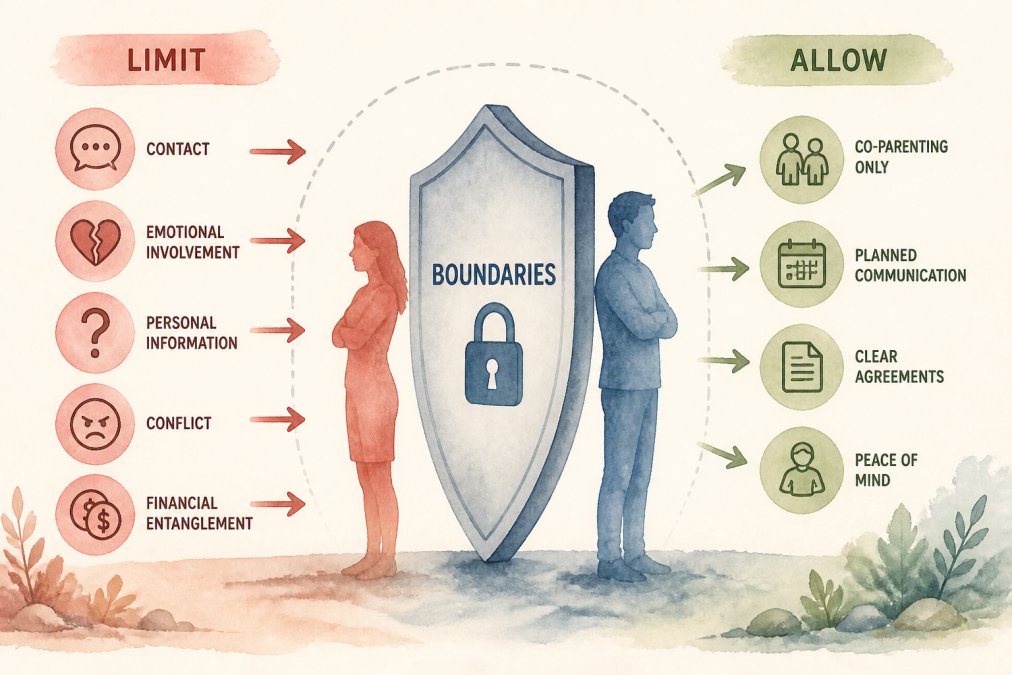
- No contact outside of co-parenting or logistical necessity
- No discussion of the affair or relationship details
- No unannounced visits
- No access to your location, passwords, or personal devices
- No involving children in adult conflict
- No financial demands beyond legal agreements
- No late-night or off-hours communication
Specificity matters. "I need respect" is not a non-negotiable. "You will not text me after 9 PM unless it’s a child emergency" is. Your brain needs to know exactly what triggers a response.
Write these down and keep them visible. When your ex manipulates or guilt-trips, your tired brain will want to negotiate. A written list anchors you to what you decided when thinking clearly.
Distinguish between non-negotiables and preferences. You might prefer your ex doesn’t date someone in front of the kids, but that’s their parenting choice. Non-negotiables are things you can control: your own availability, your communication channels, your participation in conversations.
Scripts for Setting Boundaries With Your Ex
Opening the conversation
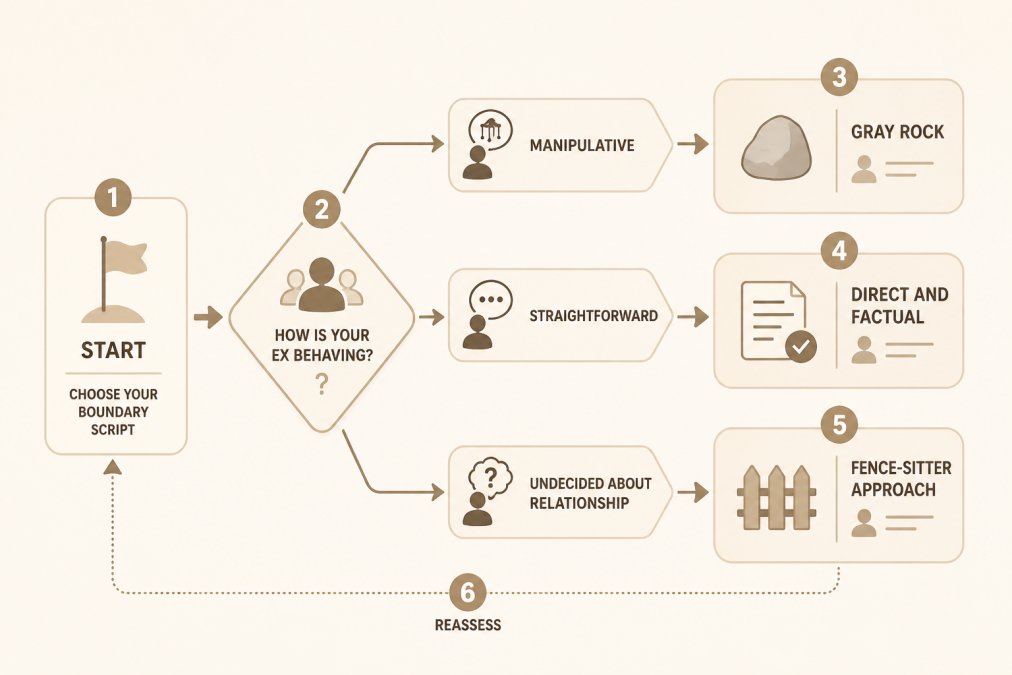
The first conversation sets the tone. Your ex will test you immediately, acting confused or offended. Stick to the script.
Script 1: Direct and factual (best for ex partners who respond to clarity)
"I’m reaching out to establish how we’ll communicate going forward. Moving forward, I need our contact to be limited to [child name] logistics and necessary co-parenting decisions. I’ll respond to messages within 24 hours during business hours. If it’s not about [child], I won’t be responding. This isn’t negotiable, it’s what I need to move forward."
Script 2: Gray Rock method (best for highly reactive or manipulative ex partners)
The Gray Rock method means you’re present but boring, like a gray rock. No emotion, no engagement, no fuel for drama.
"I understand you feel that way. Going forward, all communication about [child] will be through [communication platform: email, co-parenting app, etc.]. I’ll check messages on [specific days/times]. I’m not available for phone calls or in-person discussions outside of scheduled exchanges."
Script 3: For the fence-sitter (best if you haven’t decided whether to separate)
"I need some space right now to process what’s happened. I’m not making decisions about our relationship yet, but I do need our interactions to change. I need [specific boundary: no asking about my personal life, no unannounced visits, etc.]. I’ll let you know when I’m ready to have a bigger conversation."
Responding to boundary violations
Your ex will test your boundaries. How you respond determines whether they respect it or keep pushing.
Script for the first violation:
"I notice you’ve texted about [topic] twice this week. That’s not something I’m discussing. As I mentioned, I’m only available for [child]-related communication. Please respect that."
Script for repeated violations:
"You’ve crossed this boundary multiple times despite my asking you to stop. I’m moving our communication to [platform/method that you control more]. If you continue to contact me outside of this, I won’t be responding."
Script for guilt-tripping:
"I understand this is difficult for you. My boundary isn’t about punishing you, it’s about what I need. This isn’t changing."
Handling emotional manipulation
Emotional manipulation after infidelity often sounds like: "You’re being cruel," "The kids miss me," or "You’re using the boundary as a weapon." The goal is to make you doubt your boundary and reopen the door to contact.
Script for "You’re being cruel":
"I’m not being cruel. I’m being clear about what I need. You’re welcome to feel upset about that."
Script for "The kids need me":
"The kids will see their dad/mom at [scheduled time]. That hasn’t changed. What has changed is how we communicate when it’s not their time."
Script for "You’re using this as a weapon":
"I’m not using anything as a weapon. I’m protecting my peace so I can be a better parent. That’s not punishment, that’s self-care."
The pattern: name the manipulation, restate your boundary, don’t defend yourself. Manipulation thrives on debate. You don’t debate your own non-negotiables.
Co-Parenting Boundaries After Infidelity
Keeping conversations child-focused
Co-parenting after infidelity requires talking to someone you don’t trust about a child you both love. Every conversation, message, and exchange is about the child. Not the affair. Not hurt feelings. Child.
What child-focused communication looks like:
- "What time is pickup on Saturday?"
- "He has a soccer game Thursday at 6 PM. Can you do pickup from school?"
- "She’s been having trouble sleeping. I’m taking her to the pediatrician Tuesday."
What it doesn’t look like:
- "You’re a terrible father because of what you did"
- "I can’t believe you’d expose the kids to your new partner"
- "How could you do this to our family?"
Those conversations belong in therapy, with a trusted friend, or in a journal. Use a co-parenting app or email for all non-emergency communication. These create a paper trail, encourage factual language, and reduce emotional reactivity.
Protecting children from conflict
Children don’t need to know the details of infidelity. They need reassurance that both parents love them and the separation isn’t their fault.
This means:
- Never badmouth your ex to the kids
- Never ask children to relay messages
- Never use children as emotional support
- Never discuss adult relationship issues with children
- Never make kids choose sides
If your ex is violating these principles, address it directly.
Script for this situation:
"I’ve noticed the kids seem uncomfortable after visits. If there’s something being discussed with them that shouldn’t be, I need that to stop. They need to feel safe with both of us. Let’s keep adult issues between us."
Research is clear: kids do better when they have two parents who communicate respectfully, even if those parents don’t like each other. Your boundary-setting protects your child’s emotional safety.
Take the free 23-point assessment →
The No-Contact Rule After Cheating
When to implement no-contact
No-contact means zero communication except what’s legally required for children or finances. No "just checking in," no "I miss you," no breadcrumbing.
No-contact is appropriate when:
- Your ex refuses to respect boundaries
- You’re in early betrayal trauma and contact triggers symptoms
- Your ex is using contact to maintain control or manipulate
- You’re struggling with temptation to reconcile
- Your ex is actively hostile or threatening
No-contact is not appropriate when:
- You have young children requiring frequent exchanges
- You’re still deciding whether to separate
- Financial or legal matters require ongoing communication
No-contact is one of the most effective ways to regain agency after infidelity. When you remove the variable of your ex’s behavior, you can think clearly, grieve, and heal.
Managing exceptions for co-parenting
If you have children, true no-contact isn’t realistic. You need a system that protects your recovery while allowing necessary co-parenting communication.
The structured no-contact approach:
- All communication goes through a single channel (email or co-parenting app)
- You check messages once per day at a set time
- You respond only to child-related logistics
- You do not respond to personal, manipulative, or off-topic messages
- If your ex escalates, increase the delay in responding or reduce communication further
Script for implementing structured no-contact:
"Going forward, all communication about [child] will happen through [email/app]. I’ll check messages once daily at [time]. I won’t be responding to personal messages or anything unrelated to [child]’s needs. If there’s an emergency, you can call [trusted third party] and they’ll relay it to me."
If your ex refuses to use the structured channel and keeps texting or calling, you don’t answer. You’re enforcing the boundary you set.
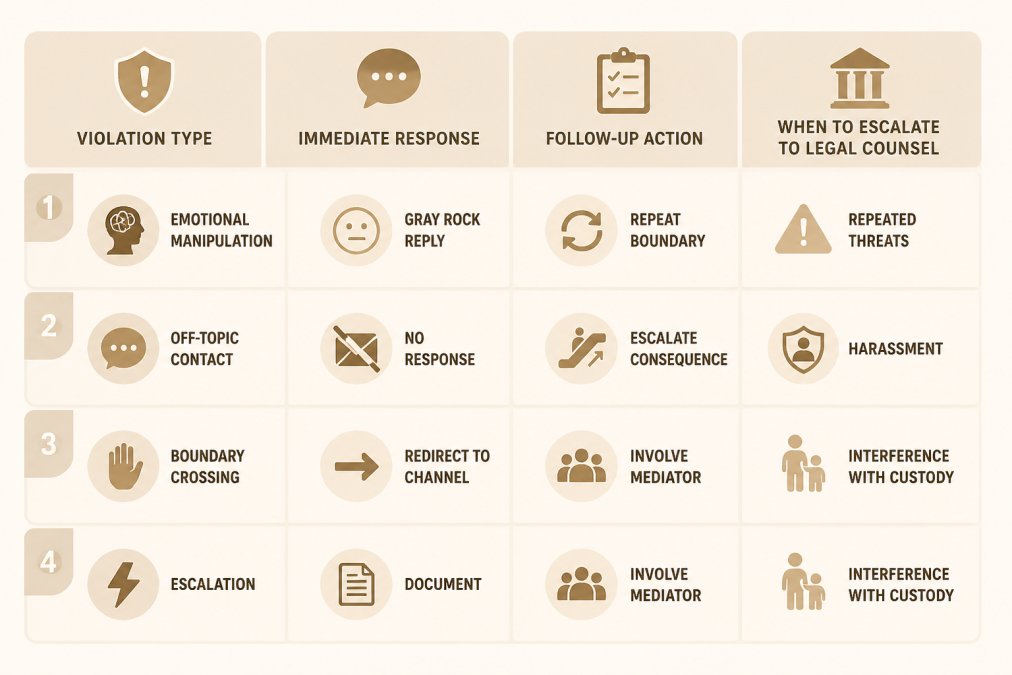
Enforce Your Boundaries Consistently
A boundary without enforcement is a suggestion. Your ex is testing you constantly. The first time you waffle, they know the boundary is negotiable.
Consistency is harder than it sounds. Your ex will cry, threaten, or say you’re hurting the kids. Your own guilt will tempt you to give in. Don’t.
What enforcement looks like:
First violation: Remind them of the boundary.
Second violation: Acknowledge it and state a consequence ("If this continues, I’m moving to email-only communication").
Third violation: Implement the consequence.
Fourth violation and beyond: Escalate (involve a mediator, attorney, or reduce communication further).
This isn’t punishment. It’s cause and effect. Your ex learns that respecting boundaries keeps communication open, and violating them closes it.
Common enforcement mistakes:
Explaining yourself repeatedly. Once you’ve stated the boundary, explaining again gives your ex material to argue with.
Threatening consequences you won’t follow through on. If you say you’ll move to email-only and then keep texting, your boundary means nothing.
Enforcing inconsistently. You can’t let them slide once and then crack down the next time.
Digital Boundaries and Social Media
Your ex can harm you digitally long after the relationship ends. They can share intimate photos, monitor your location, contact your family, or gaslight you publicly.
Digital boundaries are non-negotiable in infidelity recovery.
Immediate actions:
- Change all passwords on email, banking, and social media
- Remove shared access to cloud storage, location services, and calendars
- Delete them from emergency contacts
- Block them on all social media, or set accounts to private
- Review privacy settings on all accounts
- Check what apps have access to your location or data
Ongoing digital boundaries:
- Don’t post about your ex or the affair on social media
- Don’t check their social media
- Don’t respond to messages sent through social media
- If they contact you through a new account after being blocked, don’t engage
- If they’re harassing you digitally, document it and report it
Script for digital boundary violation:
"I’ve noticed you’re trying to contact me through [platform]. I’ve asked you to use [designated channel] for communication. This isn’t it. I’m blocking this account."
Then do it. No further explanation needed.
Resist the temptation to check your ex’s social media. Every post will either trigger you or make you feel worse. You’re not healing by staying digitally connected.
Protect Your Emotional Safety During Recovery
Boundaries protect your body and time. Emotional safety protects your mind and ability to heal.
Betrayal trauma is real. Your nervous system has been dysregulated by infidelity. When you’re in contact with the person who harmed you, that dysregulation continues. Setting boundaries creates space for your nervous system to calm down.
This means:
- You might cry after a boundary-setting conversation. That’s normal.
- You might feel guilty enforcing a boundary. That’s manipulation talking, not reality.
- You might second-guess yourself. Write down why you set the boundary and re-read it.
- You might feel lonely. This is temporary. It’s the discomfort of change.
Protect your emotional safety by building a support system that isn’t your ex: a therapist specializing in betrayal trauma, trusted friends who won’t minimize what happened, support groups for people navigating infidelity and separation, and a structured toolkit for managing the hardest moments.
After the Affair Series provides frameworks and scripts specifically designed for high-conflict situations.
Protecting your emotional safety is not selfish. It’s the foundation for everything else: better co-parenting, clearer thinking, and the ability to move forward. A parent who is emotionally regulated is a better parent.
Setting boundaries with a cheating ex partner is one of the hardest things you’ll do after infidelity. It requires you to be clear when confused, firm when exhausted, and consistent when you want to give up. The frameworks and scripts provided here give you structure when your judgment is clouded by trauma. After the Affair Series is designed specifically for this moment, offering concrete tools to protect your peace and support your children’s wellbeing. Research on betrayal trauma and recovery from the American Psychological Association shows that individuals who establish firm boundaries recover faster and experience fewer long-term symptoms. Take the free 23-point assessment to understand your specific situation and get personalized guidance for your next steps.
Frequently Asked Questions
How do you communicate boundaries to an ex who cheated?
Start with clarity about what behavior you will and won't accept. Use "I" statements and avoid accusations: "I need all communication about the children to happen through email" rather than "You always try to manipulate me." Keep the tone neutral and firm. Deliver boundaries in writing when possible so there's no ambiguity. Be specific about consequences if boundaries are crossed. Repeat the boundary calmly each time it's violated, consistency matters more than emotion. Many people find that written scripts help them stay focused and prevent the ex from derailing the conversation.
What are examples of healthy boundaries after infidelity?
Healthy boundaries include: limiting contact to child-related topics only, requiring 24-hour response time for non-emergency messages, refusing to discuss the affair or past relationship issues, declining social events where your ex will be present, and keeping financial and legal matters separate from personal communication. For co-parenting, establish that drop-offs happen at a neutral location, not your home. Set rules about new partners not being introduced to children without notice. Protect your digital privacy by unfollowing or muting your ex on social media. These boundaries aren't punishment, they're structures that protect your emotional safety and allow you to heal while still managing necessary logistics.
How do you maintain no-contact boundaries with an ex?
No-contact means zero communication except through a documented channel (email, co-parenting app, or lawyer) if you share children. Block your ex on phone, text, and social media. Inform trusted friends and family that you're no-contact so they don't relay messages. If your ex reaches out through other people, respond once in writing: "I'm not available for contact outside of [specified channel]." Stick to it. For co-parenting, use a dedicated app like OurFamilyWizard so all communication is documented and you're not tempted to respond to personal messages. No-contact isn't forever, it's a healing phase that typically lasts 6-12 months, though some people extend it longer. The goal is to break the trauma bond and regain emotional stability.
What should I do if my ex violates a boundary I've set?
First, document the violation with date, time, and details. Respond calmly and in writing if possible: "That's not something we discussed. Going forward, I need you to [restate boundary]." Don't explain or justify, boundary enforcement isn't a negotiation. If the violation continues, escalate: send a formal written warning, involve a mediator, or consult a family law attorney if it involves your children. Keep records of all violations. For serious breaches (threats, harassment, unsafe behavior around children), contact law enforcement. Remember that some exes test boundaries repeatedly, consistency and documentation are your tools. You may need to involve a third party like a parenting coordinator or lawyer if the ex refuses to respect boundaries.
This article was written using GrandRanker