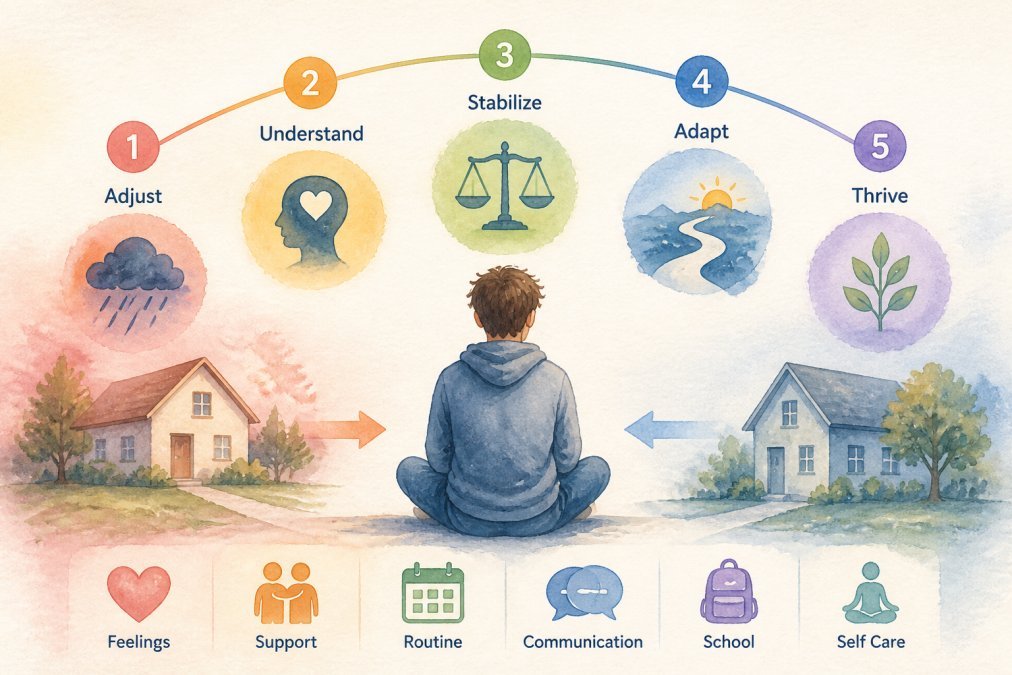
A healthy boundary is a stated action you will take to protect your time, body, or emotional energy, not a demand you place on someone else. Here are boundary examples you can adapt right now, word for word, across home, work, and social settings.
- “I won’t answer work messages after 8 p.m.” (work)
- “I can listen for 20 minutes, then I need a break.” (friends/family)
- “I’m not comfortable discussing my salary. Let’s change topics.” (family/social)
- “I need you to text before stopping by.” (home)
- “I’ll help once, but I can’t make this a regular thing.” (friends)
- “I’m turning my phone on Do Not Disturb after dinner.” (home)
- “I’m not able to lend money right now.” (family)
- “Please don’t comment on my body or my plate.” (social)
Each one names a specific action, not a wish. That distinction, backed by guidance from Simply Psychology, is what separates a boundary that holds up from one that quietly dissolves the first time someone pushes back.
- Key Takeaways
- Examples of Healthy Boundaries by Type
- How to Set and Communicate a Boundary That Actually Holds
- Healthy Boundaries in Relationships: Context Matters
- Signs Your Boundaries Are Missing or Too Blurry
- When to Get Professional Support for Boundary Struggles
- Boundaries After Infidelity: A Staged Approach
- A Personal Note on Practicing Boundaries
- Structured Support for Boundary Work After Betrayal
- FAQ
Key Takeaways
A healthy boundary works because it states an action you control, communicated clearly and enforced consistently, rather than a demand placed on someone else.
| Point | Details |
|---|---|
| Name the action, not the demand | Say “I will step away if you raise your voice,” not “stop yelling.” |
| Use the 4 C’s | Keep boundaries clear, calm, concise, and consistent every time they’re tested. |
| Enforce on the first crossing | Waiting until the fifth violation teaches people the limit isn’t real. |
| Review boundaries regularly | Check in weekly or monthly, since needs and relationships shift over time. |
| Get staged support after betrayal | Aftertheaffair’s boundary resources offer phase-by-phase scripts for infidelity recovery. |
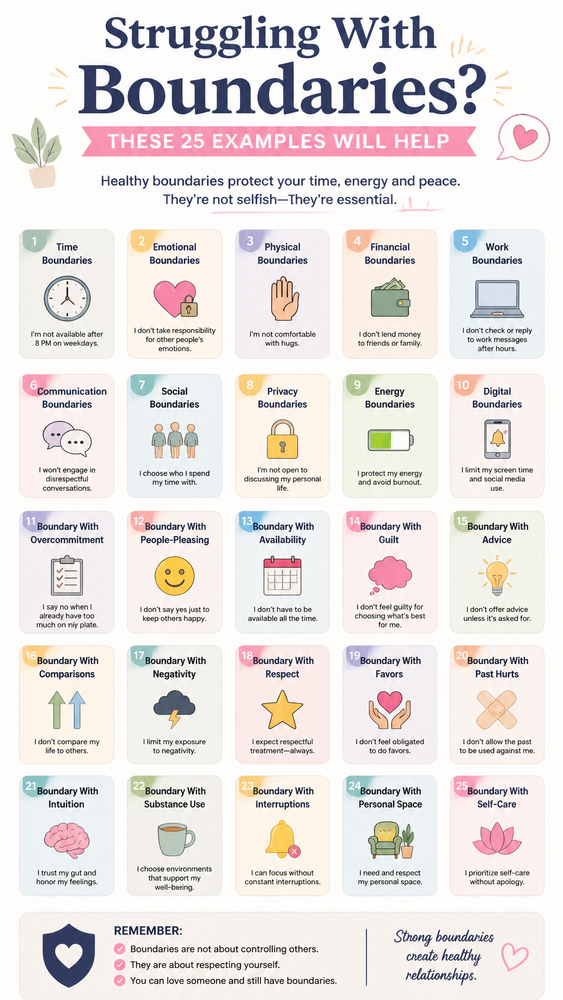
Examples of Healthy Boundaries by Type
Boundaries aren’t one-size-fits-all. The Cleveland Clinic groups them into a handful of categories, and knowing which type you’re dealing with makes it much easier to word the limit and decide what happens if it’s crossed.
1. Physical boundaries
These cover your body, personal space, and privacy. A physical boundary might sound like “I’m not a hugger, but I’d love a handshake” or “Please knock before entering my room.” At work, it can be as simple as “I need my desk area kept clear of shared clutter.”
Enforcement action: if someone repeats unwanted contact, step back physically and restate the limit once, calmly, before ending the interaction.
2. Emotional boundaries
Emotional boundaries protect you from carrying other people’s feelings as if they were your own. Examples include “I care about you, but I can’t be your only support system,” or “I’m not able to process this right now. Can we talk tomorrow?” HelpGuide frames this as refusing to take on emotional labor that isn’t yours to carry.
Enforcement action: end the conversation gently and reschedule it when you have capacity.
3. Time and energy boundaries
These protect your calendar and your bandwidth. “I have 30 minutes for this call.” “I don’t check email on weekends.” “I need two days’ notice for favors.” Time boundaries are some of the easiest to enforce because they’re measurable, which is exactly why Cleveland Clinic recommends stating them as clear windows rather than open-ended availability.
Enforcement action: set a visible timer or state the end time out loud at the start of the interaction.
Understanding the pattern is not the same as breaking it
You Can Explain Why This Happened. Can You Explain Why You’re Still Stuck In It?
Most people in affair recovery can narrate their entire situation with total clarity, the timeline, the triggers, the whole story, and still find themselves back in the same spiral by evening. Insight was never the missing piece. This free assessment shows you exactly where the gap actually is.
Take the Free Affair Recovery Clarity Check →A few honest questions · a scored result · 4 minutes · free
4. Material and financial boundaries
These govern your money, belongings, and property. “I don’t lend cash, but I’m glad to help in another way.” “Please ask before borrowing my car.” “I’m keeping our finances separate for now.” Family settings are where these get tested most, since money requests often arrive wrapped in guilt or urgency.
Enforcement action: give a short, unapologetic no and offer an alternative only if you mean it.
5. Sexual boundaries
These define consent, comfort, and pace in intimate relationships. “I’m not ready for that yet.” “I need us to check in before trying something new.” “No means no, even mid-conversation.” Healthline points out that sexual boundaries need to be revisited over time, not set once and assumed permanent.
Enforcement action: stop the activity immediately and restate the limit without qualifying it.
6. Intellectual boundaries
These protect your right to your own opinions, beliefs, and ideas. “I see this differently, and that’s fine.” “I’d rather not debate religion at dinner.” “Please don’t dismiss my opinion just because it’s different from yours.”
Enforcement action: disengage from the debate rather than defending your position on repeat.
7. Digital and technology boundaries
These are newer but just as necessary. “I don’t respond to texts after 9 p.m.” “Please don’t tag me in posts without asking.” “I’m turning off read receipts.” Healthline specifically recommends technical tools like Do Not Disturb settings and passworded devices as backup enforcement when verbal limits get ignored.
Enforcement action: mute notifications or block the specific channel being used to cross the line.

How to Set and Communicate a Boundary That Actually Holds
Setting personal boundaries follows a fairly predictable sequence, and skipping steps is usually why a boundary falls apart within a week. Simply Psychology outlines a version of this process that maps cleanly onto five stages:
- Identify what’s draining you or making you uncomfortable, specifically, not vaguely.
- Clarify what you actually need instead. “Less contact” isn’t specific; “no calls after 9 p.m.” is.
- Communicate the boundary directly, before resentment builds up.
- Enforce it the first time it’s tested, not the fifth.
- Review it periodically. Needs shift, and a boundary that made sense last year might need adjusting now.
Personal boundaries in communication tend to succeed or fail based on how they’re phrased. That’s where the 4 C’s checklist helps:
- Clear. “I need quiet after 9 p.m.” beats “I need some space sometimes.”
- Calm. State it evenly. A boundary delivered mid-anger reads as a punishment, not a limit.
- Concise. One sentence, maybe two. Over-explaining invites negotiation.
- Consistent. The same boundary, held the same way, every time it’s tested.
A few sample scripts worth memorizing:
- “I’m not available to talk about this tonight. Let’s revisit it tomorrow.”
- “I can help with one task, not all three.”
- “If you raise your voice, I’m going to step away.”
Pro Tip: Write your boundary down before the conversation happens. People who rehearse the exact wording ahead of time are far less likely to soften it under pressure.
When a boundary gets crossed anyway, you have three realistic options, in escalating order:
- Pause the conversation and revisit it later, calmly.
- Apply a stated consequence, such as ending a call or leaving a gathering early.
- Limit future contact if the pattern continues despite repeated, clear communication.
Follow-through is what makes a boundary real. As Simply Psychology puts it, a boundary that isn’t enforced becomes a suggestion, and suggestions get ignored.
Healthy Boundaries in Relationships: Context Matters
The same boundary type looks different depending on who’s on the other side of it. Healthy boundaries in relationships with a partner, a parent, and a coworker require different tones, even when the underlying need is identical.
With a partner: “I need alone time after work before we talk about the day.” “I won’t check your phone, and I ask you not to check mine.” “Let’s agree on a cooling-off signal during arguments.” Don’t: assume your partner will guess what you need. Do: say it plainly, before frustration builds.
With parents or children: “I love you, but I’m not discussing my parenting choices at dinner.” For younger kids: “You can be upset, but you may not hit. Let’s use words.” Don’t over-explain your reasoning to a child who’s testing limits; a short, repeated line works better than a paragraph.
With friends: “I can’t be your only support during this. Let’s find you additional help.” “I’m skipping the group trip this year, no hard feelings.” Don’t: agree now and cancel later out of guilt. Do: give the honest answer up front.
With coworkers: “I’m not able to take on this project without adjusting my other deadlines.” “I don’t discuss personal matters during meetings.” A common pitfall here is vague language like “I’m pretty busy,” which invites more asks rather than fewer.
With neighbors: “Please call before dropping by.” “I’d rather we settle the fence issue through email so we both have a record.” Keep it brief. A rambling explanation signals that the boundary is negotiable when it isn’t.
The corrective move, across every context, is the same: if you catch yourself over-explaining, stop mid-sentence and restate the boundary in one line instead.
Willpower was never the problem
You’ve Said No Contact Before. What Made It Fail Last Time?
It usually isn’t willpower. It’s a loophole nobody accounted for, a second number, a mutual friend, a platform nobody thought to block. This free audit maps all 47 known workarounds so the boundary holds on its own, without relying on you to be strong enough every single time.
Get the Free Loophole Elimination Matrix →47-point audit · instant download · free
Signs Your Boundaries Are Missing or Too Blurry
Chronic resentment toward people you keep saying yes to is one of the clearest signs a boundary is missing entirely. Other red flags include feeling drained after specific interactions, agreeing to things you immediately regret, and losing track of where your responsibilities end and someone else’s begin.
- You say yes and feel resentful within minutes.
- You rehearse conversations in your head but never have them out loud.
- You feel guilty for having needs at all.
- You find yourself managing other people’s emotions more than your own.
- You avoid someone rather than telling them what’s bothering you.
A healthy response to an unreasonable ask sounds like “I can’t take that on right now.” An unhealthy one sounds like agreeing while internally seething, then venting to someone else about it later. Developing and holding boundaries consistently is linked to lower stress and higher life satisfaction, according to Mayo Clinic, which also recommends reviewing your boundaries on a weekly or monthly basis rather than setting them once and forgetting them.
When to Get Professional Support for Boundary Struggles
Self-help scripts work for most everyday situations, but some patterns call for outside support. Consider reaching out to a professional when:
- The same boundary gets violated repeatedly despite clear, consistent communication.
- There’s a safety concern, physical or otherwise.
- Old trauma gets triggered every time you try to set a limit.
- You’ve tried enforcing a boundary multiple times and it never sticks.
A therapist can help untangle why a boundary feels impossible to hold. A couples counselor works well when both partners need a shared framework. A mediator suits ongoing conflicts, like co-parenting disputes, where structure matters more than emotional processing. Before a first session, write down two or three specific incidents. Specifics give a therapist far more to work with than “I have trouble with boundaries.”
Boundaries After Infidelity: A Staged Approach
Boundary work after betrayal follows a different rhythm than everyday boundary-setting, because trust itself is the thing being rebuilt. Clinical guidance suggests staging boundaries in phases rather than trying to fix everything at once, which reduces the risk of retraumatization while still creating forward motion, according to Mayo Clinic.
Stage one, survival: “I need to know where you are for the next few weeks.” “I’m not ready to discuss details tonight.” These are short-term, safety-focused limits.
Stage two, transparency: “I need access to shared accounts during this period.” “Please tell me before contact happens with anyone connected to the affair.” This stage is about rebuilding predictability.
Stage three, rebuilding: “Let’s agree on how we’ll handle triggers when they come up.” “I need us to check in weekly about how this is going.” Boundaries here shift from protective to collaborative.
Aftertheaffair’s guide on boundaries that actually work after infidelity walks through sample scripts for accountability conversations in more depth, and the piece on how boundaries help prevent relapse explains why this staged approach matters more than trying to restore full trust in a single conversation.
A Personal Note on Practicing Boundaries
Setting a boundary rarely feels good the first few times. Guilt shows up, so does the fear of disappointing someone you care about, and that discomfort is normal, not a sign you’re doing it wrong. Boundaries are a practiced skill, not a personality trait some people are simply born with.
Start small. Pick one low-stakes boundary this week and hold it once. Review how it went, adjust the wording if needed, and try again. Years spent studying recovery and relational repair have made one thing clear: consistency beats perfection, every time.
Structured Support for Boundary Work After Betrayal
Scripts and staging help, but rebuilding trust after infidelity usually takes more than a checklist you read once. Aftertheaffair’s series was built specifically for that gap between generic advice and the structured, staged support couples and individuals actually need after betrayal.
The 7-Step Infidelity Recovery Checklist walks through exactly where boundary-setting fits into early recovery, with a sequence you can follow instead of guessing at what comes next. If you need exact phrasing for a hard conversation, the Emergency Scripts Cheat Sheet gives you one-line responses for high-emotion moments when the right words won’t come on their own. For readers already deep in the accountability phase, The Partner Accountability Conversation Guide provides a structured format for the conversations that boundary work eventually leads to. Start with the checklist if you’re early in recovery and need a sense of sequence.
Reading this won’t change tomorrow’s message
You Know the Tactic Now. Do You Know What You’ll Actually Do When It Lands?
Understanding grey rock is not the same as doing it at 9pm when your phone buzzes. Most parents can explain the theory perfectly and still bite the bait every single time. The gap between the two is exactly what the free self-check measures.
Get Your Ex Out of Your Head ->5 scenarios, scored result, 4 minutes free
Sources
- Mayo Clinic Q&A: Setting boundaries for your well-being
- Setting healthy boundaries in relationships | HelpGuide
- Setting Boundaries: What Psychologists Actually Mean and How to Do It | Simply Psychology
- How To Set Boundaries in Healthy Ways
- Setting boundaries: How to do it, examples, and scripts | Healthline
This article is general information, not a substitute for advice from a qualified doctor. Consult a qualified healthcare professional about your own circumstances before acting on anything here.
FAQ
What are the 7 types of boundaries?
The seven commonly cited types are physical, emotional, time and energy, material and financial, sexual, intellectual, and digital or technology boundaries, each covering a different area of personal protection.
What are the 4 C’s of setting healthy boundaries?
The 4 C’s are clear, calm, concise, and consistent, a checklist for phrasing a boundary so it’s easy to understand and hard to argue with.
What are examples of unhealthy boundaries?
Unhealthy boundaries include agreeing to things you resent, oversharing personal details too quickly, tolerating repeated disrespect without addressing it, or taking full responsibility for someone else’s emotions.
What are the 5 normal boundaries in a relationship?
Most relationship guidance points to physical, emotional, time, financial, and sexual boundaries as the core areas partners need to define, with digital boundaries increasingly treated as a sixth.
How do healthy boundaries help after infidelity?
Staged boundaries around transparency and contact create predictability during a chaotic period, and Aftertheaffair’s staged boundary guide breaks that process down phase by phase.
Recommended
- Mastering Your Boundaries: Essential Strategies for Lasting Empowerment
- Boundaries That Actually Work – After the Affair Series
- Why Boundaries Prevent Relapse After an Affair
- The Role of Boundaries Post-Affair in Real Recovery