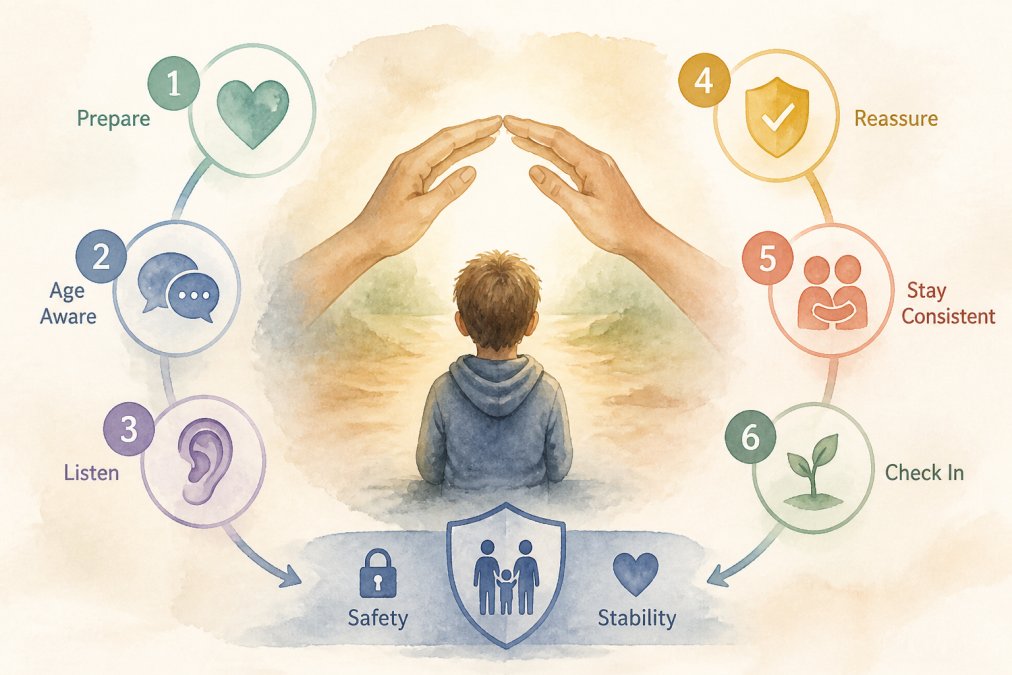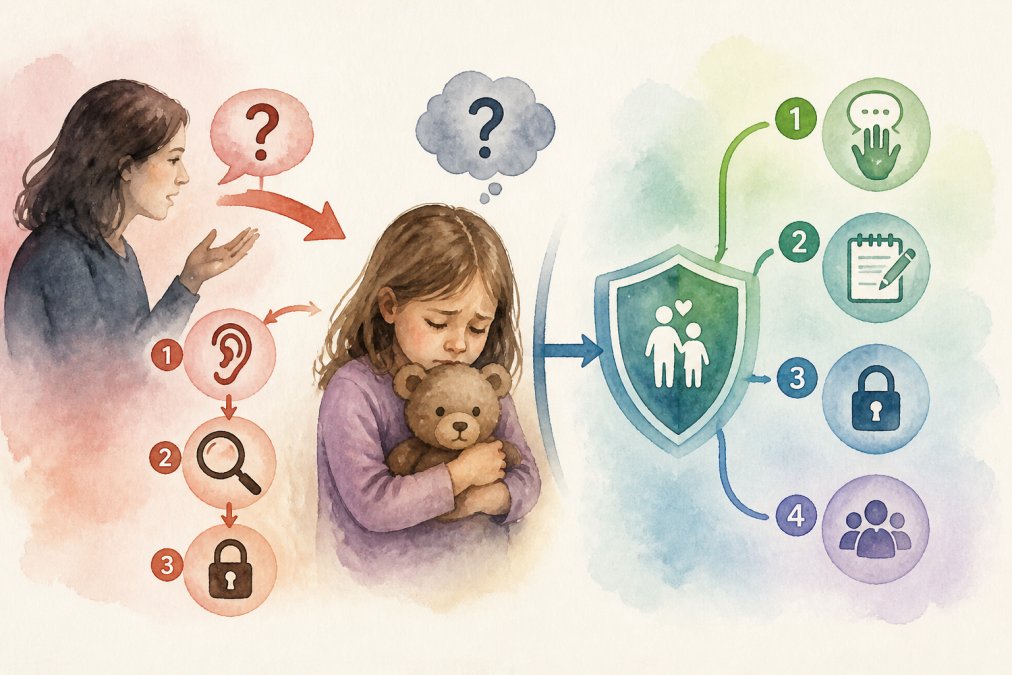
Table of Contents
- Recognize When Information Gathering Becomes a Problem
- Co-Parenting Scripts for High-Conflict Situations
- What to Tell Kids When Ex Asks Questions
- Documenting Co-Parenting Harassment and Evidence
- Set Boundaries and Establish Legal Protections
- Manage Your Emotional Response and Self-Regulation
- Conclusion
Last Updated: August 22, 2026
Recognize When Information Gathering Becomes a Problem
Your ex asks your child seemingly innocent questions about your dating life, work schedule, or finances. Your child mentions that the other parent asked where you were last weekend or who you were with. On the surface, it might feel like normal curiosity, but when it becomes a pattern, it crosses into manipulation and damages your child’s sense of safety.
A parent asking "How was school today?" is different from systematically extracting details about your personal life through a child who doesn’t understand they’re being used as an intelligence source. When one parent uses a child to gather information, it destabilizes the child’s trust in both parents and creates anxiety about what they say and to whom.
Signs of ‘Information Gathering’ vs. Normal Curiosity
Normal parental curiosity focuses on the child’s own experience: "What did you do in class?" "Did you have fun at the park?" Problematic information gathering redirects focus away from the child and toward extracting intelligence about the other parent.
Watch for these specific patterns:
The child reports being asked where you were, who you were with, details about your romantic relationships or finances, or questions phrased as "Don’t tell your mom/dad, but…" The child becomes guarded about what they share with you, asks permission before mentioning activities from your household, shows anxiety when asked about time at the other parent’s house, or reports feeling caught in the middle. Questions escalate in frequency or specificity over time, intensify during conflict periods, and the child seems rehearsed or repeats exact phrasing.
Normal curiosity is occasional, child-centered, and doesn’t create anxiety. Information gathering is systematic, parent-centered, and leaves the child feeling like a messenger or spy.
How This Behavior Affects Children
Using a child as an information source creates measurable psychological harm (peer-reviewed research). Children develop "loyalty conflicts", they feel torn between protecting a parent and maintaining honesty with the other (peer-reviewed research). This conflict creates chronic low-level anxiety.
The child learns that their words have consequences beyond normal conversation. They become hypervigilant about what they say and to whom, eroding their natural openness and creating distance in your relationship. They internalize a troubling message: "Your private life with one parent is material for the other parent to analyze." This blurs healthy boundaries and affects their ability to maintain boundaries in other relationships as they grow older.
Co-Parenting Scripts for High-Conflict Situations
When your ex uses your child to gather information, your response must protect your child from further manipulation, set a clear boundary with your ex, and avoid escalating conflict. Specific, practiced scripts accomplish this by giving you a tested response so you don’t improvise in the moment and accidentally teach your child it’s okay to report back.
Scripts to Teach Your Child
Your child needs language to deflect probing questions without lying, feeling disloyal, or creating conflict.
For children ages 6-9:
Teach your child to say:
- "I don’t remember details like that. I just know mom/dad was busy."
- "That’s grown-up stuff. I like talking about [my soccer game / my friends / my school project] instead."
- "I’m not really sure. Can we talk about something else?"
Keep answers vague and short. Young children shouldn’t carry the burden of protecting your privacy, but they can learn that some questions don’t need detailed answers.
For children ages 10-13:
Children this age can understand privacy and use more sophisticated deflection:
- "I don’t think that’s really my business to share."
- "I’m not comfortable talking about mom/dad’s personal stuff."
- "That seems like something you should ask mom/dad directly if you want to know."
Practice these scripts in a calm moment. Frame it as "Sometimes people ask questions about grown-up stuff, and you can say you’re not comfortable answering."
For teenagers:
Be direct:
- "I’ve noticed you’re asking a lot of questions about my life. I’m not going to use you as a messenger between us, and I don’t want you to feel like you have to report back. If you want to know something about me, you can ask me directly."
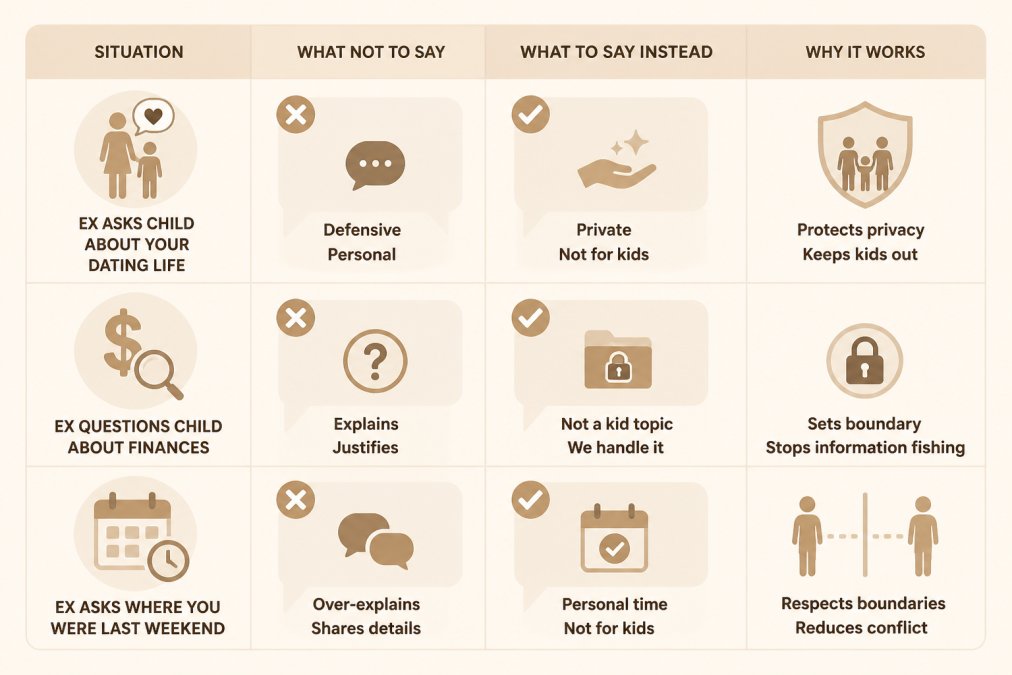
Scripts for Direct Communication With Your Ex
First boundary-setting message:
"I’ve noticed [child’s name] is being asked detailed questions about my personal life, schedule, and finances. If you have questions about me, please ask me directly. I’m happy to discuss parenting-related logistics or our child’s wellbeing, but I need to ask that you keep conversations with [child] focused on their own experience and activities."
If the behavior continues:
"I’ve asked you to stop asking [child] questions about my personal life. This is putting them in an uncomfortable position. I’m documenting these incidents, and if this continues, I’ll need to address it with my attorney and potentially request a modification to our custody agreement." custody assessment processes.
For co-parenting app communication:
Use the app for logistics and child-related matters only. When boundary violations occur, document them: "On [date], [child] reported being asked [specific question]. Please keep conversations with our child focused on their own activities and wellbeing."
What to Tell Kids When Ex Asks Questions
Your child will report back. How you respond in that moment sets the tone for whether your child continues to feel comfortable sharing with you or starts hiding information to avoid conflict.
Age-Appropriate Responses by Child Development Stage
Ages 5-7:
"Thank you for telling me that. Some questions are about grown-up stuff, and it’s okay that your other parent asked. But you don’t need to worry about answering questions like that. If they ask again, you can say ‘I don’t know’ or ‘I want to talk about something else.’ You’re not in trouble."
The child needs reassurance that reporting doesn’t mean they did something wrong.
Ages 8-11:
Take the free 23-point assessment →
"I appreciate you telling me what happened. If it happens again, you can say ‘I’m not comfortable talking about that’ or ‘You should ask my mom/dad.’ You’re allowed to have boundaries with anyone, including parents. I’m not mad at you or at them."
This validates the child’s experience while teaching them they have agency.
Ages 12+:
"I know your other parent asked you about [specific topic]. When a parent asks a child questions about the other parent’s personal life, that’s called using a child as a messenger. It’s not okay, and it’s not your job. You can tell them directly: ‘I’m not comfortable being asked about mom/dad’s personal stuff. If you want to know something, ask them directly.’ I’m not upset with you. I’m asking you to protect your own boundaries."
Naming the behavior helps the teenager understand it’s not normal co-parenting.
Documenting Co-Parenting Harassment and Evidence
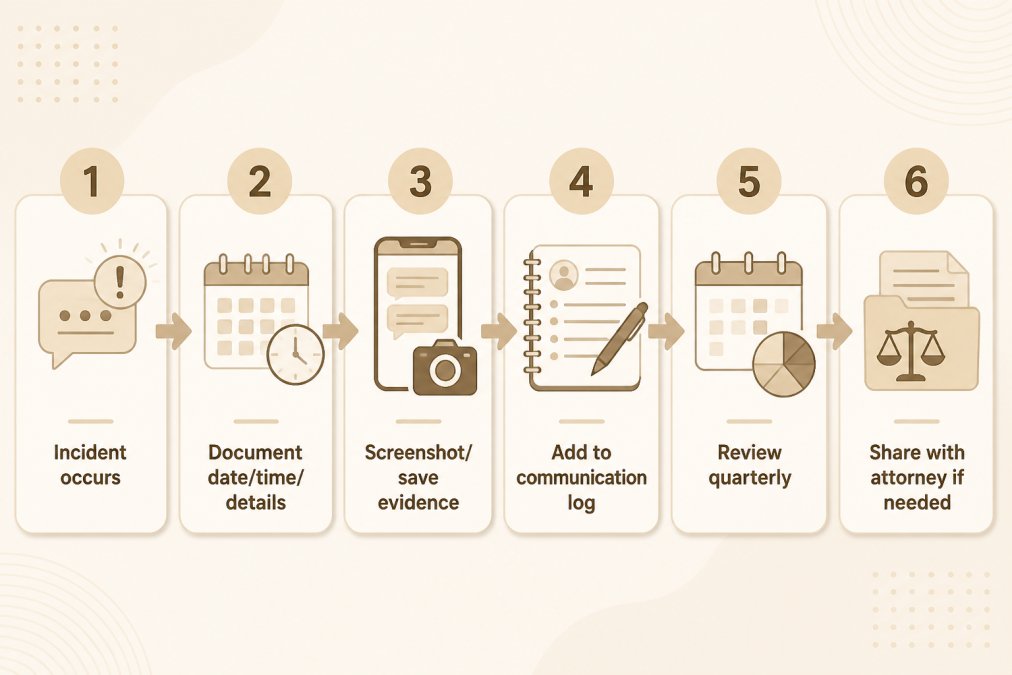
If information gathering is part of a larger pattern of harassment or control, you need a legal record. Documentation protects you if behavior escalates, provides evidence for custody modification, and demonstrates to your ex that you’re taking the situation seriously.
What Constitutes Admissible Evidence
Courts care about specific, dated, and corroborated evidence. Admissible evidence includes direct communication where the ex asks the child questions, a communication log documenting when the child reported being asked questions with dates, screenshots of messages with sender/recipient information, observations from teachers or therapists about the child’s anxiety, and records from a parenting coordinator.
Evidence that won’t help includes your interpretation of motives, hearsay from friends or family, emotional statements without specific facts, and screenshots without context.
How to Create a Communication Log
A communication log is a simple, dated record of incidents. It’s objective and admissible in court.
Format:
| Date | Time | Incident | Child’s Exact Words (if applicable) | Your Response |
|---|---|---|---|---|
| 3/15/2026 | Evening | Child reported being asked where you were Saturday night | "Dad asked me where mom was and who she was with" | Explained that some questions are about grown-up stuff and reassured child |
| 3/22/2026 | Afternoon | Child mentioned repeated questions about your finances | "Mom kept asking if you have a new job and if you make more money now" | Set boundary with child about what they need to answer |
| 4/2/2026 | Morning | Child expressed anxiety about what to tell the other parent | "I don’t want to get you in trouble, so I don’t know what to say" | Reassured child they’re not responsible for managing parent communication |
Keep this log in a secure location and update it as new incidents occur.
Set Boundaries and Establish Legal Protections
Documentation creates a record. Boundaries require action. You need to communicate the boundary to your ex, and if behavior continues, you may need legal intervention.
Modifying Your Custody Agreement
If information gathering is part of a larger pattern of harassment or parental alienation, you can petition the court to modify your custody agreement to include specific communication guidelines.
Language you might request:
"Each parent agrees to refrain from asking the minor child(ren) questions about the other parent’s personal life, romantic relationships, finances, employment, or activities unrelated to the child’s care and welfare. Each parent agrees to direct any questions about the other parent directly to that parent rather than through the child."
When to Involve a Family Law Attorney
Consult with a family law attorney if the information gathering is part of a documented pattern of parental alienation, your child shows signs of emotional distress related to the behavior, the ex has escalated to asking about financial accounts or passwords, you’ve set a boundary and the ex has ignored it repeatedly, or you want to modify the custody agreement to include communication guidelines.
According to the American Academy of Pediatrics, children exposed to ongoing parental conflict and manipulation show measurable increases in anxiety and behavioral problems. An attorney can help you understand whether the situation warrants legal intervention.
Manage Your Emotional Response and Self-Regulation
You can have perfect scripts and flawless documentation, but if you’re dysregulated when your child reports what happened, your child will absorb your panic or anger and stop reporting incidents.
Self-regulation isn’t about being emotionless. It’s about managing your nervous system so you can respond thoughtfully rather than react defensively.
When your child tells you the ex asked probing questions, your nervous system activates. Your instinct is to interrogate your child or immediately call your ex. Both teach your child that reporting is dangerous.
Instead, practice this sequence:
- Pause. Take three slow breaths before responding.
- Acknowledge. "Thank you for telling me. I appreciate that you felt comfortable sharing this."
- Reassure. "You’re not in trouble. You didn’t do anything wrong."
- Normalize. "Sometimes people ask questions they shouldn’t. That’s not your responsibility to manage."
- Redirect. "Let’s talk about something else now."
If you need to process your anger or fear, do it away from your child. Your child needs to see that you’re handling this calmly and that their safety is in capable hands.
Conclusion
When your ex uses kids to gather information, you’re facing a boundary violation that affects your child’s sense of safety and your ability to co-parent effectively. The tools that work are specific: scripts your child can use, documentation you can build, boundaries you can set, and self-regulation you can practice.
After the Affair Series provides a structured framework for this situation, from age-appropriate scripts to communication logs to legal language you can use with an attorney. The platform includes 50+ scripts for high-conflict co-parenting, a free 23-point assessment to evaluate your specific situation, and step-by-step guidance on when to involve legal counsel.
Take the free 23-point assessment and get immediate clarity on your situation.
Frequently Asked Questions
What is considered co-parenting harassment when an ex asks children questions?
Co-parenting harassment includes repeated, targeted questioning designed to extract personal information, monitor your activities, or undermine your authority. It differs from normal curiosity when the ex uses leading questions, pressures the child to report back, or reacts negatively if the child doesn't provide information. Courts recognize this as a form of parental alienation when it causes emotional distress or damages the parent-child relationship. Documentation of patterns, not isolated incidents, is what establishes harassment in a legal context.
How do I stop my ex from asking my child about my personal life?
Start by teaching your child age-appropriate responses like 'That's between Mom and Dad' or 'I'm not comfortable talking about that.' Simultaneously, communicate directly with your ex using neutral language: 'I've noticed questions about my personal life are coming up during exchanges. Let's keep conversations focused on the kids' schedules and needs.' If the behavior continues, document each instance with dates and details, then involve your family law attorney. A custody agreement modification or court order can explicitly restrict this behavior and include consequences for violations.
What evidence should I collect to prove my ex is using kids to gather information?
Collect screenshots of text messages, emails, and co-parenting app messages showing the pattern of questions. Create a communication log with dates, times, what was asked, and your child's reaction. Ask your child (age-appropriately) to describe what was asked and how it made them feel, this demonstrates impact. If possible, have a third party (teacher, therapist, family member) document observations of the child's distress. Text message histories and email correspondence are generally admissible in court; screen captures with metadata are stronger than typed summaries.
Will using these scripts make my ex think I'm coaching my child or manipulating them?
Scripts teach children healthy boundaries, not lies. Phrases like 'That's a question for Mom/Dad' or 'I'm not comfortable talking about that' are legitimate communication skills, not coaching. Courts distinguish between teaching privacy boundaries and coaching children to lie or reject a parent. Your documentation, showing the ex initiated inappropriate questions, protects you legally. If your ex claims coaching, your evidence log demonstrates you're responding to their behavior, not initiating it. Parallel parenting (minimal direct communication) reduces this risk further.
This article was written using GrandRanker