Last Updated: August 21, 2026
- Why Emotional Distance Matters After a Toxic Relationship
- Understanding Trauma Bonding and Emotional Addiction
- The No Contact Rule for Toxic Relationships
- Using the Gray Rock Method for Ex Partners
- Setting Boundaries With Your Ex Partner Effectively
- Managing Emotional Triggers and Rumination
- Navigating Co-Parenting or Shared Environments
- When Professional Support Becomes Essential
- Frequently Asked Questions
Why Emotional Distance Matters After a Toxic Relationship

Maintaining emotional distance from a toxic ex is one of the hardest things you’ll do after a breakup, especially when trauma bonding has created deep attachment patterns. The pull to stay connected through checking their social media, initiating contact, or replaying old memories feels almost involuntary. But emotional distance is not about coldness or cruelty, it’s about protecting your nervous system from further harm.
When you’ve been in a toxic relationship, your brain has learned to seek validation from someone who caused you pain. That’s how trauma bonding works. The intermittent reinforcement, moments of warmth followed by rejection or cruelty, creates a cycle neurologically similar to addiction (peer-reviewed research). Breaking that cycle requires deliberate, sustained emotional distance.
Without it, you stay in hypervigilance, monitoring their behavior and hoping for change. This keeps your nervous system activated and prevents healing. Emotional distance gives you the space to rebuild your sense of self and move forward. According to research on attachment and trauma recovery from the American Psychological Association, individuals who maintain clear emotional boundaries after toxic relationships show significantly better mental health outcomes.
Understanding Trauma Bonding and Emotional Addiction
Trauma bonding occurs when you form an attachment to someone who alternates between kindness and harm. Your brain becomes conditioned to seek the “good” moments, overlooking the damage. This creates an emotional addiction where you crave the connection despite knowing it’s harmful.
The cycle works like this: tension builds, an incident occurs, reconciliation happens with promises and affection, then calm before the cycle repeats. Each reconciliation releases dopamine, the same neurotransmitter involved in substance addiction. Over time, you become neurologically dependent on the relationship.
Common signs include obsessive thinking about your ex, intense fear of losing them, justifying their behavior, and feeling unable to leave. If you find yourself making excuses for their actions or believing you can “fix” them, trauma bonding is at work.
The path forward requires understanding that this attachment is a symptom of the abuse, not proof that the relationship was valuable. Emotional distance is the antidote. By limiting contact and starving the trauma bond of the intermittent reinforcement it needs, you gradually rewire your nervous system to seek safety elsewhere.
The No Contact Rule for Toxic Relationships
The no contact rule is the most effective framework for maintaining emotional distance from a toxic ex. It means complete cessation of all communication, no texts, calls, emails, social media contact, or indirect contact through mutual friends. No exceptions.
This isn’t punishment; it’s medicine. No contact gives your nervous system the consistent safety it needs to heal. Every time you break no contact, you reset the healing timeline and reinforce the trauma bond.
Real no contact means:
- No direct communication of any kind
- No checking their social media accounts
- No asking mutual friends about them
- No “accidental” run-ins
- No responding if they reach out (unless children are involved, in which case use structured communication tools)
Research is clear: people who maintain strict no contact recover faster and show better long-term emotional stability than those who maintain any form of contact. The first 30 days are hardest, but by day 90, most people report a significant shift in how they think about their ex.
Set a specific no contact start date and tell someone you trust. Many people find it helpful to write down their reasons for no contact and read that list when tempted to break it.
Using the Gray Rock Method for Ex Partners
The gray rock method is a communication technique used when no contact isn’t possible, typically in co-parenting situations or shared professional environments. It involves becoming as uninteresting as a gray rock: boring, unresponsive to emotional triggers, and offering nothing that would reward continued contact.
The goal is to eliminate the payoff your ex gets from interacting with you. If they contact you seeking a reaction and you respond with bland indifference, they eventually stop trying. You’re no longer emotionally available, and emotional availability is what they’re after.
How to Implement Gray Rock in Practice
Step 1: Keep responses brief and factual. Answer only what’s asked. If they ask about pickup time, you say “4 PM on Friday.”
Step 2: Use neutral language. Avoid words that signal emotion. Instead of “I’m sorry you feel that way,” say “Understood. I’ll handle that.”
Step 3: Don’t answer loaded questions. If they ask personal questions, respond with: “That’s not relevant to our arrangement.” If they push, repeat the same response.
Step 4: Document everything in writing. Use email or co-parenting apps instead of phone calls. This creates a paper trail and removes real-time emotional intensity.
Step 5: Maintain consistency. If you’re gray rock 90% of the time but occasionally engage emotionally, you’ve reinforced that persistence pays off. Your ex will keep pushing.
The gray rock method requires emotional discipline. You’ll feel like you’re being cold. You’re not. You’re protecting yourself and your children from continued emotional manipulation.
Setting Boundaries With Your Ex Partner Effectively
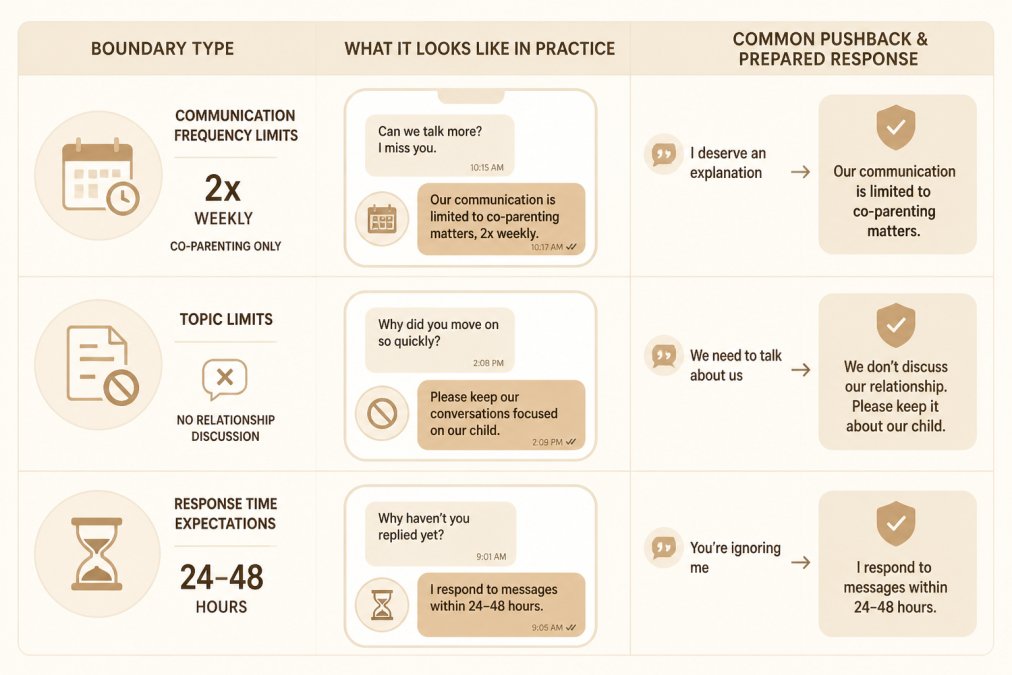
Boundaries are the framework that makes emotional distance possible. A boundary is a limit you set on what behavior you will and won’t accept, with a stated consequence. “I need you to stop calling after 9 PM” is a request. “I will not answer calls after 9 PM, and if you continue, I will block your number” is a boundary. find clarity after a breakup.
Effective boundaries with a toxic ex include:
- No discussions about the relationship or “what went wrong”
- No contact outside agreed-upon times or channels
- No involvement in your personal life or new relationships
- No discussions about your mental health or emotional state
- No attempts to reconnect through mutual friends or family
The hardest part is enforcing boundaries. Your ex will test them with statements like “But we need to talk about this” or “You’re being unreasonable.” The boundary stands regardless. When your ex violates a boundary, follow through on the consequence. Consistency is everything.
One common mistake is setting a boundary you don’t intend to enforce. If you say “I won’t answer texts after 9 PM” but then answer at 10 PM because they’re upset, you’ve taught them your boundary is negotiable. Only set boundaries you’re willing to maintain consistently.
Managing Emotional Triggers and Rumination
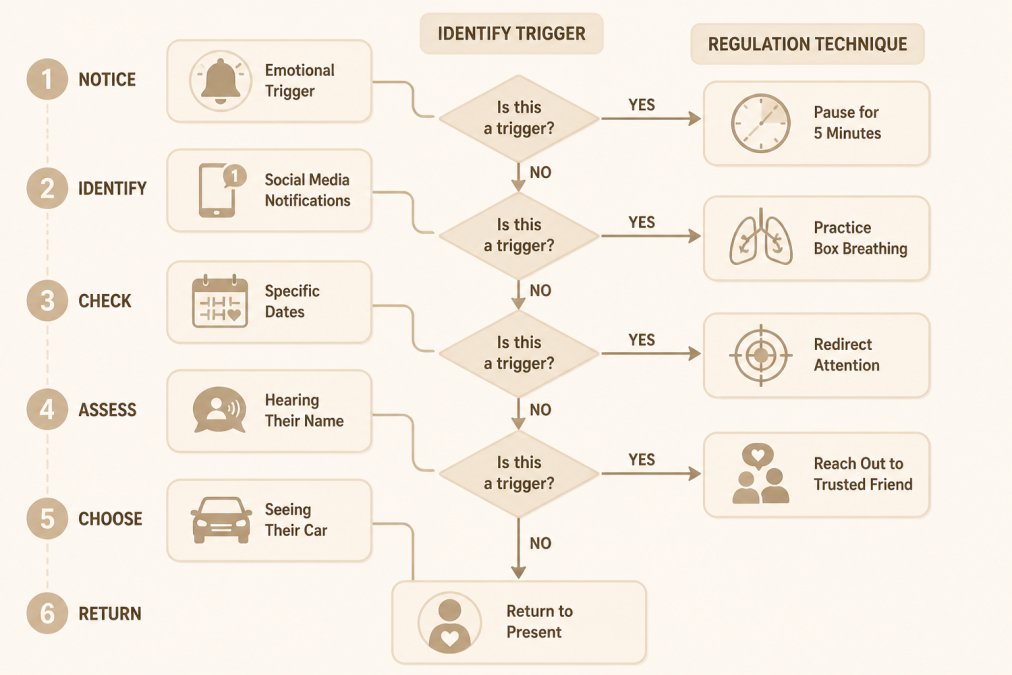
Emotional triggers are stimuli that activate your trauma response: a song you listened to together, their birthday, a location you frequented, or seeing their name. When triggered, your nervous system floods with stress hormones, and you ruminate, replaying conversations and analyzing their behavior.
Rumination feels productive but it’s actually a symptom of unresolved trauma. Your brain is trying to make sense of something that doesn’t make sense: how someone you loved could hurt you repeatedly.
Common triggers include dates, locations, sensory cues, social media, and indirect contact. Once you identify triggers, you have three options: avoid them, prepare for them, or develop a regulation technique.
Avoidance works best for the first 6-12 months. Unfollow or mute their social media accounts. Don’t drive past places you went together. Ask friends not to update you about them.
Take the free 23-point assessment →
For unavoidable triggers, develop a regulation protocol. When you feel activation (racing heart, intrusive thoughts, urge to contact them), pause and execute:
The 5-4-3-2-1 grounding technique: Name 5 things you see, 4 you can touch, 3 you hear, 2 you smell, 1 you taste. This anchors you in the present moment.
Box breathing: Breathe in for 4 counts, hold for 4, exhale for 4, hold for 4. Repeat 5 times. This activates your parasympathetic nervous system.
The urge surf: When you have the urge to contact them, notice it without acting. Observe it like a wave, it rises, peaks, and falls. Most urges pass within 10-15 minutes if you don’t act.
Somatic Techniques for Regulating Your Nervous System
Somatic healing works with your body’s nervous system directly. After toxic relationships, your body holds trauma and tension. Somatic techniques help discharge this stored activation.
Progressive muscle relaxation: Systematically tense and release muscle groups from your toes to your head. This teaches your body what relaxation feels like.
Cold water exposure: Splash cold water on your face or hold ice for 30 seconds. This triggers the vagal brake, a parasympathetic response that calms your nervous system.
Bilateral stimulation: Tap your knees alternately while thinking about the trigger. This helps process traumatic memories without intense exposure.
Shaking or TRE (Trauma Release Exercises): Allow yourself to shake, bounce, or move naturally. This discharges the freeze response that trauma creates.
These techniques aren’t replacements for therapy, but they give you tools to use when triggered. Consistent somatic practice reduces both the frequency and intensity of triggers over time.
Navigating Co-Parenting or Shared Environments
If you have children with your ex or share a professional environment, complete no contact isn’t possible. This is where emotional distance becomes even more critical.
The goal is to separate the parenting relationship from the romantic relationship. You’re co-parents because you have children who need both parents. That’s the only frame.
Structured communication is essential. Use a co-parenting app or email for all communication. Keep all discussions focused on logistics: pickup times, school events, health information, expenses. Do not discuss the relationship, your feelings, or anything personal. If they try to pull you into personal conversation, redirect: “That’s not relevant to co-parenting. Let’s focus on the kids’ schedule.”
If you share a professional environment, apply the same principles. Cordial but distant. Professional communication only. You’re colleagues, not friends.
The hardest part is managing your own emotional response when you see them. You’ll feel the pull to engage and reconnect. That’s the trauma bond talking. Your job is to notice that pull and not act on it.
Co-parenting with a toxic ex is possible, but it requires treating them like a business partner, not a person you have history with. The more you can compartmentalize the relationship, the easier it becomes.
When Professional Support Becomes Essential
Some people can maintain emotional distance through self-directed work. Many cannot. If you’re struggling with intrusive thoughts, panic attacks, inability to sleep, or persistent urges to contact your ex after several months, professional support is necessary.
Therapy is not a sign of failure. It’s a tool. Specifically, seek a therapist trained in trauma, attachment, or complex PTSD. They can help you understand the neurobiological basis of your struggle and provide evidence-based interventions like EMDR, somatic experiencing, or internal family systems.
A therapist can help you distinguish between healthy grief (which fades over time) and unresolved trauma (which intensifies without intervention). According to the National Institute of Mental Health guidelines on trauma recovery, professional treatment significantly accelerates healing from relationship trauma and reduces the risk of recurring patterns in future relationships.
If you have children, family therapy or co-parenting counseling can help establish sustainable communication patterns. Support groups, whether in-person or online, also help by reducing shame and providing practical strategies from others who’ve walked the same path.
Maintaining emotional distance from a toxic ex is one of the most important acts of self-care you can do. It’s not about being cold or unforgiving. It’s about protecting your nervous system, breaking the trauma bond, and giving yourself the space to heal and grow.
The framework is clear: no contact when possible, gray rock when necessary, consistent boundaries, trigger management, and professional support when needed. After the Affair Series provides a structured toolkit designed to help individuals navigate the complexities of betrayal, separation, and high-conflict co-parenting. By offering specific frameworks and actionable scripts, the platform empowers users to manage difficult interactions, protect their peace, and support their children’s emotional wellbeing.
If you’re struggling with the emotional weight of separation or infidelity discovery, take the free 23-point assessment to understand where you are in the recovery process. It provides clarity on next steps and connects you with the specific tools and frameworks designed for your situation.
Frequently Asked Questions
Q: What is the difference between emotional distance and completely cutting off contact with a toxic ex?
A: Emotional distance means you remain civil and functional in interactions, especially important if you co-parent, but you protect your inner emotional state from their influence. You respond without reacting, share minimal personal information, and avoid seeking validation from them. No contact is complete cessation of all communication when possible. Emotional distance is the practical middle ground when co-parenting or shared professional environments require ongoing contact. Both strategies protect you from trauma bonding and rumination, but emotional distance requires active boundary maintenance and self-regulation.
Q: How does the gray rock method for ex partners actually prevent emotional manipulation?
A: The gray rock method works by removing the emotional reward that fuels manipulation. Toxic individuals often use provocative behavior, gaslighting, or intermittent reinforcement to keep you engaged. When you respond with boring, factual, emotionally flat communication, like a gray rock, they lose the emotional reaction they’re seeking. Over time, they typically disengage because the interaction no longer serves their need for control or attention. This isn’t about being cold; it’s about refusing to participate in the emotional dance that keeps you entangled. Paired with firm boundaries, gray rock removes the fuel from the manipulation cycle.
Q: What should I do if my ex escalates when I try to set boundaries?
A: Escalation is a common extinction burst, a temporary increase in problematic behavior when the payoff disappears. Stay consistent with your boundaries and do not re-engage emotionally. Document all communication, especially if threats or harassment occur. If your ex violates agreed boundaries (parenting schedules, communication channels), address it through formal channels: co-parenting apps with timestamped records, written communication, or legal intervention if necessary. Avoid explaining, justifying, or defending your boundaries, this invites negotiation. If you feel unsafe, contact local law enforcement or seek a protective order. Professional support helps you maintain resolve during this difficult period.
Q: Can I maintain emotional distance if I still have feelings for my toxic ex?
A: Yes. Emotional distance is not about erasing feelings; it’s about preventing those feelings from dictating your actions and decisions. Trauma bonding often creates powerful attachment despite toxicity, this is a neurobiological response, not a sign of weakness. Acknowledge the feelings without acting on them. Use self-compassion rather than shame. Redirect your attention to your healing, your support network, and activities that reinforce your sense of agency and self-worth. Over time, as you consistently practice emotional regulation and avoid contact, the emotional intensity naturally decreases. Therapy or somatic healing techniques accelerate this process by addressing the underlying nervous system dysregulation that keeps you drawn to the relationship.