Start with four things: a daily check-in, a transparency routine with agreed limits, an accountability script, and one grounding exercise you do alone. In the first two weeks, structure beats sincerity. Couples who recover a working relationship after infidelity tend to lean on short, repeatable rituals rather than long emotional marathons, and the evidence on daily brief check-ins of a few minutes backs that up. These exercises are not about proving loyalty in one dramatic conversation. They work because they are small, boring, and consistent.
Do this in the next 24 to 72 hours:
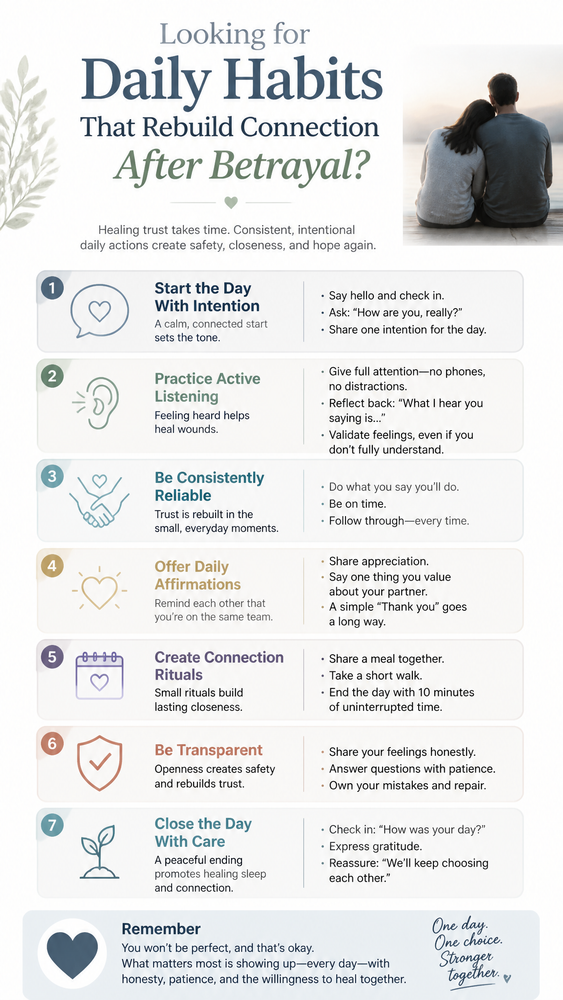
- Agree on one 10-minute check-in time each day, same time, no phones.
- Set up a “question container”: a notebook or note where the hurt partner writes questions instead of firing them off mid-crisis.
- Name one grounding practice each partner will use alone when flooded (walk, breathwork, calling a friend).
Safety callout: if either partner has thoughts of self-harm, there is any threat of violence, or conversations repeatedly spiral into uncontrollable panic, pause the exercises and contact a GP, a crisis line, or a trauma-informed therapist before continuing.
Key Takeaways
Trust rebuilds through daily, structured, time-boxed exercises rather than through single dramatic conversations, and pacing matters more than intensity.
| Point | Details |
|---|---|
| Start small | Begin with a daily 5 to 10 minute check-in before attempting harder conversations. |
| Stabilize before resolving | Use timeouts with a return time and a question container in the first 72 hours. |
| Time-limit transparency | Keep disclosure windows to 30 to 180 days and make them mutual, not covert surveillance. |
| Expect a real timeline | Plan for 3 to 6 months for erosion-type trust issues, 1 to 2 years for major betrayal. |
| Watch for crisis signs | Pause exercises and seek urgent help for self-harm risk, violence, or ongoing secrecy. |
| Use structured tools | The After the Affair workbook series offers scripts and templates for each recovery stage. |
Table of Contents
- Which trust-building exercises should you start with?
- Your first 72 hours and first two weeks
- Core trust exercises with scripts you can use today
- Making these exercises trauma-informed
- How to sequence exercises and measure real progress
- The therapy models behind these exercises
- When it’s time to bring in a therapist
- What actually works, according to clinical practice
- How After the Affair supports this work
- Sources
- FAQ
Which trust-building exercises should you start with?
Not every exercise belongs in week one. The goal early on is containment, not resolution. Reconnect Counseling’s clinical guidance on post-affair communication is blunt about this: trying to “solve” betrayal in the first days almost always backfires, because both partners are too dysregulated to think clearly.
The categories that matter, in rough order of introduction, are stabilization, accountability, communication, reconnection, and self-regulation. Stabilization exercises come first because a nervous system in fight-or-flight cannot absorb an apology or process a timeline of events. Accountability and communication exercises follow once both people can sit in a room without one of them shutting down or the other escalating. Reconnection work, the softer stuff like appreciation rituals, only lands once trust has some floor under it.
Your first 72 hours and first two weeks
The first three days are about establishing rhythm, not resolving anything.
- Hour 1 to 24: Stop contact with the affair partner if one exists. This is non-negotiable for rebuilding safety, regardless of how the affair ended.
- Day 1: Set up the question container and agree on one daily check-in time.
- Day 2: Hold the first check-in. Five minutes each, no cross-talk, just naming how the day felt.
- Day 3: Introduce a basic timeout signal. Either partner can call time, but a timeout must include an agreed return time, not an open-ended walkout, as Reconnect Counseling’s containment model recommends.
For the following two weeks, a simple daily rhythm looks like this:
- Morning (5 to 10 minutes): brief check-in on sleep, mood, and any triggers from the day before.
- Midday: individual grounding practice, done solo, no reporting required.
- Evening (15 minutes): transparency window, where the unfaithful partner offers a small, unprompted update rather than waiting to be asked.
What helps: keeping conversations time-boxed, writing questions down instead of ambushing your partner, and treating small consistency (a text sent when promised, a location shared without being asked) as the real currency of trust. What backfires: demanding a full disclosure in one sitting, checking a partner’s phone at 2 a.m., or skipping check-ins because “things feel calmer now.”
Core trust exercises with scripts you can use today
These six exercises form the backbone of most affair-recovery work, whether you are doing it with a therapist or largely on your own using structured materials like the 15 workbook exercises in the After the Affair series.
1. The daily check-in. Purpose: rebuild predictability. Led by both partners, five to ten minutes, once a day. Script: “On a scale of one to ten, how safe did you feel today? What’s one thing that helped, and one thing that didn’t?” Risk note: if one partner uses this slot to relitigate the affair itself, redirect to the question container instead.
2. Transparency check-in. Purpose: reduce surveillance urges by replacing them with agreed disclosure. Led by the unfaithful partner, once daily, two to five minutes. Script: “Here’s where I was today and who I was with, unprompted.” Time-limited transparency windows, commonly 30 to 180 days when therapist-guided, work far better than indefinite phone-checking, which tends to keep both partners locked in hypervigilance.
3. AVR scripting (Acknowledge, Validate, Reassure). Purpose: de-escalate a hard conversation before it floods. Led by whichever partner is calmer in the moment. Script: “I hear that you’re scared this could happen again (acknowledge). That makes sense given what happened (validate). I’m here, and I’m not going anywhere tonight (reassure).” Validation-focused responses measurably lower physiological arousal during these conversations, which is why the sequence matters more than the exact words.
Noticing the pattern is not the same as proving it
You Can Feel the Pattern. Can You Prove It to a Judge?
A diary of what happened reads as emotional venting. A structured, timestamped record reads as evidence. Most parents lose that distinction until it costs them. The free checklist shows you exactly what to document today, before the evidence window closes.
Get the Free Red Flag Checklist →3 categories · 5 minutes · free
4. Full accountability protocol. Purpose: a structured, one-time-per-topic conversation where the unfaithful partner answers a pre-agreed set of questions without minimizing. Led by both, ideally with a therapist present for the first attempt.
5. Progressive disclosure. Purpose: answer hard questions in stages rather than all at once, to avoid overwhelming either partner.
6. Appreciation ritual. Purpose: reintroduce warmth once safety is more stable. One specific, genuine appreciation shared daily, no more than a sentence.
Pro Tip: If a scripted conversation starts to spiral, switch to a 10-minute break with an agreed return time rather than pushing through. A paused conversation that resumes calmly does more for trust than one that ends in a shutdown.
Making these exercises trauma-informed
Betrayal trauma behaves like other forms of trauma: intrusive images, hypervigilance, and sleep disruption are common, not signs that someone is “overreacting.” Trauma-informed adaptation means regulation comes first, exposure to graphic details stays limited, and every difficult conversation has a hard time limit.
Watch for these signs that an exercise needs to pause:
- Nightmares or intrusive images that intensify rather than settle after a few weeks.
- Any statement suggesting self-harm or hopelessness.
- Inability to function at work or care for children for more than a few days running.
- One partner using check-ins to punish rather than inform.
Containment comes before resolution. Trying to fix the relationship before either partner can regulate their own nervous system almost guarantees the conversation ends in more damage than it started with.
If you use a shared tracking app for transparency, agree in writing on what gets shared and for how long, and avoid covert monitoring. Non-consensual surveillance creates its own trust problems and can carry legal complications. If either partner needs immediate crisis support, a GP, a crisis line, or emergency services should come before any scheduled exercise.
Willpower was never the problem
You’ve Said No Contact Before. What Made It Fail Last Time?
It usually isn’t willpower. It’s a loophole nobody accounted for, a second number, a mutual friend, a platform nobody thought to block. This free audit maps all 47 known workarounds so the boundary holds on its own, without relying on you to be strong enough every single time.
Get the Free Loophole Elimination Matrix →47-point audit · instant download · free
How to sequence exercises and measure real progress
Rushing the timeline is the single most common mistake couples make. Recovery from an affair typically runs one to two years for major betrayal, compared with three to six months for lower-intensity erosion of trust. That is not a life sentence. It is a realistic runway that lets both partners stop treating every good week as proof it is “over” and every bad week as proof nothing worked.
- Weeks 1 to 2 (stabilization): daily check-ins, question container, grounding.
- Weeks 3 to 8 (practice): transparency check-ins, AVR scripting, first accountability conversations.
- Months 3 to 6 (consolidation): progressive disclosure, appreciation rituals, longer conversations without a timer.
- Months 6 onward (integration): reduced transparency scaffolding as trust is re-earned, shift toward growth-stage work.
| Phase | Typical Timeline | Suggested Measure |
|---|---|---|
| Stabilization | 1 to 2 weeks | Percent of days with a completed check-in |
| Practice | 3 to 8 weeks | Weekly self-rated safety score, 1 to 10 |
| Consolidation | 3 to 6 months | Frequency of unprompted transparency |
| Integration | 6 months to 2 years | Distress score trend over monthly journal entries |
A simple weekly log, just a 1-to-10 safety rating and a one-line note, tells you more about direction than any single conversation. If the trend line is flat or worsening after six to eight weeks of consistent effort, that is your cue to adjust pace or bring in outside help.
The therapy models behind these exercises
None of this is improvised. Each exercise maps to an established clinical framework, which is worth knowing if you want to understand why it works rather than just following steps blindly.
- Emotionally Focused Therapy (EFT) treats the affair as an attachment injury and focuses on accessing the underlying fear and need beneath anger, which is where the AVR script comes from.
- The Gottman Method contributes the daily check-in habit and the emphasis on small, repeated bids for connection over grand gestures.
- Cognitive Behavioral Therapy (CBT) underlies the trigger-response planning: identifying a thought pattern, testing it, and building a coping response before the trigger hits.
- Attachment theory explains why inconsistent behavior, more than the affair itself, often keeps the nervous system on alert.
- Trauma-informed care shapes the pacing rules: time-boxed exposure, regulation before disclosure, and consent at every step.
The TRUST framework, which breaks recovery into Transparency, Regulation, Understanding, Steady consistency, and Time, is a useful lens for why these exercises are sequenced the way they are. Corrective emotional experiences, meaning consistent, predictable behavior over time, do more to rebuild a sense of safety than any single apology, no matter how well delivered.
Steady, boring consistency rebuilds trust faster than grand gestures. A partner who shows up for the 7 p.m. check-in every night for two months says more than one tearful confession ever will.
S.J. Howe and the After the Affair series draw on this combined evidence base to build reproducible worksheets rather than one-off advice, which is part of why structured exercises tend to outperform unstructured conversation for couples doing this work largely on their own.
When it’s time to bring in a therapist
Some signals mean self-guided exercises are not enough on their own.
- Persistent thoughts of self-harm or hopelessness in either partner.
- Any threat or history of violence.
- Ongoing secrecy or a new discovery after disclosure was thought complete.
- No measurable progress after six to eight weeks of consistent daily effort.
- Conflict that escalates every time you attempt a scripted conversation.
If you’re evaluating a therapist for affair recovery, ask these questions before booking:
- Do you have specific training in EFT, Gottman Method, or trauma-informed couples work?
- How many affair-recovery cases have you worked with recently?
- What does a typical first three sessions look like?
- Are individual and joint sessions both available, and how do you handle confidentiality between them?
Bring a rough timeline of events, any completed check-in or safety logs, and two or three specific goals for therapy. Couples therapy after infidelity works best when both partners arrive with concrete material rather than trying to reconstruct the whole story from memory in the room.
What actually works, according to clinical practice
Recovery rarely moves in a straight line, and the couples who do best are the ones who stop expecting it to. In practice, the partners who make real progress are not the ones who have the most intense conversations. They’re the ones who show up for the boring five-minute check-in on a Tuesday when nothing dramatic has happened.
One pattern shows up again and again: a couple spends the first month barely holding it together, check-ins short and stiff, transparency windows feeling forced. By month four, the same check-in has become almost mundane, two people trading a quick update before dinner. That shift from forced to mundane is what stabilization actually looks like. It’s not dramatic, and it’s not supposed to be.
Setbacks do not erase progress. A relapse into old arguing patterns, a missed check-in, a resurfaced trigger after a good stretch, none of that resets the clock to zero. It usually means the pace needs adjusting, not that the work has failed.
How After the Affair supports this work
There’s a real gap between reading about trust exercises and actually having the words ready when a hard conversation starts. That gap is where structured resources earn their place. The After the Affair series was built specifically to fill it, with step-by-step books for each recovery stage and workbook exercises you can use whether or not you have a therapist involved yet.

The Partner Accountability Conversation Guide gives the unfaithful partner an actual script for accountability conversations, rather than leaving them to improvise under pressure and say the wrong thing. Hurt partners who need daily structure tend to lean on the 7 Steps Infidelity Recovery Checklist for the stabilization phase covered earlier in this article. Therapists looking for reproducible worksheets to hand clients often start with the same workbook exercise library.
If you’re not ready to commit to a full program yet, the broader After the Affair hub has free guides to browse first. When you are ready for structured, stage-specific support, start with whichever book matches where you are right now.
Sources
- Trust Exercises for Couples: 10 Activities That Rebuild Security — South Denver Therapy
- When Conversations Explode: Rebuilding Trust After Infidelity – Reconnect Counseling
- Restored
- After Infidelity: Who helps couples create phone, social media, and location-sharing boundaries? – Marina Edelman, Marriage and Family Therapist
- The TRUST Framework: A Couples Therapist’s Step-by-Step Guide to Rebuilding Trust After Cheating — Wes White Counseling
This article offers general, evidence-informed guidance and is not a substitute for individualized care from a licensed therapist. If you are in crisis or unsafe, contact emergency services or a crisis line in your area immediately.
FAQ
What is the first trust-building exercise to try after an affair?
A daily five-to-ten-minute check-in is the most commonly recommended starting point, since it builds predictability without requiring either partner to relive the affair in detail.
How long does it take to rebuild trust after infidelity?
Recovery from major betrayal typically takes one to two years, while lower-intensity erosion of trust often improves within three to six months of consistent effort.
Is it safe to check my partner’s phone after an affair?
Covert or indefinite phone-checking tends to keep both partners locked in hypervigilance; a mutual, time-limited transparency agreement, ideally therapist-guided, works better than one-sided surveillance.
When should we stop doing exercises on our own and see a therapist?
Seek professional help if either partner has thoughts of self-harm, there’s any threat of violence, secrecy continues after disclosure, or you see no progress after six to eight weeks of consistent daily effort.
What if my partner isn’t ready to do these exercises?
Start with exercises that require only one partner, like individual grounding or a personal check-in log, and reintroduce joint exercises gradually as readiness grows; forcing pace usually backfires.
Do workbooks and self-help guides actually help, or do we need a therapist?
Structured materials like the After the Affair series can support meaningful progress on their own, though a therapist becomes important if crisis signs appear or progress stalls.
Recommended
- Trust-Building Exercises for Couples After Betrayal – After the Affair Series
- Relationship Growth After Infidelity – After the Affair Series
- Trust Rebuilding Guide: Steps to Heal After Infidelity
- Healing together guide: rebuild trust after infidelity – After the Affair Series