If you feel unable to leave after discovering an affair, even though the pain is constant, you may be caught in a trauma bond after affair: a physiological attachment built from cycles of harm and repair, not a character flaw or weak willpower. The immediate task isn’t to force a decision about the relationship. It’s to create enough physical and emotional distance to let your nervous system settle.
- Key Takeaways
- Understanding a Trauma Bond After an Affair
- Signs of a Trauma Bond After an Affair
- Why Trauma Bonds Feel Like Addiction
- Why Leaving or Staying Feels So Confusing
- How to Weaken or Break a Trauma Bond
- When to Get Professional Help Immediately
- What Recovery Actually Looks Like
- Why After the Affair Is Built for This Exact Moment
- What the Research Actually Supports, and What It Doesn’t
- Start With a Structured First Step, Not a Blank Page
- FAQ
Right now, do this:
- If you are in any physical danger, or your partner uses threats, intimidation, or control to keep you close, contact emergency services or a domestic-violence helpline before anything else.
- If you’re safe but stuck in a loop of checking their phone, replaying the discovery, or waiting for the next confession, pick one boundary you can hold for 24 hours. Delete a thread. Mute a notification. Sleep in another room.
This craving to reconnect with someone who hurt you isn’t a moral failure. Trauma bonding forms through cycles of harm and reward, and the pull you feel is your brain’s chemistry, not your judgment.
Key Takeaways
Breaking a trauma bond after an affair requires safety first, physical and digital distance, nervous-system regulation, and trauma-informed support sustained over months, not days.
| Point | Details |
|---|---|
| Trauma bond vs. betrayal trauma | Betrayal trauma is the wound; a trauma bond is the addictive attachment that can form around it through repeated cycles. |
| Watch for urgent signs | Isolation, fear, and compliance against your own interest point toward coercive control and need professional attention. |
| The craving is chemical | Dopamine, oxytocin, and cortisol combine to make withdrawal from a betraying partner feel like substance withdrawal. |
| Minimal contact needs a plan | When full no-contact isn’t possible, a tailored, limited-contact structure protects your recovery better than no plan at all. |
| Start with a structured tool | Aftertheaffair’s 7 Steps Infidelity Recovery Checklist gives an immediate, stabilization-first starting point before deeper work begins. |
This article is general information, not a substitute for advice from a qualified doctor. Consult a qualified healthcare professional about your own circumstances before acting on anything here.
Understanding a Trauma Bond After an Affair
A trauma bond after an affair is a specific attachment pattern: your brain has linked the person who hurt you with relief from that same hurt, so pulling away feels like withdrawal rather than freedom. That’s different from betrayal trauma and different again from ordinary grief, even though all three can show up in the same week. Understanding a trauma bond after affair can help you navigate the complexities of your feelings.
Betrayal trauma is the wound itself: the shock, hypervigilance, and shattered sense of safety that follow discovering infidelity. Betrayal trauma hijacks the attachment system, disrupting your ability to trust your own perception of the relationship. A trauma bond is what can grow out of that wound when the harm and the comfort keep coming from the same source, in cycles, over time.
Ordinary grief moves in one direction, however messily. It has bad days and better days, but it doesn’t require the person who caused the pain to keep showing up and dosing out relief. A trauma bond does. Every partial confession, tearful apology, or brief return to how things used to be resets the cycle. Therapists call this intermittent reinforcement: unpredictable rewards are more addictive than steady ones, and “trickle truth”, the slow, incomplete drip of admissions after discovery, keeps that unpredictability running for months.
It helps to know that “trauma bond” is a descriptive term clinicians use, not a diagnosis in the DSM. You won’t find it coded in a chart. That doesn’t make it less real; it just means treatment focuses on the underlying attachment and stress response rather than a label.
Trauma bonding shows up well beyond affairs. It’s documented in:
- Domestic violence and coercive control
- Cult and high-control group involvement
- Workplace abuse by a manager who alternates cruelty and praise
- Repeated infidelity within the same relationship, where each betrayal and reconciliation deepens the cycle
Willpower was never the problem
You’ve Said No Contact Before. What Made It Fail Last Time?
It usually isn’t willpower. It’s a loophole nobody accounted for, a second number, a mutual friend, a platform nobody thought to block. This free audit maps all 47 known workarounds so the boundary holds on its own, without relying on you to be strong enough every single time.
Get the Free Loophole Elimination Matrix →47-point audit · instant download · free
Signs of a Trauma Bond After an Affair
Some of these signs are uncomfortable to recognize in yourself. That’s normal. Naming them is the first real step toward loosening their grip.
- Compulsive checking. You monitor your partner’s phone, location, or whereabouts far past what feels healthy, and you can’t stop even when it exhausts you.
- Craving reconciliation despite the pain. You want them back within hours of a fight about the affair, even when nothing has actually changed.
- Minimizing the harm. You catch yourself saying “it wasn’t that bad” or “I probably drove them to it,” even about details that devastated you a day earlier.
- Identity erosion. You’ve lost track of your own opinions, routines, or friendships because managing the relationship has become a full-time job.
- Extreme highs and lows. A small kindness from your partner produces a flood of relief and hope disproportionate to the gesture itself.
- Complying against your own interest. You agree to their terms, drop boundaries, or stay silent about your own needs to avoid another rupture.
- Isolation from support. Friends and family have quietly fallen away, either because your partner discouraged them or because you didn’t have the energy to keep up those relationships.
- Rationalizing the betrayer’s behavior. You build explanations for the affair that shift responsibility away from them, sometimes without noticing you’re doing it.
- Euphoria after partial apologies. A vague, incomplete admission produces relief so strong it feels like the crisis is over, even though almost nothing has been resolved.
- Reacting hard to trickle truth. Each new detail that surfaces reopens the wound and restarts compulsive checking, even after you thought you’d moved past it.
Some of these are more urgent than others. Isolation from support, compliance against your own interest, and any hint of fear when your partner is upset point toward coercive control, not just an affair’s aftermath, and deserve a safety conversation with a professional sooner rather than later.
Pro Tip: Keep a short, dated log of moments that trigger a craving to reconnect. Patterns you can’t see in the moment often become obvious after a week of entries, and that log becomes useful if you ever need to describe the relationship to a therapist or advocate.
Why Trauma Bonds Feel Like Addiction
The craving you feel to reach out, forgive, or reconnect isn’t metaphorical. It runs on the same reward circuitry involved in substance dependence, and understanding that circuitry is often the first thing that makes people stop blaming themselves.
Affairs create an unpredictable pattern of pain and relief: discovery, distance, a partial explanation, a moment of tenderness, then another piece of the truth surfaces and the cycle restarts. Unpredictable rewards train the brain harder than steady ones. Every small comfort after a period of pain triggers a dopamine spike, and because you never know when the next one is coming, your brain stays primed to chase it.
Oxytocin complicates this further. It’s the hormone tied to bonding and trust, and it doesn’t switch off just because trust has been broken. Physical closeness, a familiar voice, even a text from your partner can trigger an oxytocin response that feels like safety, layered right on top of the dopamine hit from unpredictable reward.
Meanwhile, cortisol, your body’s primary stress hormone, stays elevated for as long as the threat feels unresolved, which for many people means for as long as the affair remains only partly explained. That prolonged stress response produces symptoms that resemble PTSD: intrusive thoughts, hypervigilance, and trouble sleeping. Clinical explainers describe trauma bonding as recruiting both the brain’s reward circuitry and its threat-detection system, which is why withdrawal from a betraying partner can feel like withdrawal from a substance.
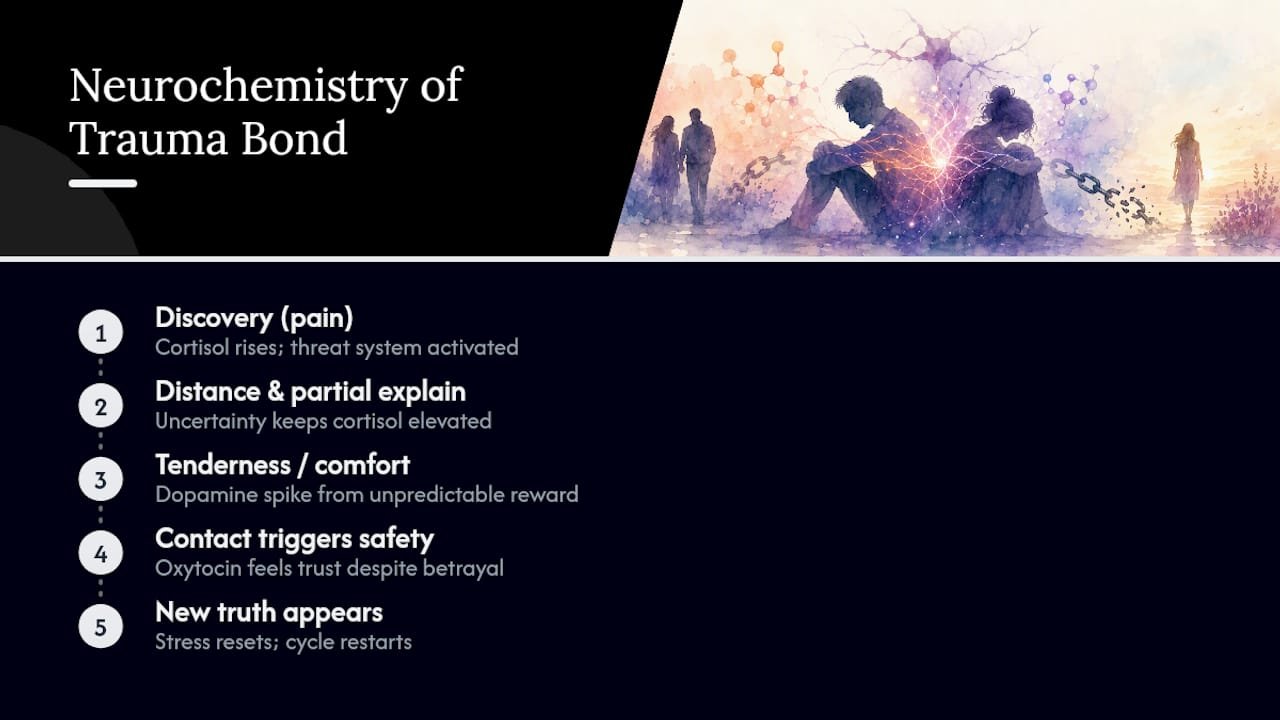
Trickle truth extends all of this. Every time a new detail emerges, weeks or months after the initial discovery, it resets the stress response and creates another opportunity for a reconciling gesture to deliver a fresh reward. The cycle doesn’t get a chance to close.
Why Leaving or Staying Feels So Confusing
Your body and your brain are operating on two different timelines, and that mismatch is where most of the guilt and confusion comes from. Intellectually, you may already know the relationship is unsafe or unsustainable. Physiologically, you’re in withdrawal, and withdrawal doesn’t respond to logic on command.

Practical barriers make this worse. Shared housing, children, joint finances, and social circles that assume the relationship is intact all raise the real cost of stepping back, even temporarily. These aren’t excuses; they’re genuine constraints that deserve planning, not shame.
Psychological barriers run just as deep:
- Shame about “letting it happen” or staying this long
- A sense of obligation, especially if children or extended family are involved
- The belief that leaving means giving up on something that could still be saved
Partial disclosures make all of this harder to resolve. Each new piece of information the betraying partner reveals, and each attempt they make to explain, apologize, or minimize, actively re-forms the bond rather than closing it. Betrayal bonds built through intermittent reinforcement and trickle truth produce symptoms that mirror PTSD, and repair, if it happens at all, requires the betraying partner’s sustained, consistent participation, not a single good conversation.
How to Weaken or Break a Trauma Bond
Breaking a trauma bond isn’t a single decision. It’s a sequence of smaller, deliberate choices that reduce the cycle’s grip over weeks and months.
- Address safety first. If there’s any risk of violence, coercion, or retaliation, contact emergency services or a domestic-violence advocate and build a safety plan before working on anything else.
- Define your contact terms. Full no-contact is the clearest way to interrupt the cycle, but it isn’t always realistic, especially with shared children. Therapists recommend a tailored minimal-contact plan with fixed topics, fixed channels (email over phone, for instance), and no late-night conversations that reopen old wounds.
- Remove the triggers you control. Mute notifications, unfollow shared accounts, put reminders of the relationship out of daily view.
- Get trauma-informed support. Look for a therapist trained in betrayal trauma, EMDR, or trauma-focused CBT. Group support with others who’ve been through infidelity can reduce the isolation that keeps the bond alive.
- Regulate your nervous system daily. Paced breathing, grounding exercises, and short walks or stretching sessions lower cortisol and make cravings easier to ride out without acting on them.
- Build a concrete support structure. Keep an evidence journal, name one trusted friend or advocate you check in with, and start any legal or financial planning you may need before a crisis forces the timeline.
When a partial disclosure or a text from your partner lands, pause before responding. Write down what you feel first, wait at least an hour, and only then decide whether a reply is necessary. That gap is often enough to keep a single message from resetting weeks of progress.
Pro Tip: Read every incoming message from your partner as if a friend had sent it to you about their own relationship. It’s a small trick, but it interrupts the automatic emotional reflex long enough for you to actually think.
Understanding the pattern is not the same as breaking it
You Can Explain Why This Happened. Can You Explain Why You’re Still Stuck In It?
Most people in affair recovery can narrate their entire situation with total clarity, the timeline, the triggers, the whole story, and still find themselves back in the same spiral by evening. Insight was never the missing piece. This free assessment shows you exactly where the gap actually is.
Take the Free Affair Recovery Clarity Check →A few honest questions · a scored result · 4 minutes · free
When to Get Professional Help Immediately
Some situations need a professional response now, not next week. Watch for threats of any kind, physical violence, stalking or excessive surveillance, and financial control that limits your ability to leave if you choose to. Any one of these moves the situation from “difficult relationship” into safety-planning territory.
- Domestic-violence advocates can help you build a safety plan even if you’re not sure you’re ready to leave.
- Trauma-informed therapists treat the attachment and stress-response symptoms directly.
- Solicitors can advise on urgent legal steps if property, custody, or finances are involved.
- Emergency services are the right call if you are in immediate danger.
Before a first appointment or call, write down key incidents with dates, save any threatening messages, and decide in advance who else needs to know for your own safety. Documenting incidents and building distance are standard first steps advocates recommend when someone is preparing to leave a harmful pattern. If you’re outside the US and searching for support, look for your own country’s national domestic-abuse helpline or local authority rather than a service that can’t actually reach you.
| Situation | What to do |
|---|---|
| Threats, violence, or stalking | Contact emergency services or a domestic-violence advocate immediately. |
| Financial control limiting your options | Speak with a solicitor about urgent legal protections available to you. |
| Emotional cycling without physical danger | Start with a trauma-informed therapist and a minimal-contact plan. |
What Recovery Actually Looks Like
Recovery from a trauma bond doesn’t move in a straight line, and it rarely resolves in weeks. Clinical reviews describe recovery unfolding over months to years, with sustained therapeutic support making the biggest difference in how fast someone stabilizes.
Most people move through three broad phases: establishing safety and distance, processing the story of what happened, and slowly rebuilding an identity and daily life that don’t revolve around the betrayal. Therapist-authored recovery models describe this same safety-first, then-processing, then-reconnection sequence.
Progress rarely looks dramatic. It looks like this:
- You notice a craving to check on your ex-partner and it passes without you acting on it.
- A calm day starts to feel normal instead of unsettling.
- You make a decision based on what you want, not on anticipating their reaction.
Why After the Affair Is Built for This Exact Moment
After the Affair was built specifically for the gap that traditional therapy often leaves open: the hours between sessions when the craving hits hardest. The site’s resources, written with S.J.Howe’s clinical and personal grounding in infidelity recovery, translate the safety-first, evidence-informed approach clinicians recommend into something you can use immediately.
- What Is Trauma Bonding? Signs, Effects, and Healing expands on the signs covered here with deeper case examples.
- Betrayal Trauma Symptoms walks through the physiological symptoms in more detail.
- The staged book series maps directly onto the survival, decision-making, transformation, and growth phases most people move through.
For a therapist’s outside perspective on how trauma bonds form and heal, this clinical explainer offers a useful second angle.
What the Research Actually Supports, and What It Doesn’t
Most advice on trauma bonds treats “just leave” as the whole answer, and that’s where conventional wisdom fails people. Leaving is often necessary. It’s rarely sufficient. The body doesn’t stop craving the source of relief just because the person is out of the house, and treating distance as the finish line sets people up to feel like failures when the cravings persist for months.
What the evidence actually supports is a layered approach: safety and distance first, then structured nervous-system work, then the slower identity rebuilding that most articles skip because it doesn’t fit in a listicle. The mistake I see most often is skipping straight to “process your feelings” before the nervous system has calmed down enough to make that processing useful. Regulation has to come before insight, not after it.
The other overlooked piece is trickle truth. People blame themselves for “not being over it” when a new detail resurfaces six months later, without realizing that each new disclosure is a fresh injury, not a failure to heal from the first one. If you take one thing from this article, let it be that: measure progress by how you respond to setbacks, not by whether setbacks stop happening.
— S.J.Howe
Start With a Structured First Step, Not a Blank Page
Trying to figure out where to begin on your own, while your nervous system is still in overdrive, is one of the hardest parts of this whole process. That’s exactly the gap the 7 Steps Infidelity Recovery Checklist was built to close: a structured, stabilization-first sequence you can start using today, without waiting for a therapy appointment or the “right” moment.
Once the immediate crisis has some structure around it, longer-form guidance matters more. Book 1: Navigating Infidelity walks through the first months after discovery in the same staged, evidence-informed way clinicians recommend, covering the withdrawal period, the trickle-truth cycle, and the early decisions that don’t need to be made right away. Together, the checklist and the book give you both an immediate anchor and a longer map, instead of one or the other. Start with the checklist today, then move to the book series when you’re ready to go deeper.
Sources
- What Is Trauma Bonding? (Domestic Shelters)
- How to Break a Trauma Bond: A Therapist’s Guide (Annie Wright)
- What Is Betrayal Trauma? The Neurobiology of Partner Betrayal and the Path to Recovery (Empathi / Figs O’Sullivan Couples Therapy)
- Trauma bonding explained (Healthline)
FAQ
What Are 10 Signs of Trauma Bonding?
Common signs include compulsive checking, craving reconciliation despite harm, minimizing the betrayal, identity erosion, intense emotional highs and lows, complying against your own interest, isolation from support, rationalizing the betrayer’s actions, euphoria after partial apologies, and strong reactions to trickle truth.
What Are the Stages of Trauma Bonding?
Descriptions vary across sources, but most trace a repeating cycle through tension building, an incident of harm, reconciliation or a partial apology, and a calm period before tension builds again, with each pass through the cycle deepening the attachment.
What Does a Trauma Bond Feel Like?
It feels like craving someone who hurt you, relief that’s disproportionate to a small kindness they offer, and confusion between attachment and love, often alongside physical symptoms like anxiety, intrusive thoughts, and trouble sleeping.
What Are Some Examples of Trauma Bonding After an Affair?
Feeling euphoric after a partner’s vague, partial confession, staying up late waiting for “the whole truth,” or agreeing to drop a boundary just to avoid another rupture are all common examples specific to infidelity recovery.
Can You Actually Break a Trauma Bond on Your Own?
Awareness and distance help, but therapist guidance consistently recommends professional support alongside self-directed steps, since the nervous-system symptoms involved rarely resolve through willpower alone.
Recommended
- What Is Trauma Bonding? Signs, Effects, and Healing
- Was ist Trauma-Bonding? Ursachen, Muster und Heilung 2026 – After the Affair Series
- AM I TRAUMA BONDED OR ACTUALLY IN LOVE? – After the Affair Series
- The Extinction Burst Survival Guide – After the Affair Series
Willpower was never the problem
You’ve Said No Contact Before. What Made It Fail Last Time?
It usually isn’t willpower. It’s a loophole nobody accounted for, a second number, a mutual friend, a platform nobody thought to block. This free audit maps all 47 known workarounds so the boundary holds on its own, without relying on you to be strong enough every single time.
Get the Free Loophole Elimination Matrix →47-point audit · instant download · free