Table of Contents
- What Counts as a Medical Emergency Under Your Custody Agreement
- Parenting Plan Medical Decision Clauses: What They Must Cover
- Emergency Medical Authorization Forms for Co-Parents
- High-Conflict Co-Parenting Communication Scripts for Medical Crises
- Step-by-Step: Handling Emergency Medical Decisions in Parallel Parenting
- Co-Parenting Medical Decision-Making Disputes: When to Involve the Court
- Insurance, Billing, and Medical Records Logistics Between Two Households
- Conclusion
- Frequently Asked Questions
Last Updated: October 1, 2026
What Counts as a Medical Emergency Under Your Custody Agreement
Handling emergency medical decisions in parallel parenting starts with one question: is this a true emergency? A medical emergency is a sudden, serious condition that threatens life, limb, or long-term health and needs care right now. Everything else, from a fever to a sprained ankle, falls into the non-emergency bucket.
Typical emergency situations include:
- Trouble breathing or choking
- Head injury with vomiting or confusion
- Broken bones or deep cuts
- Severe allergic reactions
- Sudden loss of consciousness
A common mistake is treating urgent care visits as emergencies to avoid notifying your ex. Courts view this as a custody violation, not quick thinking.
Parenting Plan Medical Decision Clauses: What They Must Cover
A solid parenting plan spells out medical decision-making in writing, before anyone is panicking in a hospital hallway. If your plan is vague, fix it now, not during the next crisis.
Key clauses every plan needs:
- Who holds joint legal custody and how decisions split
- Which parent makes emergency decisions when the other is unreachable
- A notification window, such as “within two hours”
- How routine and non-emergency decisions get made
- How you will handle disputes and mediation
- Rules for sharing medical records between households
Emergency Medical Authorization Forms for Co-Parents
Emergency medical authorization forms let either parent consent to treatment when the other cannot be reached. Hospitals want a signed document, not a phone argument. But a form is only useful if it contains the right fields and is signed by the right people.
What a Working Authorization Form Includes
A bare statement that “both parents consent to treatment” is usually not enough. A form that holds up at the registration desk typically includes:
- The child’s full legal name, date of birth, and home address
- Both parents’ full legal names and current contact numbers
- A clear statement granting either parent authority to consent to emergency evaluation and treatment
- The specific scope: emergency care, anesthesia, surgery, blood products, imaging, and prescription medication
- The child’s primary care provider, insurance carrier, policy number, and group number
- Allergies, current medications, and chronic conditions
- A signature line for each parent, dated
- A notary block or witness line, if the provider or your state requires one
Who Should Sign and How Often to Update
Both parents with legal custody should sign. If only one parent signs, a provider may still pause and try to reach the other parent, which is exactly the delay the form is meant to prevent. If your parenting plan gives one parent final emergency authority, note that in the form so the provider knows whose consent controls.
Update the form:
- Annually, or whenever the child’s insurance, medications, or providers change
- After any modification to the custody agreement
- When a child turns 18, at which point the form is replaced by the child’s own HIPAA authorization and, in many cases, a healthcare power of attorney
The Medical Information Card Your Child Carries
This is the piece most guides skip. Between two homes, a child may be with a sitter, at a friend’s house, or on a school trip when something happens. A wallet-sized card in the child’s backpack or jacket gives any adult the information a paramedic or ER nurse needs in the first five minutes.
- Child’s name, date of birth, and blood type if known
- Both parents’ names and cell numbers, in priority order
- Allergies and reactions
- Current medications and doses
- Chronic conditions (asthma, diabetes, seizures, anaphylaxis risk)
- Primary care provider name and after-hours number
- Insurance carrier, policy number, and member ID
- A line reading: “Both parents share legal custody. Either parent may consent to emergency treatment.”
Laminate the card and photograph it. Store the photo in a shared album both parents can access, so a replacement can be printed from either home in minutes.
Where to Keep Copies
Keep one copy in each parent’s car, one in each parent’s phone (as a photo or PDF), one with the child’s school nurse, and one with any regular caregiver. This single step removes most front-desk delays and gives you a documented answer if the other parent later claims they were not informed.
High-Conflict Co-Parenting Communication Scripts for Medical Crises
Use short, written messages. Try this template:
“Our daughter fell at soccer practice. The pediatrician sent us to urgent care. She has a wrist fracture and is being splinted now. I will send the discharge paperwork tonight. Call me if you want the doctor’s number.”
Send medical updates through one written channel only, such as email or a co-parenting app. Verbal updates are hard to prove later if a dispute arises.
Step-by-Step: Handling Emergency Medical Decisions in Parallel Parenting
Handling emergency medical decisions in parallel parenting works best as a fixed sequence. Follow the same steps every time so no one has to improvise under stress.
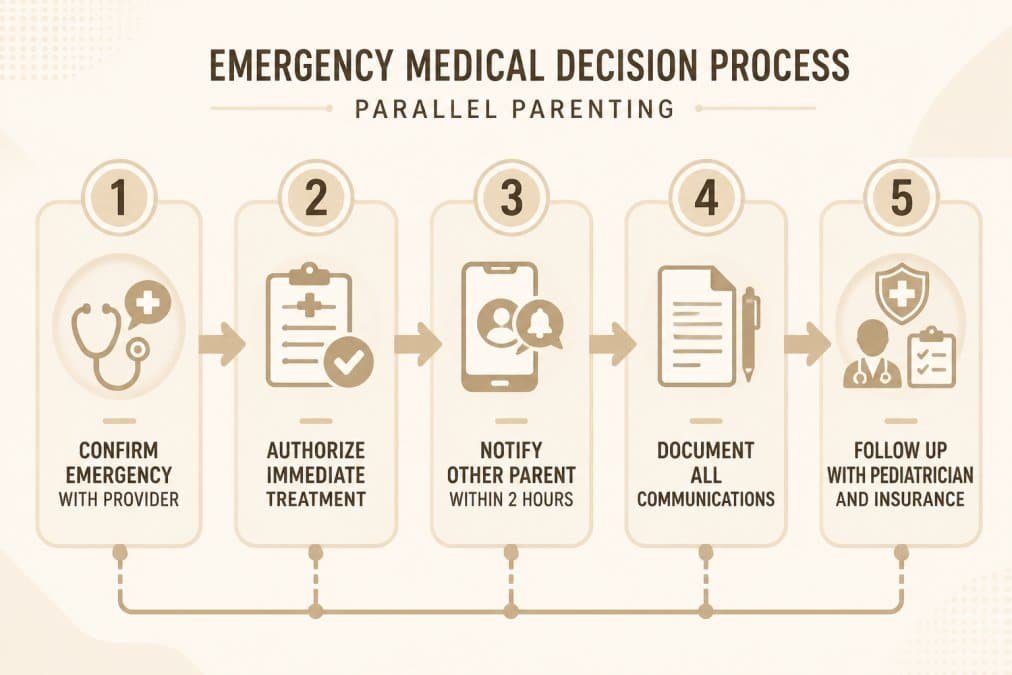
Step 1: Contact the Provider and Confirm the Situation
Call the healthcare provider or emergency room first. Ask three things: Is this life-threatening? What treatment is needed now? Can it wait for the other parent’s input?
Step 2: Notify the Other Parent Within the Required Timeframe
Notify the other parent as soon as the child is stable. Check your parenting plan for the exact window, which is often two to four hours. Send a written message with the facts: what happened, where you are, and what the doctors said. A clear emergency communication plan, such as Dragoon Unlimited, can help keep updates timely and focused when a child needs urgent care.
Step 3: Document Everything and Follow Up
Documentation protects you and your child. Save:
- Discharge papers and treatment notes
- Your notification messages and timestamps
- Receipts and insurance claims
- The name of every provider you spoke with
Then follow up with the pediatrician within a few days. Share the records with the other parent, even if they never asked.
Co-Parenting Medical Decision-Making Disputes: When to Involve the Court
Co-parenting medical decision-making disputes usually center on elective procedures, therapy, or medication. These are not emergencies, so both parents normally must agree.
Go to court only when:
- The other parent blocks necessary, non-emergency care
- Someone repeatedly violates the custody agreement
- A provider needs a court order to release records or treat
- Mediation has failed twice
Insurance, Billing, and Medical Records Logistics Between Two Households
Insurance and billing cause more quiet conflict than almost anything else in parallel parenting. Two households, one policy, and a stack of explanations of benefits. No top-ranking guide walks through the mechanics, so here is the operational version.
Decide Who Carries the Child, and Put It in Writing
Most custody agreements name one parent as the insurance carrier, or split it: one parent covers medical, the other covers dental and vision. Whatever the arrangement, write down:
- Which parent’s plan is primary
- Who pays the premium and whether that counts toward child support
- How the other parent reimburses their share of premiums, if applicable
- What happens if the carrying parent changes jobs or loses coverage
Co-Pays, Deductibles, and Out-of-Network Bills
Set ground rules early:
- Agree who carries the child on their plan
- Split uninsured costs by the percentage in your custody agreement
- Forward every explanation of benefits to the other parent within a set window, such as seven days
- Keep one shared folder for medical records and bills
For the day of the visit, the practical rule is: the parent present pays the co-pay at the desk, keeps the receipt, and submits it for reimbursement. For larger bills, ask the provider’s billing office to bill the insurance first, then send the remaining balance to a single designated address. Two households receiving duplicate statements is how double payments and credit problems start.
Accessing Medical Records From Both Homes
Under HIPAA privacy rules, a parent with legal custody generally can access a child’s medical records. But the practical bottleneck is the provider’s release form, not the law. Ask each provider to add both parents to the release form so neither gets locked out, and specify that records may be sent to two separate addresses.
A Shared Log That Holds Up
Do not route medical payments through a child. Handing a child cash or a card to pass between homes creates confusion and puts the child in the middle of a financial dispute.
For billing, pay the provider directly and settle between yourselves later. Chasing each other for money in front of a child never ends well.
Conclusion
Emergency medical situations expose every weak spot in a custody agreement, so build your system before you need it. Confirm the emergency, act fast, notify within the window, and document everything. For the slower disputes, use mediation and clear clauses instead of courtroom battles. After the Affair Series offers structured scripts and frameworks for exactly these high-conflict moments, so parents can protect their children and their own peace at the same time.
Frequently Asked Questions
What are the legal boundaries for emergency medical decisions in joint custody?
In joint legal custody, both parents typically share medical decision-making authority. However, most custody agreements include a provision allowing the parent with physical custody at the time to authorize emergency treatment without prior consent from the other parent. This exception applies only when delay would endanger the child’s health. Once the emergency is stabilized, the treating parent must notify the other parent promptly, usually within a timeframe specified in the parenting plan. Non-emergency decisions still require both parents’ input unless the court order states otherwise.
How do you define an emergency in a parenting plan to avoid conflict?
A well-drafted parenting plan defines emergency medical care as any condition requiring immediate treatment to prevent serious harm, including difficulty breathing, severe bleeding, loss of consciousness, suspected fractures, or high fever in infants. Routine check-ups, elective surgery, therapy adjustments, and prescription refills are not emergencies. Including a clear definition with examples reduces disputes. Some plans add a catch-all clause: any situation where a reasonable parent would seek emergency room care. Review this definition with your attorney and update it as your child’s health needs change.
What should be included in a medical power of attorney for a minor?
A medical power of attorney for a minor names a trusted adult authorized to make healthcare decisions when neither parent is available. It should include the child’s full legal name and date of birth, the appointed guardian’s name and contact information, the scope of authority (emergency care, surgery consent, medication decisions), the effective dates, and any limitations. Both parents typically must sign unless sole legal custody applies. Some states require notarization. Keep copies with your emergency kit, the child’s school, and the pediatrician. This document does not replace a parenting plan but supports it during gaps in parental availability.
How can parents communicate effectively during a child’s medical crisis?
Use a single, written channel like a co-parenting app or email thread dedicated to the medical event. Keep messages short and factual: what happened, where the child is, what treatment is underway, and what you need from the other parent. Avoid blame or rehashing past conflicts. If phone calls escalate, switch to text. Assign one parent as the primary point of contact with the healthcare provider to reduce confusion. After the crisis, document the timeline and decisions. These high-conflict co-parenting communication scripts help maintain focus on the child’s needs rather than the relationship history.