Last Updated: August 30, 2026
- Why Documentation Matters in Custody Cases
- What Types of Incidents to Record
- Creating a Co-Parenting Communication Log Template
- Handling Communication Logs and Text Messages
- Best Co-Parenting Apps for High Conflict
- Admissible Evidence for Child Custody Court
- Organizing Evidence for Legal Proceedings
- The Role of Documentation in Court Hearings
- Creating a Sustainable Documentation System
- Frequently Asked Questions
Why Documentation Matters in Custody Cases
Judges make decisions based on evidence, not impressions. A detailed incident log showing repeated patterns of behavior carries far more weight than testimony about what happened “sometime last month.” Documentation creates a factual record that protects your interests and demonstrates your commitment to your child’s wellbeing. This is especially crucial in situations where you may face a document co-parenting conflict.
According to the American Academy of Pediatrics on parental conflict, children exposed to high-conflict co-parenting situations experience measurable stress responses. Courts increasingly recognize this and look for evidence of how each parent manages conflict. Your documentation shows you’re taking the situation seriously and maintaining objectivity, two qualities judges value.
Beyond the courtroom, documentation keeps you grounded when emotions run high. Writing down facts forces you to separate what actually happened from how it made you feel, protecting your decision-making and preventing escalation.
Start documenting now, even if you’re not currently in litigation. The strongest evidence is built over time, not created in a panic when court dates appear.
What Types of Incidents to Record
Focus on incidents that demonstrate patterns of behavior affecting your child’s wellbeing or your ability to co-parent effectively. Document these categories:
Custody Order Violations, When the other parent violates the parenting plan (late pickups, missed exchanges, unauthorized schedule changes).
Unsafe or Concerning Behavior, Incidents involving substance use, unsafe environments, inappropriate discipline, or failure to supervise.
Interference with Parenting Time, When the other parent prevents you from exercising custody time, withholds communication, or uses your child as a messenger.
Verbal Abuse or Threats, Direct threats, hostile language, or aggressive communication directed at you or your child.
Parental Alienation Behaviors, Actions designed to damage your relationship with your child (badmouthing you, limiting contact, coaching false reports).
Pattern-Based Incidents, Three instances of the same behavior (chronic lateness, repeated boundary violations) build a stronger case than a single incident.
Child-Reported Concerns, When your child reports something concerning that happened at the other parent’s home, document what they said, when, and their emotional state.
Avoid documenting everyday frustrations, minor scheduling conflicts, or one-off incidents that don’t reflect a pattern. Overcrowding your log weakens your case.
Avoid documenting your own emotional reactions or interpretations. “He was being deliberately antagonistic” is your conclusion. “He raised his voice during the exchange and made statements about my parenting” is fact. Courts need the latter.
Reading this won’t change tomorrow’s message
You Know the Tactic Now. Do You Know What You’ll Actually Do When It Lands?
Understanding grey rock is not the same as doing it at 9pm when your phone buzzes. Most parents can explain the theory perfectly and still bite the bait every single time. The gap between the two is exactly what the free self-check measures.
Get Your Ex Out of Your Head \→5 scenarios \· scored result \· 4 minutes \· free
Creating a Co-Parenting Communication Log Template
A structured template provides consistency and professional presentation. Your log becomes evidence itself, so it needs to look organized and credible.
Essential Fields for Your Log
Date and Time, Record the exact date, time of day, and duration. “March 15, 2026, 2:45 PM during pickup” is stronger than “last week sometime.”
Location, Where the incident occurred (school parking lot, your home, phone call, text message, etc.).
Incident Type, Use consistent categories (custody violation, unsafe behavior, verbal abuse, alienation, communication breakdown).
Objective Description, What happened, in neutral language. Include direct quotes if relevant, but focus on observable facts: who said what, what actions were taken, what the child witnessed.
Witnesses, Who else was present or aware of the incident?
Child’s Reaction, How did your child respond? Emotional state, any statements they made, visible distress or behavioral changes.
Follow-Up Actions, What did you do in response? Did you contact the other parent, involve authorities, seek medical attention?
Legal Relevance, Why does this matter? How does it connect to custody concerns or your child’s wellbeing?
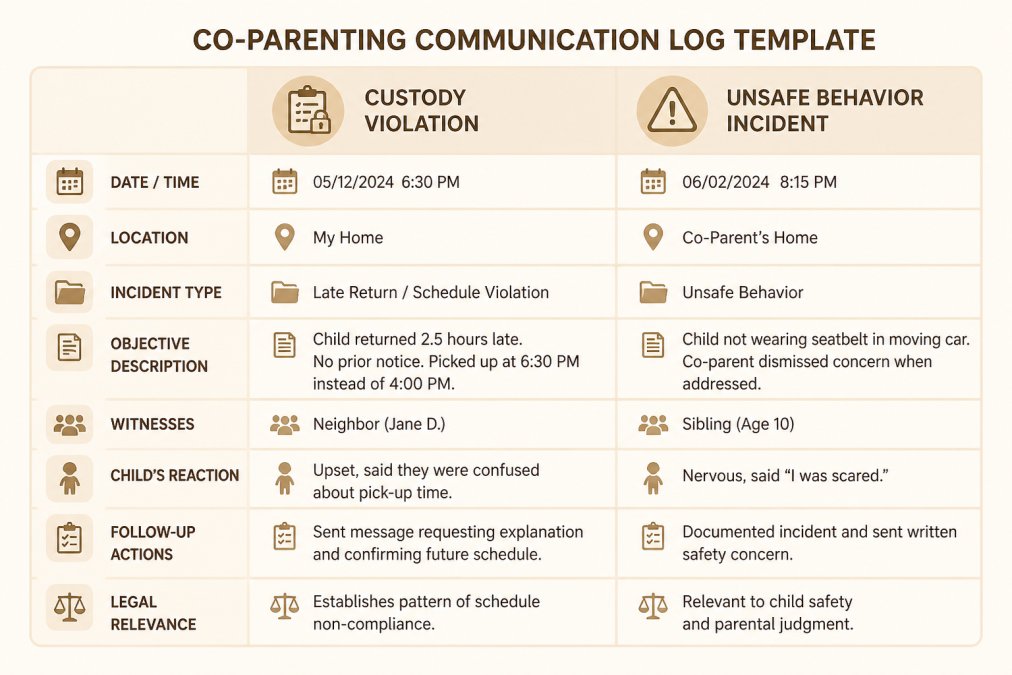
Keep each entry brief, three to five sentences maximum. Concise, factual entries are far more powerful than detailed narratives.
Maintaining Objectivity in Written Logs
Objectivity makes your documentation legally useful. The moment you inject emotion or interpretation, you’ve created a personal narrative rather than evidence.
Write what you observed, not what you concluded. “He was irresponsible” is a judgment. “He arrived 45 minutes late for pickup without advance notice or explanation” is fact. Use neutral language consistently: “did not” instead of “refused,” “stated” instead of “claimed.”
When you quote the other parent, use exact words in quotation marks. When paraphrasing, use “stated that” or “said approximately.” If uncertain about exact wording, write “approximately” before the quote.
Separate what you know from what you infer. If your child reports the other parent was drinking, document exactly what the child said and observed (“Child reported seeing empty beer bottles on the kitchen counter and stated that parent smelled like alcohol”). Don’t write “Parent was intoxicated” unless you directly observed it.
The strongest logs read like police reports, not personal journals. Stick to observable facts, use neutral language, and let patterns speak for themselves.
Noticing the pattern is not the same as proving it
You Can Feel the Pattern. Can You Prove It to a Judge?
A diary of what happened reads as emotional venting. A structured, timestamped record reads as evidence. Most parents lose that distinction until it costs them. The free checklist shows you exactly what to document today, before the evidence window closes.
Get the Free Red Flag Checklist \→3 categories \· 5 minutes \· free
Handling Communication Logs and Text Messages
Text messages, emails, and app-based communication are already timestamped and documented (peer-reviewed research). They’re powerful evidence because they’re contemporaneous and contain direct quotes.
Save everything. Don’t delete messages even if they’re hostile. Deletion suggests you’re hiding something. Store originals in multiple places (cloud backup, external drive, printed copies).
Screenshot text messages with full date, time, and sender information visible. For longer conversations, screenshot the full thread in chronological order. For email, print to PDF or screenshot the full message including headers (from, to, date, subject line).
Organize communications chronologically or by topic. If documenting escalating hostility, chronological order shows progression. If documenting violations of a specific parenting plan rule, organizing by topic makes patterns clearer.
Create a summary index if you have hundreds of messages. “Attachment A: Communications regarding school schedule, January-March 2026” with messages numbered sequentially.
Avoid using communication logs to argue your case in real time. Sending the other parent a message saying “I’m documenting this for court” escalates conflict. Document quietly and let evidence speak later.
Best Co-Parenting Apps for High Conflict
Specialized co-parenting apps create automatic documentation and reduce direct communication. Apps designed for high-conflict situations include message screening, communication templates, and neutral tone reminders.
Many apps provide built-in communication logs that are automatically timestamped. Some include expense tracking, parenting time logs, and shared calendars that create an objective record of agreements. This reduces “he said, she said” disputes about scheduling.
Take the free 23-point assessment →
App-based communication creates a neutral space where both parents see the same information, messages are documented automatically, and there’s no ambiguity about what was said or when. Some apps include message filtering or tone indicators.
When selecting an app, look for automatic message timestamping, ability to export communication records, shared calendar with change history, expense tracking, and document storage.
High-conflict co-parents who need automatic documentation without relying on memory or manual record-keeping.

Admissible Evidence for Child Custody Court
Not all documentation is admissible in court. Understanding what evidence holds weight helps you focus on what actually matters legally.
Admissible evidence includes contemporaneous written records (incident logs, messages, emails created when events occurred), photographs or videos of unsafe conditions, medical or school records documenting injuries or behavioral changes, communications showing custody violations, and testimony from witnesses who observed incidents.
Weak evidence includes your personal interpretation of the other parent’s motivations, secondhand reports, your emotional reactions, and conclusions without supporting facts.
Courts care about evidence that directly demonstrates how the other parent’s behavior affects the child or violates court orders. A log showing the other parent was 30 minutes late for pickup on five occasions is relevant. Your opinion that they’re “irresponsible” is not.
Documentation created specifically for litigation is less persuasive than documentation maintained consistently over time. This is why starting early is strategic.
Photographs of unsafe living conditions, evidence of substance use, medical records documenting injuries, or school records showing behavioral changes carry significant weight. These are objective, third-party documentation. child custody fitness evaluation.
Text messages and emails are admissible if you can establish authenticity (you received them, you have the original, sender’s identity is clear). Screenshots are acceptable if they show full headers and timestamps.
Avoid recording conversations without the other parent’s consent unless you live in a one-party consent state ([the CDC](https://ftp.cdc.gov/pub/health_Statistics/nchs/Software/mmds/2009/spell/mmds_spell.txt)). Recording laws vary, and illegally recorded conversations can be inadmissible and damage your credibility.
Organizing Evidence for Legal Proceedings
When moving from personal documentation to legal proceedings, organization becomes critical. Your attorney needs to review evidence quickly and identify the strongest patterns.
Create a chronological master list of all incidents with brief descriptions and reference numbers. Each incident gets a number (Incident #1, #2, #3, etc.) that you reference in detailed logs and supporting documents.
Separate incidents by category: custody violations, unsafe behavior, communication breakdowns, alienation. This helps your attorney identify which incidents support which legal arguments.
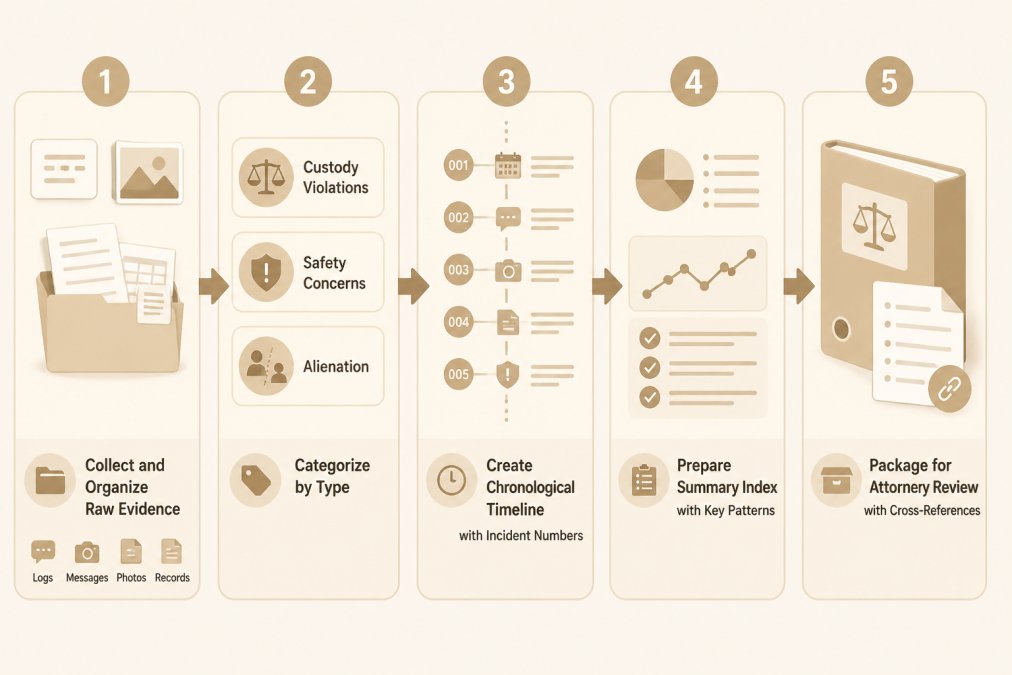
Compile supporting documents in organized folders. Messages related to Incident #5 should be clearly labeled and easy to locate.
Create a summary document highlighting patterns. “Between January and March 2026, the other parent was late for pickup on eight occasions, ranging from 15 to 45 minutes late, without advance notice or explanation.” This ties individual incidents into a pattern demonstrating behavior.
Include context where relevant. If documentation shows the other parent missed pickup, include evidence of how that affected your child (school called asking for pickup, child waited in aftercare, child’s emotional response).
Prepare your documentation professionally. Printed logs should be clean, organized, and easy to read. Professional presentation suggests careful, credible record-keeping.
Work with your attorney on how to present evidence. They’ll advise which incidents are strongest, which patterns matter most, and how to sequence information for maximum impact.
The Role of Documentation in Court Hearings
In the courtroom, your documentation either supports your testimony or contradicts it. If you testify that the other parent was hostile during exchanges, but your contemporaneous logs describe neutral, factual interactions, the judge notices the inconsistency.
Documentation is most powerful when it corroborates testimony. You describe an incident, and your log confirms the date, time, and details. You testify about patterns, and your organized evidence shows those patterns clearly.
Judges view consistent, objective documentation as credible. They view emotional, heavily interpreted documentation as biased. This is why maintaining objectivity throughout your documentation process determines how much weight your evidence carries.
Documentation can also protect you from false accusations. If the other parent claims you violated the parenting plan on a specific date, your detailed log creates a factual record that defends your position.
Courts also consider documentation as evidence of how each parent handles conflict. A parent who maintains objective, detailed logs demonstrates they’re taking their responsibilities seriously and managing emotions appropriately.
Your documentation tells a story about your character as much as it documents the other parent’s behavior. Make sure the story it tells is one of careful, responsible, emotionally regulated parenting.
Creating a Sustainable Documentation System
The biggest challenge with documentation isn’t starting, it’s sustaining it. Maintaining detailed logs for months or years requires a system that doesn’t burn you out.
Set a realistic frequency. A weekly review where you document significant incidents is more sustainable than attempting daily documentation. Use templates or apps to reduce friction. A simple form takes 5 minutes; a blank page takes 20.
Establish a specific time and place. “Every Sunday evening at 8 PM, I review the week and update my log” is more sustainable than reactive documentation.
Separate your personal processing from your documentation. Your journal is where you process emotions. Your log is where you document facts. Keep them separate.
Consider using structured frameworks for high-conflict co-parenting. When you’re using evidence-based communication tools, your logs naturally become more factual and less emotionally charged.
Backup your documentation regularly. Digital files should be stored in multiple locations (cloud backup, external drive). Printed copies should be stored safely.
Review your logs periodically with an attorney or mediator. They can tell you which incidents are legally relevant and which are wasting your energy.
Documentation transforms high-conflict co-parenting from an exhausting emotional battle into a structured, evidence-based process. When you’re documenting objectively and organizing strategically, you’re protecting your child’s interests and building a factual record that courts respect. The investment in clear, consistent documentation pays dividends when custody decisions are made. Start now, maintain consistency, and let the evidence speak for itself.
Frequently Asked Questions
What specific details should be included in a co-parenting log?
Record the date, exact time, location, and a factual description of what happened without emotional language. Include names of witnesses, what was said or done, and the impact on your child if relevant. Add the parenting plan violation or court order breach if applicable. Avoid conclusions like ‘he was abusive’, instead write ‘he raised his voice during pickup, and the child became visibly upset.’ This objective approach makes your documentation credible in court and harder to dispute.
Are text messages and emails admissible as evidence in custody cases?
Yes, text messages and emails are generally admissible in custody hearings if they are authentic and relevant to the case. Save the full conversation thread with timestamps intact. Screenshots alone may be challenged; courts often prefer printed copies with metadata or digital exports from the phone carrier or email provider. Avoid altering, cropping, or editing messages before presenting them. If your ex claims you fabricated messages, authenticated digital records carry more weight than screenshots.
How do I maintain objectivity when documenting conflict?
Write as if you’re describing the incident to a judge, not venting to a friend. Use neutral language: ‘She did not return the child by 6 p.m.’ instead of ‘She deliberately kept my child late again.’ Record observable facts, tone, volume, words spoken, not your interpretation of intent. Avoid words like ‘narcissistic,’ ‘abusive,’ or ‘malicious’ unless you’re quoting a professional evaluation. Include context that explains why the incident matters legally, but let the facts speak for themselves. This credibility is your strongest asset in litigation.
What is the best way to organize evidence of parental alienation?
Create a chronological index of incidents that show a pattern of interference with the other parent’s relationship with the child. Group by category: statements the child reported, refusal to allow contact, scheduling interference, or negative comments about the other parent. Include dates, what the child said or did, and any corroborating evidence like emails or witness statements. Courts look for a sustained pattern over time, not isolated incidents. Organize by month or quarter so the progression is visually clear. Provide your attorney with both the raw documentation and a summary highlighting the pattern.
Willpower was never the problem
You’ve Said No Contact Before. What Made It Fail Last Time?
It usually isn’t willpower. It’s a loophole nobody accounted for, a second number, a mutual friend, a platform nobody thought to block. This free audit maps all 47 known workarounds so the boundary holds on its own, without relying on you to be strong enough every single time.
Get the Free Loophole Elimination Matrix \→47-point audit \· instant download \· free