Last Updated: October 19, 2026
Table of Contents
Why Co-Parenting Communication Without Apps Works
High-conflict co-parenting drains your energy.
Most people reach for a co-parenting app promising neutrality and documentation.
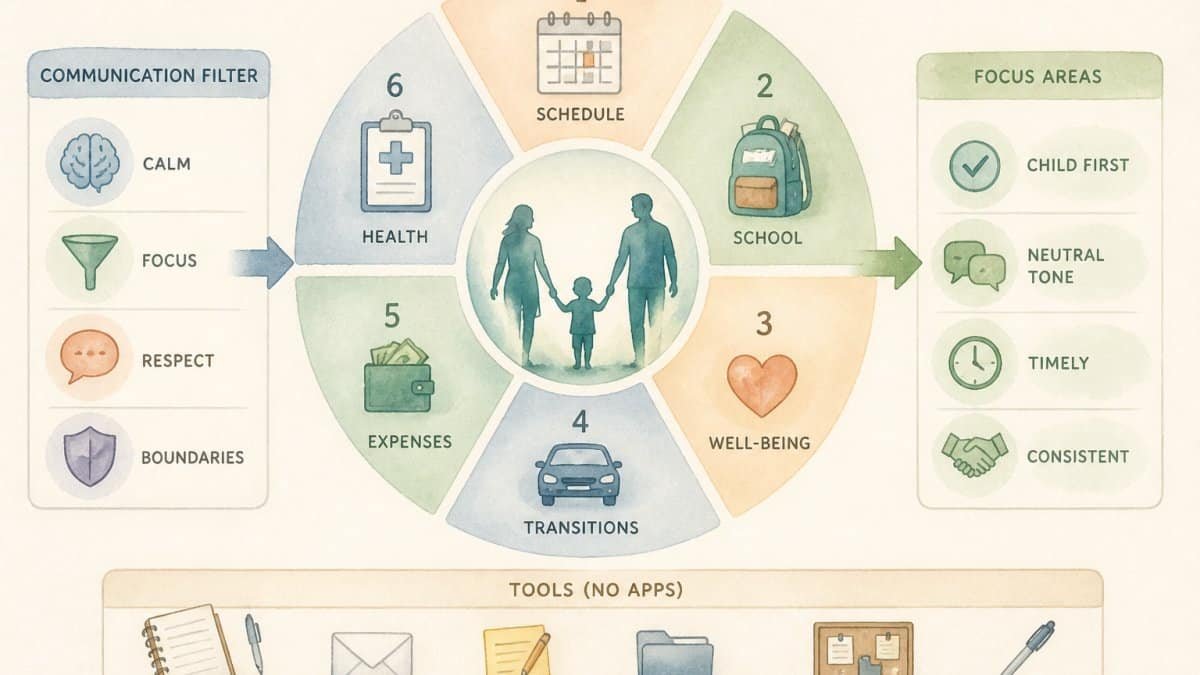
Co-parenting communication without apps relies on principles, not platforms.
After the Affair Series provides a structured toolkit designed to help individuals navigate the complexities of betrayal, separation, and high-conflict co-parenting.
Core Principles for Effective Co-Parenting Communication
Effective co-parenting communication rests on three non-negotiable principles. Master them and your message gets through; skip them and even the best words backfire.
Keep Messages Child-Focused and Brief
Your ex doesn’t care about your feelings, but they do care about your children.
Child-focused message:
“Emma has a soccer game Saturday at 10 a.m.
Not child-focused:
“Emma has a soccer game Saturday.
The first message is clear. The second invites debate about what’s “important” or what’s “best.”
Use Calm, Factual Language
Emotion bleeds through text. Sarcasm reads as hostility.
Stick to facts. Names, dates, times, and decisions. Nothing else.
Factual:
“School pickup is 3:15 p.m. on Thursdays.
Emotional:
“I can’t believe you’re STILL late picking up the kids!
The factual version is a proposal. The emotional version is a complaint.
Stay on Topic and Avoid Reactive Responses
Your ex says something designed to provoke you, and your instinct is to defend or fire back.
Reactive response:
“That’s not fair. You always do this. You know I’ve been a good parent.
Focused response:
“Let’s discuss the school schedule. What days work for you?”
The reactive response is honest but useless.
Co-Parenting Communication Scripts: Ready-to-Use Examples
Scripts work because they remove emotion from the moment. When tension is high, you don’t think clearly, a script gives you a template.
Scheduling Changes and Logistics
When you need to change a pickup time:
If they say no, offer an alternative or explain why the change is necessary for the child.
When your ex is consistently late:
“Pickup has been late the last three times.
When custody time conflicts with a child event:
“[Child] has been invited to [event] on your scheduled day. This is important to [child].
You’re offering options, not demanding, the event matters, and you’re problem-solving together.
Health and Medical Decisions
“[Child] has a dental appointment on [date] at [time].
When your child needs medical care and you’re making the decision:
“[Child] has been complaining of [symptom].
This isn’t a request, it’s a notification.
When medication or treatment is involved:
“[Child]’s doctor recommended [treatment].
You’re including them while moving forward with the child’s care.
Addressing Boundary Violations
When your ex is calling or texting outside agreed times:
“I’m not available for calls outside [times].
Don’t explain or apologize. This is a boundary.
When your ex is asking you personal questions unrelated to the child:
“I’m not able to discuss that.
Short. Direct. No elaboration.
When your ex is involving the child in adult conversations:
“[Child] mentioned you discussed [topic].
Firm but not accusatory, you’re protecting the child.
Co-Parenting Email Templates for Different Situations
Email creates a record and forces you to think before sending. Use these templates when documentation matters.
The Information-Only Email
Use this when you’re sharing information, not asking for agreement.
Subject: [Child], [Topic]
Hi [Name],
I wanted to let you know that [fact/event/decision].
[Specific detail: date, time, location, or what happened]
I’ll follow up with you [timeframe] if you have any questions.
[Your name]
Example:
Subject: Emma, School Pickup Change
Hi James,
I wanted to let you know that Emma’s school changed pickup time to 3:30 p.m. starting next month.
This affects Wednesday and Friday pickups. I’ll handle those days.
Let me know if you have any questions.
Sarah
The Request for Agreement Email
Use this when you need your ex’s input or approval.
Subject: [Child], [Decision Needed]
Hi [Name],
I need to schedule [event/appointment/decision] and need your input.
Here are the options: [2-3 specific options with dates/times]
Please let me know which works best for you by [date].
[Your name]
Example:
Subject: Liam, Spring Break Plans
Hi Marcus,
I need to schedule Liam’s spring break time. School breaks March 17-21.
Here are the options:
- I take March 17-19, you take March 20-21
- You take March 17-19, I take March 20-21
- Split each day (you take mornings, I take afternoons)
Please let me know which works by March 1st.
Sarah
The Documentation Email
Use this when you need a clear record of a conversation or decision.
Subject: [Child], Confirmation of [Topic]
Hi [Name],
Following up on our conversation about [topic], here’s what we agreed to:
[List the specific agreement]
This will take effect [date/timeframe].
Please confirm you received this and agree to these terms.
[Your name]
Example:
Subject: Emma, Confirmation of Medication Plan
Hi James,
Following up on our phone conversation about Emma’s allergy medication, here’s what we agreed to:
- I’ll manage the prescription and keep it at my house
- You’ll keep an over-the-counter backup at your house
- We’ll both carry an EpiPen when Emma is in our care
Please confirm you received this and agree to these terms.
Sarah

Setting Co-Parenting Boundaries With a High-Conflict Ex
Boundaries aren’t walls, they’re rules that protect your peace and your children.
Define What Topics Are Off-Limits
Your ex may want to rehash the past, debate your parenting choices, or pull you into conversations about your relationship. None of that is your job anymore.
Off-limits topics:
- Your relationship or what went wrong
- Your personal life or dating
- Your finances (unless it affects child support)
On-limits topics:
- Child’s health, school, activities
- Custody schedule changes
- Expenses related to the child
When your ex brings up an off-limits topic, respond the same way every time: “That’s not something I can discuss.
Establish Response Timelines and Communication Methods
Your ex texts at midnight, calls during work, and expects immediate responses. Set expectations.
Choose a communication method:
- Email for decisions and documentation
- Text for urgent, time-sensitive information only
- Phone calls by appointment only
Set response timelines:
- Non-urgent: respond within 24 hours
- Urgent (child safety, health): respond within 2 hours
- Emergencies: respond immediately
Put this in writing, send it once, then enforce it. When your ex texts at midnight, don’t respond until morning; when they call without scheduling, don’t answer. This isn’t punishment, it’s consistency, and it teaches them how to reach you.
Know When to Stop Engaging
Some conversations have no resolution, your ex is angry, defensive, or determined to argue.
Signs it’s time to disengage:
- The conversation is repeating itself
- Your ex is using insults or threats
- You’re explaining the same thing for the third time
Disengagement script:
“I see we’re not going to agree on this. I’m going to stop responding now.
Then stop, no more messages, explanations, or defending. It feels rude, but it’s the only way to break a cycle of conflict.
Parallel Parenting Communication Strategies for Hostile Situations
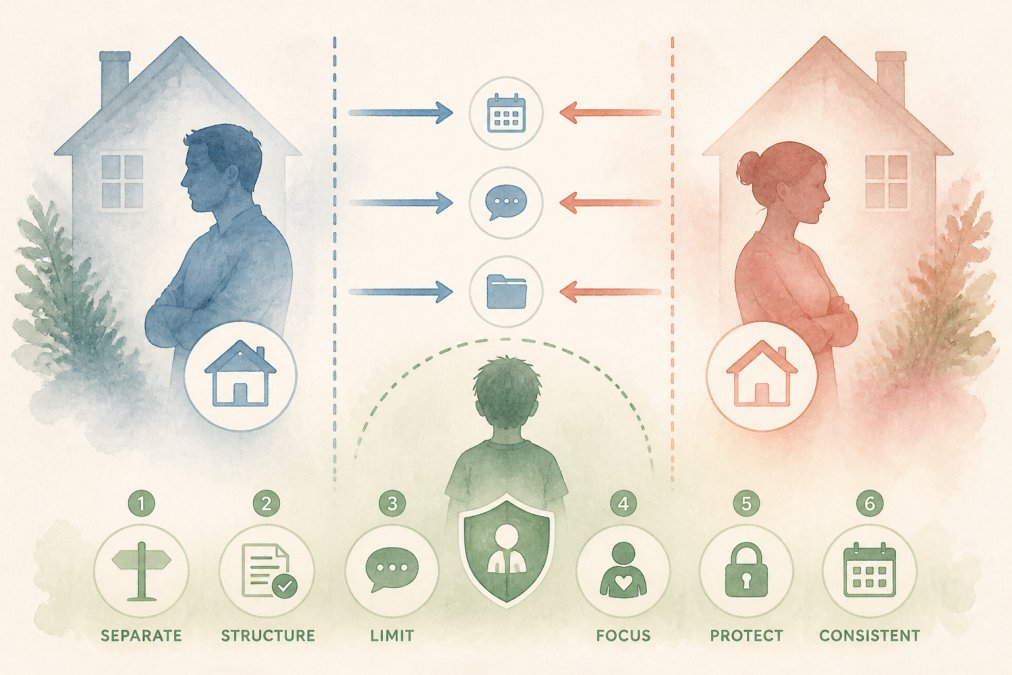
When your ex is genuinely hostile, parallel parenting is your lifeline. You stop trying to co-parent together. You parent separately, in parallel.
Separate Communication Into Child-Related Topics Only
In parallel parenting, you communicate only about logistics and the child’s basic needs, nothing else.
What you discuss:
- Pickup and dropoff times
- School and medical appointments
- Child’s activities and schedule
What you don’t discuss:
- Parenting philosophy
- How the child behaves at the other house
- Your opinions on the other parent’s choices
It sounds cold, and it is, but when your ex is hostile, cold is safe.
Example of parallel parenting message:
“Pickup is Friday at 4 p.m. Emma has soccer at 6 p.m. on Saturday.
Use Written Records Instead of Conversations
Hostile co-parents twist what was said, deny agreements, and use your words against you. Stop having conversations and use written communication instead.
This creates a record and forces you both to be more careful with your words, writing is slower, more deliberate, more defensible.
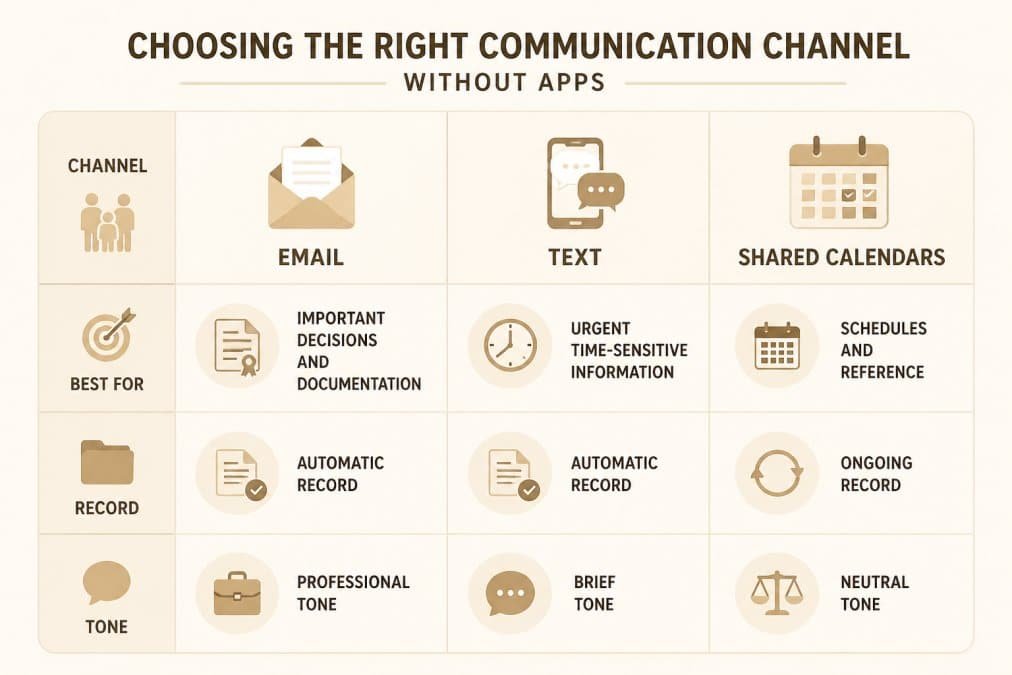
| Communication Method | Best For | Record | Tone |
|---|---|---|---|
| Important decisions, documentation | Automatic | Professional | |
| Text | Urgent, time-sensitive info | Automatic | Brief |
| Phone | Emergencies only | Manual follow-up required | Conversational |
| In-person | Rare, with mediator present | Manual documentation | Formal |
Choosing the Right Communication Channel Without Apps
Not every message needs the same channel, the right one depends on urgency, importance, and whether you need a record.
Email for Important Decisions and Documentation
Use email when:
- You need a record
- The decision affects the child’s schedule or health
- You’re setting a boundary
Email creates an automatic record. It’s formal enough to encourage careful language. It gives you time to think before sending.
Email is best for:
- Schedule changes
- Medical decisions
- Behavioral concerns
Don’t use email for:
- Emergencies (too slow)
- Quick logistical questions (use text)
- Time-sensitive information (use text)
Text for Urgent, Time-Sensitive Information
Use text when:
- Something needs immediate attention
- The information is simple and factual
- You need a quick response
Text is fast and recorded, but informal enough that it won’t escalate tension the way a formal email might.
Text is best for:
- “I’m running 10 minutes late”
- “Emma forgot her lunch”
- “Can you pick up at 4 instead of 3?”
Don’t use text for:
- Complex decisions (too easy to misunderstand)
- Sensitive topics (too informal)
- Setting boundaries (too casual)
Shared Calendars and Documents for Schedules and Records
A shared calendar (Google Calendar, Outlook, or even printed) keeps everyone on the same page about schedules, and a shared document (Google Docs, Dropbox Paper) tracks information you both need to reference. These aren’t communication tools but reference tools. Use them for:
- Custody schedule
- School calendar
- Medical appointments
Both parents see the same information, no miscommunication about “whose weekend it is” and no arguments about when the appointment was scheduled.
Common Mistakes to Avoid in Co-Parenting Communication
Most parents make the same mistakes. Knowing them helps you avoid them.
Mistake 1: Explaining your reasoning
Mistake 2: Asking questions you don’t want answered
“Do you think Emma should try soccer?” gives your ex veto power.
Mistake 3: Sending messages when you’re angry
Mistake 4: Expecting your ex to change
Your ex is who they are.
Mistake 5: Using the child as a messenger
“Tell your dad I said…” is never acceptable.
Mistake 6: Keeping score
After the Affair Series provides structured frameworks and ready-to-use scripts for exactly these situations.
Frequently Asked Questions
How can co-parents communicate without using an app?
Email, text, and shared calendars or documents are the most practical alternatives. Email creates a documented record ideal for important decisions. Text works for urgent, time-sensitive updates. Shared calendars (Google Calendar, Outlook, or Cozi) handle scheduling without messaging. Written communication removes the pressure of immediate responses and reduces reactive conflict. The key is choosing the right channel for each type of message and maintaining consistent, factual communication focused on your children’s needs.
What should you include in a co-parenting communication script or message?
Keep messages brief, factual, and child-focused. Include only the essential information: what happened, what you’re requesting, and when you need a response. Avoid emotional language, accusations, or references to your ex’s behavior. For example: ‘Sarah has a dentist appointment Tuesday at 3 p.m. Can you confirm pickup at 5 p.m.?’ is clear and neutral. Avoid: ‘You never pick her up on time, so I’m arranging this myself.’ Scripts that follow this structure reduce defensiveness and keep the focus on your children’s wellbeing.
How do you set healthy boundaries with a high-conflict co-parent?
Define which topics are off-limits (personal relationships, finances unrelated to children, past conflicts) and communicate this clearly once. Establish response timelines: ‘I expect replies to scheduling requests within 24 hours.’ Use written communication to maintain a record. If your ex sends hostile or off-topic messages, do not respond immediately. Take time to decide whether a response is necessary or if engaging will escalate conflict. Boundaries also mean limiting conversations to child-related topics and refusing to engage in arguments, even if provoked. Consistency is critical, enforce the same boundaries every time.
What is parallel parenting communication, and when should you use it?
Parallel parenting communication minimizes direct interaction and focuses exclusively on child-related logistics. Use this approach when your ex is consistently hostile, refuses to cooperate on decisions, or escalates conflicts. Instead of negotiating, you communicate information only: ‘Emma’s soccer schedule is attached. Please confirm which games you’ll attend.’ Parallel parenting avoids requests for agreement or discussion, you inform rather than consult. This strategy protects your emotional energy and reduces conflict exposure. It works best when combined with written records and clear boundaries, and it’s especially valuable when your ex uses communication to control or manipulate.