Last Updated: October 24, 2026
Quick Summary
Court ordered custody exchanges are formal handoffs of your child from one parent to the other per a judge’s terms, with specific timing, location, and conditions. Best practices include using safe, neutral public locations, keeping communication minimal and controlled, following a consistent checklist, and documenting every exchange to protect your child’s wellbeing and your legal standing.
- Use public locations like police station lobbies or library parking lots to reduce conflict and create witnesses.
- Apply the Gray Rock Method for in-person exchanges: respond in brief, bland, unemotional statements without engaging provocations.
- Complete a checklist before, during, and after each exchange covering preparation, arrival, handoff, communication, and follow-up.
- Document every exchange with date, time, location, punctuality, child’s condition, and any incidents in a co-parenting app or log.
- Wait a reasonable period if your co-parent is late, document the instance, and communicate in writing through your co-parenting app.
Table of Contents
Understanding Your Court Ordered Custody Exchange
How you handle exchanges affects your child’s sense of security and your legal standing. Courts notice patterns at handoffs, missed exchanges, late arrivals, hostile interactions, and notice when a parent consistently follows the order.
This guide covers executing exchanges safely and predictably, even with a difficult co-parent: clear structure, minimal direct contact, and documentation that protects you and your child.
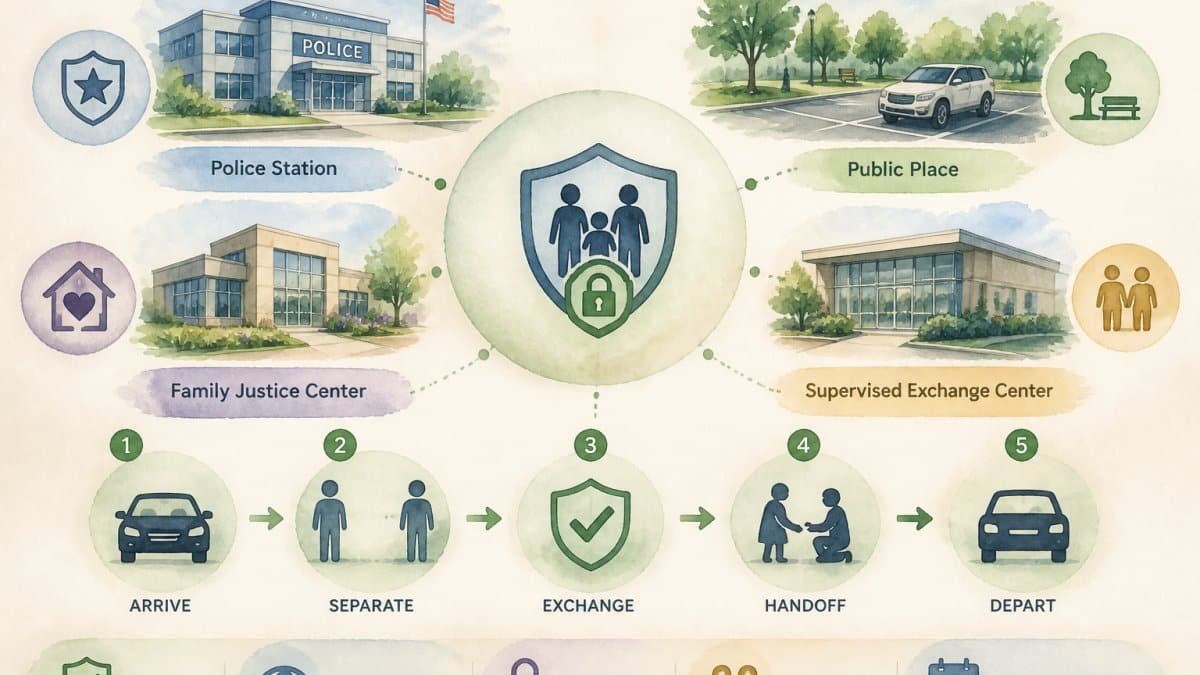
Safe Custody Exchange Locations and Setup
A safe, neutral location removes the emotional weight of meeting at someone’s home and creates a buffer between you and your co-parent.
Public places work best because they’re monitored, neutral, and discourage escalation.
Set a consistent location and time. Predictability calms children and removes negotiation from every exchange.
Learn practical strategies to avoid conflict during custody exchanges by understanding how location choice and predictable timing reduce tension at the handoff point.
Custody Exchange Communication Scripts for Difficult Situations
When you interact directly with your co-parent, keep communication minimal and controlled using structured tools.
The Gray Rock Method works here: respond in brief, bland, unemotional statements.
Example exchange:
- Co-parent: “You’re always late. You don’t care about our daughter.”
- Gray rock response: “I’m here at the scheduled time. I have her until Sunday at 6 PM.”
That’s it. No defense of your character. No explanation of your schedule. No emotional reaction.
For written communication, texts, email, co-parenting apps, use the BIFF method: Brief, Informative, Friendly, Firm.
Example BIFF message:
“Sarah has soccer at 9 AM Saturday.
Get practical scripts and communication strategies for co-parenting with a narcissist that show you exactly how to handle high-conflict interactions during exchanges.
Creating a Custody Exchange Checklist You Can Use Every Time
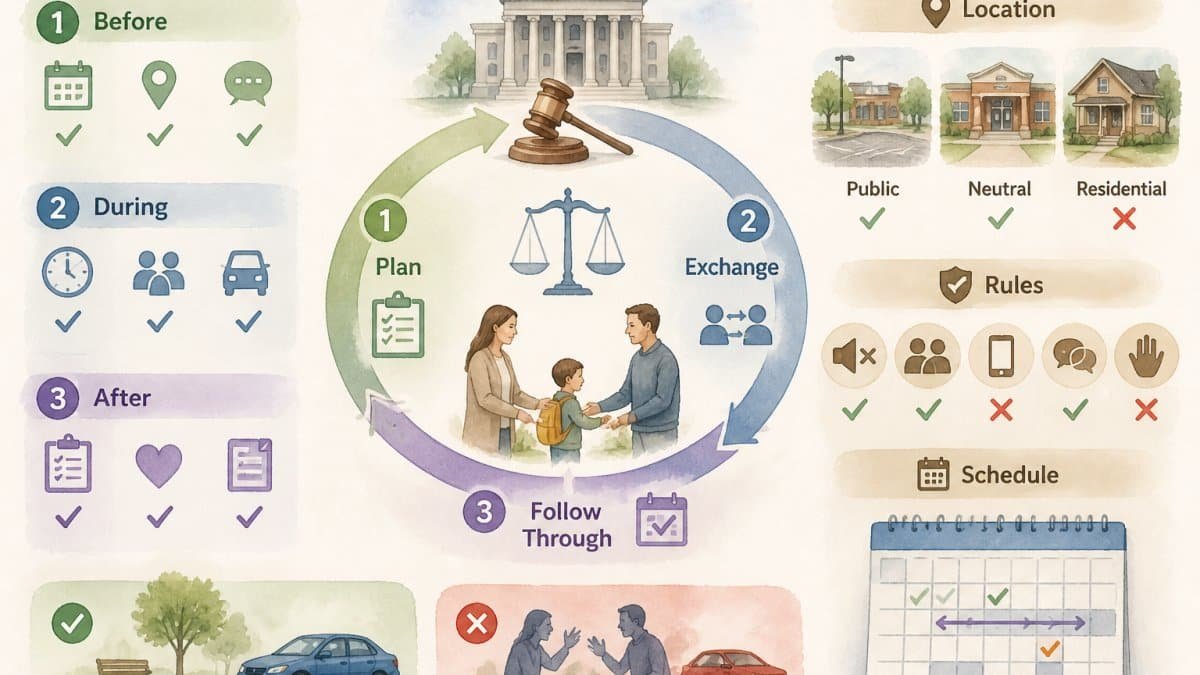
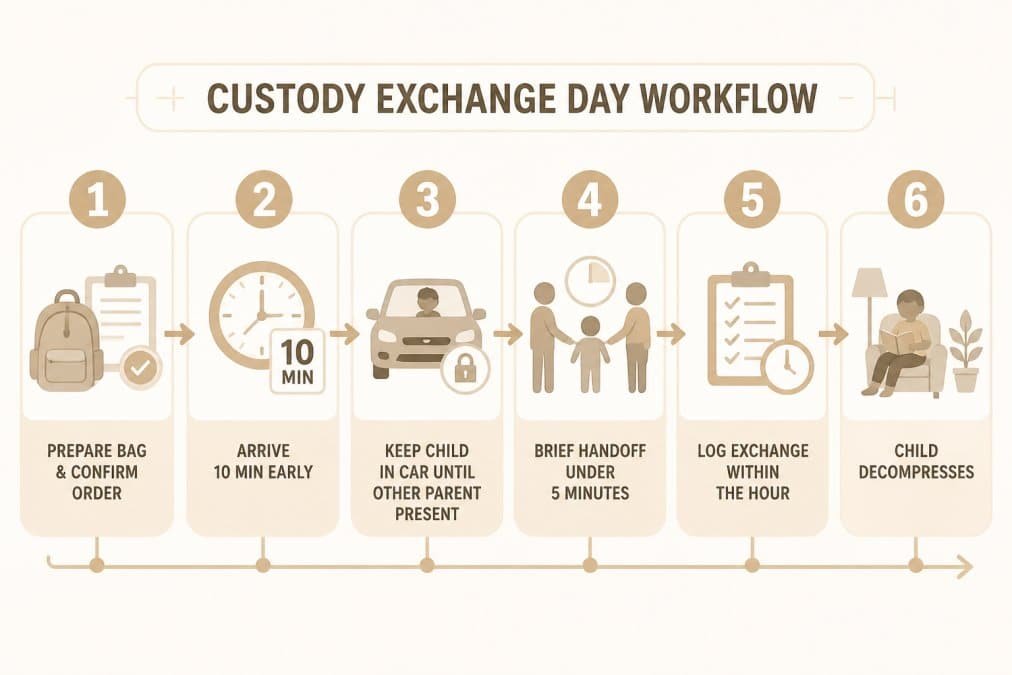
A usable exchange-day checklist covers the whole arc of the handoff: preparation, arrival, the handoff, communication, and follow-up. Adapt this routine to your order.
Before You Leave (the night before and the morning of)
- Re-read the exchange provision, confirm exact time, location, and who transports this leg.
- Pack the child’s bag the night before: labeled medications, schoolwork, sports gear, comfort item, change of clothes.
- Charge your phone and confirm your co-parenting app works.
On Arrival
- Arrive 10 minutes early and park with visibility of the exchange point.
- Keep the child in the car until the other parent is present, never leave a young child alone at the handoff point.
- Greet briefly and warmly. Keep the handoff under five minutes.
Communication at the Handoff
Keep spoken words to logistics; a neutral script beats improvising:
- “She ate at 3. Her inhaler is in the front pocket. I’ll have her back Sunday at 6.”
- “Everything’s in the bag. Have a good week.”
If your co-parent tries to pull you into an argument, use a short, flat response and disengage: “I’m here at the scheduled time. I’ll see you Sunday.” Then leave.
After the Exchange (within the hour)
- Log the exchange in your co-parenting app or your own record: date, time, location, who was present, punctuality, the child’s condition, and any incidents.
- Note missing belongings or confirmed schedule changes.
- Give your child space to decompress, a quiet activity, a snack, time with a pet, rather than interrogating them about the other household.
Age-Appropriate Support During the Transition
Children experience handoffs differently by age, so flex the checklist:
- Toddlers and preschoolers: Keep goodbyes short and cheerful. A consistent comfort object and predictable routine (same snack, same song in the car) do more than explanations.
- School-age children: Tell them the schedule in advance and let them pack a favorite item. Don’t make them carry messages or ask the other parent questions for you.
- Teens: Give them more say in logistics where the order allows (e.g., which parent drives to practice), and never ask them to choose sides or report on the other household.
Across all ages, the rule is the same: the child is not a messenger, a spy, or a referee.
Why the Checklist Matters Legally
The checklist keeps you calm during a stressful moment and creates a contemporaneous record. If a dispute later arises about whether the child was fed, properly clothed, or handed off on time, dated notes are far more persuasive than memory, courts weigh specific, consistent records over general complaints.
Print the checklist and keep a copy in your car and one in the child’s bag. The fewer decisions you have to make in the moment, the less room there is for conflict to start.
What to Do When a Co-Parent Is Late for an Exchange
Lateness is the most common exchange failure, but not the only one. This section covers late arrivals, missed handoffs, refusal to return the child, and immediate safety concerns, and where to draw the line between handling it yourself, calling your attorney, and calling law enforcement.
Start With the Order, Not Your Assumptions
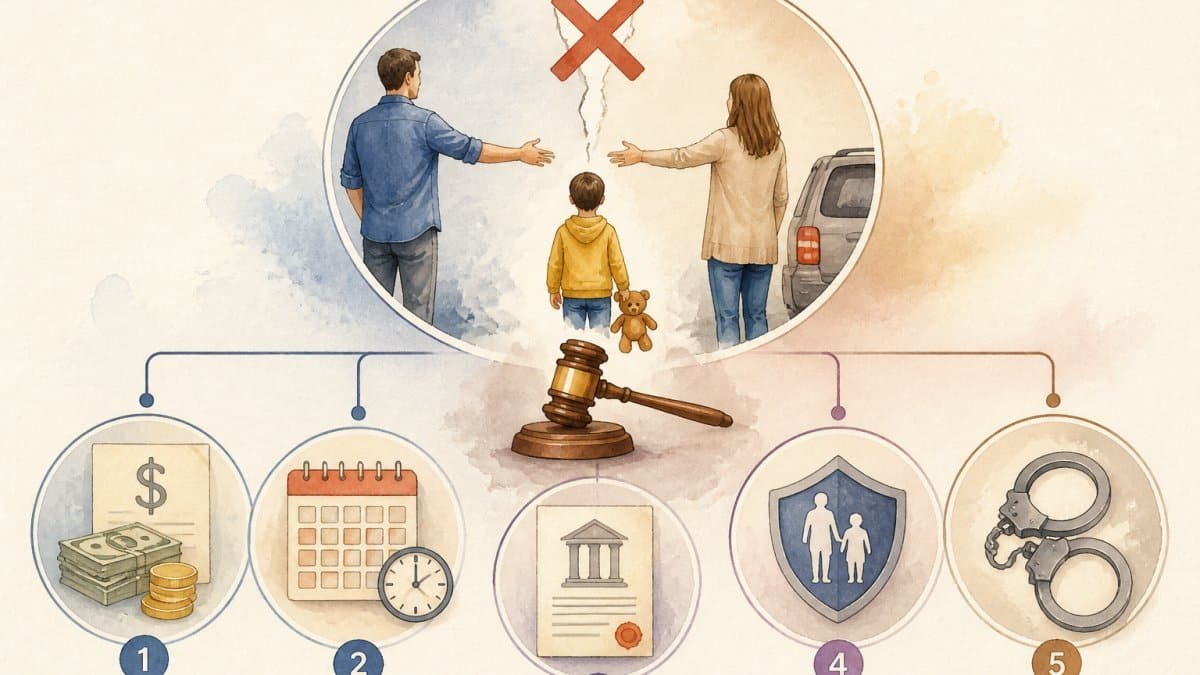
Before reacting to any exchange problem, read the exact language of your order. If it says “6:00 p.m. at the police station lobby,” that is the standard, not “around 6” or “whatever we agreed by text last month.” Parents cannot unilaterally change the order without risking a contempt finding; a permanent change is a modification request to the court, not a parking-lot negotiation.
When a Co-Parent Is Late
Don’t assume malice, traffic, weather, and genuine emergencies happen. But a pattern is different from an incident.
- Wait a reasonable period consistent with your order and safety, many practitioners suggest documenting your arrival and waiting a set window (e.g., 30 minutes) before leaving, unless your order says otherwise.
- Document every instance: date, scheduled time, your arrival time, actual exchange time, and how late the other parent was.
- Communicate in writing through your co-parenting app: “I was at the exchange location at 6:00 p.m. as ordered. You arrived at 6:40. Please plan to arrive on time going forward.” Keep it factual.
After three or four documented instances, you have a pattern that matters if you later ask the court to enforce or modify the order.
When a Handoff Is Missed Entirely
A missed handoff, the other parent simply doesn’t show, differs from lateness. Document your arrival, the time you left, and any messages sent. Send one written message noting the missed exchange and asking whether they intend to exercise their time, then follow your order’s missed-visitation provision, if it has one. Don’t treat a single missed exchange as permanent forfeiture of the other parent’s rights.

When a Co-Parent Refuses to Return the Child
Refusal to return the child at the end of your parenting time is serious; the right response depends on the circumstances.
- If there is an immediate safety concern, you believe the child is in danger, call 911. Law enforcement can conduct a welfare check. Keep a copy of your custody order in your car and on your phone to show officers.
- If there is no immediate danger but the other parent refuses to return the child, do not escalate physically. Document the refusal in writing, contact your attorney, and consider a motion to enforce. In many jurisdictions, willful violation can support a contempt action, but specifics depend on your state’s law and your order.
- Do not attempt a self-help recovery, showing up at the other parent’s home to take the child back can escalate into confrontation and may harm your legal position.
Distinguishing Emergencies From Issues for Counsel or the Court
A useful rule of thumb:
- Call 911: immediate danger to the child, a medical emergency, or a credible threat of harm.
- Call your attorney: refusal to return the child, repeated missed exchanges, suspected violation of the order, or a need to modify the schedule.
- Document and continue: occasional lateness, minor schedule confusion, or a one-time missed handoff with a reasonable explanation.
Never use the child as leverage in an exchange dispute. Withholding the child to punish the other parent, or refusing to hand the child over because you are angry about lateness, can be treated as a violation of the order and can damage your credibility with the court.
Building the Record That Supports Enforcement
If exchanges keep failing, documentation turns a complaint into a case. Log each incident with date, time, location, what happened, and any witnesses, and keep copies of messages.
Learn when to modify a custody exchange schedule and how to request changes if your current arrangement stops working for your child or your circumstances shift.
Know how to respond to different exchange failures and when to involve your attorney or law enforcement.
| Exchange Problem | Response | When to Escalate |
|---|---|---|
| Co-parent is late | Document arrival and actual time; wait reasonable period; communicate in writing | After 3-4 documented instances |
| Handoff missed entirely | Document your arrival and departure; send one written message; follow order’s missed-visitation provision | Contact attorney if pattern emerges |
| Co-parent refuses to return child | Do not escalate physically; document refusal in writing; contact attorney | Call 911 if immediate safety concern |
| Immediate danger or credible threat | Keep custody order copy in car and on phone | Call 911 immediately |
Protecting Your Child During Transitions
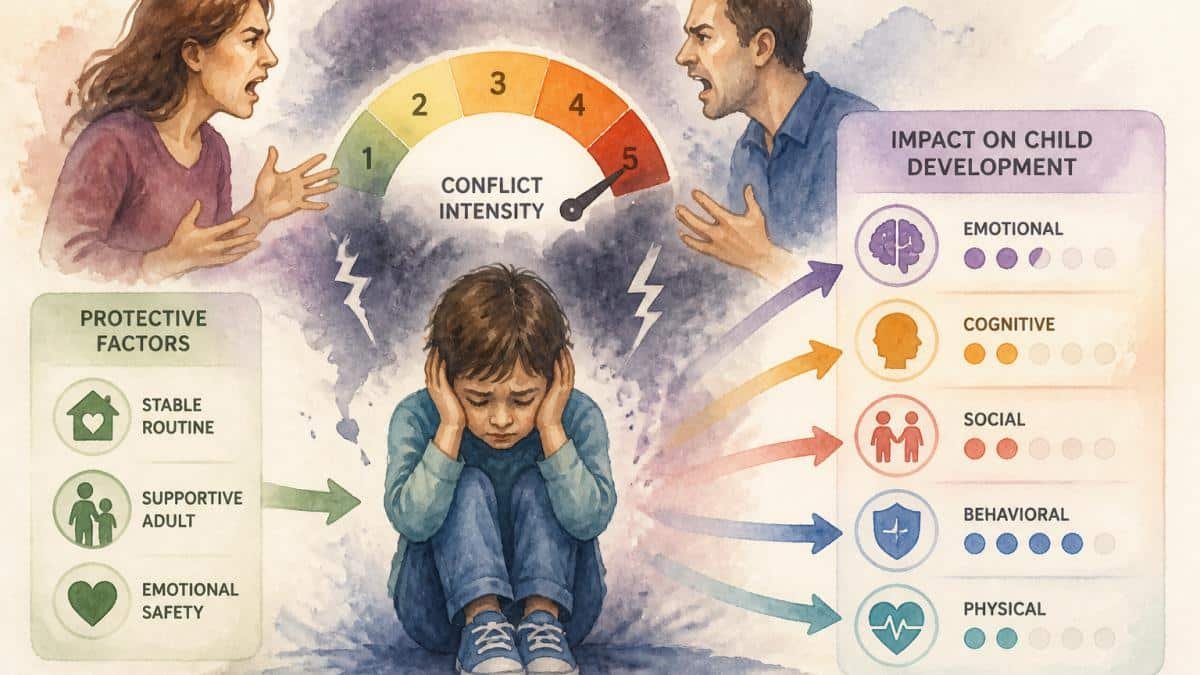
Your child doesn’t cause the conflict, but they absorb it.
Keep goodbyes and hellos brief and warm.
Keep the exchange focused on logistics and your child’s emotional state: “You look tired. Do you need a snack?” “Your backpack is packed.
Afterward, give your child time to decompress.
Discover practical activities to reduce child anxiety after divorce that help your child feel secure during transitions between homes.
Documenting Exchanges and Building Your Record
Documentation is your protection, facts instead of he-said-she-said arguments. Document three things consistently:
- Exchange logistics: Date, time, location, who was present, whether the exchange was on time
- Your child’s condition: How they appeared physically and emotionally, what they wore, what belongings they had
- Any incidents: Missed exchanges, late arrivals, hostile behavior, safety or wellbeing concerns
Use a co-parenting app like OurFamilyWizard for a shared, timestamped record, or keep your own log in a spreadsheet or notebook.
If your co-parent is genuinely hostile, abusive, or neglectful, this documentation becomes evidence. Courts want facts, not feelings, dates, times, specific behaviors, and patterns drive decisions about custody modifications or enforcement.
Learn how to document everything when co-parenting with a narcissist to protect yourself legally and emotionally with effective strategies and tools.
Starting Your Structured Exchange Plan
You don’t need your co-parent’s permission to implement these practices, start immediately.
Pick a safe, public location and commit to it. Establish a consistent time if you haven’t already.
Start documenting now, even if exchanges have been smooth.
The structured approach removes emotion from logistics.
Learn when to modify a custody exchange schedule and how to request changes if your current arrangement stops working for your child or your circumstances shift.
Court ordered custody exchanges don’t have to be a source of constant conflict.
Frequently Asked Questions
What should you do if the other parent is late to a custody exchange?
Document the exact time you arrived and when the other parent arrived. Send a follow-up text within 24 hours stating the facts: ‘You arrived 20 minutes late to the 3 PM exchange on Tuesday.’ Do not accuse or demand explanations. If lateness becomes a pattern, photograph the clock or use a timestamped photo of your car. After three documented late arrivals, consult your family law attorney about whether the pattern violates your custody order and whether modification is necessary.
Can parents change the location of a court-ordered custody exchange?
Only if both parents agree in writing and the court approves the change. A text or verbal agreement is not sufficient. If you want to change the location, propose it in writing to the other parent and ask them to sign a stipulation. Both parents then file the signed agreement with the court. If the other parent refuses to change locations or you cannot agree, you must follow the original court order or petition the court for modification, which requires showing a substantial change in circumstances.
How can parents make custody exchanges less stressful for children?
Keep exchanges brief and predictable. Arrive on time, keep the child out of adult conversation, and avoid discussing the other parent or custody issues. Use neutral language: ‘Your mom is here’ rather than ‘Your mom is picking you up.’ Allow the child a few minutes to adjust if needed, but do not extend the exchange. Maintain the same location and time each week so the child knows what to expect. If the child is anxious, offer reassurance that both parents love them and that exchanges are routine.
What is the best way to communicate about custody exchanges?
Use written communication only: email or a dedicated co-parenting app. Avoid phone calls, texts, or in-person discussion about logistics. Keep messages short, fact-based, and focused on the child’s schedule and needs. Example: ‘Soccer practice moves to 4 PM next week. I’ll drop off at 3:50 PM instead of 3:30 PM.’ Do not discuss the other parent’s behavior, your feelings, or relationship issues. Stick to dates, times, locations, and the child’s needs.
Should custody exchanges take place in a public location?
Yes. Public locations reduce conflict and provide witnesses if disputes arise. Safe options include police station lobbies, library parking lots, shopping centers, parks, and supervised exchange facilities. Public places make it harder for either parent to escalate arguments and protect your safety. If your custody order does not specify a location, propose a neutral public place to the other parent in writing. If you feel unsafe, ask the court to order supervised exchanges or use a professional exchange service.
How can you document missed or difficult custody exchanges?
Keep a log with the date, time, location, and what happened. Note if the other parent was late, did not show up, or if conflict occurred. Take timestamped photos of your arrival time (your car’s clock visible, or a photo with your phone timestamp). Send a follow-up email within 24 hours summarizing the exchange: ‘You did not arrive for the 6 PM exchange on Friday. I waited until 6:45 PM.’ Keep all messages, photos, and logs in a folder. This documentation supports any future court motion about compliance with the custody order.
What should you do if the other parent does not follow the custody order?
First, document each violation with dates, times, and details. Send a written reminder of the court order: ‘Our order states exchanges occur at 3 PM on Fridays at Central Park. Please follow the schedule.’ Do not argue or threaten. If violations continue after two written reminders, contact your family law attorney. You may need to file a motion for enforcement, which asks the court to hold the other parent accountable. The court can impose sanctions, modify the order, or change custody arrangements if violations harm the child.