TL;DR:
- Personality traits like high narcissism and low conscientiousness are linked to higher infidelity risk.
- Traits influence impulse control, empathy, and emotional regulation, affecting cheating behaviors.
- Understanding these traits aids healing by clarifying the role of personality without assigning blame.
When a relationship ends in betrayal, most people immediately ask: why? Opportunity, unhappiness, and circumstance are the usual suspects. But research increasingly points somewhere more personal: the traits that define who someone fundamentally is. Scientific studies now link specific personality characteristics to a measurably higher risk of infidelity, and understanding this connection is not about assigning blame. It is about gaining clarity. For anyone rebuilding after betrayal, knowing the personality science behind cheating can transform a confusing, painful experience into a roadmap for genuine recovery and stronger future choices.
Table of Contents
- Understanding personality types and infidelity risk
- Which personality traits are most linked to cheating?
- Why do personality traits influence infidelity?
- Personality is not destiny: Healing and growth after betrayal
- Our perspective: Understanding is the first step to true healing
- Practical steps for recovery and growth
- Frequently asked questions
Key Takeaways
| Point | Details |
|---|---|
| Certain traits raise risk | High narcissism and low conscientiousness increase the likelihood of cheating. |
| No trait guarantees betrayal | Personality is only one factor and does not determine anyone’s choices. |
| Self-awareness supports healing | Understanding these links helps set boundaries and promote recovery. |
| Structured tools aid recovery | Guides and support resources can make healing after infidelity easier. |
Understanding personality types and infidelity risk
The word “personality” gets used loosely in everyday conversation, but psychologists are far more precise. A personality type is a stable pattern of thoughts, feelings, and behaviors that shapes how a person responds to the world around them. The most widely used research framework is the Big Five model, which identifies five major personality traits assessed across openness, conscientiousness, extraversion, agreeableness, and neuroticism. Researchers often use the acronym OCEAN to remember them.
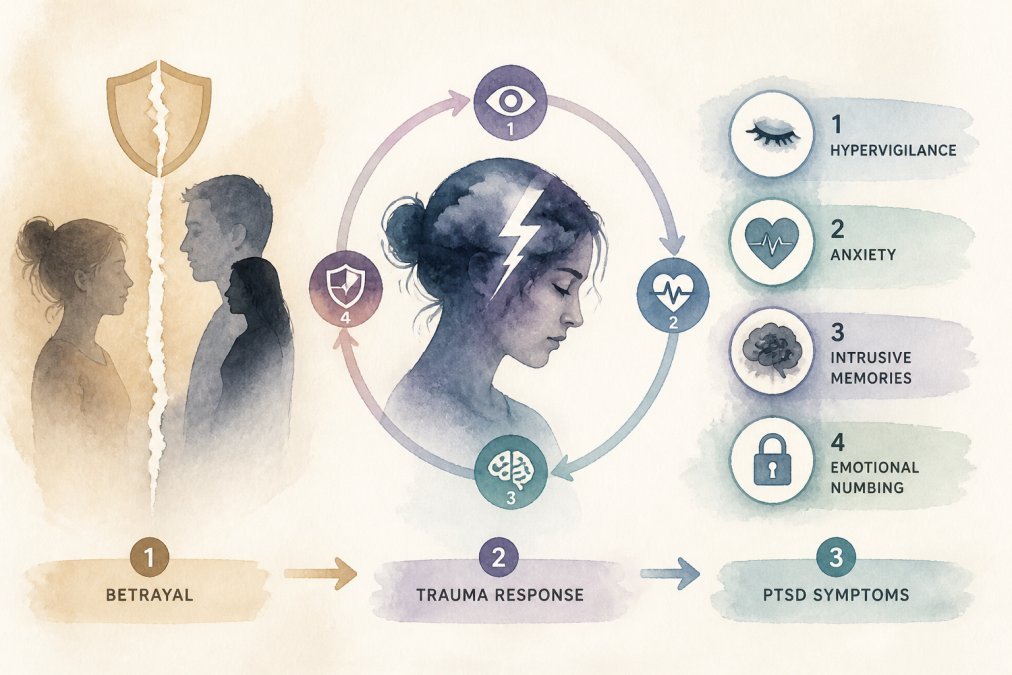
Why do researchers connect personality to infidelity? Because these traits predict how someone manages impulse control, empathy, commitment, and risk. The effects of infidelity ripple far beyond a single decision, and understanding the personality conditions that make cheating more likely can help survivors make sense of what happened without internalizing false guilt.
Here is a breakdown of each Big Five trait and how it relates to relationship behavior:
| Big Five trait | Core quality | Relationship behavior link |
|---|---|---|
| Openness | Curiosity, novelty-seeking | May crave variety; can be linked to emotional affairs |
| Conscientiousness | Self-discipline, reliability | Strong predictor of fidelity and commitment |
| Extraversion | Sociability, assertiveness | More social exposure; mixed findings on infidelity risk |
| Agreeableness | Empathy, cooperation | Generally associated with lower cheating risk |
| Neuroticism | Emotional instability, anxiety | Linked to relationship dissatisfaction and impulsive decisions |
No single trait operates in isolation. A person high in openness and neuroticism but low in conscientiousness faces a very different risk profile than someone with the opposite combination. Personality works like a recipe: each ingredient matters, and proportions change the outcome significantly.
Pro Tip: Reflecting on your own Big Five profile can sharpen your ability to recognize which dynamics in a past relationship were genuinely incompatible, rather than personal failures on your part.
Which personality traits are most linked to cheating?
Now that we have defined personality types, let’s look at what empirical research actually reveals about infidelity risk. The findings are more specific than most people expect.
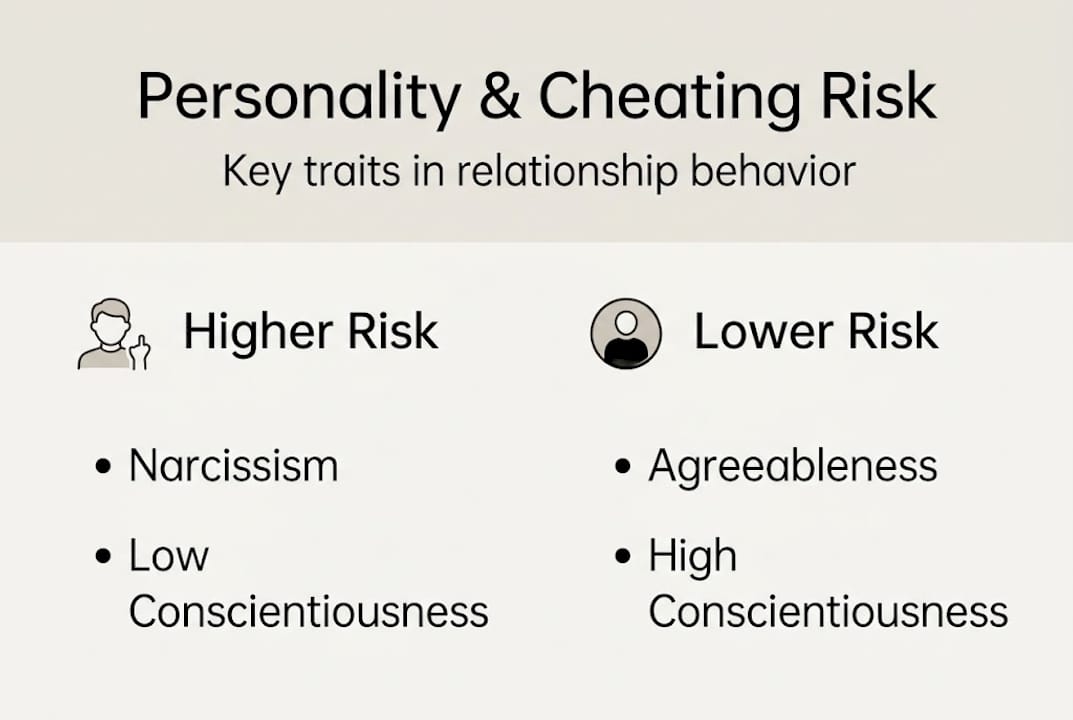
Studies consistently show that high narcissism and low conscientiousness are the strongest personality predictors of cheating. In fact, people high in narcissism are nearly twice as likely to report infidelity compared to those with low narcissistic traits. Narcissism feeds a sense of entitlement, reduces empathy for a partner’s pain, and inflates the belief that the usual rules simply do not apply.
On the protective end, individuals high in agreeableness and conscientiousness are significantly less likely to cheat. Agreeableness supports genuine empathy and consideration of consequences. Conscientiousness builds the self-regulation needed to stay committed even when attraction to someone else emerges. These are not just nice qualities; they function as psychological guardrails.
Here is a direct comparison:
| Personality trait | Infidelity likelihood | Why |
|---|---|---|
| High narcissism | Higher | Entitlement, low empathy, need for admiration |
| Low conscientiousness | Higher | Poor impulse control, reduced guilt response |
| High neuroticism | Moderate to higher | Emotional volatility, seeking comfort outside relationship |
| High agreeableness | Lower | Empathy and conflict avoidance reduce risk |
| High conscientiousness | Lower | Commitment, self-discipline, value alignment |
Some common misconceptions often cloud this topic. Here is what the research actually shows:
- Myth: Extroverts are naturally more likely to cheat. Reality: Extraversion alone is not a reliable predictor; it is the combination with other traits that matters.
- Myth: Only unhappy people cheat. Reality: Even those who report relationship satisfaction can cheat if narcissistic or low on conscientiousness.
- Myth: Cheating is a one-time impulsive act. Reality: The causes of repeated infidelity are often rooted in deep personality patterns, not isolated moments of weakness.
- Myth: If someone cheated once, their personality guarantees they will again. Reality: Context, support, and intentional growth all play a role in whether behavior changes.
Why do personality traits influence infidelity?
Having data about which traits matter, the next critical question is: why do these traits actually drive cheating behavior? The answer lies in three distinct psychological pathways.
1. Impulse control failures. Low conscientiousness is directly associated with impulsivity and elevated risk-taking behaviors. When someone lacks the psychological wiring to pause before acting on desire, the gap between temptation and action becomes dangerously thin. This is not a moral weakness so much as a structural deficit in how their mind regulates behavior.
2. Empathy deficits. Traits like narcissism and low agreeableness reduce a person’s capacity to fully picture their partner’s pain. If you cannot viscerally imagine the devastation your actions will cause, the emotional brake that stops most people simply does not engage. The ability to empathize with a betrayed partner is itself a form of protection against cheating.
3. Emotional regulation problems. Neuroticism creates chronic relationship dissatisfaction even when circumstances are objectively fine. People high in neuroticism often seek external validation or emotional escape, making them vulnerable to affairs born of anxiety rather than desire.
“Personality traits shape the psychological context in which relationship decisions are made. They do not determine choices, but they do create conditions where certain choices become far more or less likely.” This distinction matters deeply for anyone working through emotional trauma after infidelity, because it separates what was about the cheating partner’s internal world from what was about you.
Understanding these pathways can also reshape how you approach future relationships. Recognizing early signs of low empathy or impulsivity is not paranoia. It is informed pattern recognition. If you are working with a counselor, exploring these dynamics with the benefits of therapy after infidelity in mind can accelerate insight significantly.
Pro Tip: When reflecting on a past partner’s behavior, try mapping it to these three pathways rather than asking “what did I do wrong?” It redirects the question from self-blame to honest analysis.
Personality is not destiny: Healing and growth after betrayal
Here is the most important thing to hold onto: understanding that certain traits increase infidelity risk does not mean personality is destiny. The complex psychology of infidelity involves choices, circumstances, relational dynamics, and personal values all interacting at once. A person high in narcissism may never cheat because their values, faith, or personal commitments override that risk. Conversely, someone with a generally healthy trait profile can make destructive choices under extreme stress or poor social influence.
This matters for healing because it protects you from two equally damaging errors: assuming you could have changed the outcome by being different, or writing off all future partners because of one person’s behavior.
Building resilience and choosing partners wisely going forward involves focusing on what genuinely builds trust and stability:
- Prioritize demonstrated consistency over stated intentions. People show their conscientiousness in small, observable daily choices long before major loyalty tests arise.
- Watch for empathy in action, not just words. Does a person show genuine curiosity about your feelings, or primarily redirect conversations to themselves?
- Notice how someone handles frustration and impulse. Low conscientiousness often shows up in small ways: broken commitments, impulsive spending, difficulty following through.
- Invest in your own healing first. Learning to cope after infidelity is not about rushing to trust again; it is about rebuilding your internal compass.
- Consider professional support. If you work in a caregiving or support role, understanding how to guide clients after infidelity can also deepen your own framework for recovery.
- Reconnect with your own values. Betrayal often shakes confidence in personal judgment. Grounding yourself in what you know to be true about your character is a powerful stabilizer.
Recovery is not about becoming suspicious of everyone. It is about becoming more precise in what you observe, what you require, and what you will not rationalize away.
Our perspective: Understanding is the first step to true healing
After working through the science and sitting with countless stories of betrayal, we hold one conviction firmly: understanding personality traits connected to cheating is not the same as excusing them. Knowing that someone is high in narcissism or low in conscientiousness explains a behavioral tendency. It does not absolve the choice to hurt someone they claimed to love.
What conventional healing advice often misses is the difference between intellectual understanding and emotional integration. People read about narcissism and feel briefly satisfied, then return to spiraling guilt. The missing piece is using that understanding as a tool, not a conclusion. It should sharpen your boundaries, clarify your expectations, and free you from the exhausting question of what you did wrong.
The path forward is structured and intentional, not just explanatory. Working through an infidelity recovery checklist moves insight from your head into your actual life. That transition, from knowing to doing, is where genuine healing begins.
Practical steps for recovery and growth
If this article has helped you see your experience through a clearer lens, the next step is turning that clarity into concrete action.
At After the Affair, we have built resources specifically for people ready to move beyond confusion and into structured recovery. Start with the infidelity recovery checklist, a practical seven-step guide that moves you from raw pain toward grounded decision-making. When you are ready to rebuild, explore the relationship growth after infidelity series for evidence-informed guidance on rebuilding trust. For broader support and deeper reading, the full infidelity recovery resources library gives you access to tools across every stage of the journey.
Frequently asked questions
Can someone’s personality type predict if they will cheat?
Certain traits increase risk, but no personality type guarantees infidelity. Risk is higher with certain traits but personal values and situation always play a role.
Which personality traits most often lead to cheating?
High narcissism and low conscientiousness are most consistently linked to unfaithfulness. These traits predict cheating more reliably than any other combination in current research.
Is healing possible after discovering a partner’s personality-related betrayal?
Yes, healing is entirely possible with the right support, self-insight, and structured tools. The stages of healing after betrayal are well-documented and achievable with guided recovery.
Do all people with ‘risky’ traits cheat?
No. Many people with higher-risk personality profiles never cheat because personal values, relational commitment, and life circumstances matter significantly. No single trait determines behavior; choices remain choices.
What can I do to recover after infidelity?
Access step-by-step recovery guides, seek professional or peer support, and build a structured healing plan. The infidelity recovery checklist is a strong, practical starting point for anyone beginning this process.
Recommended
- How to Recognize Each Type of Affair – After the Affair Series
- Recognize the Affair Type – After the Affair Series
- Serial Cheating vs. Opportunistic Affairs – After the Affair Series
- 7 Types of Infidelity-Healing & Recovery – After the Affair Series