TL;DR:
- Repeated infidelity is driven mainly by psychological traits like narcissism, impulsivity, and low empathy.
- Emotional trauma from betrayal can resemble complex PTSD, requiring long-term support and patience.
- Therapy and deep individual work significantly increase chances of relationship recovery after repeated affairs.
Only 31% of marriages survive infidelity long-term, and when betrayal happens more than once, the emotional consequences multiply. Yet most people still assume affairs happen because something is broken in the relationship. That assumption misses the deeper truth. Repeated infidelity is rarely just about dissatisfaction with a partner. It is driven by psychological patterns that live inside the person who cheats, not between two people. This guide walks you through the real causes of serial betrayal, the emotional toll it takes on partners, and the concrete steps that make genuine recovery possible, whether you choose to stay or leave.
Table of Contents
- What drives repeated infidelity?
- Emotional and psychological impacts on partners
- Can relationships survive repeated infidelity?
- Actionable recovery steps for individuals and couples
- Why the standard advice misses the heart of repeated infidelity
- Moving forward: guided support and resources
- Frequently asked questions
Key Takeaways
| Point | Details |
|---|---|
| Personality predictors matter | Repeated infidelity is most often linked to individual psychological patterns, not just relationship issues. |
| Healing is possible | Many couples and individuals can recover with commitment, support, and structured guidance. |
| Recovery takes time | Restoring trust and emotional stability after repeated betrayal often requires up to two years. |
| Therapy boosts survival | Couples in therapy after infidelity have twice the chance of staying together long-term. |
What drives repeated infidelity?
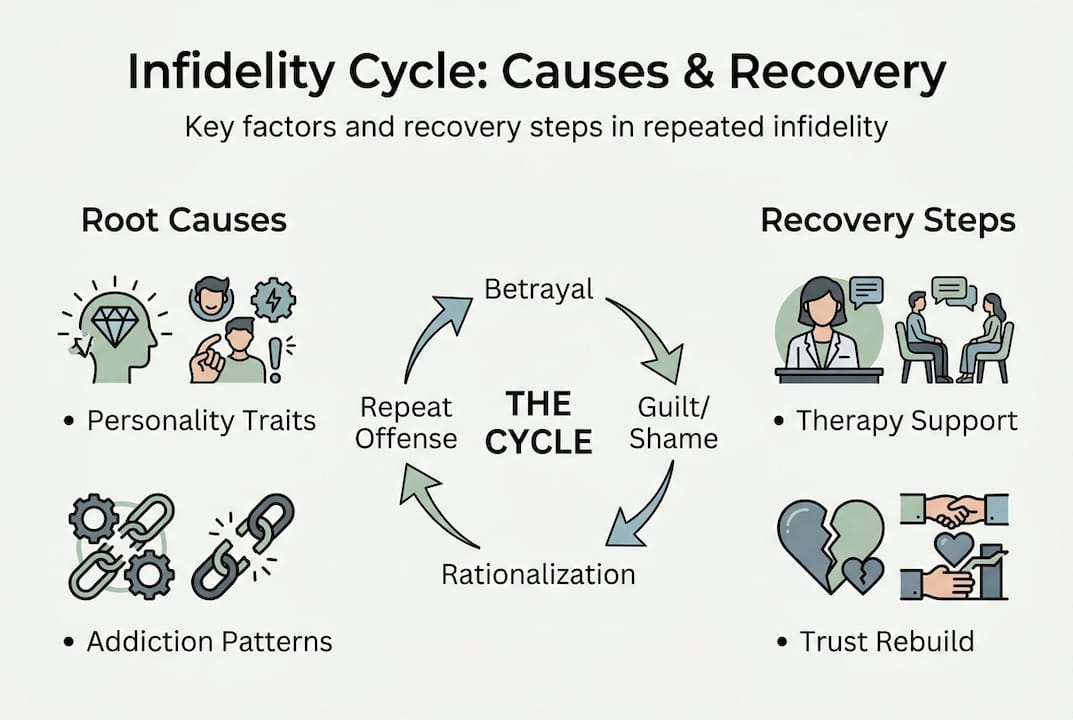
Repeated infidelity is not the same as a one-time affair. A single affair can stem from a moment of weakness, a life crisis, or a relationship hitting a wall. Repeated infidelity, by contrast, is a pattern. It happens across relationships, across years, and often regardless of how good or loving the partnership is. That distinction matters enormously for how you approach healing.
So what actually drives it? Research consistently links repeated infidelity to specific psychological traits:
- Narcissism: A deep need for admiration and an inability to fully empathize with a partner’s pain.
- Impulsivity: Acting on desire without weighing consequences, often tied to poor emotional regulation.
- Low empathy: Difficulty connecting with how betrayal affects others.
- Dark Triad traits: A cluster of narcissism, Machiavellianism, and psychopathy that predicts manipulative behavior.
- Anxious or avoidant attachment: Difficulty with emotional intimacy that drives people to seek connection or escape outside the relationship.
- Addictive thrill-seeking: The neurological reward of novelty and secrecy can become compulsive over time.
Here is how personality-based causes compare to relational or situational ones:
| Cause type | Examples | Likelihood of recurrence |
|---|---|---|
| Personality traits | Narcissism, Dark Triad, impulsivity | High |
| Attachment issues | Anxious, avoidant, fearful styles | Moderate to high |
| Situational factors | Stress, opportunity, life transitions | Lower |
| Relationship dissatisfaction | Conflict, emotional distance | Lower without personality factors |
The APA’s handbook on infidelity makes this point clearly: personality and individual pathology predict repeated affairs far more reliably than relationship quality. In other words, a loving, attentive partner does not protect against a serial cheater’s behavior.
“The most consistent predictors of infidelity are individual-level variables, not relationship-level ones.” — APA Handbook on Infidelity
This is hard to hear, but it is also freeing. If you have been asking yourself what you did wrong, the answer is often: nothing.
For those seeking infidelity guidance after repeated betrayal, understanding these root causes is the first real step. It shifts the recovery focus from fixing the relationship to understanding the person.
Pro Tip: If you recognize Dark Triad or addictive patterns in your partner’s behavior, know that recovery requires addressing those traits directly, not just rebuilding communication.
Emotional and psychological impacts on partners
Understanding the why behind repeated infidelity sets the stage for recognizing its emotional impacts on those affected. And those impacts are significant.
The most common immediate responses include shock, rage, deep shame, and a destabilizing sense of unreality. Many partners describe feeling like the ground disappeared beneath them. That is not an exaggeration. Repeated betrayal attacks your sense of reality, your self-worth, and your ability to trust your own perceptions.
Over time, the emotional effects can include:
- PTSD-like symptoms: Intrusive thoughts, nightmares, and flashbacks triggered by ordinary moments.
- Hypervigilance: Constant scanning for signs of deception, which is exhausting and hard to switch off.
- Anxiety and depression: Persistent low mood, difficulty concentrating, and loss of pleasure in daily life.
- Shame and self-blame: A painful but common response, especially after repeated betrayal where you may have chosen to stay.
- Emotional triggers: Certain songs, places, or phrases can suddenly flood you with grief or anger months later.
Repeated betrayal compounds this trauma. Each new discovery reopens wounds that had barely begun to close. The nervous system stays in a state of threat. Trust does not just erode. It shatters.
“Partners of repeated cheaters often experience a form of relational trauma that mirrors complex PTSD, requiring both safety and sustained therapeutic support to heal.” — Infidelity research literature
The timeline for rebuilding trust after infidelity is longer than most people expect. Recovery averages 18 to 24 months even in cases where both partners are committed and working hard. When infidelity has been repeated, that timeline can stretch further.
You are not broken for struggling. You are responding normally to an abnormal level of betrayal. The healing process steps are real, but they take time, and that is okay.
Can relationships survive repeated infidelity?
Once the emotional stakes are clear, readers naturally ask: can a relationship survive repeated wounds? The honest answer is yes, some can. But the conditions matter enormously.
| Scenario | Survival rate | Key factor |
|---|---|---|
| No therapy after infidelity | Around 31% long-term | Commitment alone |
| Couples therapy after infidelity | Around 60% | Structured support and accountability |
| Repeated infidelity without intervention | Very low | Unaddressed psychological patterns |
| Repeated infidelity with deep individual work | Possible | Partner’s genuine change and transparency |
Therapy raises survival rates from 31% to around 60%. That is not a small difference. It reflects what structured, professional support actually does: it creates a container for honesty, accountability, and guided emotional processing that couples rarely manage alone.
If you are considering whether to stay or leave, these steps help clarify the path forward:
- Full disclosure: The unfaithful partner must be completely honest about what happened. Partial truths keep the trauma alive.
- Structured couples therapy: Work with a therapist who specializes in infidelity, not just general relationship counseling.
- Individual therapy for both partners: The betrayed partner needs their own space to heal. The unfaithful partner needs to address their psychological patterns.
- Rebuilding accountability: Concrete, agreed-upon behaviors that restore a sense of safety over time.
- Setting realistic timelines: Healing is not linear, and both partners need to understand that progress will be slow.
Exploring growth after infidelity is possible, but it requires both people to do genuine individual work, not just couple work. For those wondering whether couples can recover from multiple affairs, the answer depends heavily on the depth of that individual commitment.
Pro Tip: Not every relationship should be saved. Sometimes the healthiest outcome is a clear, supported decision to separate. Clarity is its own form of healing.
Actionable recovery steps for individuals and couples
With hope and context for survival, most people want to know: what concrete steps can be taken right now? Healing is possible, though the timeline is long and the path is rarely straight.
- Assess and accept the reality: Name what happened clearly, without minimizing it. Repeated infidelity is a pattern, not an accident. Accepting that is painful but necessary.
- Find immediate support: Tell someone you trust. Isolation makes trauma worse. A therapist, a close friend, or a structured support resource can hold you while you process.
- Begin structured couples therapy: If you are staying together, find a therapist who works specifically with infidelity. General couples counseling is not the same thing.
- Address underlying traits in the unfaithful partner: Therapy for the person who cheated must go beyond remorse. It needs to examine the psychological patterns that drove the behavior, including attachment style, impulse control, and empathy deficits.
- Prioritize self-care and boundary setting: The betrayed partner needs to rebuild their sense of self. Exercise, sleep, creative outlets, and clear personal boundaries are not luxuries. They are recovery tools.
Therapeutic intervention significantly improves healing outcomes. This is not just about emotional support. It is about having a structured framework that guides both partners through a process that would otherwise feel chaotic and overwhelming.
For practical tools, the guide on coping after infidelity offers grounded, evidence-informed strategies. If you are working through this as a couple, the healing together steps resource provides a structured roadmap.
Pro Tip: Healing is not linear. Setbacks and emotional triggers are normal, not signs that you are failing. Expect two steps forward and one step back, and keep going anyway.
Why the standard advice misses the heart of repeated infidelity
Most advice about infidelity recovery centers on communication, rebuilding trust, and reconnecting emotionally. That advice is not wrong. But for repeated infidelity, it is incomplete.
When betrayal happens more than once, surface-level fixes are not enough. The APA’s research on infidelity is clear that individual pathology and personality issues often matter more than relationship dynamics. Telling a couple to “communicate better” when one partner has deep narcissistic or addictive patterns is like patching a crack in a wall without addressing the foundation.
True recovery from repeated betrayal requires asking harder questions. Why did this happen more than once? What psychological needs was the unfaithful partner trying to meet? What kept the betrayed partner in a cycle of hope and devastation? These are not comfortable questions, but they are the ones that lead somewhere real.
Therapists play a crucial role here, but only when they engage with individual healing as deeply as couple healing. The role of therapists in infidelity recovery is not just to mediate. It is to help each person understand their own patterns.
Sometimes the most honest outcome of that deeper work is the decision to separate. That is not failure. That is clarity, and clarity after repeated betrayal is one of the most valuable things you can find.
Moving forward: guided support and resources
If you are navigating the aftermath of repeated infidelity, structured support can make a real difference in how far and how fast you heal.

At aftertheaffair.uk, the resources are built specifically for people at every stage of this journey. Start with the infidelity recovery checklist to get a clear picture of where you are and what your next steps look like. If you are in the early weeks, the navigating infidelity guide walks you through the first months with practical, compassionate direction. And when you are ready to look at the bigger picture, the stages of healing resource helps you understand where you are in the process and what comes next. You do not have to figure this out alone.
Frequently asked questions
What personality traits are linked to repeated infidelity?
Repeated infidelity connects to narcissism, impulsivity, low empathy, and Dark Triad traits far more consistently than to relationship problems. These are individual characteristics, not reflections of what a partner did or did not do.
Can therapy truly help couples recover after multiple affairs?
Yes. Couples in therapy after an affair stay together at roughly double the rate of those who do not seek professional support, with survival rates rising from around 31% to around 60%.
How long does recovery from repeated infidelity usually take?
Trust rebuilding averages 18 to 24 months even in committed, therapy-supported situations. Repeated betrayal often extends that timeline, so patience with the process is not optional.
Does repeated infidelity always mean the relationship should end?
Not always. Some couples do heal and stay together, but it requires genuine individual change from the unfaithful partner and deep personal work from both people. Long-term survival depends more on that internal work than on love alone.
Which first step should someone take if they discover repeated infidelity?
Seek support immediately, whether that is a trusted friend, a therapist, or a structured recovery resource. Isolation amplifies trauma, and you do not have to process this alone.
Recommended
- What is post-infidelity stress and how to heal in 2026 – After the Affair Series
- 7 Steps-Infidelity Recovery Checklist – After the Affair Series
- Effects of Infidelity: 65% Face Anxiety, UK Recovery Guide – After the Affair Series
- Why Couples Relapse After Affairs – After the Affair Series