Table of Contents
- What Is Betrayal Trauma and Why It Feels Different
- Step 1: Recognize Your Physiological Response and Stabilize Your Nervous System
- Step 2: Acknowledge and Validate Your Pain Without Judgment
- Step 3: Setting Boundaries After Infidelity
- Step 4: Using Betrayal Trauma Recovery Scripts in Difficult Conversations
- Step 5: Build Your Support System and Know When to Seek Professional Help
- How Long Does Betrayal Trauma Recovery Take
- Step 6: Differentiate Between Reconciliation and Recovery
Last Updated: August 23, 2026
What Is Betrayal Trauma and Why It Feels Different
Betrayal trauma is the acute psychological injury that occurs when someone you trust deeply violates that trust through infidelity, deception, or hidden behaviors. Unlike other forms of trauma, it uniquely damages your sense of safety within a relationship because the source of harm is the person you relied on for protection. Your nervous system responds as if you’ve been physically attacked, even though the wound is emotional.
This distinction matters because it explains why generic advice about "moving forward" or "communication" often fails. Your brain has been rewired to perceive danger in the place where you expected security. Research shows that betrayal activates the same neurological pathways as physical violence (peer-reviewed research). Your amygdala has learned that this person cannot be trusted, sending distress signals even during calm moments. This is why you might panic during a normal conversation or obsessively check your partner’s phone despite conscious efforts to stop.
The After the Affair Series framework recognizes that betrayal trauma recovery is not about reconciliation or forgiveness. Recovery means restoring your ability to function, protecting your nervous system, and building clarity about what you actually want, whether that’s rebuilding the relationship or leaving it safely.
Step 1: Recognize Your Physiological Response and Stabilize Your Nervous System
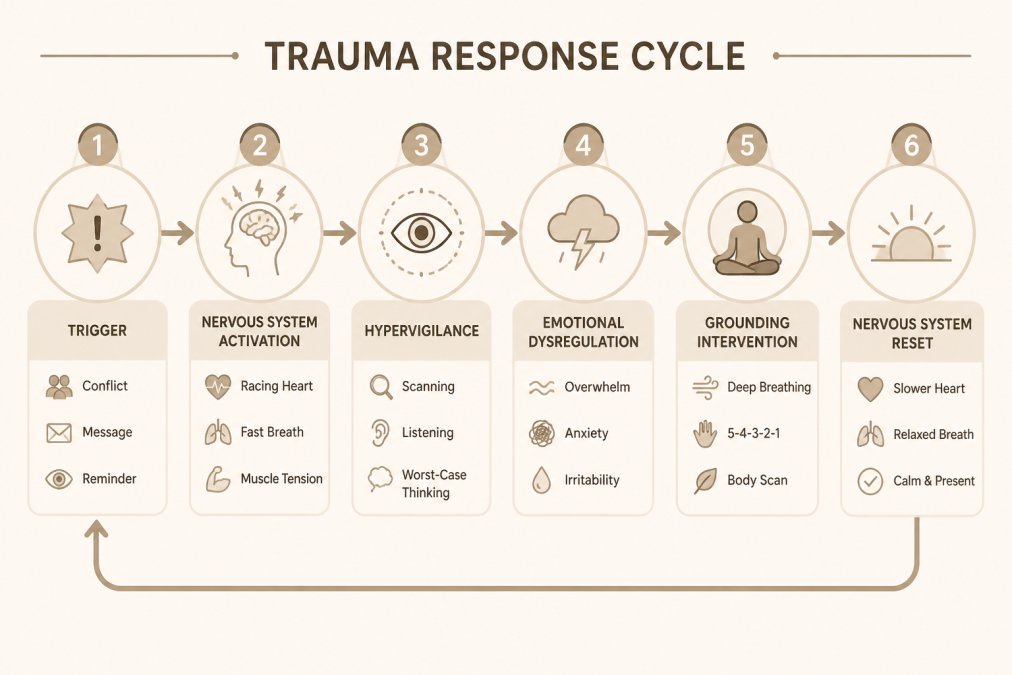
Your body is not overreacting. The racing heart, intrusive thoughts, insomnia, and sudden rage are not signs of weakness, they’re signs that your nervous system has correctly identified a threat and is attempting to keep you safe.
When betrayal occurs, your brain categorizes your partner as unsafe, triggering hypervigilance: your body remains primed for danger, your attention narrows to threat detection, and your emotional regulation system shuts down. You might feel numb one moment and explosively angry the next. This is hypervigilance, not instability.
Grounding techniques for immediate relief
When panic feels unbearable, grounding techniques interrupt the trauma response cycle by anchoring you to the present moment.
The 5-4-3-2-1 technique forces your prefrontal cortex to engage, quieting your alarm brain:
- Name 5 things you can see
- Name 4 things you can touch
- Name 3 things you can hear
- Name 2 things you can smell
- Name 1 thing you can taste
Box breathing signals safety to your vagus nerve:
- Inhale for 4 counts, hold for 4, exhale for 4, hold for 4
- Repeat 5-10 times
Why your body is reacting this way
Your nervous system doesn’t distinguish between physical threats and relational threats. When your partner betrayed you, your brain received the same signal it would receive if you were physically attacked: "The person you depend on is a threat."
During this phase, your body floods with cortisol and adrenaline (the NIH). These hormones are useful if you need to run from a predator, but destructive if they’re running continuously for weeks or months. Cortisol impairs your memory, damages your immune system, and keeps your nervous system in survival mode.
The goal of this first step is not to eliminate these responses, they’ll take time to settle, but to recognize them as a normal trauma response and begin creating small windows of nervous system regulation throughout your day.
Step 2: Acknowledge and Validate Your Pain Without Judgment
A critical mistake during betrayal trauma recovery is minimizing your own pain. You tell yourself: "It could be worse. At least they didn’t physically hurt me."
This internal dismissal deepens the trauma. Your nervous system needs to know that what happened was serious, was wrong, and was worth your full emotional response.
Validation is not the same as deciding to stay or leave. It’s simply acknowledging: this betrayal harmed you, and your pain is proportional to the harm.
The After the Affair Series approach emphasizes that betrayal trauma recovery requires a grief phase. You’re grieving the relationship you thought you had, the partner you believed them to be, and the future you imagined. These are real losses deserving real mourning.
Practical validation looks like:
- Speaking the truth aloud: "My partner lied to me repeatedly. That was wrong."
- Naming the specific harm: "This betrayal has made me feel unsafe in my own home."
- Acknowledging the impact: "I’m struggling to sleep, to focus at work, to trust anyone."
- Refusing minimization: Not adding "but I’m sure they didn’t mean to hurt me."
This phase typically lasts 4-8 weeks in acute form, though waves of grief will return (peer-reviewed research). Your job is to let yourself feel it fully so you can eventually process it and move forward.
Step 3: Setting Boundaries After Infidelity
Boundaries are not about punishment. They’re about defining what you need to feel safe while you’re healing, and they’re non-negotiable regardless of whether you stay in the relationship.
Common boundaries after infidelity include:
- "I need you to be completely transparent about your location and communications for the next 90 days."
- "I’m not ready to have sex. I need at least 30 days before we discuss this again."
- "I need you to attend therapy individually before we consider couples counseling."
- "I need you to acknowledge specifically what you lied about and why."
- "I need separate sleeping arrangements while I process this."
- "I need you to end all contact with the person you were involved with."
These boundaries are reasonable. They’re the minimum requirements for your nervous system to begin feeling safe again.
The challenge is that many people set boundaries and then don’t enforce them. Your partner may apologize and gradually return to old patterns. Your nervous system will notice these violations immediately and your hypervigilance will intensify.
Enforcing boundaries means following through with stated consequences if boundaries are violated, not accepting apologies as a substitute for changed behavior, and being willing to escalate if necessary.
Step 4: Using Betrayal Trauma Recovery Scripts in Difficult Conversations
Structured communication is one of the most useful tools in betrayal trauma recovery. When your nervous system is dysregulated, conversations with your partner quickly escalate into arguments where you say things you regret or fail to communicate what you actually need.
Scripts aren’t about being robotic or inauthentic. They’re about giving your rational brain a framework to follow when your emotional brain is flooded.
When to use structured communication
Structured scripts are most useful for conversations about logistics, moments when you need to set a boundary and expect resistance, and situations where your partner typically deflects or minimizes.
A script doesn’t mean reading from a card. It means having a clear structure:
Take the free 23-point assessment →
- State the situation factually (no emotion, no blame): "Our custody schedule has been inconsistent for the past two weeks."
- Name the impact: "This unpredictability is making it difficult for me to plan my work schedule and is affecting our daughter’s routine."
- State what you need (specific, measurable, non-negotiable): "I need you to confirm custody pickups by 6 p.m. the day before, every week."
- Name the consequence: "If this doesn’t happen, I’ll need to use a co-parenting app to document all scheduling changes."
This structure removes the emotional charge while making your position unmistakable.
Step 5: Build Your Support System and Know When to Seek Professional Help
Betrayal trauma recovery cannot happen in isolation. Your nervous system needs external regulation, the presence of people who believe you, and validation that you’re not alone.
A functional support system includes:
- One trusted person you can call during acute panic
- A therapist trained in trauma (ideally with experience in relational trauma or infidelity)
- A community (support group, online community, or understanding friends)
- A practical ally (someone who can help with logistics, childcare, or legal matters) books about healing.
When to seek professional therapy:
- Immediately if you’re having thoughts of self-harm or suicide
- Within the first 2-4 weeks if you’re unable to eat, sleep, or function
- Within the first month if you’re having intrusive thoughts you cannot control
- Within 6-8 weeks if you’re unable to make decisions about your relationship
A trauma-informed therapist can help you process the betrayal without becoming stuck in rumination, understand your nervous system’s response, clarify whether reconciliation is possible, and navigate co-parenting if separation is necessary.
The After the Affair Series provides structured frameworks that complement therapy with immediate, specific scripts and protocols you can use today.
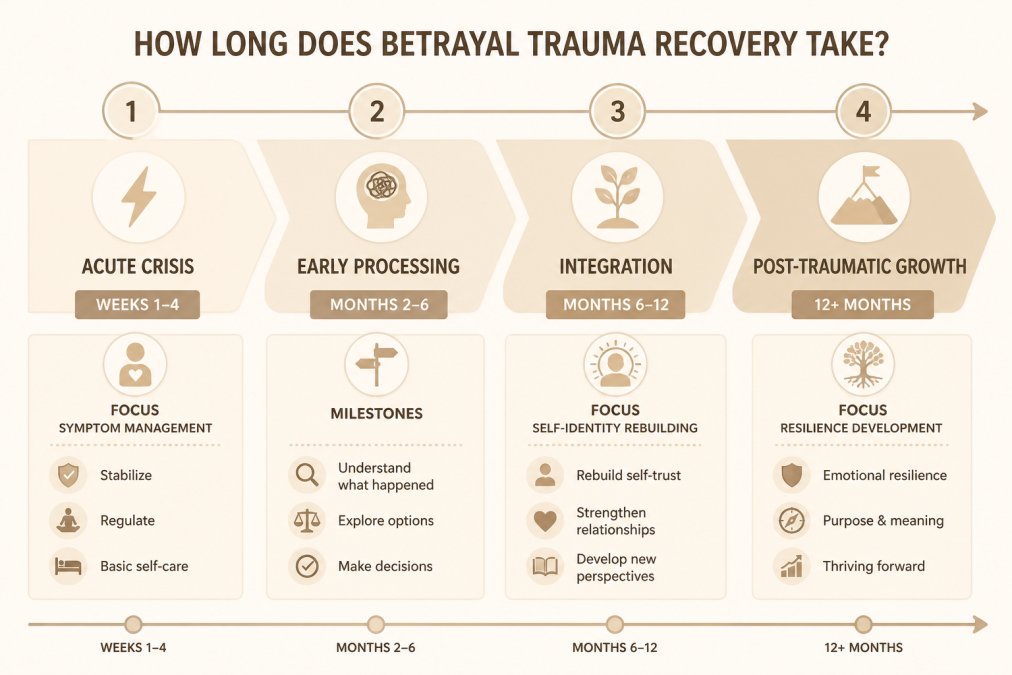
How Long Does Betrayal Trauma Recovery Take
The honest answer is: it depends on the severity of the betrayal, your support system, whether you’re in ongoing contact with your partner, and whether you pursue professional help.
The acute crisis phase, where you cannot sleep or focus, typically lasts 2-6 weeks. The early processing phase, where you’re beginning to understand what happened, typically spans 2-6 months. The integration phase, where you’re rebuilding your sense of self and capacity for intimacy, typically takes 6-12 months.
Critical variables that speed or slow recovery:
- Ongoing deception: If your partner continues to lie, your nervous system cannot begin to heal.
- Separation from the betraying partner: If you leave, you remove the constant trigger. If you stay, you’re attempting to heal while living with the source of trauma.
- Quality of support: Professional therapy and a strong support system accelerate recovery.
- Your own nervous system baseline: Some people naturally recover faster from stress; others take longer.
- Children involved: Recovery is complicated by the need to maintain contact with your partner and manage co-parenting.
Most people see meaningful improvement within 3-4 months if actively engaged in recovery work. Full integration typically takes 12-18 months.
Step 6: Differentiate Between Reconciliation and Recovery
This distinction changes everything, and it’s where many people get stuck.
Recovery means healing your own nervous system, restoring your sense of safety, and rebuilding your capacity to function and make clear decisions. Recovery is about you and is necessary whether you stay or leave.
Reconciliation means rebuilding the relationship with your partner. Reconciliation requires that your partner takes full responsibility, demonstrates genuine remorse, makes concrete changes, and works to rebuild trust.
These are not the same process, and they don’t happen on the same timeline.
Many people attempt reconciliation before they’ve completed their own recovery. If your nervous system is still dysregulated, you cannot accurately assess whether your partner is genuinely changing or whether you’re desperate to return to "normal."
The sequence should be:
- Stabilize your nervous system (weeks 1-4)
- Process the betrayal (months 2-6)
- Clarify your own needs and boundaries (months 4-8)
- Only then decide whether reconciliation is something you want to pursue
If you decide reconciliation is possible, your partner must take full responsibility without minimizing, explain specifically why they betrayed you, agree to complete transparency for a defined period, attend individual therapy, and demonstrate consistent behavioral change over months.
If reconciliation is not possible, recovery continues. You’re healing from trauma, not from a failed relationship.
The After the Affair Series framework supports both paths. Whether you’re working toward reconciliation or toward a healthy separation, the first steps are the same: stabilize, process, clarify, and build a support system.
Navigating betrayal trauma feels impossible in the moment. The confusion, panic, and inability to trust your own judgment are real symptoms of a real injury. You’re not overreacting, and you’re not weak for struggling.
The path forward begins with stabilizing your nervous system, validating your pain, and building the specific tools and support you need to make clear decisions about your future. The After the Affair Series provides exactly this: structured frameworks, specific communication scripts, and immediate protocols designed for the crisis moments when you need clarity most. Take the free 23-point assessment to understand where you are in your recovery journey and what your next steps should be.
Frequently Asked Questions
Q: What are the first steps in healing from betrayal trauma?
A: Start by stabilizing your nervous system through grounding techniques like the 5-4-3-2-1 sensory method or box breathing. Next, acknowledge your pain without judgment, betrayal trauma is a real psychological injury. Set boundaries with the person who caused the harm, whether that means limiting contact or establishing communication protocols. Finally, seek support from a trauma-informed therapist or support group. These foundational steps create safety and prevent you from making major life decisions while in acute distress.
Q: How long does betrayal trauma recovery take?
A: Betrayal trauma recovery typically unfolds over a period of time, though this varies based on the depth of deception, your support system, and whether you're managing co-parenting. The acute crisis phase lasts for a period, followed by active processing, then integration and stabilization. Post-traumatic growth can continue beyond this. Recovery isn't linear, you may experience setbacks, especially during co-parenting exchanges or anniversaries of discovery. Working with a therapist can support this timeline and helps prevent prolonged hypervigilance.
Q: Can I use structured communication scripts if my ex is hostile and refuses to cooperate?
A: Yes. Betrayal trauma recovery scripts work precisely because they don't require cooperation from the other person. Scripts like the Gray Rock Method neutralize hostile responses by removing emotional content and staying factual. Your ex's hostility often intensifies when you respond emotionally; structured communication removes that fuel. These scripts are designed for high-conflict situations where the other party is unpredictable. They won't change your ex's behavior, but they protect your emotional stability and model healthy communication for your children.
Q: How do I know if I need therapy versus self-guided recovery tools?
A: If you're experiencing intrusive thoughts, hypervigilance, sleep disruption, or difficulty functioning in daily life, therapy with a trauma-informed professional is essential. Self-guided tools like grounding techniques and structured scripts are valuable complements but not substitutes for professional care in moderate-to-severe cases. A free assessment can help you gauge symptom severity. Therapy is particularly important if you're navigating co-parenting, managing financial or legal consequences, or struggling with whether to reconcile. Professional support can aid healing and prevent re-traumatization.
This article was written using GrandRanker