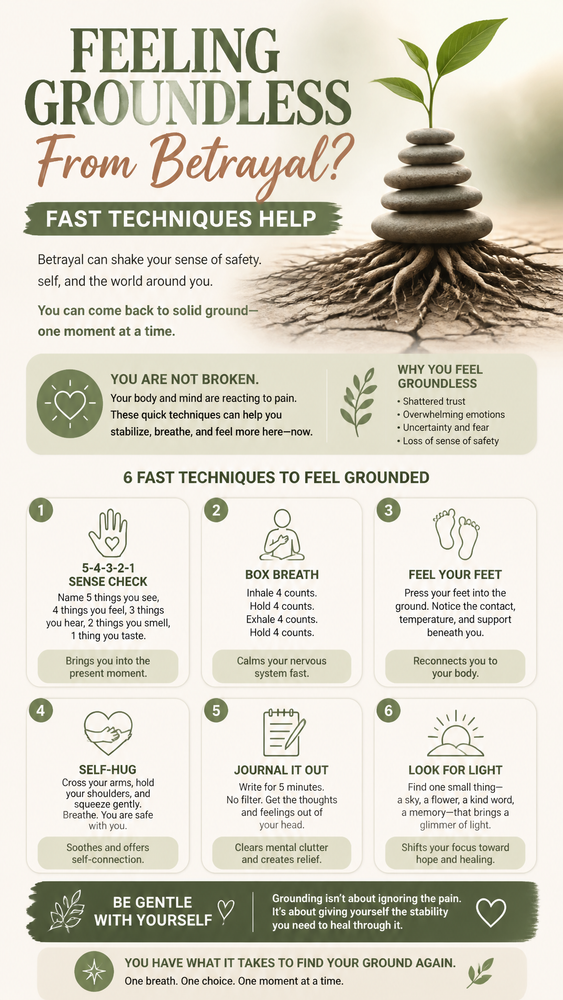
Grounding for betrayal trauma works by interrupting the body’s alarm response and pulling your attention back to the present moment, usually within a few minutes. Try this right now: name five things you can see, four you can hear, three you can touch, two you can smell, and one you can taste. This is the 5-4-3-2-1 technique, and it takes about 90 seconds.
What it does: slow your breathing, loosen the chest tightness, and quiet the racing thoughts enough to think clearly again.
What it will not do: resolve the betrayal, answer your questions about the affair, or undo the hypervigilance that shows up again tomorrow. Grounding is containment, not a cure.
- Name 5 things you see, 4 you hear, 3 you touch, 2 you smell, 1 you taste
- Or try a 4-4-4 breath: inhale 4 seconds, hold 4, exhale 4, repeat 4 times
- Expect calmer breathing and clearer thinking within 1 to 3 minutes, not full resolution
- Key Takeaways
- What Betrayal Trauma Is and Why Triggers Feel Like Danger
- Recognizing Your Triggers and Physical Symptoms
- Why Grounding Works: Window of Tolerance and Stabilization
- Grounding Techniques for Betrayal Trauma, by Type
- Building a Personal Grounding Kit and Safety Plan
- Practicing Grounding Daily So It Sticks
- When to Seek Professional Help for Betrayal Trauma
- Why This Guidance Holds Up Clinically
- Grounding for Betrayal Trauma vs Other Trauma Types
- Mindfulness and Acceptance in Betrayal Trauma Recovery
- Guided Imagery and Visualization for Betrayal Trauma
- Grounding Alongside Self-Compassion
- Finding Community and Support After Betrayal
- FAQ
Key Takeaways
Grounding for betrayal trauma stabilizes your nervous system fast, but lasting recovery requires pairing those techniques with self-compassion, professional support, and a structured plan.
| Point | Details |
|---|---|
| Use 5-4-3-2-1 first | This sensory technique needs no tools and works in 1 to 2 minutes anywhere you are. |
| Stabilize before processing | Clinical practice sequences containment before deeper trauma work, so grounding always comes first. |
| Combine physical and mental tools | Pairing one body-based technique with one thought-based technique tends to regulate faster than either alone. |
| Rehearse your kit weekly | Practicing your grounding kit in calm moments makes it usable during real triggers, when decision-making is hardest. |
| Build a full stabilization plan | The 7 Steps Infidelity Recovery Checklist from Aftertheaffair extends grounding into a complete early-recovery framework. |
This article is general information, not a substitute for advice from a qualified doctor. Consult a qualified healthcare professional about your own circumstances before acting on anything here.
What Betrayal Trauma Is and Why Triggers Feel Like Danger
Betrayal trauma is the psychological injury caused by a person you trusted violating that trust, most often through infidelity, deception, or emotional abandonment. Unlike trauma from a stranger or an accident, betrayal trauma comes from inside your safety network. That is what makes it so disorienting: your brain has to keep functioning around the very person (or memory) it now flags as a threat.
When a trigger hits, your amygdala reads it as danger and fires the fight, flight, or freeze response before your rational brain catches up. That is why a text notification, a certain restaurant, or even a smell can produce a racing heart, tight chest, or sudden nausea seconds before you consciously register why.
Clinicians who treat trauma follow a “stabilization first” principle: before you process what happened, you need reliable tools to bring your nervous system back to baseline. Grounding for betrayal trauma is that tool. It is containment, not confrontation.
Recognizing Your Triggers and Physical Symptoms
Triggers usually split into two categories. External triggers include a partner’s phone buzzing, a specific street or hotel, a song, or a smell tied to the affair. Internal triggers are quieter but just as powerful: intrusive replay of a conversation, a “what if” spiral, or a memory that surfaces uninvited.
Physically, betrayal trauma tends to show up as a tight chest, stomach knots or nausea, shaking hands, a racing pulse, or a foggy, disconnected feeling that resembles dissociation. Some people go numb instead of activated, which is its own form of freeze response.
Try this three-step log for a week:
- Write down each moment you feel triggered and what preceded it by 60 seconds.
- Note the physical sensation (chest, stomach, jaw, breath) alongside the trigger.
- Rank your top three recurring triggers by frequency, then build your grounding kit around those three first.
Patterns emerge fast. Most people find one or two triggers account for most of their spikes, which makes recognizing betrayal trauma symptoms far more manageable than it first feels.
Why Grounding Works: Window of Tolerance and Stabilization
Your “window of tolerance” is the zone where you can feel distress without being overwhelmed by it. Betrayal trauma narrows that window, so smaller and smaller triggers push you into hyperarousal (panic, racing thoughts) or hypoarousal (numbness, shutdown). Grounding widens the window back out.
There are two directions of regulation. Top-down work uses thoughts to calm the body: reframing, reasoning, talking it through. Bottom-up work uses the body to calm the mind, which is exactly what sensory and breathing techniques do. Betrayal trauma often makes top-down work nearly impossible in the moment, because the thinking brain is offline. That is why bottom-up tools work faster when you are activated.
Cleveland Clinic notes that grounding can interrupt cycles of anxiety by redirecting attention through the five senses or breath, and that repeated practice tends to lower baseline stress-hormone activity over time. The clinical sequence matters here: containment comes before processing. Trying to analyze the affair while your body is in fight-or-flight rarely produces insight. It just re-traumatizes. Ground first, reflect later, ideally with a therapist guiding the pace.
Grounding Techniques for Betrayal Trauma, by Type
Different techniques reach different systems, and combining a physical method with a mental one often regulates you faster than either alone, according to Cleveland Clinic. Here is a working toolkit, organized by category.
Physical grounding anchors you through the body. The 5-4-3-2-1 method (five seen, four heard, three touched, two smelled, one tasted) takes about one to two minutes and needs no props, according to NHS inform. Cold water on your wrists or an ice cube held in your palm works in seconds and is especially good for panic spikes. Holding a textured object (a stone, a scarf, a stress ball) and describing its texture out loud pulls attention into the hands. Progressive muscle relaxation, tensing then releasing each muscle group for 5 seconds, takes 3 to 5 minutes and works well before sleep.
Bilateral stimulation uses rhythm to calm the nervous system. The Butterfly Hug, crossing your arms over your chest and tapping alternating shoulders slowly, often eases intensity within minutes. Pair it with a spoken anchor like “I am safe right now” to reinforce the calming effect.

Breathing techniques trigger the parasympathetic nervous system directly. Box breathing (4 seconds in, 4 hold, 4 out, 4 hold) for several rounds slows heart rate within about a minute. A longer exhale than inhale, 4 seconds in and 6 to 8 out, signals safety to the vagus nerve faster than even breath counts.
Mental grounding includes orientation statements (“Today is Tuesday, I am in my kitchen, it is 2026”), counting backward from 100 by sevens, or the 3-3-3 game: name three things you see, three sounds, and move three body parts.
Soothing grounding uses comfort over distraction: a focus word, a saved playlist, or a mental image of somewhere safe.
- Physical: fastest for full panic, works anywhere
- Bilateral: best for emotional flooding, needs privacy for 60 to 90 seconds
- Breathing: best for pre-emptive use before known triggers
- Mental: best when dissociating or numb
- Soothing: best as a wind-down after the spike passes
Pro Tip: Keep one technique from each category memorized cold. When you’re activated, you won’t remember five options, but you will remember one.
Clinical guidance consistently frames the 5-4-3-2-1 method as a first-line sensory tool precisely because it requires no equipment and interrupts intrusive replay almost immediately.
Reading this won’t change tomorrow’s message
You Know the Tactic Now. Do You Know What You’ll Actually Do When It Lands?
Understanding grey rock is not the same as doing it at 9pm when your phone buzzes. Most parents can explain the theory perfectly and still bite the bait every single time. The gap between the two is exactly what the free self-check measures.
Get Your Ex Out of Your Head →5 scenarios · scored result · 4 minutes · free
Building a Personal Grounding Kit and Safety Plan
A grounding kit works best when it is physical, not just mental. Assemble it before you need it.
- A card with 3 to 5 written prompts (your go-to breath count, your anchor phrase, one orientation statement).
- A small textured object, a smooth stone or piece of fabric, kept in your bag or pocket.
- A saved playlist of 3 to 4 songs that calm rather than trigger.
- A bottle of water and, if useful, a small ice pack for cold-response grounding.
- A one-line note in your own handwriting: “This feeling will pass. I have survived it before.”
Pair the kit with a one-page safety plan: your quickest grounding sequence (usually breath first, then sensory), the name and number of one safe contact, and one boundary you commit to during a spike (no reactive texting, no confronting mid-panic).
Rehearse the kit for five minutes, twice a week, when you are calm. Rehearsal in low-arousal moments is what makes the kit actually usable during a real trigger, since it removes the decision-making load exactly when your thinking brain is least available.
Practicing Grounding Daily So It Sticks
Grounding works better as a habit than an emergency-only tool. Try a 2 to 5 minute morning breath practice, a midday 5-4-3-2-1 rehearsal even when you feel fine, and a short wind-down routine before sleep using your soothing techniques.
Repetition matters because it builds automaticity. Practiced tools become accessible during high distress, which reduces the pull toward avoidance or impulsive reactions, according to Grayslate Therapy.
If grounding stops helping, if panic escalates instead of easing, or if you feel unsafe, contact a crisis line, emergency services, or a trauma therapist immediately. Grounding is a bridge, not a replacement for professional support when symptoms are severe.
When to Seek Professional Help for Betrayal Trauma
Grounding is a bridge. If triggers are disrupting work, sleep, or parenting for weeks rather than days, if panic escalates instead of easing, or if you have any thoughts of self-harm, it is time to bring in a licensed therapist.
Three approaches show up consistently in trauma treatment after stabilization. EMDR (Eye Movement Desensitization and Reprocessing) uses guided eye movements to help the brain reprocess traumatic memories. Trauma-focused CBT targets the thought patterns that keep replaying the betrayal. Somatic approaches work through body sensation and movement rather than talk alone.
Ask a prospective therapist directly: “How do you pace stabilization before processing?” and “What grounding skills will we build first?” Their answers reveal whether they understand betrayal-specific trauma or are applying a generic anxiety protocol.
Why This Guidance Holds Up Clinically
This guide draws on infidelity-recovery author S.J.Howe’s work with the After the Affair series, which structures recovery into survival, decision-making, transformation, and growth phases. The techniques above, 5-4-3-2-1, window of tolerance, paced breathing, are anchored in Cleveland Clinic, NHS inform, Healthline, and the triphasic trauma model, all cited above. Clinical practice consistently sequences containment before processing, which is exactly how this article is built: stabilize first, then move toward deeper work with a therapist.
Grounding for Betrayal Trauma vs Other Trauma Types
Grounding for betrayal trauma shares its mechanics with grounding for any trauma. What differs is the trigger landscape and the relational wound underneath it.
Trauma from an accident or assault usually has a defined endpoint. The event happened, and while flashbacks recur, the source of danger is typically gone. Betrayal trauma is different because the “danger” often still shares your home, your children, or your social circle. You cannot fully avoid the trigger the way you might avoid a specific street after a car accident. This is why grounding for betrayal trauma has to work in real time, often mid-conversation with the person who caused the injury, rather than only in retrospective flashback moments.
Orientation statements need adjusting too. A general trauma orientation script says “the danger has passed.” For betrayal trauma, especially during active co-parenting or ongoing contact, a more honest version is: “I am safe in this specific moment, even though the relationship is still unresolved.” That distinction keeps grounding truthful instead of falsely reassuring.
Betrayal trauma also carries a unique layer of hypervigilance around information itself, checking phones, scanning for inconsistencies, replaying old conversations for missed clues. Mental grounding techniques that redirect attention to neutral facts (today’s date, the room you’re in, your next task) tend to work harder here than in trauma types without that compulsive-checking pattern. Physical grounding stays largely the same across trauma types, but the mental and soothing categories usually need betrayal-specific wording to feel credible rather than dismissive.
Noticing the pattern is not the same as proving it
You Can Feel the Pattern. Can You Prove It to a Judge?
A diary of what happened reads as emotional venting. A structured, timestamped record reads as evidence. Most parents lose that distinction until it costs them. The free checklist shows you exactly what to document today, before the evidence window closes.
Get the Free Red Flag Checklist →3 categories · 5 minutes · free
Mindfulness and Acceptance in Betrayal Trauma Recovery
Mindfulness in betrayal trauma recovery is not about accepting the affair itself. It means observing your thoughts and body sensations without immediately reacting to them, which is a very different task than “letting it go.”
A useful distinction: acceptance targets your internal experience (the wave of anger, the intrusive image), not the external situation (what your partner did). You can accept that a memory just surfaced and made your chest tighten, fully, without accepting that the betrayal was acceptable. Conflating the two is one of the most common reasons people resist mindfulness after betrayal, understandably, since being told to “accept” the situation feels like being told to minimize it.
In practice, this looks like naming the sensation out loud or in your head: “This is the anger wave. It usually lasts about ten minutes.” Labeling reduces the intensity of the emotion because it engages the prefrontal cortex instead of leaving you fused with pure amygdala reaction. Paired with a grounding technique, mindfulness gives you the observing distance that makes the grounding stick rather than just distracting you temporarily.
Acceptance-based practice also helps with the “why can’t I just move on” pressure that so many betrayed partners put on themselves. Healing from betrayal trauma is rarely linear, and the goal of mindfulness here is tolerating the nonlinear parts, some days will feel like progress, others will feel like a full reset, without treating either as proof you are failing at recovery.
Guided Imagery and Visualization for Betrayal Trauma
Visualization works differently for betrayal trauma than it does for generic stress relief, because generic “imagine a beach” scripts can feel hollow when your nervous system is scanning for relational threat. The imagery needs to target safety specifically, not just relaxation.
One effective script: picture a physical boundary, a wall, a locked door, a body of water, that separates you from the person or memory that triggered you. This is not about denial. It is a way of giving your nervous system a concrete image of separation when the real-life boundary (co-parenting contact, shared friends, a shared home) cannot be that clean.
Another useful image is the “container” technique: visualize placing the intrusive thought or memory into a box, describing its size, color, and material in detail, then setting it on a shelf with the understanding that you can open it again later, in therapy or in a scheduled worry period, but not right now. This works because it does not ask you to suppress the memory permanently. It just delays processing until you are in a state where processing is actually productive.
A third option pulls from safe-place imagery used broadly in trauma work: recall a specific real memory, a room, a hike, a childhood spot, where you felt fully safe, and rebuild it in detail: temperature, sounds, light. The specificity matters more than the scenery. A vague “calm beach” rarely works as well as a real, textured memory your brain already trusts.
Grounding Alongside Self-Compassion
Grounding calms your body. Self-compassion changes how you talk to yourself once you’re calm enough to talk at all. Betrayal trauma tends to produce brutal self-criticism, “I should have seen it,” “I’m stupid for trusting them,” and grounding without self-compassion can turn into just another form of self-management that skips the actual wound.
A simple sequence: ground first using a physical or breathing technique, then once your heart rate has settled, add one self-compassionate phrase. Not “everything is fine,” which your brain will reject as false, but something more honest: “This is hard, and it makes sense that it’s hard.” Research on self-compassion consistently distinguishes it from self-pity: it is not about excusing the betrayal or lowering your standards, it is about not adding a second layer of self-punishment on top of an injury someone else caused.
Try pairing your anchor phrase from the grounding kit with a compassion phrase. If your grounding anchor is “I am safe right now,” a natural self-compassion follow-up is “and this pain is not a sign I did anything wrong.” Saying both, in that order, prevents grounding from becoming another way to just white-knuckle through the day.
This combination also protects against the exhaustion that comes from constant vigilance. Betrayed partners who ground without self-compassion often report feeling like they are managing a problem rather than healing from one. Adding the self-compassion layer, even briefly, shifts grounding from crisis management toward actual recovery, and pairs naturally with structured emotional recovery strategies that address the self-talk patterns underneath the panic.

Finding Community and Support After Betrayal
Isolation makes betrayal trauma worse. Most people who have been betrayed instinctively withdraw, partly from shame, partly from not knowing who is safe to tell, and that withdrawal removes one of the fastest paths to regulation: co-regulation with another person who understands.
Peer support groups, whether in-person community groups or moderated online forums for infidelity recovery, offer something grounding techniques alone cannot: the felt sense that your reaction is not disproportionate. Hearing someone else describe the exact same chest-tightening, phone-checking, 3 a.m. replay loop can do more for your nervous system in ten minutes than an hour of solitary grounding practice.
Look for groups explicitly focused on betrayal or infidelity recovery rather than general relationship support, since the trigger patterns and shame dynamics are specific enough that generic breakup groups often miss the mark. A licensed therapist who specializes in infidelity recovery can typically point you toward vetted groups in your area or online, and many trauma-informed therapy practices maintain referral lists for exactly this reason, as Journey Mental Health notes when discussing why stabilization work benefits from a support network alongside individual therapy.
Community support does not replace grounding or therapy. It sits alongside both, giving you a place to practice the self-compassion piece out loud, with people who will not flinch at the details.
A Short Note From S.J.Howe
The routine I come back to most often is embarrassingly simple: one long exhale, one named object in the room, one honest sentence to myself. Grounding does not need to be elaborate to work. Go gently. Some days it will hold you; other days it will just buy you five calmer minutes, and that is still worth having.
Turning Grounding Skills Into a Full Stabilization Plan
Grounding gets you through the next ten minutes. What most betrayed partners actually need is a structured plan for the next ten weeks, and that is where a scattered collection of coping tips starts to fall short.
Aftertheaffair built the 7 Steps Infidelity Recovery Checklist specifically for this early stabilization window, mapping out the practical decisions and emotional first-aid steps that grounding alone cannot address, like what to do about shared finances, how to talk to children, and when to involve a therapist. Unlike generic anxiety apps or one-off grounding scripts, the checklist sequences everything by phase, so you are never guessing what comes after today’s panic subsides. For readers further along who have stabilized and are ready to rebuild trust or decide the relationship’s future, the Relationship Growth After Infidelity program picks up exactly where grounding leaves off. Start with the checklist today to get your next concrete step in writing rather than in your head.
Sources
Willpower was never the problem
You’ve Said No Contact Before. What Made It Fail Last Time?
It usually isn’t willpower. It’s a loophole nobody accounted for, a second number, a mutual friend, a platform nobody thought to block. This free audit maps all 47 known workarounds so the boundary holds on its own, without relying on you to be strong enough every single time.
Get the Free Loophole Elimination Matrix →47-point audit · instant download · free
FAQ
How Do You Let Go of Betrayal Trauma?
You do not “let go” of betrayal trauma on command. Stabilizing with grounding techniques first, then working through EMDR or trauma-focused CBT with a therapist, is what actually processes the memory over time rather than suppressing it.
What Are the Physical Symptoms of Betrayal Trauma?
Common symptoms include a tight chest, nausea, shaking, a racing heart, and dissociation or numbness, all driven by the amygdala’s alarm response to perceived relational danger.
How Do You Release Betrayal Trauma From the Body?
Bottom-up techniques, physical grounding, paced breathing, and bilateral stimulation like the Butterfly Hug, release trauma-driven tension because they work through the nervous system directly rather than through analysis alone.
What Is the Best Therapy for Betrayal Trauma?
EMDR, trauma-focused CBT, and somatic therapy are the most commonly recommended approaches, but the right choice depends on whether you have stabilized enough for deeper processing; a therapist experienced in infidelity recovery can help you decide.
Can Grounding Replace Therapy for Betrayal Trauma?
No. Grounding provides short-term containment for triggers, but it does not process the underlying trauma; persistent panic or functional impairment warrants a licensed trauma therapist.
Recommended
- Physical Symptoms of Betrayal – After the Affair Series
- Choosing a Betrayal Trauma Book That Works – After the Affair Series
- Betrayal Trauma Hub – After the Affair Series
- How to address betrayal trauma: steps for healing