When a conversation about an affair starts looping, the single most effective move is to pause, name your state out loud, and set a specific return time. Not “I need space.” Something concrete: “I’m flooded right now. Can we come back to this in 30 minutes?” That one shift, grounded in what Gottman-based repair research calls a repair attempt, does more for recovery than another hour of the same exchange. Consider using Effective Scripts to facilitate this process.
Couples trapped in unproductive affair conversation loops share a recognizable pattern: one partner pushes for answers, the other retreats or defends, and both end up more hurt than before. The loop isn’t a sign that you’re incompatible or that healing is impossible. It’s a sign that your nervous systems are doing exactly what nervous systems do under threat.
Immediate action checklist:
- Pause before you escalate. If your voice is rising or your chest is tight, stop speaking.
- Name your state, not your accusation. “I’m overwhelmed” lands differently than “You’re doing it again.”
- Set a specific return time. “Let’s come back to this at 8 PM” is a promise, not an avoidance.
- Avoid detail demands in the heat of the moment. “Tell me everything right now” increases re-traumatization, not clarity.
- Check for safety. If the exchange involves threats, intimidation, or any physical element, stop the conversation and contact a crisis line or therapist immediately.
Three one-sentence scripts for right now:
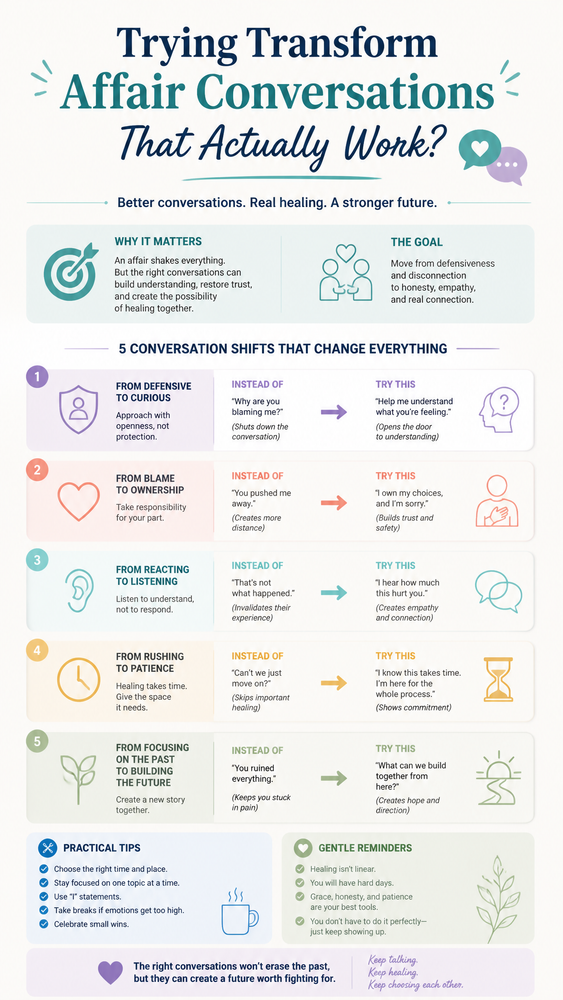
- Hurt partner: “I need to understand what happened, and I also need us to slow down so I can actually hear you.”
- Unfaithful partner: “I want to answer your questions, and I need a few minutes to calm down so I can do that well.”
- Neutral pause line: “I think we’re in the loop again. Can we take 20 minutes and come back?”
Pro Tip: If either partner feels physically unsafe at any point, stop the conversation entirely. The National Domestic Violence Hotline (1-800-799-7233) is available 24/7.
Key Takeaways
Breaking the affair conversation loop requires pausing the nervous system before attempting repair, because high arousal makes productive exchange impossible.
| Point | Details |
|---|---|
| Pause and name your state | Say “I’m flooded” and set a specific return time before the conversation escalates further. |
| Match the script to your loop | Identify whether you’re in a pursue/withdraw or avoidance pattern before choosing a de-escalation approach. |
| Use structured conversations | A short agenda with a single topic, a repair moment, and a scheduled follow-up reduces re-triggering. |
| Seek therapy when the loop persists | If the pattern hasn’t shifted in a few weeks, or if safety is at risk, professional support is the right next step. |
| Aftertheaffair resources | The Emergency Scripts Cheat Sheet and 7-step recovery checklist provide ready-to-use tools for each stage of the loop-breaking process. |
Table of Contents
- Why couples get stuck in the same affair conversation loop
- How do you know which loop you’re in?
- What to do in the moment when the loop starts
- How to plan follow-up conversations so the loop doesn’t restart
- When should you seek professional help?
- How to respond when your partner shuts down or gets defensive
- Field-tested scripts and the emergency scripts cheat sheet
- Why micro-repairs matter more than getting every fact straight
- The After the Affair series gives you the structure to stop the loop
- Sources
- FAQ
Why couples get stuck in the same affair conversation loop
Utilizing Effective Scripts can significantly enhance your ability to navigate these conversations.
The pursue/withdraw cycle is the most common pattern therapists see after infidelity. One partner, usually the betrayed one, pushes for more information, more reassurance, more accountability. The other, often the unfaithful partner, pulls back, goes quiet, or becomes defensive. The first partner pushes harder. The second retreats further. Neither gets what they actually need.
This is the anxious-avoidant trap, and attachment theory explains why it’s so hard to break. The betrayed partner’s attachment system has been destabilized. Seeking information feels like seeking safety. But the unfaithful partner, flooded with shame, reads each question as an attack and responds with the only tool shame offers: withdrawal or counter-attack. The more one pursues, the more the other retreats. The more the other retreats, the more the first pursues.
“The goal of repair is not to resolve every disagreement but to interrupt the escalation before it causes lasting damage. Small repair attempts, a brief apology, a request for a pause, a moment of physical reassurance, are stronger predictors of relational health than the absence of conflict itself.”
Gottman-based research, via Simply Psychology
Shame and secrecy compound the loop. The unfaithful partner often withholds details not to deceive but because full disclosure feels like detonating a bomb. The betrayed partner senses the withholding and asks more questions. The loop tightens.
Here’s what makes it worse: repeating the same factual questions rarely produces new information. What it produces is a higher threat level for both partners. A flooded nervous system, as clinical guidance confirms, reduces comprehension and increases re-traumatization risk. You’re not getting closer to the truth. You’re getting further from the capacity to hear it.
Common loop types at a glance:
| Loop Type | Hurt Partner’s Move | Unfaithful Partner’s Move | What Escalates It |
|---|---|---|---|
| Pursue/withdraw | Repeated questions, emotional intensity | Silence, short answers, leaving | More questions, more silence |
| Accusation/retreat | Blame statements, “you always” | Defensiveness, counter-blame | Louder accusations, shutdown |
| Chronic re-checking | Monitoring phone, social media | Frustration, feeling surveilled | Discovery of more hiding |
| Avoidance/stonewall | Emotional withdrawal, flat affect | Relief, then guilt | Growing distance, no repair |
How do you know which loop you’re in?
Identifying your specific pattern is the step most couples skip, and it’s the reason generic advice doesn’t stick. Pattern awareness changes the question from “who is right?” to “what is happening between us?” That shift is what makes intervention possible.
Observable signs you’re in a loop:
- The conversation ends the same way every time, regardless of how it starts.
- One or both of you feel more hopeless after talking than before.
- You recognize the moment it starts but feel unable to stop it.
- Physical symptoms appear: tight chest, raised voice, tears before a word is spoken.
- One partner goes completely silent; the other can’t stop talking.
Common triggers:
- Seeing a notification on a phone
- A question about whereabouts or timing
- A social media post from the other person
- An anniversary, a location, or a song
- Any perceived evasion, even a slight pause before answering
A one-interaction tracking template:
After a difficult exchange, write down: (1) what triggered the conversation, (2) what you said first, (3) what your body felt like at that moment, (4) what your partner said or did next, and (5) how it ended. Do this for three separate conversations. The pattern will become visible.
Two brief examples of how different loops look in practice:
Pursue/withdraw: She asks for the third time that week whether he deleted all contact. He says yes. She asks again, differently. He goes quiet and leaves the room. She follows, voice rising. He sits down and stares at the floor. The conversation ends with her crying alone and him in the garage.
Avoidance/stonewall: He brings up the affair at dinner. She says she doesn’t want to talk about it right now. He agrees, relieved. Three days pass. Neither mentions it. The silence feels like safety but functions as distance. When it finally erupts, it’s bigger than before.
Common communication failures, including assuming motives, criticism that triggers defensiveness, and stonewalling, are well-documented contributors to these repeating patterns. Naming the pattern you’re in is the first concrete step toward changing it.
What to do in the moment when the loop starts
The sequence matters more than the words. Clinical guidance is consistent on this: calm the nervous system first, contain the interaction second, then exchange information. Reversing that order is what keeps couples stuck.
Step-by-step in-the-moment protocol:
- Notice the signal. Tight chest, raised voice, tears, or shutdown are your body’s warning that you’re flooded.
- Say it out loud. “I’m getting flooded” or “I can feel this escalating.”
- Request a break with a return time. “I need 30 minutes. I’ll come back at 9 PM.”
- Do something physiologically calming during the break (see Pro Tip below).
- Return at the agreed time, even if you only say: “I’m back. I’m not fully ready, but I’m here.”
Three scripts for common flashpoints:
- When a question triggers a spiral: “That question matters to me. I want to answer it when I can do it without shutting down. Can we come back to it in an hour?”
- When an accusation lands: “I hear that you’re angry. I’m not going to defend myself right now. I want to understand what you need.”
- When you feel yourself withdrawing: “I’m pulling away and I don’t want to. Give me ten minutes and I’ll come back.”
What to avoid:
- “Tell me everything right now” — detail demands under high arousal increase re-traumatization.
- “You always” / “You never” — absolute language shuts down reflection.
- Following a partner who has asked for space — it signals that their boundary won’t be honored.
- Checking your phone during the break — it restarts the loop before it has a chance to cool.
Opening with curiosity rather than accusation changes the defensive posture of the conversation. “I want to understand what was happening for you” invites reflection. “How could you do this to me” prompts protection.
Pro Tip: During a break, try box breathing: inhale for 4 counts, hold for 4, exhale for 4, hold for 4. Repeat four times. This activates the parasympathetic nervous system and reduces the physiological flooding that makes repair attempts impossible.

How to plan follow-up conversations so the loop doesn’t restart
Unstructured conversations after an affair tend to drift back into the loop within minutes. A short agenda, agreed in advance, changes that. Structured conversations and explicit return agreements reduce re-triggering and create measurable steps for repair.
Agenda template for a scheduled conversation (30 minutes):
- Check-in (5 minutes): Each partner says one sentence about how they’re feeling right now, no responses yet.
- Topic (15 minutes): One agreed topic only. Write it down beforehand so neither partner can expand the scope mid-conversation.
- Repair moment (5 minutes): Each partner names one thing the other did well in this conversation.
- Close and schedule (5 minutes): Agree on the next conversation time before you end this one.
Transparency agreements and boundary examples:
- Agree on what counts as a red flag that requires an immediate conversation versus what goes on the “later list.”
- Define what “later” means. “Later” without a time is experienced as avoidance.
- Decide together what level of detail is helpful versus re-traumatizing. Some couples find full disclosure stabilizing; others find it destabilizing. A therapist can help calibrate this.
- Agree on a signal word or phrase that either partner can use to pause without it feeling like stonewalling.
Dos and don’ts for disclosure and question limits:
- Do limit each scheduled conversation to two or three questions maximum.
- Do write questions down before the conversation so they don’t multiply under emotion.
- Don’t ask the same question in multiple forms hoping for a different answer.
- Don’t use the scheduled conversation to relitigate what was already agreed.
Repair attempts belong inside the agenda, not saved for after. A micro-repair can be as small as: “I know this is hard for you too” or “Thank you for staying in this conversation.” These small moments, repeated across many conversations, are what rebuild trust incrementally over time.
When should you seek professional help?
Some loops can be interrupted at home with the right tools. Others can’t, and trying to manage them without support can make things worse.
Signs that professional help is warranted:
- The loop has been running for more than a few weeks with no change.
- Either partner has expressed thoughts of self-harm or suicide. Contact the 988 Suicide and Crisis Lifeline immediately.
- Conversations have become physically threatening or intimidating.
- One partner is completely refusing to engage, and the refusal has lasted more than two weeks.
- Either partner is using substances to manage the emotional pain.
- The betrayed partner’s anxiety has become so severe that daily functioning is impaired.
Therapy modalities that address affair-related loops:
- Trauma-informed couples therapy: Treats the affair as a relational trauma and addresses both partners’ nervous-system responses.
- Gottman Method couples therapy: Uses structured interventions, including repair attempts and the Sound Relationship House framework, to interrupt negative cycles.
- EMDR (Eye Movement Desensitization and Reprocessing): Particularly useful for the betrayed partner processing intrusive images or flashbacks.
- Attachment-focused individual therapy: Helps each partner understand their own attachment patterns and how those patterns drive the loop.
What to expect in the first three sessions:
Session one is typically stabilization: establishing safety, assessing risk, and agreeing on ground rules. Session two moves toward identifying the specific pattern. Session three begins targeted intervention. Progress is rarely linear, and affair recovery is typically slower than people expect, built through repeated micro-moments rather than a single breakthrough.
When choosing a therapist, look explicitly for trauma competency and stated experience with infidelity. Not every couples therapist has this training. Ask directly: “Have you worked with couples recovering from affairs?” and “Are you familiar with trauma-informed approaches?”
How to respond when your partner shuts down or gets defensive
Defensiveness and avoidance after an affair aren’t always obstruction. They’re usually shame, and shame responds very differently to pressure than to curiosity.
Common resistances and why they happen:
- Denial: Minimizing the affair’s impact reduces the unbearable weight of what was done.
- Anger: Counter-attack is faster than sitting with guilt.
- Shame-driven silence: Some people literally cannot speak when flooded with shame.
- Refusal to discuss: Avoidance feels like self-protection when every conversation ends in pain.
Scripts for when a partner shuts down:
- “I can see you’re struggling to respond. I’m not going anywhere. Take the time you need.”
- “I don’t need you to have all the answers right now. I just need to know you’re still in this with me.”
- “When you go quiet, I feel abandoned. I’m not saying that to blame you. I’m saying it so you know what’s happening for me.”
Scripts for when a partner becomes defensive:
- “I’m not trying to attack you. I’m trying to understand.”
- “Can we slow down? I want to hear what you’re actually saying, not just react to it.”
For the betrayed partner: when responses feel inadequate, self-care is not optional. Lean on a trusted friend, a therapist, or a support resource. You cannot regulate your partner’s shame for them. You can only manage your own response to it.
Reducing defensiveness is a skill the unfaithful partner can build deliberately, and it’s one of the most concrete contributions they can make to breaking the loop.
Pro Tip: If a partner’s resistance has been consistent for more than two weeks and shows no softening, treat it as a signal to bring in a professional rather than a problem to solve alone. Persistent avoidance is a clinical sign, not just a communication style.

Field-tested scripts and the emergency scripts cheat sheet
The following scripts are drawn from clinical practice and the After the Affair methodology. They’re designed for the moments when you know what you should do but can’t find the words.
Immediate de-escalation:
- “I’m not okay right now. I need ten minutes.”
- “I can feel this getting bigger. Let’s pause.”
Accountability requests:
- “I need you to tell me, in your own words, what you understand about how this has hurt me.”
- “I’m not asking for a perfect answer. I’m asking for an honest one.”
Asking for a scheduled conversation:
- “I have some things I need to say and some questions I need to ask. Can we set aside an hour this week where that’s the only thing we’re doing?”
- “I don’t want to bring this up in the middle of dinner again. Can we plan a time?”
Return-and-repair lines:
- “I said I’d come back, and I’m back.”
- “I don’t have everything figured out, but I want to keep trying.”
Emergency Scripts Cheat Sheet (screenshot or print this):
| Situation | Script |
|---|---|
| Feeling flooded | “I’m flooded. I need 20 minutes. I’ll be back at [time].” |
| Partner withdrawing | “When you go quiet, I feel scared. Can you tell me you’re still here?” |
| Accusation spiral | “I hear your anger. I’m not defending. I want to understand.” |
| Detail demand escalating | “That question matters. Let’s put it on the list for our next scheduled talk.” |
| After a break | “I’m back. I’m calmer. I want to try again.” |
“The scripts that work in crisis moments are short, specific, and focused on the present state, not the history. ‘I’m flooded’ is more useful than ‘You always do this.’ The goal isn’t to win the exchange. It’s to keep the conversation alive long enough to repair it.”
After the Affair methodology, via Aftertheaffair.uk
Assessment tools from the After the Affair series are designed to help couples identify their specific loop type before attempting scripts, so the language they practice matches the dynamic they’re actually in. Using a script designed for a pursue/withdraw loop when you’re in an avoidance/stonewall pattern will feel off and won’t hold. Match the tool to the pattern.
Adapt every script to your own voice. If “I’m flooded” doesn’t sound like you, say “I’m overwhelmed” or “I need to stop.” The phrasing matters less than the function: pause, name, return.
Why micro-repairs matter more than getting every fact straight
There’s a version of affair recovery that looks like an investigation. One partner compiles a timeline. The other is cross-examined. Every inconsistency is flagged. The logic is understandable: if I can just know everything, I’ll feel safe again.
It rarely works that way. The betrayed partner’s need for information is real, but it’s driven by an attachment system trying to restore safety, not a legal proceeding trying to establish facts. More facts don’t automatically produce more safety. What produces safety, incrementally, is evidence that the relationship can hold a hard conversation without collapsing. That evidence comes from repair attempts, not from complete disclosure.
For the hurt partner: your need to understand is legitimate. You don’t have to give it up. What you can do is separate the factual questions from the relational ones, and address the relational ones first. “Are you still in this with me?” matters more, right now, than “What exactly did you say to them on Tuesday?”
For the partner who betrayed: the urge to give your partner everything they ask for, immediately, to make the pain stop, is understandable. But a flooded conversation rarely produces the kind of honest, nuanced answer that actually helps. Slowing down isn’t withholding. It’s making space for the truth to land.
The After the Affair workbook exercises are built around this principle: structured, sequenced work that addresses communication, emotional connection, and trust repair in stages rather than all at once.
The After the Affair series gives you the structure to stop the loop
Reading about scripts is one thing. Having them ready when a conversation starts to spiral is another. The After the Affair series was built specifically for that gap: the moment between knowing what to do and being able to do it under pressure.
The Emergency Scripts Cheat Sheet gives you a compact, printable set of scripts for the most common escalation moments, designed to be used in real time, not just studied in calm moments. The 7-step infidelity recovery checklist maps the workflow this article describes into a week-by-week structure: immediate de-escalation first, then scheduled conversations, then longer-term trust repair. The Partner Accountability Conversation Guide walks the unfaithful partner through the specific language and structure of an accountability conversation, so it doesn’t have to be improvised.
These tools are designed to complement therapy, not replace it. If you’re already working with a couples therapist, bring the scripts into session. If you’re not yet in therapy, the checklist gives you a structured starting point while you find the right professional.
The next step is simple: download the Emergency Scripts Cheat Sheet and keep it somewhere both of you can reach it before the next hard conversation.
Sources
- Couples communication breakdown (Gottman-based summary)
- Is my partner having an affair with an AI chatbot? (Psychologies)
- We keep having the same fight: how couples get stuck (EMCounseling blog)
- Communication in relationships: importance + how to improve it (Verywell Mind)
- When conversations explode: rebuilding trust after infidelity (Reconnect Counseling)
This article is general information, not a substitute for advice from a qualified doctor. Consult a qualified healthcare professional about your own circumstances before acting on anything here.
FAQ
What is the “woodpecker syndrome” in relationships?
The woodpecker syndrome describes a pattern where one partner repeatedly returns to the same grievance or question, unable to stop even when it causes pain, much like a woodpecker drilling the same spot. It’s a common feature of affair-related conversation loops, driven by unresolved anxiety rather than new information.
What are the four signs a relationship is failing?
Gottman research identifies criticism, contempt, defensiveness, and stonewalling as the four most reliable predictors of relational breakdown. In affair recovery, all four tend to appear inside repeating conversation loops, which is why interrupting the loop early matters.
What is the 3-3-3 rule in relationship psychology?
The 3-3-3 rule is an informal grounding technique sometimes used in therapy: name 3 things you can see, 3 you can hear, and 3 you can physically feel. It’s used to reduce acute anxiety during a flooded conversation, helping partners return to a regulated state before continuing a difficult exchange.
Why do couples keep having the same fight after an affair?
Repeating arguments after an affair usually reflect a stable relational pattern, pursue/withdraw or accusation/retreat, rather than the specific content of each fight. Until the underlying loop is identified and interrupted with structured tools, the same dynamic will keep reasserting itself regardless of the topic.
When should a couple stop trying to resolve affair conversations on their own?
Seek professional help when the loop has persisted for more than a few weeks without change, when either partner expresses thoughts of self-harm, or when conversations have become threatening. A trauma-informed couples therapist can intervene where self-guided tools reach their limit.
Recommended
- The Conversation Closer Scripts – After the Affair Series
- 15 Boundary Scripts for Divorce Moments – After the Affair Series
- The Pattern Interrupt: Why Serial Cheaters Keep Cheating PR-11 – After the Affair Series
- Short Version-Transition Scripts Supplement – After the Affair Series