Boundaries framed around the betrayed partner’s own responses and consequences are the most reliable mechanism to stop repeat infidelity and protect emotional recovery. Not rules handed down to a partner, not surveillance for its own sake, but clear, self-focused limits with real teeth.
- Safety and predictability calm the nervous system, reduce hypervigilance, and lower the triggers that destabilize healing.
- Enforceable consequences create the internal pressure that motivates genuine, lasting change in the person who caused harm.
- Key Takeaways
- Why boundaries prevent relapse: the psychological mechanisms
- Which boundaries to consider after an affair
- How to phrase effective boundaries: the four-part formula
- How to negotiate, document, enforce, and wind down boundaries
- What typically goes wrong and red flags that predict relapse
- When should you involve a professional?
- Three short case examples
- The case for self-focused boundaries as an act of self-care
- FAQ
Key Takeaways
Clear, self-focused boundaries with real consequences are the most reliable way to stop repeat infidelity and protect emotional recovery after betrayal.
| Point | Details |
|---|---|
| Use self-focused wording | Phrase every boundary around your own response, not a demand on your partner. |
| Document the agreement | A brief written record reduces disputes and makes enforcement consistent. |
| Name consequences in advance | Consequences applied after the fact carry far less weight than ones stated upfront. |
| Set a review timeline | Plan to reassess at 3, 6, and 12 months; intensive monitoring should not be permanent. |
| Aftertheaffair resources | The Partner Accountability Conversation Guide and 7-Step Checklist provide ready-to-use scripts and timelines for every stage of boundary work. |
Why boundaries prevent relapse: the psychological mechanisms
The core reason boundaries reduce relapse risk after infidelity comes down to two things working together: restored safety and meaningful accountability.
When a betrayed partner’s environment becomes predictable again, the nervous system can begin to regulate. Hypervigilance drops. Intrusive thoughts lose some of their grip. That shift is not cosmetic; it is a physiological change that makes healing possible.
The second mechanism is accountability. As Dr. Stan Tatkin argues, treating boundaries as a “good faith effort” with real consequences increases the likelihood that the person who caused harm will do the internal work needed for change. Without tangible costs, old behavior tends to resume. Consequences are not cruelty; they are the signal that the agreement is real.
Psychology Today notes that effective post-infidelity boundaries are phrased around the betrayed partner’s responses rather than as demands controlling the other person. That framing matters enormously. “I will leave the room if you minimize what happened” is enforceable. “You must never minimize” is not. One restores locus of control to the person who lost it; the other sets up a power struggle neither partner can win.
Pro Tip: Write every boundary in first person before you bring it to your partner. If you cannot state what YOU will do when the boundary is crossed, the boundary is not yet ready to be spoken aloud.
Which boundaries to consider after an affair
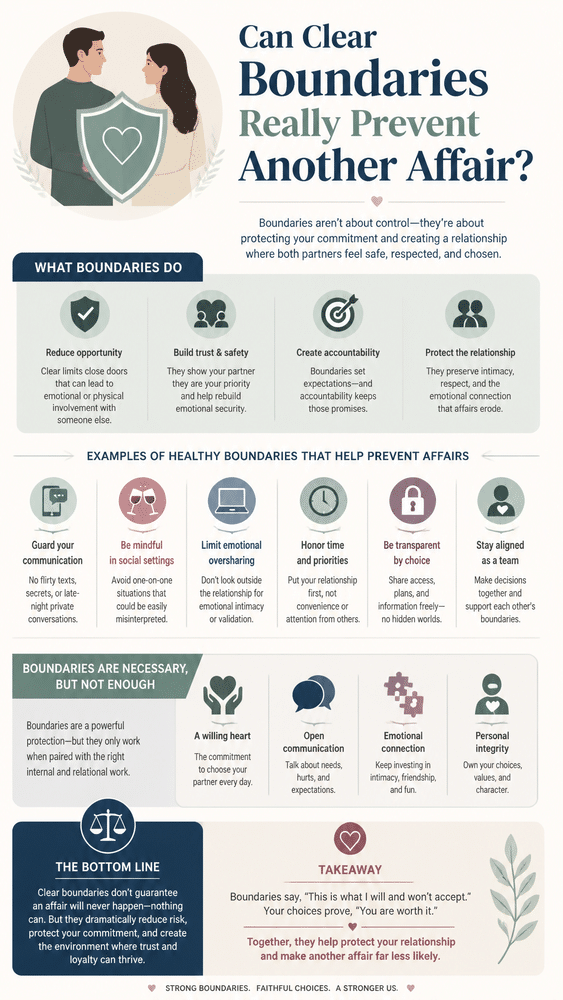
Boundaries after infidelity fall into five practical categories. Each one addresses a different dimension of safety.
- Technology and transparency: Access to phones, email, or location sharing during an agreed window. Script: “I need to be able to check your messages for the next three months. If that’s not possible, I’ll need to reassess whether I can stay.”
- Emotional limits: Time-outs when a conversation becomes dysregulating. Script: “When I feel flooded, I’ll say ‘I need 20 minutes’ and we pause. I’ll come back.”
- Communication rules: Scheduled weekly check-ins rather than on-demand interrogations. Script: “I’d like us to set aside Sunday evenings to talk about how the week felt. That helps me feel less anxious the rest of the time.”
- Financial transparency: Joint access to accounts or a shared monthly summary. Script: “I need to see all account activity each month. That’s what safety looks like for me right now.”
- People, places, and things: No contact with the affair partner, limits on certain social settings. Script: “If [name] is at an event, I need you to leave and tell me. That’s the agreement.”
SimplyPsychology notes that surveillance-style boundaries can be useful short-term but should not become permanent controlling behavior. Every category above should carry a planned review date.
How to phrase effective boundaries: the four-part formula
The four-part formula turns a vague demand into a clear, self-focused statement:
Partner behavior → your thought → your feeling → what would help you.
Five annotated scripts:
- “When you don’t share your location [behavior], I think you might be hiding something [thought], and I feel terrified [feeling]. What would help me is knowing where you are during work hours [specific ask].”
- “When I see you texting late at night [behavior], I assume the worst [thought], and my anxiety spikes [feeling]. What would help is keeping your phone on the kitchen counter after 9 PM [specific ask].”
- “When you change the subject after I ask a direct question [behavior], I feel dismissed [feeling]. What would help is a simple yes or no, even if the conversation is hard [specific ask].”
- “When I’m triggered and you get defensive [behavior], I feel unsafe continuing [feeling]. What would help is a 30-minute pause before we continue [specific ask].”
- “When physical intimacy feels pressured [behavior], I feel violated [feeling]. What would help is knowing I can say no without it becoming an argument [specific ask].”
Each script works because it centers the speaker’s experience, names an observable behavior, and specifies a concrete change. Boundaries that actually work avoid blame language and stay anchored to what the betrayed partner will do, not what the offending partner must do.
Pro Tip: Rehearse scripts with a therapist or trusted friend before the actual conversation. High-emotion moments compress language; practice makes the formula automatic.
How to negotiate, document, enforce, and wind down boundaries
- Negotiate. Name the specific behavior, the monitoring method, and the timeline. Vague agreements dissolve under pressure.
- Document. Send a brief follow-up email or shared note after the conversation: “To confirm what we agreed: phone access for 90 days, weekly Sunday check-ins, no contact with [name].” Written terms reduce “I never agreed to that” disputes.
- Enforce. When a boundary is crossed, respond with the consequence you named, not a new one. Calibrated responses (a temporary separation, a therapy session, a pause on physical intimacy) signal that the agreement is real.
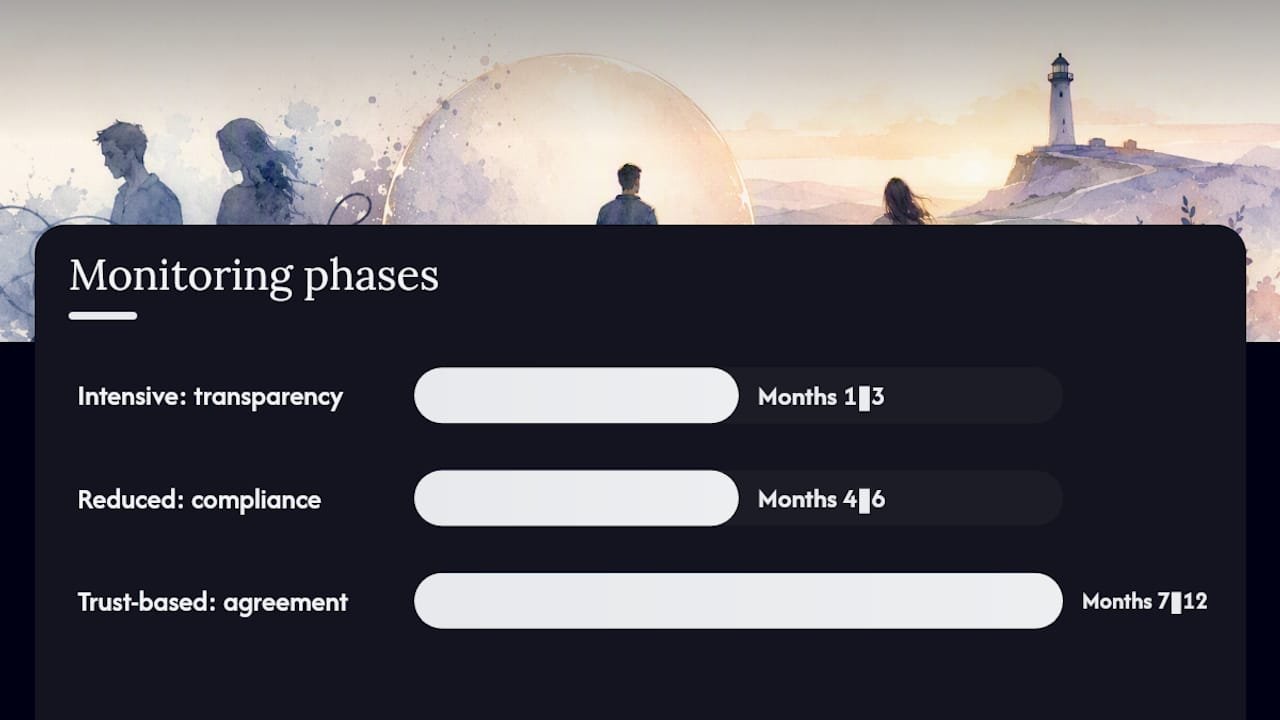
- Monitor. Stages of healing suggest that intensive monitoring is most appropriate in the first 3–6 months. Review at 3 months, 6 months, and 12 months.
- Wind down. Reduce surveillance when trust behaviors are consistent, not when you feel pressured to. A planned sunset date agreed in advance makes this feel like progress, not capitulation.
Rochester Therapy Center recommends specific, observable, revisitable boundaries over open-ended demands. The difference between a boundary and an ultimatum is that a boundary describes your response; an ultimatum tries to force theirs.
Enforcement checklist:
- Boundary stated in writing? Yes / No
- Consequence named in advance? Yes / No
- Consequence applied consistently? Yes / No
- Review date set? Yes / No
- Therapist informed of any violations? Yes / No
Pro Tip: If you find yourself inventing new consequences on the spot after a violation, the original boundary was not specific enough. Go back to the four-part formula.
| Phase | Suggested window | Review trigger |
|---|---|---|
| Intensive monitoring | Months 1–3 | Consistent transparency |
| Reduced surveillance | Months 4–6 | No violations, therapy ongoing |
| Trust-based check-ins | Months 7–12 | Mutual agreement |
What typically goes wrong and red flags that predict relapse
Common mistakes:
- Framing boundaries as demands (“You must never lie to me”) rather than self-focused responses (“I will end this conversation if I’m being lied to”).
- Indefinite surveillance with no review date, which slides into controlling behavior and erodes the offending partner’s motivation to change genuinely.
- Announcing consequences and then not following through, which teaches the offending partner that violations carry no real cost.
Red flags the plan is failing:
- Secrecy persists: new passwords, deleted messages, unexplained absences.
- Repeated violations without accountability or remorse.
- Minimization or blame-shifting by the offending partner after a violation.
- Emotional reactivity so intense that the betrayed partner cannot enforce anything without a crisis.
Boundaries are not about controlling your partner. They are about defining the conditions under which you are willing to stay and heal. When those conditions are repeatedly ignored, the boundary is not the problem — the relationship’s safety is.
Ongoing mental health support significantly increases the likelihood that boundary plans are implemented effectively. A clinician can help calibrate enforcement, prevent escalation, and distinguish a boundary from a control pattern.
When should you involve a professional?
Individual therapy first when: there are active safety concerns, severe emotional dysregulation, a history of domestic violence, or substance use by either partner.
Couples therapy (emotionally focused therapy or PACT-informed work) is appropriate when both partners are physically safe, the offending partner has taken responsibility, and there is genuine motivation to repair.
Therapy-prep checklist:
- Write down two or three boundaries you want to discuss.
- Note any violations that have already occurred.
- Bring the written agreement if one exists.
- State your desired outcome: repair, or clarity about whether to stay.
Useful external support:
- Individual therapist specializing in betrayal trauma.
- Support group for betrayed partners (in-person or online).
- Accountability partner (a trusted friend who knows the agreement and can help you hold it).
- Clinician-ready tools like the Partner Accountability Conversation Guide for structured scripts.
Therapists: the clinician guide on Aftertheaffair offers session-ready frameworks for introducing boundary work with clients who are in the early stages of recovery.
Three short case examples
Case 1: The technology boundary
A betrayed partner discovered an emotional affair through shared cloud storage. She set one boundary: phone access for 90 days, with a written agreement sent by email the same evening. When her partner deleted an app without telling her in week three, she invoked the consequence she had named in advance: a two-week pause on couples therapy while she met individually with her therapist. Her partner reinstalled the app and disclosed the reason for deleting it.
Script extract: “If you delete any app or account without telling me first, I’ll pause our couples sessions until I feel safe enough to continue.”
What worked: the consequence was named in advance, was proportionate, and was applied without negotiation. The offending partner experienced a real cost.
Case 2: The no-contact boundary
A couple agreed that the offending partner would have no contact with the affair partner, who worked in the same industry. When an unavoidable professional event came up, the offending partner disclosed it 10 days in advance, attended briefly, and texted when leaving. The betrayed partner had stated: “If you attend any event where [name] is present without telling me first, I’ll need a week apart to decide whether I can continue.” Because disclosure happened proactively, the consequence was not triggered.
What worked: the boundary was specific enough to account for a realistic scenario. Proactive disclosure became the behavior the boundary was actually shaping.
Case 3: The emotional time-out boundary
A betrayed partner struggled with flooding during difficult conversations. He set a boundary: “When I say ‘pause,’ we stop for 30 minutes. If you follow me or keep talking, I’ll leave the house for the evening.” Over six weeks, his partner learned to respect the pause. Conversations became shorter and more productive.
What worked: reduced ambiguity. Both partners knew exactly what “pause” meant and what followed if it was ignored.
The case for self-focused boundaries as an act of self-care
Most people arrive at boundary-setting after infidelity believing they are doing it to fix their partner. The clinical evidence points somewhere else entirely. Boundaries framed around your own responses restore something the betrayal took: a sense that your choices matter and that you have agency in your own life.
They are also reversible. A boundary set at month one does not have to exist at month twelve. If safety and accountability follow, the limits can be renegotiated. That flexibility is not weakness; it is the whole point. Boundaries create the conditions for trust to rebuild, not a permanent architecture of suspicion.
Structured resources to support your boundary work
Recovery from infidelity is hard enough without starting from a blank page. Aftertheaffair offers structured tools built specifically for this work: the Partner Accountability Conversation Guide gives you step-by-step scripts and prompts for the conversations that feel impossible to start, and the 7-Step Infidelity Recovery Checklist walks you through immediate post-discovery actions, boundary essentials, and monitoring checkpoints in a format you can bring to a therapy session.

The Healing Together guide covers the longer arc: rebuilding trust, winding down surveillance, and deciding what the relationship becomes next. These are not generic self-help materials. They were built by clinicians who work with betrayal trauma, and every script has been tested in real recovery conversations. Start with the Partner Accountability Conversation Guide if you have one difficult conversation coming up and need language that works.
Sources
- After Your Partner Cheated: Setting Healthy Boundaries | Psychology Today
- Cheating and boundaries overview | SimplyPsychology
- Boundaries After Betrayal: Why “Good Faith Effort” Is the Only Path Forward (Dr. Stan Tatkin) — Shame To Resilience
- Boundaries After Infidelity – Thrive Beyond Trauma
- Blog 9: Boundaries vs Ultimatums After Infidelity — How to Protect Yourself Without Controlling Your Partner – Rochester Therapy Center
Therapists: the scripts and four-part formula in this article may be used in clinical practice with client consent. The Partner Accountability Conversation Guide provides session-ready versions of each script.
This article is general information, not a substitute for advice from a qualified doctor. Consult a qualified healthcare professional about your own circumstances before acting on anything here.
FAQ
Why do boundaries prevent relapse after infidelity?
Boundaries restore safety and create real consequences, the two conditions that make genuine change more likely. Without enforceable limits, the offending partner faces no meaningful cost for repeating the behavior.
What is the difference between a boundary and an ultimatum?
A boundary describes what you will do if a specific behavior occurs; an ultimatum tries to force the other person’s behavior. Boundaries are self-focused and enforceable; ultimatums tend to escalate conflict without producing lasting change.
How long should post-infidelity boundaries stay in place?
Intensive monitoring is most useful in the first 3–6 months. Review boundaries at 3, 6, and 12 months, and reduce surveillance when trust behaviors are consistent, not when you feel pressured to do so.
What should I do when a boundary is crossed?
Apply the consequence you named in advance, consistently and without renegotiating it in the moment. If you find yourself improvising a new consequence, the original boundary was not specific enough.
When does boundary work require a therapist?
Involve a therapist when there are active safety concerns, repeated violations without accountability, severe emotional dysregulation, or when you cannot enforce any limit without a crisis. Individual therapy before couples therapy is recommended in those situations.
Recommended
- Boundaries That Actually Work – After the Affair Series
- The Role of Boundaries Post-Affair in Real Recovery
- Role of boundaries after betrayal to rebuild trust – After the Affair Series
- Boundaries After Serial Cheating: What Works – After the Affair Series