TL;DR:
- The 80/20 rule explains that a primary partner provides most needs, but a perceived smaller gap can lead to infidelity. It serves as a diagnostic tool to understand what was missing and guide recovery. Recognizing that affair partners often offer only a transient 20% helps focus on rebuilding trust and addressing real relationship gaps.
- What is the 80/20 rule in infidelity recovery?
- How the 80/20 mindset can push someone toward an affair
- Why the 80/20 idea is more limited than it sounds
- A step-by-step framework for using the 80/20 idea in recovery
- Concrete actions to start closing the gap right now
- When should you bring in professional help?
- Key Takeaways
- The 80/20 rule deserves more honesty than it usually gets
- Aftertheaffair has the tools to move from diagnosis to recovery
- FAQ
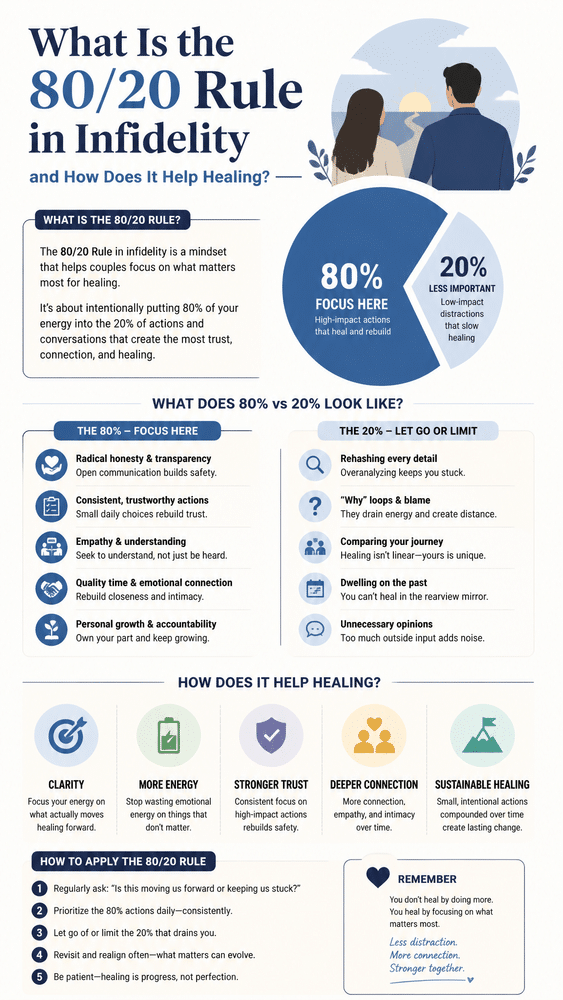
The 80/20 rule in infidelity says your primary partner provides most of your emotional, physical, and social needs, while a perceived smaller gap — often novelty, passion, or a specific shared interest — can push someone to seek that missing piece outside the relationship. Used correctly, it is a diagnostic tool, not an excuse. The first recovery step is straightforward: acknowledge the hurt caused, then map what that 20% actually was so you can address it honestly, together or apart.
The typical 80% (what the primary relationship usually provides):
- Emotional stability, shared history, and daily companionship
- Financial partnership, co-parenting, and domestic life
- Deep familiarity, loyalty, and long-term commitment
The typical 20% (what people report feeling is missing):
- Sexual chemistry, novelty, or physical intensity
- Intellectual stimulation, a niche shared passion, or a sense of being truly “seen”
- Excitement, mystery, or escape from routine stress
The 80/20 framing explains many affairs not because the missing 20% is more valuable, but because it feels more vivid when you are fixated on it. Recovery means shifting that focus back to what you actually have — and deciding whether the gap is closable.
What is the 80/20 rule in infidelity recovery?
The original Pareto principle, formulated by Italian economist Vilfredo Pareto in the early 20th century, observed that roughly 80% of outcomes trace back to 20% of causes. Joseph M. Juran later applied it to quality management, and the ratio has since been adapted across business, health, and now relationships — always as a rule of thumb, never a mathematical law.
In the relationship context, the 80/20 rule describes a specific dynamic: a long-term partner provides roughly 80% of an individual’s emotional, social, and physical needs, while the remaining 20% — perceived as unmet desires for passion, mystery, or specific interests — stays as a gap. The concept is widely cited in infidelity therapy materials as a way to explain why people risk stable partnerships for what turns out to be temporary fulfillment.
Mapping needs into the two buckets looks like this in practice:
80% bucket (foundation): consistent emotional support, shared finances, parenting, physical affection within a familiar rhythm, mutual history, and social belonging.
20% bucket (gap): intense sexual chemistry with a new person, an intellectual or creative connection the primary partner doesn’t share, a sense of being pursued or desired, or simply the adrenaline of something new.
Here is a scenario that illustrates how the rule gets applied — and misapplied. A person in a 12-year marriage feels their partner is a devoted co-parent and reliable companion, but the spark has faded. They meet someone at work who shares their passion for music and flirts openly. The new person seems to supply exactly what is missing. The internal logic becomes: “My partner gives me almost everything, but not this — so I deserve to find it somewhere.” That reasoning is where the 80/20 idea crosses from description into rationalization.
How the 80/20 mindset can push someone toward an affair
The psychology behind this is not mysterious. When someone fixates on the 20% they feel is missing, the brain’s reward system amplifies it. Dopamine spikes around novelty and pursuit, which makes the missing piece feel more urgent than it actually is relative to everything the relationship provides. This is a well-documented cognitive bias — the scarcity of something inflates its perceived value.
Contrast bias makes it worse. When someone meets a potential affair partner, they are comparing a freshly staged 20% against the full weight of a long-term relationship — the bills, the arguments, the tired Tuesday evenings. The affair partner has none of that baggage. They show up as pure upside: attentive, exciting, and unburdened by shared obligations. Clinicians call this life-baggage asymmetry, and it creates a profoundly distorted picture.
Three common scenarios show how this unfolds:
Sexual chemistry: A partner feels the physical intensity has faded. Someone new is openly attracted to them. The comparison is not “new person vs. my partner” — it is “new person vs. the version of my partner I see on a tired Wednesday night.”
Emotional intimacy: A partner feels emotionally unseen. A colleague listens intently, asks questions, and mirrors their values. What looks like a deep connection is often a relationship that has never been tested by real life.
Novelty as escape: Stress, grief, or career pressure makes the familiar feel suffocating. An affair becomes an exit from reality rather than a genuine connection — the 20% is really just “not this.”
The rationalization step is where accountability breaks down. The 80/20 frame gets weaponized: “I only did this because you weren’t meeting my needs.” That is not a diagnostic observation. It is a way of shifting responsibility onto the betrayed partner’s supposed shortcomings instead of owning the choice to betray. Recognizing that distinction is the first accountability task in recovery.
Why the 80/20 idea is more limited than it sounds
The most obvious problem with the 80/20 rule is that it implies a perfect 100% exists somewhere. It does not. No single person provides every emotional, intellectual, social, and physical need another person has — and expecting them to is a setup for chronic disappointment. Recovery reframes unmet needs as opportunities for shared projects or independent pursuits, not as evidence that the relationship is fundamentally broken.
The “illusion of the missing piece” is a clinical observation worth taking seriously. Affair partners appear to supply only the targeted 20% without the burdens of daily life, which inflates the perceived fit. Put that same affair partner into a shared mortgage, a sick child, and a disagreement about in-laws, and the 20% advantage narrows fast. Most affairs that become long-term relationships eventually reproduce the same 80/20 dynamic — just with a different person.
There is also an ethical dimension the rule glosses over. Using 80/20 language in the aftermath of betrayal can become a form of gaslighting: the unfaithful partner frames the affair as a logical response to a gap, implicitly blaming the betrayed partner for not filling it. This is not a neutral diagnostic conversation. It is a power move that compounds the original harm and derails genuine accountability.
The rule helps when it is held lightly — as a starting question (“What was I actually seeking?”) rather than a verdict (“My needs weren’t being met, so this was inevitable”). That distinction determines whether the concept supports recovery or sabotages it.
A step-by-step framework for using the 80/20 idea in recovery
Used as a diagnostic tool, the 80/20 concept gives both partners a structured way to move from shock and blame toward something more workable. The framework below draws on evidence-based recovery sequencing and maps directly to the stages of healing most clinicians recognize.
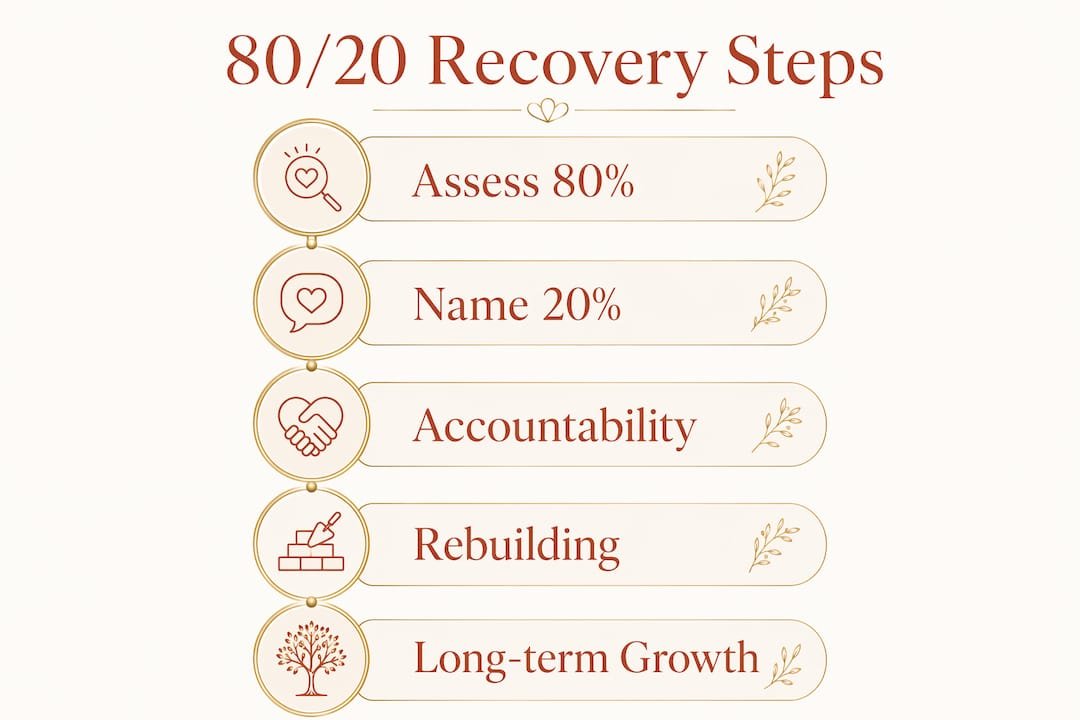
Step 1: Assess the 80% and name the 20%
Both partners answer these questions separately, then share:
- What did our relationship reliably provide? (List at least five specific things.)
- What did I feel was missing — and for how long?
- Was I ever direct about that gap with my partner?
- What did the affair (or the person involved) seem to offer that I wasn’t getting?
The betrayed partner does this exercise too, not to accept blame, but to understand what the relationship dynamic actually looked like before discovery. Structured recovery tools give both partners a concrete scaffold for this assessment rather than leaving it as an open-ended conversation that can spiral.
Step 2: Establish immediate safety and emotional stabilization (weeks 1–6)
Before any productive conversation about the 20% gap is possible, the immediate environment needs to be stable. This means:
Step 3: Accountability conversation
This is the hardest step and the one most often skipped. The partner who cheated needs to name the choice they made — not the gap that preceded it. A useful script:
The betrayed partner needs space to respond without being asked to immediately forgive or problem-solve. Expressing needs post-affair is a skill that takes practice, and most couples benefit from a therapist in the room for this conversation.
- No contact with the affair partner (or a clearly defined boundary if contact is unavoidable, e.g., a coworker).
- Agreed-upon transparency rules — location sharing, open phone access, or whatever both partners can genuinely sustain.
- Individual emotional regulation practices: therapy, journaling, physical exercise, or meditation for trauma recovery.
Step 4: Targeted rebuilding steps (months 2–9)
Once the 20% gap is named, the couple can build specific repair actions around it. If the gap was emotional intimacy, the rebuilding task is structured vulnerability — weekly check-ins, shared journaling, or a couples journal that creates a regular ritual for depth. If it was novelty, the task is deliberate new experiences together, not just date nights but genuinely unfamiliar territory.
Pro Tip: Try the 777 Rule as a maintenance structure: a date every 7 days, a weekend away every 7 weeks, and a longer trip every 7 months. This keeps novelty and connection alive in the primary relationship without leaving the 20% gap unaddressed.
Step 5: Long-term growth and independent needs (9+ months)
Some portion of the 20% is legitimately better met outside the primary relationship — through friendships, hobbies, or professional pursuits. Recovery that insists one partner must now supply everything is just a different version of the same unrealistic expectation. Healthy long-term recovery builds relationship growth that includes both partners having independent sources of meaning.
A brief case illustration: one couple who worked through this framework (details changed for privacy) identified the 20% gap as the unfaithful partner’s need for intellectual challenge and peer recognition — something that had been absent since a career change. The rebuilding plan included the partner returning to a professional community and the couple scheduling monthly conversations about each person’s individual goals. By month eight, both partners reported the original gap felt addressed without either person having to be everything. More real-life recovery examples show how varied these paths can be.
Concrete actions to start closing the gap right now
Recovery does not wait for the perfect moment. The table below maps specific actions to who leads them, what they target, and a realistic timeframe.
| Action | Who leads | Goal | Typical timeframe |
|---|---|---|---|
| No-contact or boundary agreement | Both partners | Safety and trust baseline | Week 1 |
| Individual trauma therapy | Betrayed partner (primarily) | Emotional stabilization | Weeks 1–12 |
| 80/20 gap assessment exercise | Both partners, with therapist | Name the unmet need clearly | Weeks 2–4 |
| Accountability conversation | Partner who cheated | Own the choice, not just the gap | Weeks 3–6 |
| Targeted rebuilding activities (novelty, intimacy, shared interest) | Both partners | Close the specific 20% gap | Months 2–9 |
| Couples therapy with betrayal-focused protocol | Therapist-led | Rebuild communication and trust | Months 1–9 |
| Independent need-meeting plan (hobbies, friendships, career) | Both partners individually | Reduce unrealistic expectations | Months 6–12+ |
| Long-term check-ins and boundary reviews | Both partners | Sustain growth, prevent relapse | 9+ months |
Short-term (weeks 1–12), the priority is safety and stabilization. Trying to resolve the 20% question before the immediate crisis is managed usually backfires — the betrayed partner cannot engage productively while still in acute trauma. Coping in the immediate aftermath is its own skill set, separate from the longer rebuilding work.
Mid-term (months 3–9), the work shifts to trust protocols and targeted gap-closing. This is where rebuilding trust after betrayal becomes concrete: specific agreements, followed through consistently, over time. Vague promises do not rebuild trust. Repeated small actions do.
Long-term (9+ months), the focus moves to independence and growth. Both partners need to be able to answer the question: “What do I need that only I can provide for myself?” Couples who skip this step tend to recreate the same dependency dynamic that made the 20% gap feel so urgent in the first place.
When should you bring in professional help?
Some situations call for outside support from the start, not after self-help resources have been exhausted. Seek professional help immediately if you notice any of these:
- Ongoing secrecy: the partner who cheated has not ended the affair or continues to minimize what happened.
- Repeated boundary violations: agreements made in the first weeks are broken consistently.
- Severe trauma symptoms: flashbacks, inability to sleep, dissociation, or intrusive thoughts that interfere with daily functioning — these are signs of betrayal trauma that need clinical attention.
- Escalating conflict: arguments that become verbally or physically unsafe.
- Children showing distress: behavioral changes in children that suggest they are absorbing the household tension.
Treatment modalities that work specifically for betrayal trauma include:
- Individual trauma therapy: EMDR (Eye Movement Desensitization and Reprocessing) has strong evidence for trauma processing and is increasingly used with betrayal trauma specifically.
- Couples therapy with a betrayal-focused protocol: not all couples therapists are trained in infidelity. Ask specifically whether the therapist has experience with betrayal trauma and whether they use a structured protocol.
- Structured recovery programs: self-guided programs with clinical scaffolding — checklists, scripts, and sequenced exercises — can supplement therapy or serve as a first step when therapy is not immediately accessible.
- Group support: peer groups for betrayed partners can reduce isolation and normalize the recovery timeline.
When choosing a therapist, ask three questions at the first intake: Have you worked specifically with infidelity and betrayal trauma? Do you assign structured homework between sessions? What does a safety plan look like in your practice? A therapist who answers these concretely is better positioned to help than one who offers only open-ended talk therapy. Understanding how to improve your therapy experience from the start makes a real difference in outcomes.
The early sessions should include a clear safety plan, an agreed-upon communication structure for between sessions, and some form of psychoeducation about betrayal trauma responses. If the first few sessions feel like venting with no structure, that is useful feedback.
Key Takeaways
The 80/20 rule in infidelity is most useful as a diagnostic question — “What was actually missing?” — not as a moral verdict about who is to blame.
| Point | Details |
|---|---|
| Diagnostic, not justification | The 80/20 rule names a gap; it does not excuse the choice to betray. Accountability must come first. |
| The 20% illusion | Affair partners appear to supply only the missing piece because they carry none of the relationship’s real-life weight. |
| Name the gap specifically | Vague “something was missing” thinking stalls recovery. Naming the exact 20% makes rebuilding concrete and targeted. |
| Recovery is staged | Stabilization (weeks 1–12), trust rebuilding (months 3–9), and long-term growth (9+ months) each require different actions. |
| Aftertheaffair resources | The Aftertheaffair series provides staged checklists, accountability scripts, and playbooks that map directly to each recovery phase. |
The 80/20 rule deserves more honesty than it usually gets
The 80/20 concept circulates widely in infidelity conversations, and most of the time it gets used in one of two unhelpful ways: either as a sophisticated-sounding excuse (“I was only seeking the 20% I wasn’t getting”) or as a reason to dismiss the whole framework as pop psychology. Both responses miss what is actually useful about it.
What the rule captures accurately is that long-term relationships do develop gaps, and those gaps are real. Dismissing them as irrelevant does not make them go away. What the rule gets badly wrong is the implicit suggestion that a gap justifies seeking it elsewhere rather than addressing it directly. The choice to betray is always a choice, regardless of what preceded it.
The piece that most recovery conversations underweight is the betrayed partner’s relationship to the 80/20 idea. Being told “you provided 80% of what I needed” is not reassuring. It is a reminder that you were weighed, measured, and found slightly short. Recovery requires the partner who cheated to move past the diagnostic language quickly and into concrete accountability — because the 80/20 frame, however accurate as a description, can easily become a way of keeping the betrayed partner on the defensive.
The most honest use of this concept is a private one: the partner who cheated uses it to understand their own psychology, takes full responsibility for the choice, and then works to address the gap through the relationship rather than around it. That is the version that actually leads somewhere.
Aftertheaffair has the tools to move from diagnosis to recovery
If the 80/20 assessment has helped you name what was missing, the harder work is knowing what to do next. Aftertheaffair provides structured, evidence-informed resources built specifically for this stage: the 7-step infidelity recovery checklist maps directly to the assessment and stabilization steps described in this article, giving you concrete milestones rather than open-ended reflection.
For the accountability conversation, the Partner Accountability Conversation Guide provides word-for-word scripts for both partners — the kind of language that is almost impossible to find in the moment when emotions are running high. The series also includes staged books covering the first months after discovery through long-term growth, so the resource you reach for matches where you actually are in the process. If you are ready to move from understanding the 80/20 dynamic to doing something about it, the recovery checklist is the clearest place to start.
Useful sources
The following sources informed this article and offer further reading for individuals, couples, and clinicians working through infidelity recovery.
- PMC / NCBI — Infidelity research: Peer-reviewed research on infidelity prevalence, psychological impact, and recovery outcomes. Useful for clinicians seeking evidence-based grounding.
- Wikipedia — Pareto principle: Clear origin and explanation of the 80/20 rule as a statistical and management concept, useful for understanding what the relationship adaptation borrows (and distorts).
- Investopedia — The 80/20 Rule: Accessible explanation of the Pareto principle’s original application and its limits as a rule of thumb.
- Ammirati Counseling Group — Infidelity therapy: Clinical framing of the 80/20 rule in a therapy context, with practical notes on how therapists use it in session.
- Sasha7 — 80/20 rule in infidelity: Detailed relationship-focused breakdown of the 80/20 concept, including the “illusion of the missing piece” and practical alternatives.
- Baltimore Therapy Group — Recovering from infidelity: Clinician-authored guide covering recovery phases, realistic timelines, and the reframing of unmet needs.
- Aftertheaffair — 7-step recovery checklist: Step-by-step recovery scaffold with concrete milestones; maps directly to the assessment and stabilization framework in this article.
- Aftertheaffair — Stages of healing: Explains the typical recovery arc from immediate crisis through long-term growth, with realistic timeline guidance.
- Aftertheaffair — Partner Accountability Conversation Guide: Scripts and structured protocols for the accountability conversation; referenced in the communication-scripts section above.
- Meet Me Here — The Couples Journal: A structured couples journaling resource that supports the shared rituals and regular check-ins recommended in the long-term maintenance phase.
FAQ
What does the 80/20 rule mean in the context of cheating?
The 80/20 rule in infidelity suggests that a primary partner provides roughly 80% of a person’s needs, and the perceived missing 20% — often novelty, passion, or a specific connection — can drive someone to seek it outside the relationship. It describes a psychological pattern, not a moral justification.
Should you stay or leave after infidelity?
There is no universal answer. The decision depends on whether the partner who cheated takes full accountability, whether both partners are willing to do the repair work, and whether the relationship’s 80% foundation is genuinely strong enough to rebuild on. A structured recovery program or couples therapist can help both partners assess this honestly.
How do couples actually heal after infidelity?
Healing follows a staged process: immediate stabilization and safety, then targeted trust rebuilding, then long-term growth work. Marriage healing strategies that include concrete agreements, consistent follow-through, and professional support produce better outcomes than open-ended conversations alone.
What is the 90/10 rule in infidelity?
The 90/10 rule is a less common variation suggesting that most of a person’s emotional reaction to a current situation is actually rooted in unresolved past experiences, and only a small portion is about the present event. In infidelity recovery, it is sometimes used to help partners recognize when their responses are being amplified by older wounds rather than the current situation alone.
How does an affair partner typically feel when the unfaithful partner returns to their spouse?
Affair partners often experience a combination of rejection, grief, and disillusionment. The relationship they experienced was staged without real-life obligations, so the ending can feel disproportionately painful relative to what the relationship actually was. This is part of why the “illusion of the missing piece” is so powerful — and so damaging to everyone involved when it collapses.
Recommended
- How to Guide Clients After Infidelity for Healing – After the Affair Series
- Effects of Infidelity: 65% Face Anxiety, UK Recovery Guide – After the Affair Series
- 7 Steps-Infidelity Recovery Checklist – After the Affair Series