Last Updated: August 8, 2026
- Understanding Evidence-Based Protocols for Separated Parents
- Co-Parenting Communication Templates That Reduce Conflict
- How to Reduce Parental Conflict After Separation
- Parallel Parenting Plan Examples for High-Conflict Situations
- Protecting Child Development and Resilience
- Co-Parenting Apps for High-Conflict Families
- Implementing Evidence-Based Protocols: A Step-by-Step Approach
- Conclusion: Moving Forward With Structured Support
Understanding Evidence-Based Protocols for Separated Parents
Evidence-based protocols for separated parents are structured communication frameworks and parenting strategies grounded in clinical research, designed to reduce conflict while protecting child wellbeing. High-conflict separation shapes how children regulate emotions, manage stress, and approach relationships years later. Parents who implement structured protocols show measurable behavioral improvements in their children within weeks.
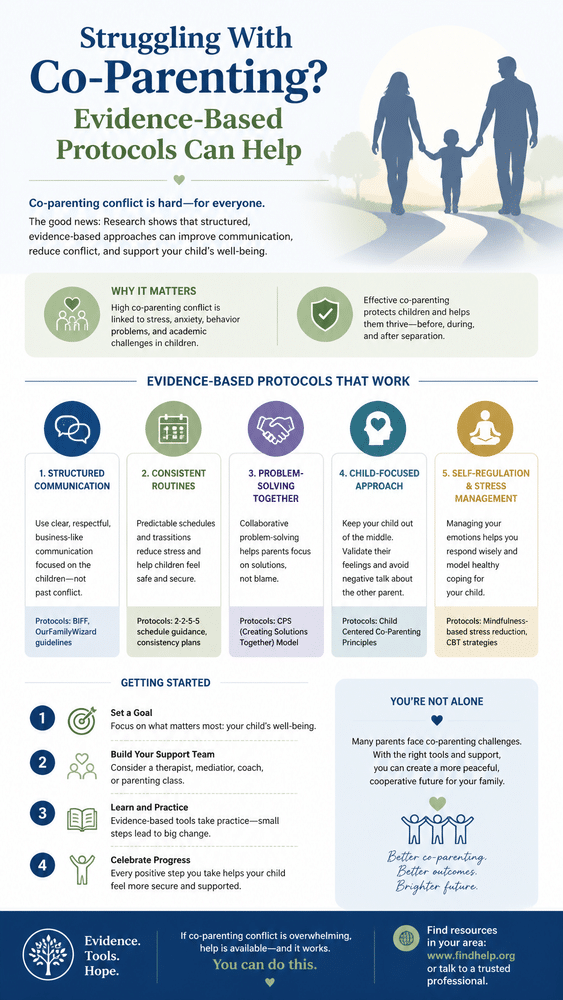
Good intentions fail without structure. Without specific tools and decision frameworks, parents default to old patterns under stress. This guide breaks down evidence-based protocols that work in high-conflict situations: communication templates for hostile interactions, how to recognize when your child is internalizing stress, and a step-by-step implementation process you can start this week.
Co-Parenting Communication Templates That Reduce Conflict
Effective co-parenting communication requires intentional word choice and structured response patterns. You need templates that work when you’re angry, when your ex is aggressive, and when stakes feel impossibly high.
The Gray Rock Method for High-Conflict Interactions
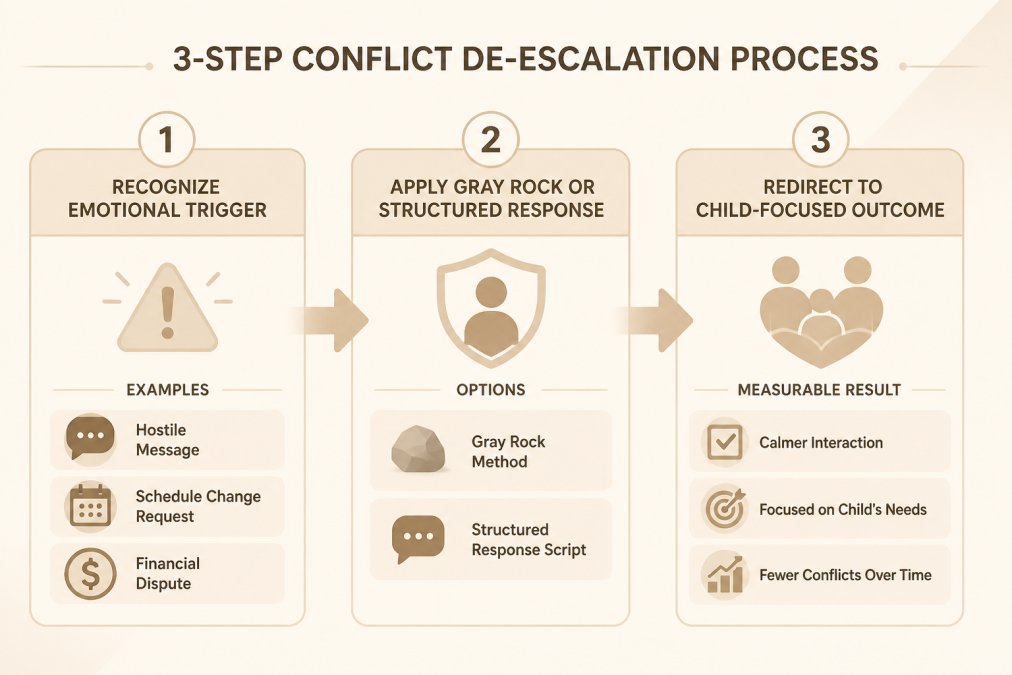
The Gray Rock Method is a communication technique where you respond to hostile or manipulative behavior with boring, emotionally neutral responses that remove the reward your ex gets from escalating. When you stop providing that reaction, the behavior typically decreases.
How to use Gray Rock in practice:
- Keep responses short: one or two sentences maximum
- Use neutral, factual language; avoid emotional words, sarcasm, or detailed explanations
- Don’t defend yourself or explain your reasoning
- Stick to logistics: pickup times, payment amounts, medical appointments
- Repeat the same information if your ex pushes back
Example Gray Rock responses:
Hostile message: “You’re the worst parent. You’re ruining our kids with your selfish decisions.”
Gray Rock response: “I’ll pick up the kids at 6 PM on Friday as scheduled.”
The most common mistake is breaking Gray Rock by adding explanations. When your ex pushes back, repeat the same response word-for-word if necessary. Consistency matters more than elaboration.
Structured Response Scripts for Common Triggers
High-conflict co-parenting involves predictable trigger situations: disagreements about parenting decisions, requests for schedule changes, financial disputes, and conflicts about the other parent’s involvement. Pre-written scripts prevent you from improvising under stress.
Script for schedule change requests:
“I received your request for [specific change]. I’ll review it against the parenting plan and get back to you by [specific date]. If modifications are needed, we can discuss through [mediation/app/email].”
Script for parenting disagreement:
“I understand you have concerns about [specific issue]. My approach is based on [child’s needs/medical advice/parenting plan]. We can discuss this further if you’d like to involve a mediator.”
Script for financial disputes:
“The payment of [amount] is due on [date] per the agreement. I can send you the documentation if needed.”
The power of structured scripts isn’t in sounding robotic, it’s in preventing yourself from being drawn into arguments that don’t serve your children. When you know what you’re going to say before conflict starts, you can’t be manipulated into saying something you’ll regret.
How to Reduce Parental Conflict After Separation
Reducing ongoing parental conflict requires understanding the patterns that drive escalation and deliberately interrupting them. The evidence suggests reducing the frequency and scope of communication while increasing its structure.
Emotional Regulation and Parental Stress Management
Your ability to regulate your own emotions directly impacts your child’s stress levels and behavioral outcomes. Children in high-conflict homes show elevated cortisol levels and increased behavioral problems. When separated parents implement emotional regulation practices, their children’s behavioral markers improve measurably.
Practical emotional regulation techniques:
- Pause before responding: Wait 24 hours before responding to a message. This single practice prevents most escalation cycles.
- Name the feeling: Before you respond to your ex, say out loud what you’re feeling. Naming emotions activates the prefrontal cortex and reduces amygdala reactivity.
- Physical release: Exercise, cold water immersion, or intense breathing work better than sitting with anger.
- Separate the person from the behavior: Your ex’s hostile message reflects their dysregulation, not your parenting quality.
When you manage your own stress response, you model emotional regulation for your children.
You don’t need to resolve your emotional response before interacting with your ex. You can feel furious and still send a Gray Rock response. Emotional regulation means managing your behavior, not eliminating your feelings.
Conflict Resolution and Mediation Strategies
In high-conflict situations, direct negotiation often fails because the relationship itself is damaged. Mediation introduces a neutral third party who can reframe positions, identify common ground, and prevent the conversation from derailing into personal attacks.
Use mediation for discrete issues: summer schedule, school choice, medical treatment decisions, financial disputes. The mediator keeps the conversation focused, prevents interruptions and personal attacks, reframes positions as interests, and documents agreements in writing. Mediation often costs less than ongoing conflict and works faster than trying to negotiate directly.
Parallel Parenting Plan Examples for High-Conflict Situations
Parallel parenting is a co-parenting model designed specifically for situations where direct communication and shared decision-making aren’t possible. Each parent makes independent decisions within their own household while maintaining minimal, structured communication about essential logistics.
When Parallel Parenting Is the Right Choice
Parallel parenting is appropriate when:
- Direct communication consistently escalates into conflict
- One parent is unwilling or unable to cooperate
- Gray Rock and communication scripts haven’t reduced conflict
- The parents’ values or parenting styles are fundamentally incompatible
- A parent exhibits controlling, manipulative, or abusive behavior patterns
The key shift in parallel parenting is accepting that you cannot control your ex’s parenting in their home. You can only control what happens in yours. This acceptance often reduces conflict because you stop trying to enforce consistency across two households.
Building a Functional Parenting Plan Model
A functional parallel parenting plan specifies:
Decision-making authority: Each parent makes decisions independently in their home. Joint decisions are limited to major issues: school choice, medical treatment, extracurricular commitments.
Communication boundaries: Communication happens only about logistics, pickup times, medical appointments, and school events.
Information exchange: Each parent provides essential information through a neutral channel (co-parenting app or email, not text).
Pickup and handoff protocol: Clear procedures minimize in-person conflict. Example: “Pickup occurs at 5 PM at [location]. Child is ready with backpack and medications. No discussion beyond logistics occurs during handoff.”
Flexibility boundaries: Specify which schedule changes require agreement and which each parent can make independently.
Parallel parenting acknowledges reality: you’re two separate parents managing the same child in different households.
Protecting Child Development and Resilience
High-conflict separation affects child development measurably. Children show elevated anxiety, depression, behavioral problems, and difficulty with peer relationships. Specific parenting interventions can buffer these effects and build resilience.

Recognizing Internalizing and Externalizing Behaviors
Children respond to high-conflict separation in two primary ways: internalizing behaviors (turning stress inward) and externalizing behaviors (expressing stress outward).
Internalizing behaviors include anxiety, depression, withdrawal, perfectionism, and sleep problems without medical cause.
Externalizing behaviors include aggression, defiance, hyperactivity, angry outbursts, and risk-taking behavior.
If you notice these behaviors emerging, the most powerful intervention is reducing the conflict they’re witnessing. When you implement structured communication protocols and reduce hostile interactions, you’ll often see behavioral improvements within weeks.
Building Child Resiliency Through Consistent Parenting
Child resilience comes from experiencing manageable challenges with consistent, supportive adults who help them develop coping skills. In high-conflict separation, resilience-building parenting includes:
Consistency across time: Same bedtime, same expectations, same emotional availability.
Consistency across situations: Clear, consistent rules and consequences build trust.
Validation without problem-solving: When your child expresses distress, listen without immediately trying to fix it. “That sounds really hard” is more powerful than “Don’t worry, it’ll be fine.”
Age-appropriate honesty: Children sense dishonesty. They need simple, truthful information about the separation
No loyalty conflicts: Never ask your child to choose sides, carry messages, or report on the other parent.
Emotional coaching: Help your child name and manage their feelings. This builds emotional literacy and self-regulation.
Research shows that children with one consistently supportive parent often do better than children with two parents in conflict. Your stability matters more than the other parent’s choices.
Co-Parenting Apps for High-Conflict Families
Digital tools designed for co-parenting communication remove emotional intensity and create documentation that protects both parents. For high-conflict families, these apps enforce structure and create a neutral communication channel.
Digital Tools for Documentation and Communication
Co-parenting apps typically include:
- Messaging with timestamps: All communication is documented, time-stamped, and stored.
- Shared calendar: Schedule coordination happens in one place.
- Expense tracking: Shared costs are documented with receipts.
- Information sharing: Medical appointments, school contacts, and emergency information are accessible without requiring direct communication.
- Tone monitoring: Some apps flag messages that might escalate conflict and suggest rewording.
When communication happens through a structured platform rather than text or email, parents often communicate less frequently and more carefully. The structure itself reduces conflict.
Choosing the Right Platform for Your Situation
When selecting a co-parenting app, consider accessibility, tone indicators, legal admissibility, integration with other tools, cost, and privacy. Using a dedicated app changes communication patterns dramatically because everything is documented.
Implementing Evidence-Based Protocols: A Step-by-Step Approach
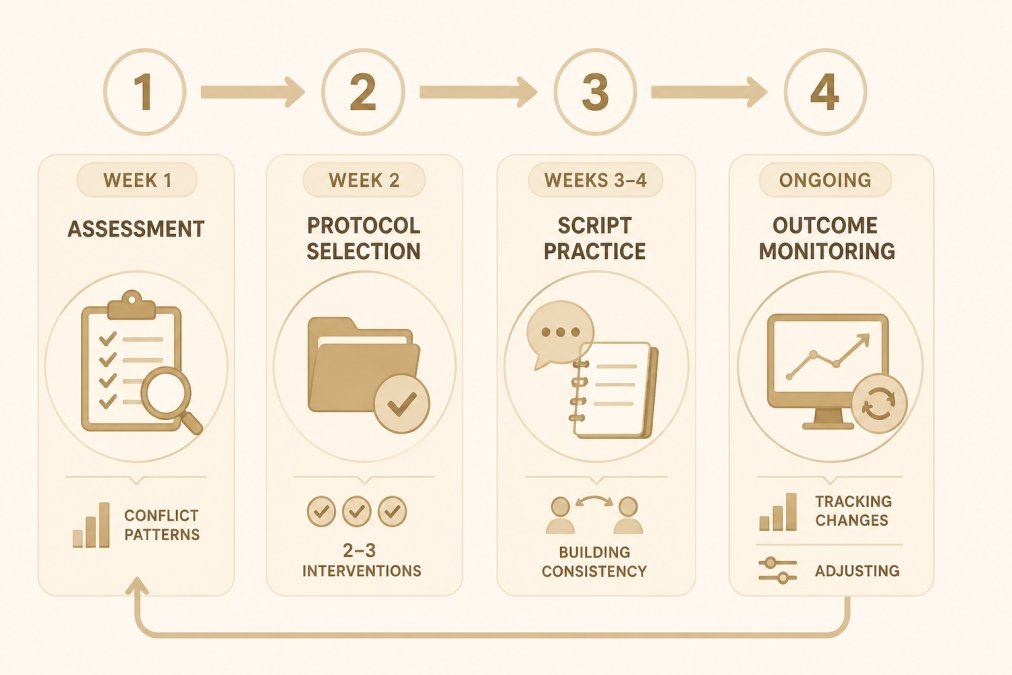
Moving from understanding these protocols to actually using them requires a deliberate implementation process. A staged approach works better than trying to change everything at once.
Step 1: Assess Your Current Conflict Level and Patterns
Before selecting a protocol, understand your baseline. Create a simple conflict log for one week documenting date, trigger, your response, their response, and your child’s reaction. This identifies patterns. Most parents discover they escalate around specific topics or situations.
Step 2: Select the Right Protocol for Your Family
Based on your conflict patterns, choose which protocols to implement first. Pick two or three protocols that address your biggest pain points.
Step 3: Practice Scripts and Build Consistency
Take your chosen communication scripts and practice them. Write them down. Have them accessible when you’re likely to need them. Under stress, you default to old patterns. Most people need 2-3 weeks of consistent practice before new communication patterns feel natural.
Step 4: Monitor Behavioral Outcomes and Adjust
After implementing protocols for 2-3 weeks, assess what’s working. Is conflict frequency decreasing? Are individual conflicts resolving faster? Is your stress level lower? Are you noticing changes in your child’s behavior? Track the same metrics you logged in Step 1 and compare.
Evidence-based protocols aren’t one-size-fits-all. They’re frameworks you adapt to your specific situation. The key is monitoring outcomes and adjusting based on what you observe.
The difference between parents who successfully reduce conflict and those who don’t isn’t intelligence or good intentions. It’s follow-through on a structured process. You don’t need to be perfect. You need to be consistent.
Conclusion: Moving Forward With Structured Support
High-conflict separation is one of the most difficult experiences a parent can navigate. The protocols in this guide, Gray Rock communication, structured scripts, parallel parenting, emotional regulation, and digital tools, are tested methods that reduce conflict while protecting your child’s development.
The challenge is implementation. Knowing these protocols exist is different from actually using them when you’re angry, scared, or triggered. After the Affair Series provides a framework specifically designed for separated parents managing hostile dynamics, including communication scripts you can use immediately, assessment tools to identify your conflict patterns, and step-by-step guidance for building consistency.
Start with the free 23-point assessment to understand your current situation. It identifies your conflict patterns, behavioral risks, and which protocols are most relevant for your family.
Real Customer Questions Answered:
I’ve tried therapy and read books on co-parenting. How is this different?
Therapy addresses your emotional processing. Books provide general frameworks. After the Affair Series provides specific scripts and protocols for the exact moments when you need them, when your ex sends a hostile message, when you need to make a joint decision, when your child is struggling.
My ex is hostile and unpredictable. Will these scripts actually work?
Scripts work differently in high-conflict situations. They’re designed to remove the reward your ex gets from escalating. When you respond to hostility with boring, neutral Gray Rock responses, the behavior typically decreases because it’s no longer getting the reaction they’re seeking.
Won’t my ex see through the scripts and use them against me?
The scripts aren’t deceptive. They’re honest, factual, and focused on logistics. What matters is that you’re documenting clear, reasonable communication. This protects you if disputes escalate.
Do you have data showing these actually reduce conflict and improve child outcomes?
These protocols are based on clinical research on high-conflict separation, emotional regulation, and child resilience. The implementation approach helps you track outcomes in your own family. You’ll see whether conflict frequency decreases, whether your child’s behavior improves, whether your stress level drops.
Why pay for this when free resources exist online?
Free resources provide general information. After the Affair Series provides specific, sequenced protocols with scripts you can implement immediately. The difference is like the difference between reading about exercise and having a personal trainer who tells you exactly what to do today.
I’m still in the fog about whether to stay. Will this help?
This toolkit is designed for separated parents managing hostile co-parenting. If you haven’t decided whether to separate, you need different support. Take the assessment to understand which resources fit your current situation.
How is this better than OurFamilyWizard or other co-parenting apps?
Co-parenting apps are communication tools. After the Affair Series is a protocol toolkit. Apps help you document and organize communication. The toolkit teaches you what to communicate, when, and how to respond when your ex escalates.
Is there legal risk in using these scripts?
Clear, factual, emotionally neutral communication protects you legally. If disputes escalate to court, reasonable, documented communication demonstrates that you’ve acted in good faith. These scripts are designed to be legally defensible.