Ambiguous loss is grief with no finish line: a loss that never gets confirmed and never gets a funeral. Therapist Pauline Boss coined the term to describe exactly what is ambiguous loss. It feels different from ordinary grief because there’s no body to bury and no clean boundary between “here” and “gone,” so hope and mourning end up tangled together for years. Understanding what is ambiguous loss can help in processing these emotions.
If you’re in it right now, start small. Say out loud, to yourself or someone you trust, “this is ambiguous loss, and it’s allowed to hurt without a clear ending.” Naming it is the first real coping move you can make today.
- What Are the Types of Ambiguous Loss?
- How Does Ambiguous Loss Change the Way You Grieve?
- How Do You Cope With Ambiguous Loss?
- How Can You Support Someone Living With Ambiguous Loss?
- Ambiguous Loss in Relationships: When a Partner Feels Like a Stranger
- When Should You Seek Professional Help?
- A Short Perspective on Living With Ambiguous Loss
- A Path Forward if Betrayal Is Behind Your Loss
- FAQ
Key Takeaways
Ambiguous loss stays unresolved because it lacks both confirmation and social ritual, so coping means learning to tolerate uncertainty rather than chasing closure that may never arrive. It’s essential to recognize what is ambiguous loss to address it effectively.
| Point | Details |
|---|---|
| Two distinct types | Type 1 is physical absence with psychological presence; Type 2 is psychological absence with physical presence. |
| Grief often freezes | Without a confirmed ending or a ritual, mourning loops instead of progressing toward acceptance. |
| Naming it helps | Calling the experience “ambiguous loss” reduces self-doubt and opens the door to asking for validation. |
| Build your own rituals | Letters, memory boxes, and anniversary markers substitute for the public rituals this loss doesn’t get. |
| Betrayal-based loss has options | Aftertheaffair’s structured recovery checklist offers one pathway for ambiguous loss rooted in infidelity. |
What Are the Types of Ambiguous Loss?
Boss identified two distinct types, and most real-life situations fall cleanly into one.
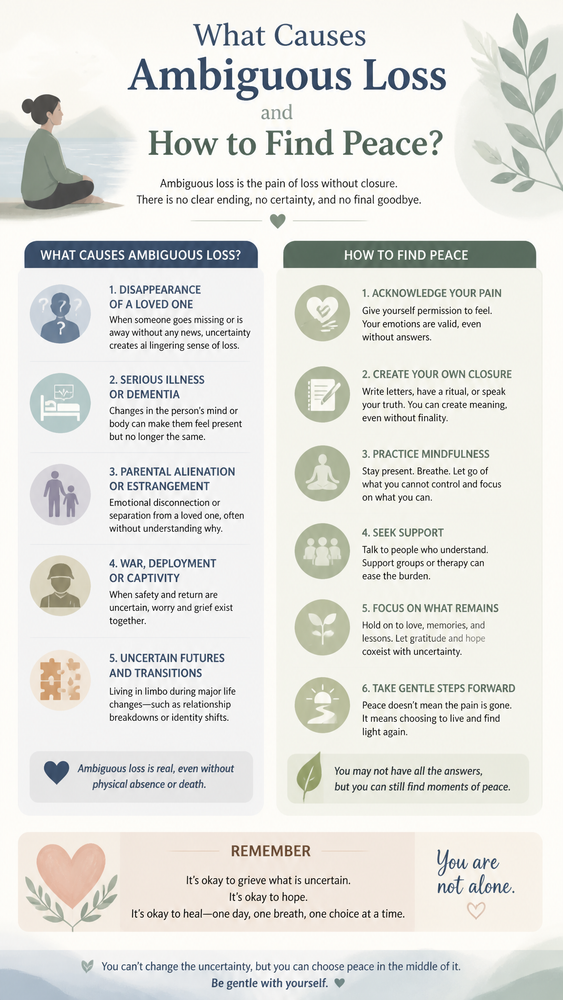
Type 1: physical absence, psychological presence. The person is gone, but you can’t confirm the ending. A missing person, a deployed soldier, a family member cut off by long-term estrangement, or a relative separated by immigration all fit here. You keep them alive in your mind because nothing has closed that door.
Type 2: psychological absence, physical presence. The body is there, but the person you knew isn’t. Dementia, severe addiction, brain injury, and some mental illnesses create this version, where you grieve someone sitting across the dinner table from you.
Some situations blur the two. A parent estranged after a child’s addiction often lives with both: the physical absence of the relationship and the psychological absence of who that person used to be. Everyday experiences carry the same shape, too:
- Being ghosted by someone you were emotionally invested in, with no explanation ever coming
- Chronic illness that changes a partner’s personality or energy without warning
- Infertility, where the loss is a future that never arrives rather than a person who leaves
How Does Ambiguous Loss Change the Way You Grieve?
Ordinary grief moves, however painfully, toward acceptance. Ambiguous loss tends to freeze in place. Without a verifiable ending or a ritual to mark it, grief has nowhere to go, so it loops instead of resolves.
It’s also often disenfranchised. Friends may not know what to say to someone whose husband is alive but doesn’t recognize her, or whose sister is missing but not declared dead. That silence teaches people to doubt their own pain.
Common experiences include longing for the person as they used to be, guilt over wanting to move on, anger at the unfairness, numbness, obsessive replaying of events, and a shaken sense of your own identity, especially if the relationship shaped who you were.
There is no socially recognized ritual, no funeral, no memorial, to validate this kind of grief, which leaves people isolated and second-guessing whether their feelings are even legitimate.
Left unaddressed, this can deepen into chronic anxiety, depression, or lasting relationship strain. If that’s where you are, the professional help and resources section further down covers what to do next.
Understanding the pattern is not the same as breaking it
You Can Explain Why This Happened. Can You Explain Why You’re Still Stuck In It?
Most people in affair recovery can narrate their entire situation with total clarity, the timeline, the triggers, the whole story, and still find themselves back in the same spiral by evening. Insight was never the missing piece. This free assessment shows you exactly where the gap actually is.
Take the Free Affair Recovery Clarity Check →A few honest questions · a scored result · 4 minutes · free
How Do You Cope With Ambiguous Loss?
Coping starts with meaning-making, not closure. Therapeutic approaches to ambiguous loss focus on tolerating uncertainty rather than chasing an ending that may never come. That reframe alone takes pressure off people who think they’re failing at grief because it won’t finish.
From there, a few concrete moves help most:
- Set boundaries around how much space the loss gets in your day; grief needs room, but it shouldn’t run every hour.
- Build small rituals, even private ones, since public ones often don’t exist for this kind of loss.
- Limit rumination with a scheduled “grief window” rather than letting it intrude all day.
- Protect basic self-care: sleep, food, movement, before anything else.
- Ask directly for validation from people you trust, rather than waiting for them to guess what you need.
Therapy formats that commonly help include individual counseling, family therapy when the loss involves a shared household, and peer support groups where other people actually understand the ambiguity. Some readers find coping strategies focused specifically on betrayal useful when the loss traces back to a relationship rupture. Narrative therapy and CBT adaptations both show up frequently in clinical guidance because they help people rebuild identity around the loss instead of waiting to “get over” it.
Pro Tip: Where society doesn’t hand you a ritual, build your own. Write an annual letter to the person you’re grieving, keep a memory box, or mark the anniversary of the loss with something small and repeatable. Naming the loss and creating personal markers is one of the few coping strategies with real therapeutic backing.
How Can You Support Someone Living With Ambiguous Loss?
Listen more than you advise. Validate what they’re feeling rather than trying to talk them out of it, and ask directly what kind of help they actually want instead of guessing.
Avoid platitudes like “everything happens for a reason” or “at least they’re still here.” Don’t push for closure they can’t have, and never compare their loss to a grief experience that had a clear ending.
A simple script works better than most people expect: “I’m so sorry you’re carrying that. I can’t imagine how hard this is, and I’m here.” Pair words with action: offer a walk, cook a meal, or handle one task off their plate.
Encourage professional help if you notice sustained functional decline, talk of suicide, or an inability to manage daily self-care.
Ambiguous Loss in Relationships: When a Partner Feels Like a Stranger
Infidelity, addiction, and major personality shifts all produce a distinct version of ambiguous loss: your partner is physically present, but the person you married feels gone. Grief in this context often centers on yearning for a partner’s former identity while that same person still sits beside you at dinner.

That combination complicates everything: attachment, trust, and even basic decisions about whether to stay. You’re grieving and negotiating at the same time, which ordinary grief support isn’t built for.
For readers whose ambiguous loss traces to betrayal specifically, structured guidance on rebuilding trust offers one credible pathway alongside individual therapy and peer support. None of these routes cancels the others out; most people benefit from combining them.
When Should You Seek Professional Help?
Some signs mean don’t wait: suicidal thoughts, self-harm, severe functional decline, or substance dependency all warrant urgent care.
Other signs matter but aren’t emergencies. Persistent frozen grief, a relationship that’s quietly falling apart, or anxiety and depression that keep building are all valid reasons to book a therapist, even if nothing has reached crisis point yet.
When searching for a therapist, look specifically for grief-informed or trauma-trained practitioners. Not every counselor understands ambiguous loss, and the wrong fit can leave you feeling more dismissed than helped. Worth checking:
- A therapist directory filtered by grief or trauma specialization
- Family support strategies if the loss stems from a loved one’s mental health crisis
- Peer support groups built specifically around ambiguous or unresolved loss
A Short Perspective on Living With Ambiguous Loss
What strikes me most, working through the research on this, is how often people apologize for grieving something that hasn’t technically ended. It hasn’t. Give yourself permission anyway.
A Path Forward if Betrayal Is Behind Your Loss
If your version of ambiguous loss started with infidelity, the grieving partner you were is real, and so is the confusion about how to move forward when the relationship itself is still technically intact. That’s a specific, well-documented shape of loss, and Aftertheaffair built its resources around exactly that gap: structured, stage-by-stage guidance instead of generic grief advice that doesn’t account for betrayal’s particular tangle of trust and identity.

The 7-step infidelity recovery checklist walks through the practical decisions and emotional stages most people face after discovering an affair, without pretending there’s a tidy finish line. If you’re ready for something more structured than searching alone, that checklist is a reasonable place to start today.
Sources
- What Ambiguous Loss Is and How To Deal With It
- Grieving Loss When There’s No Clean Goodbye | Psychology Today
- Coping with ambiguous loss – Mayo Clinic Health System
- Ambiguous Loss: Grieving Someone Who Is Still Alive (2026) | Simply Psychology
This article is general information, not a substitute for advice from a qualified doctor. Consult a qualified healthcare professional about your own circumstances before acting on anything here.
FAQ
What is an example of ambiguous loss?
A missing person, a spouse with advanced dementia, or a parent estranged for years without explanation are all classic examples: the loss lacks confirmation or a clear ending.
How do you heal from ambiguous loss?
Healing focuses on tolerating uncertainty rather than reaching closure. Naming the loss, building personal rituals, setting boundaries around grief, and seeking grief-informed therapy all support that process.
What is ambiguous loss in relationships?
It’s grieving a partner who is physically present but psychologically changed, often after infidelity, addiction, or a major personality shift. Structured resources like Aftertheaffair’s therapy guidance address this specific version.
What does Pauline Boss say about living with ambiguous loss?
Boss argues that closure is often impossible with this kind of loss, so the goal is learning to live with the ambiguity and build meaning around it rather than waiting for resolution.
Recommended
- Can Couples Recover From Multiple Affairs? – After the Affair Series
- Mutual Infidelity Recovery: A Real Plan for Both of You
- How to Cope After Infidelity – After the Affair Series
- The Reality of Exit Affair – After the Affair Series