- What to do right now when your partner won’t cut contact
- Why does a partner keep contact with their affair partner?
- How to communicate about ending contact without it becoming a fight
- How to protect your emotional health while this is still unresolved
- The ambivalence you’re feeling is normal, and it’s hard
- Expert guidance on healing and rebuilding after an affair with ongoing contact
- How to tell if the continued contact is a sign of ongoing betrayal
- What to do if your partner refuses to end contact
- How to protect yourself legally and financially if things deteriorate
- Strategies for rebuilding trust if you choose to stay
- Key Takeaways
- FAQ
What to do right now when your partner won’t cut contact
If your partner is still in contact with their affair partner, your first move is to make one thing unmistakably clear: trust cannot rebuild while that contact continues. That isn’t an ultimatum born of anger. It’s a basic condition for healing, and therapists who specialize in infidelity recovery say so directly. Safety must come first before any conversation about reconciliation can mean anything.
Here’s what to do in the immediate term:
- State your boundary plainly. Tell your partner, calmly and specifically, that all contact with the affair partner must end. Not reduced. Not managed. Ended.
- Prioritize your physical basics. Sleep, food, and water are not luxuries right now. Trauma suppresses appetite and disrupts sleep, and your body needs fuel to process what you’re going through.
- Seek individual therapy. If your partner refuses to end contact, a therapist trained in betrayal trauma gives you a space to process the injury without having to manage your partner’s emotions at the same time.
- Document incidents. Keep a private record of contacts you become aware of, broken promises, and your own emotional responses. Documenting incidents protects you emotionally and, if the relationship deteriorates, legally and financially.
- Delay major decisions. Experts recommend taking time to slow down before making irreversible choices about your relationship, living situation, or finances. Your prefrontal cortex is genuinely impaired by acute stress. The clarity will come, but not today.
Establishing your own safety is not optional. It is the prerequisite for everything else.
Why does a partner keep contact with their affair partner?
The instinctive answer is the most painful one: they’re still choosing that person. But the reality, according to Emotionally Focused Therapy (EFT), is more complicated and, in a strange way, more workable.
Affairs create attachment bonds. The affair partner often became a source of emotional comfort during a period of stress or disconnection. Severing that bond doesn’t happen cleanly the moment someone decides it should. The unfaithful partner’s nervous system is still reaching for a familiar source of relief, even when their conscious intention is to repair the relationship with you.
Common reasons ongoing contact persists include:
- Emotional dependency. The affair partner became a coping mechanism for difficult feelings the unfaithful partner didn’t know how to manage in the primary relationship.
- Guilt management. Some unfaithful partners maintain contact because they feel responsible for the affair partner’s emotional state and can’t tolerate the guilt of a clean break.
- Unresolved attachment. Ongoing contact often reflects unresolved attachment needs, not necessarily a lack of intent to repair the relationship with you.
- Avoidance of intensity. Reaching out to the affair partner can be a way to escape the overwhelming emotional weight of the primary relationship post-discovery.
- Habitual comfort. The communication pattern itself became a habit, and habits don’t dissolve on willpower alone.
Understanding this doesn’t excuse the behavior. But it does shift the frame from “they’re choosing her over me” to “there is real emotional work that hasn’t happened yet.” That distinction matters for how you respond.
How to communicate about ending contact without it becoming a fight
Calm, clear, and firm is the combination that works. Avoiding accusations and raised voices improves the odds of a productive conversation. That doesn’t mean softening your position. It means delivering it in a way your partner can actually hear.
Practical communication strategies:
- Use “I” statements. “I cannot feel safe in this relationship while contact continues” lands differently than “You’re still choosing her.” One describes your experience; the other triggers defensiveness.
- Be specific about what you need. “No contact” is clearer than “less contact.” Vague requests get vague compliance.
- Name the consequence without threatening. “If contact continues, I’ll need to reassess whether I can stay in this relationship” is honest. It’s not a threat. It’s information.
- Don’t have the conversation when you’re flooded. If your heart is racing and your thoughts are scattered, wait. A conversation started in crisis rarely ends productively.
- Write it down first. Putting your thoughts on paper before speaking helps you stay on point when emotions spike mid-conversation.
Pro Tip: If direct conversation keeps escalating into a fight, consider bringing in a couples counselor for a single structured session before attempting the no-contact conversation again. A neutral third party changes the dynamic significantly.
If your partner responds to your boundary with defensiveness, dismissal, or counter-accusations, that response itself is information about where they are in the process. It doesn’t mean the conversation failed. It means more work is needed, likely with professional support.
How to protect your emotional health while this is still unresolved
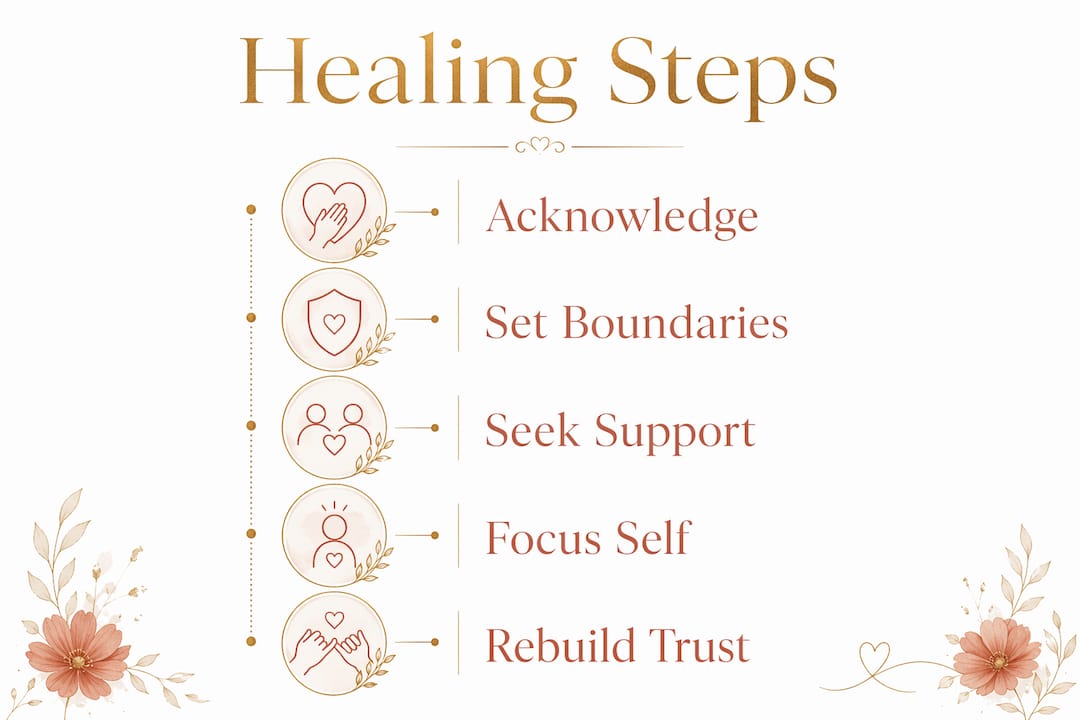
You cannot wait for your partner to make the right choice before you start taking care of yourself. Your healing begins now, regardless of what they decide.
Building a support network of non-judgmental, trusted people is one of the most concrete things you can do. Choose carefully. You want people who can sit with your pain without trying to fix it, and who won’t make you manage their feelings about your situation on top of your own.
Self-care practices that actually help during betrayal trauma:
- Physical movement. Walking, running, or even push-ups on your bedroom floor. Your body is flooded with cortisol and adrenaline, and physical activity is the most direct way to metabolize those stress hormones.
- Journaling. Writing down what you’re feeling, without editing, helps externalize the chaos and gives you a record of your own emotional arc over time.
- Mindfulness and breathing. Slow, deliberate breathing activates the parasympathetic nervous system and interrupts the threat-response cycle.
- Sleep hygiene. If sleep is impossible, try guided meditations or natural remedies before reaching for medication. Talk to your doctor if nothing works.
- Connecting with betrayal trauma resources. Understanding what you’re experiencing neurologically can reduce the terrifying sense that you’re losing your mind.
Pro Tip: Set a strict time limit on any digital investigation. Compulsive checking of phones, emails, or social media feeds your nervous system a constant stream of threat signals. Thirty minutes per day maximum, then close the device.
Forgiveness is not something you need to force right now. Healing focuses on releasing trauma’s hold on your nervous system, and forgiveness often emerges as a byproduct of that process, not as a prerequisite for it.
The ambivalence you’re feeling is normal, and it’s hard
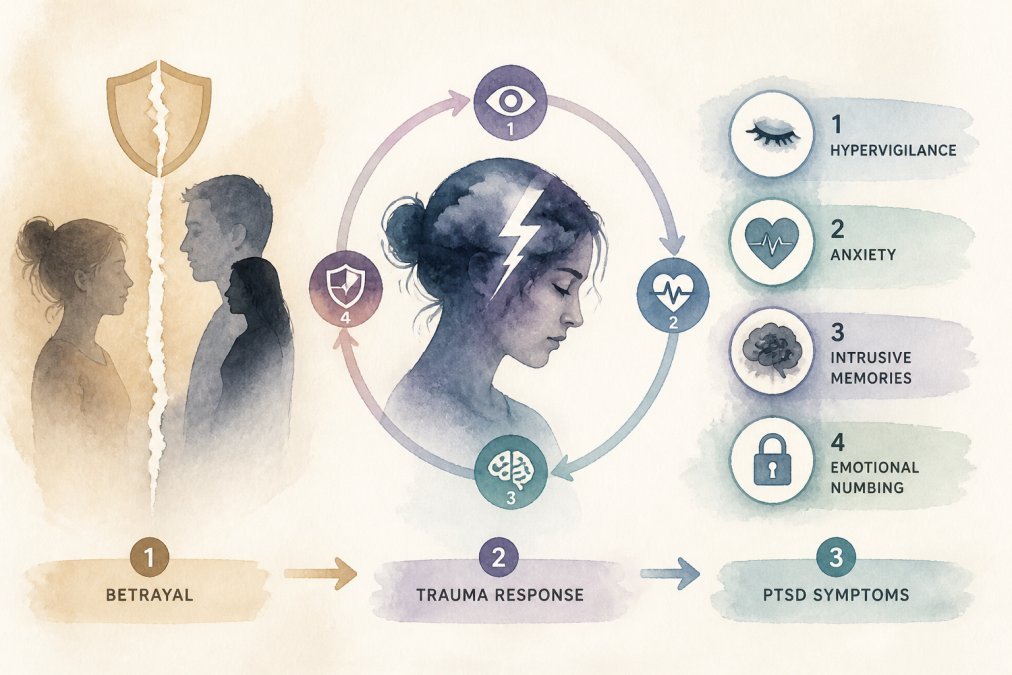
Most people in this situation cycle through the same emotional loop: hope that their partner will finally end contact, rage when they don’t, grief over the relationship they thought they had, and confusion about what to do next. Then the loop starts again. That’s not weakness. That’s what betrayal trauma looks like.
Common experiences people describe:
- Wondering whether ongoing contact means their partner was never truly committed to the relationship.
- Feeling retraumatized every time contact happens again, even when it was “just one message.”
- Oscillating between wanting to fight for the relationship and wanting to walk away entirely.
- Doubting their own perception of reality, especially if their partner minimizes or denies the contact.
- Fearing that setting a firm boundary will push their partner further away.
The difficulty in deciding whether to stay, seek separation, or set conditions for healing is not a sign that you’re indecisive. It’s a sign that you’re dealing with something genuinely complex. These feelings are normal and require patience and professional support to navigate, not a forced resolution on someone else’s timeline.
One thing worth naming directly: every time contact happens again, it resets the clock on rebuilding safety. It’s not a small thing. It reopens the wound and sends a message, even if unintended, that you are not safe and not the priority.
Expert guidance on healing and rebuilding after an affair with ongoing contact
Healing from infidelity is not about returning to the relationship you had before. That relationship is gone. What you’re building, if you choose to stay, is something new with the same person. That process requires more than promises.
According to EFT, infidelity is an attachment injury, one of the deepest wounds a relationship can sustain. Like a serious physical injury, it doesn’t heal through good intentions alone. It heals through consistent, deliberate action over time.
Here’s what that process looks like in practice:
- Full transparency, not partial honesty. The unfaithful partner must provide open access to all communications, 24 hours a day, 7 days a week. Not because you’ll check forever, but because the ability to verify is what allows the urge to check to eventually fade.
- Zero contact with the affair partner. Every exception resets the clock. There cannot be a plan to “check in” later. The line must be firm.
- The unfaithful partner responds to pain with comfort, not defensiveness. This is what therapists call the “missing experience.” When the betrayed partner shows their rawest pain and the unfaithful partner meets it with care instead of withdrawal, a new neural pathway forms. It’s not a one-time event. It’s a pattern that must be established and sustained.
- Accountability and compassion must coexist. Accountability without emotional understanding causes the unfaithful partner to shut down. Compassion without accountability leaves the betrayed partner feeling unsafe. Both are required simultaneously.
- EFT-based couples therapy. Emotion-Focused Therapy addresses the attachment wounds beneath the behavior. In EFT, the unfaithful partner learns to turn toward their spouse with vulnerable feelings instead of numbing out or avoiding. The betrayed partner gains a safe space to express pain without being retraumatized.
- Patience with the timeline. Recovery is not linear. Three good days followed by a morning of rage is a normal step in the process, not a sign of failure.
Pro Tip: If couples therapy feels too overwhelming right now, start with individual therapy for yourself. A therapist trained in infidelity trauma can help you stabilize before you’re ready to do the relational work.
Aftertheaffair offers structured, evidence-informed resources built around exactly this kind of healing. The series addresses each phase of recovery, from the initial shock through decision-making and into genuine transformation, with frameworks grounded in clinical practice and real experience.
How to tell if the continued contact is a sign of ongoing betrayal
There’s a meaningful difference between privacy and secrecy. Privacy is healthy. Secrecy, in the context of affair recovery, is destructive. If your partner is hiding contact rather than disclosing it, that secrecy itself prevents the affair from being truly over, even if the physical relationship has ended.
Signs the continued contact crosses into ongoing betrayal:
- Hidden communication. You discover contact through snooping rather than disclosure. Your partner denies contact you have evidence of.
- Emotional intimacy is still present. The conversation topics go beyond logistics. They’re sharing feelings, problems, or personal details that belong in your relationship.
- Your partner becomes defensive when you raise it. Defensiveness about contact, rather than transparency and remorse, signals that something is being protected.
- Broken promises repeat. Your partner agrees to end contact and then doesn’t. Once is a struggle. A pattern is a choice.
- Your gut is giving you consistent feedback. Intuition after betrayal is often accurate. If something feels wrong, it usually is.
Contact that is genuinely unavoidable, such as a shared workplace, looks different. It involves disclosed, business-only communication, a willingness to find alternative arrangements where possible, and full transparency about what was said. The Mayo Clinic notes that if contact is limited to professional necessity, the unfaithful partner should consider whether a job change is possible. Anything beyond that is a choice, not a constraint.
What to do if your partner refuses to end contact
A refusal to end contact is not a neutral act. It’s a statement about priorities. You deserve to respond to it clearly.
Concrete steps to take:
- Restate your boundary in writing. A written message removes ambiguity and creates a record. Keep it factual and calm.
- Consult a therapist individually. This is no longer a couples issue at this stage. You need support that is entirely focused on you.
- Consider a structured separation. A temporary separation, with defined terms, can create the space for your partner to understand the real consequences of their choice. It’s not the same as divorce.
- Seek infidelity recovery counseling for yourself. Specialized counselors who use trauma-informed and EFT-based approaches can help you process what you’re experiencing and clarify what you actually want.
- Stop trying to manage the affair partner relationship for your partner. That is their responsibility. Your energy belongs to yourself.
- Reassess the relationship honestly. If your partner is unwilling to end contact after you’ve clearly stated it’s a condition for healing, you are not dealing with someone who is ambivalent. You are dealing with someone who has made a choice.
A refusal is painful information. But it’s better to have it clearly than to spend months in a holding pattern that is slowly eroding your sense of self.
How to protect yourself legally and financially if things deteriorate
You don’t have to decide to leave to start protecting yourself. Taking practical steps now is not a betrayal of your relationship. It’s responsible self-care.
- Open a personal bank account in your name only and begin directing a portion of your income there. This is not about hiding assets. It’s about having access to funds if you need to move quickly.
- Gather financial documents. Tax returns, bank statements, mortgage documents, investment accounts, and retirement accounts. Make copies and store them somewhere your partner cannot access.
- Consult a family law attorney. A single consultation, even if you don’t intend to file for divorce, gives you a clear picture of your rights and options in your state. Many attorneys offer free initial consultations.
- Review your credit. Check your credit report for accounts you may not know about. Ensure you have credit established in your own name.
- Document the affair. The records you’ve been keeping of contact incidents may be relevant in divorce proceedings, depending on your state’s laws on fault-based divorce.
- Understand your health insurance situation. Know whether you’re covered under your partner’s plan and what your options are if that coverage changes.
None of these steps commit you to a particular outcome. They give you options. And having options is what makes it possible to make a clear-headed decision rather than a desperate one.

Strategies for rebuilding trust if you choose to stay
Rebuilding trust after infidelity is possible. Couples who do the deeper emotional work, not just making promises but addressing the attachment wounds beneath the behavior, can emerge with a relationship that is more honest and more connected than what existed before. Not because the affair was acceptable, but because the repair process forced a depth of communication they had never previously reached.
Trust rebuilds through consistent action, not words. Here’s what that looks like in practice:
- Radical transparency becomes the new baseline. Open phones, open accounts, and a willingness to answer the same question sixteen different ways without shutting down. Transparency shifts from suspicion-driven checking to natural trust as the betrayed partner repeatedly finds nothing to confirm their fears.
- The unfaithful partner initiates repair, not just responds to it. Asking “How are you doing today?” without being prompted. Sitting with you while you cry. Not waiting to be asked before demonstrating accountability.
- Couples therapy with an infidelity specialist. Not general couples counseling. A therapist trained specifically in betrayal trauma and attachment injuries. The Aftertheaffair recovery book series offers structured guidance for each stage of this process, from survival through transformation.
- Agreed-upon rituals of reconnection. Small, consistent acts of turning toward each other. A daily check-in. A weekly conversation about how the healing is progressing. Rituals create predictability, and predictability rebuilds safety.
- Patience with regression. Healing is not linear. A trigger, an anniversary, or a random song can send the betrayed partner back to acute pain months after things seemed stable. That’s not failure. It’s the nervous system doing its job.
The Aftertheaffair infidelity recovery checklist offers a structured, step-by-step framework for exactly this process, grounded in therapeutic evidence and designed for real people navigating real pain.
Key Takeaways
When your partner is still in contact with their affair partner, establishing non-negotiable boundaries and prioritizing your emotional safety are the two actions that determine whether healing is even possible.
| Point | Details |
|---|---|
| Safety before reconciliation | Trust cannot rebuild while contact continues; state this clearly and without negotiation. |
| Delay major decisions | Experts recommend a minimum 30-day pause before making irreversible relationship or financial choices. |
| Contact reflects attachment, not just choice | Ongoing contact often signals unresolved emotional dependency, not simply a lack of commitment to you. |
| Transparency is the foundation | Full, 24/7 access to communications is what allows the urge to check to eventually fade naturally. |
| Protect yourself regardless of outcome | Gathering financial documents and consulting a family law attorney gives you options, not obligations. |
FAQ
My husband says the affair is over but still talks to her. What should I do?
State clearly that no contact is a non-negotiable condition for healing, and seek individual therapy if he refuses. Ongoing contact means the emotional connection isn’t over, even if the physical relationship has ended.
How do I stop my partner from contacting their affair partner?
You cannot control your partner’s behavior, but you can set a clear boundary and name the consequence if it isn’t respected. Couples therapy with an infidelity specialist can help structure that conversation and hold both partners accountable.
How long do relationships with affair partners typically last?
Affairs sustained by secrecy and the intensity of forbidden contact rarely survive when exposed to ordinary life. The emotional dependency that drives ongoing contact tends to fade when the unfaithful partner does the deeper attachment work, often through EFT-based therapy.
What is the 80/20 rule in infidelity?
The concept in infidelity suggests that unfaithful partners often pursue affair partners who seem to offer what they feel is missing from their primary relationship, only to realize later that the affair partner represents a fraction of what their spouse actually provides. It’s a framework for understanding why affairs rarely deliver what the unfaithful partner imagined they would.
Should I forgive my partner for cheating?
Forgiveness is not a prerequisite for healing. Research-informed therapy focuses on releasing trauma’s hold on your nervous system first, and forgiveness often emerges naturally from that process rather than being forced as an early step.
Recommended
- How to Cope When Your Spouse Works With Their Affair Partner
- How to heal when the affair partner won’t leave: 5 steps – After the Affair Series
- How to heal when the affair partner won’t leave: 5 steps
- Is Your Partner a Serial Cheater? Signs and Next Steps