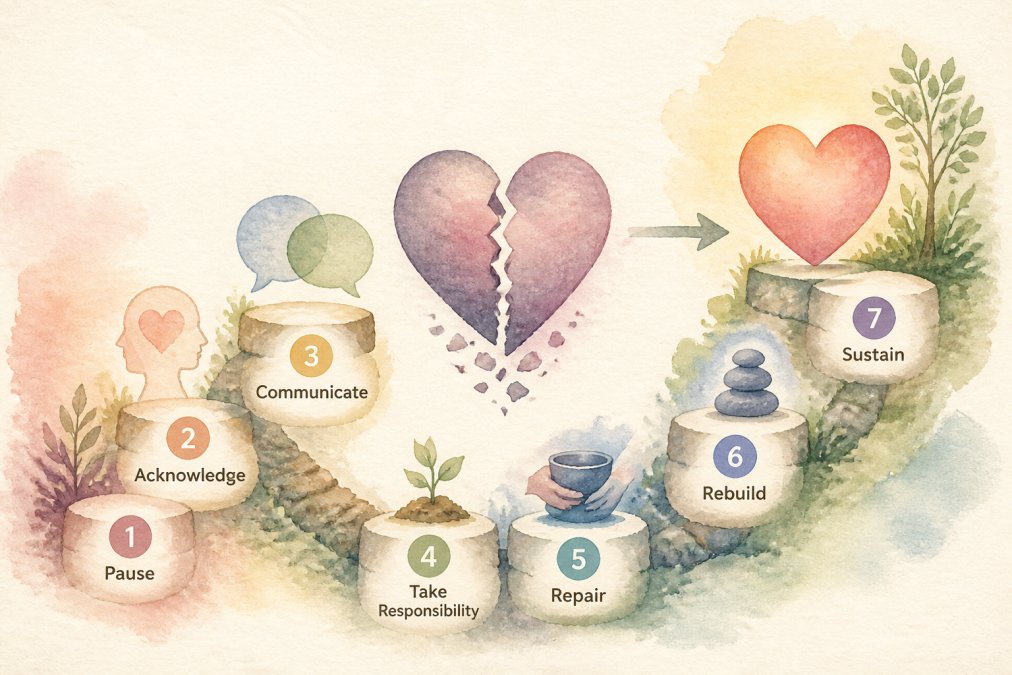
Table of Contents
- Understanding Betrayal Trauma and Its Impact
- Step 1: Accept Full Responsibility and Practice Radical Honesty
- Step 2: Use Scripts for Difficult Conversations After Betrayal
- Step 3: How to Set Boundaries After an Emotional Affair
- Step 4: Recognize Signs of Genuine Change After Infidelity
- Step 5: Rebuild Trust Through Consistent Small Actions
- Understanding the Emotional Affair Recovery Timeline
- When to Walk Away: Recognizing Unworkable Situations
Last Updated: August 25, 2026
Understanding Betrayal Trauma and Its Impact
Betrayal trauma is the acute psychological injury that occurs when a partner’s emotional infidelity shatters the foundation of trust. This isn’t just hurt feelings, it’s a neurobiological response. Your brain has been wired to trust this person, and that violation triggers the same threat-detection systems that activate during physical danger. According to research from the American Psychological Association on trauma responses, betrayal activates the same neural pathways as physical threat.
This matters because recovery requires stabilizing your nervous system before making major relationship decisions. You’re managing a physiological state while trying to think clearly about the future. The recovery timeline varies dramatically, some couples find their way back to intimacy within months, others take years. The difference rarely comes down to how much the betrayer loves the betrayed partner. It comes down to whether both people understand what actually needs to happen and whether they’re willing to do the work of behavioral change, vulnerability, and radical honesty.
Betrayal trauma is a neurobiological response, not an emotional weakness. Recovery requires stabilizing your nervous system before making major relationship decisions.
Step 1: Accept Full Responsibility and Practice Radical Honesty
This is where most attempts to rebuild trust after emotional betrayal fail.
The betrayer typically falls into one of three patterns: minimizing what happened, justifying it, or offering a surface apology without actually taking responsibility. None of these work.
Full responsibility means acknowledging three specific things: what you did, why you did it, and how it affected your partner. Here’s what this actually looks like: "I chose to pursue an emotional connection with someone else instead of addressing the problems in our relationship. I did this because I was avoiding conflict and seeking validation outside our marriage. This destroyed your sense of safety and made you question every interaction we’ve had. That’s on me."
Notice what’s missing: excuses about stress, explanations about your past, or context about your partner’s behavior. First comes accountability.
Radical honesty means answering every question your partner asks, even the ones that hurt (peer-reviewed research). The betrayed partner’s nervous system needs complete information to begin regulating. Partial truths or "I don’t remember" responses keep them in a state of uncertainty, which is neurologically worse than harsh truth.
Surface apologies without behavioral change will deepen the betrayal. Your partner needs to see you consistently choosing differently, not just saying you’re sorry.
Step 2: Use Scripts for Difficult Conversations After Betrayal
Most people freeze when they need to have these conversations. Scripts aren’t about being robotic, they’re about removing the paralysis so you can actually show up authentically.
Here’s a framework for the betrayer initiating a conversation:
"I want to talk about [specific situation]. I know this is hard for you to hear, and it’s hard for me to say. I’m going to tell you what happened, and I want you to know you can ask me anything. If I get defensive, I’m giving you permission to call that out. Here’s what I need to tell you: [specific facts]. I understand this means [specific consequence for your partner]. I’m not asking for forgiveness right now. I’m asking you to know the truth."
For the betrayed partner expressing what you’re feeling:
"When I found out about [specific behavior], it made me feel [emotion]. What I need from you right now is [specific action]. I’m not ready to [what you’re not ready for]. I need time to [what you need time for]."
These scripts remove the pressure to be eloquent, keep the focus on what actually happened, and signal respect. The key is repetition. You’ll have versions of these conversations dozens of times, and each time your partner will understand something new.
Step 3: How to Set Boundaries After an Emotional Affair
Setting boundaries after an emotional affair is not punishment, it’s the structure that makes healing possible.
The most critical boundary is digital transparency. This means the betrayer is willing to share passwords, location data, and communication history as a temporary reset. Agree on what transparency looks like: "I’ll share my location with you. You can ask to see my messages anytime. I’ll tell you if I’m talking to someone who might trigger you."
Other essential boundaries:
No contact with the person involved. Full stop. If the relationship involved work colleagues or mutual friends, the boundary becomes limiting interaction to necessary professional or social contexts, with full transparency about those interactions.
Accountability check-ins. Set a regular time, weekly or biweekly, where the betrayer reports on how they’re managing triggers and what they’re doing differently.
Separate space for processing. The betrayed partner needs room to grieve and process without managing the betrayer’s guilt or defensiveness. The betrayer’s job is to support this process, not interrupt it.
Limits on what the betrayer can ask for. Intimacy, reassurance, and forgiveness are not negotiable right now. The betrayed partner is in survival mode.
Digital transparency is temporary, not permanent. Set a timeline, 6 months, a year, and revisit whether it’s still necessary. The goal is to rebuild trust, not create a surveillance system.
Step 4: Recognize Signs of Genuine Change After Infidelity
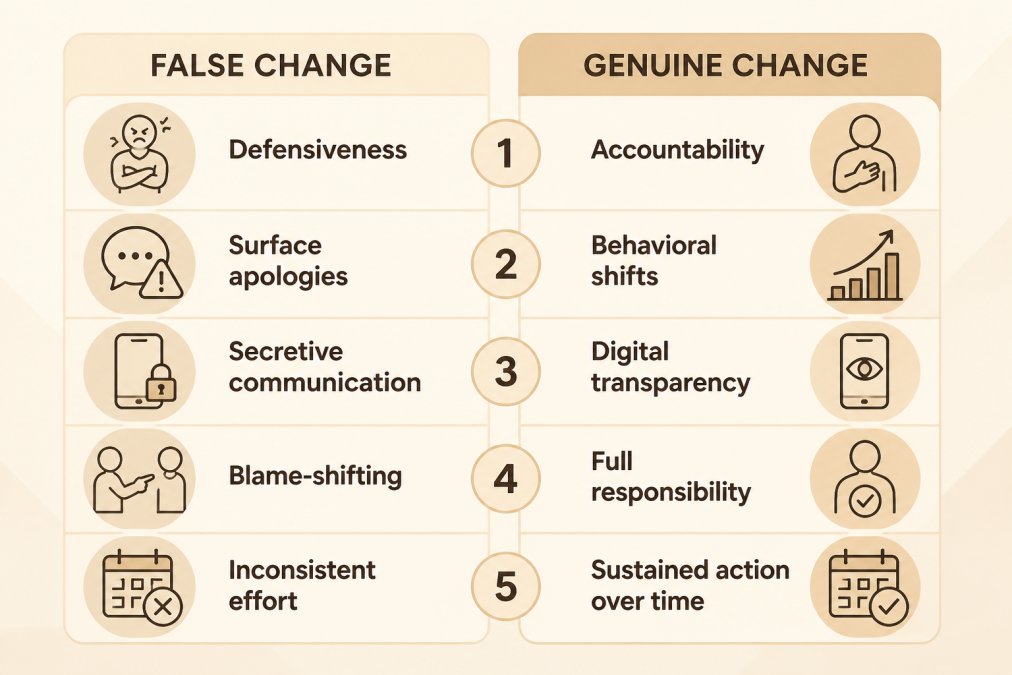
Real behavioral change after emotional betrayal shows up in small, consistent actions over time. A single weekend of attentiveness means nothing. Showing up differently for 90 days straight means something.
Here are the actual markers of genuine change:
Accountability without defensiveness. When you bring up something they did that hurt you, they don’t explain it away. They sit with it and take responsibility.
Vulnerability about their own struggles. The betrayer talks about why they made the choice they did, not as an excuse but as information. "I was avoiding intimacy with you because I was afraid of being rejected."
Proactive transparency. They’re not waiting to be asked. They’re volunteering information about interactions that might trigger you.
Willingness to go to therapy. Individual therapy where they’re examining their own patterns and attachment style.
Behavioral shifts in how they treat you. More presence, less phone checking, more initiation of difficult conversations, more follow-through on commitments.
What genuine change does NOT look like: a perfect apology, grand gestures, promises of "never again," or expecting forgiveness on a timeline.
Step 5: Rebuild Trust Through Consistent Small Actions
Your brain doesn’t rebuild trust through big moments (apa.org). It rebuilds through thousands of small moments of consistency.
Take the free 23-point assessment →
When someone betrays you, your threat-detection system goes into overdrive. Every interaction becomes data. The only way to change that calculation is through repeated, consistent evidence that the person is trustworthy.
Here’s what rebuilding trust actually requires:
Consistency over months, not weeks. Your nervous system needs to see the same behavior repeated across different contexts and stress levels. When the betrayer is tired or frustrated, that’s when you learn whether the change is real.
Small, repeated actions that matter. Showing up on time, following through on commitments, being present during conversations, actually listening. These are unglamorous but they’re the actual mechanism of trust rebuilding.
Tolerating your partner’s skepticism. The betrayed partner will test the betrayer’s consistency. This isn’t manipulation, it’s the nervous system trying to regulate. The betrayer’s job is to answer patiently.
Accepting that trust rebuilding is not linear. You’ll have good weeks, then something will trigger you and you’re back to square one. A song, a time of day, a similar situation can reactivate the trauma. This isn’t failure, it’s part of the process.
Many couples find that working with a therapist who specializes in betrayal trauma helps accelerate this process.
Trust rebuilds through thousands of small, consistent moments, not through grand gestures or perfect apologies. Your nervous system needs repeated evidence that the person is safe.
Understanding the Emotional Affair Recovery Timeline
The timeline for emotional affair recovery is not linear and varies for every couple.
Initial discovery and acute shock (weeks 1-4): Your nervous system is in crisis mode. You can’t sleep or eat. You cycle through rage, despair, and numbness. This is not the time to make major decisions.
Intense emotional processing (months 2-3): The shock wears off and grief hits harder. You’re cycling through the same questions repeatedly. Your brain is trying to make sense of the violation.
Early signs of behavioral change (months 3-6): If the betrayer is doing the work, you’ll start to see consistency. You might feel small moments of connection again, followed by setbacks.
Deepening trust rebuilding (months 6-12): The nervous system is beginning to regulate. You’re having more good days than bad days. Intimacy is becoming possible again.
Sustained recovery and intimacy restoration (12+ months): You’ve integrated the betrayal into your story. You’ve seen enough consistent behavior change to believe your partner is different.
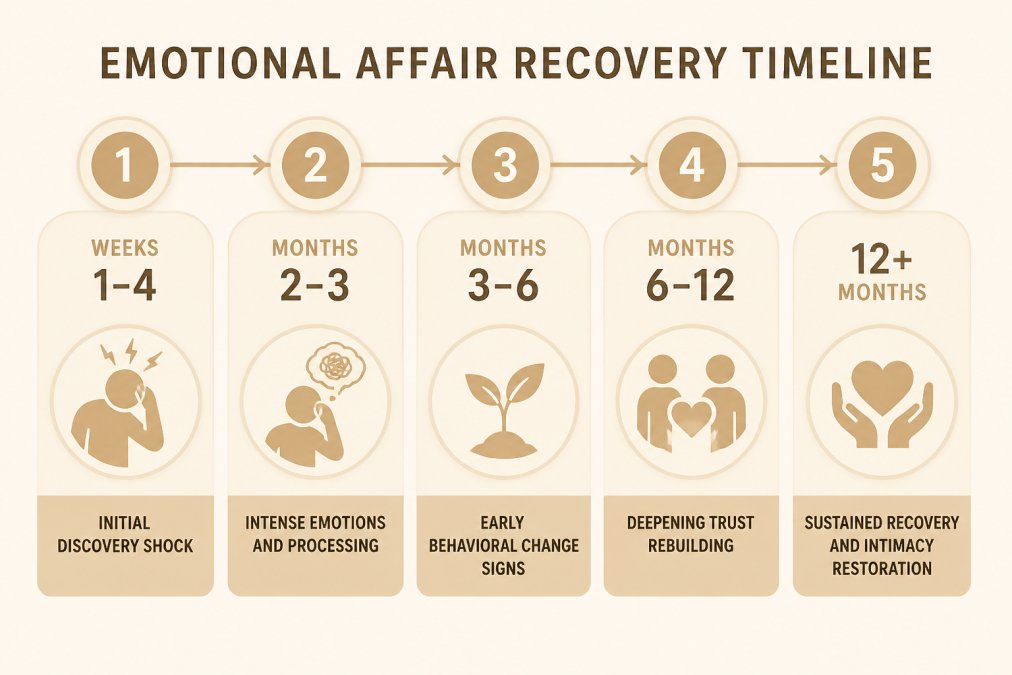
This timeline is approximate. The speed usually depends on how much work the betrayer is doing and how much support the betrayed partner has access to. If you’re at month 6 and seeing no behavioral change, no accountability, and no genuine effort, that’s information.
When to Walk Away: Recognizing Unworkable Situations
Not every relationship survives emotional betrayal. Sometimes the healthiest choice is to leave.
Here are the signs that a relationship may not be salvageable:
The betrayer is not taking responsibility. Months have passed and they’re still minimizing, justifying, or blaming you. They’re not in therapy or doing the work.
There’s a pattern, not an isolated incident. Multiple affairs or a pattern of betrayal across the relationship suggests this is how the betrayer relates to commitment.
The betrayed partner cannot regulate their nervous system. If months have passed and you’re still in acute crisis, staying in the relationship may be keeping you dysregulated.
There’s active abuse. If the betrayer responds to conversations with anger, intimidation, or aggression, that’s abuse. Leave.
The betrayer is unwilling to be transparent. If they’re refusing to answer questions or hiding their phone, they’re not willing to do the work.
You’ve lost all respect. Without respect, the relationship becomes transactional. You’re staying out of fear or obligation, not a foundation for healing.
Walking away doesn’t mean failure. It means recognizing that this particular relationship cannot provide what you need.
Rebuilding trust after emotional betrayal is one of the hardest things you’ll ever do. It requires the betrayed partner to manage a dysregulated nervous system while deciding whether to stay. It requires the betrayer to sit with the consequences of their choices and demonstrate genuine change through months of consistent behavior. It requires both people to be willing to be vulnerable, communicate differently, and accept that healing is not linear.
The framework in this guide, from taking responsibility to setting boundaries to recognizing genuine change, gives you a structure for that work. But structure alone isn’t enough. You need support, whether that’s a therapist, a community, or tools specifically designed for this situation. After the Affair Series provides a structured toolkit designed to help individuals navigate the complexities of betrayal, separation, and high-conflict co-parenting. The free 23-point assessment helps you understand where you are in the recovery process and what comes next.
Frequently Asked Questions
Q: How long does it typically take to rebuild trust after an emotional affair?
A: There's no fixed timeline. The emotional affair recovery timeline depends on several factors: the depth of betrayal, how quickly the betrayer takes responsibility, and both partners' commitment to healing. Early months focus on managing betrayal trauma and establishing transparency. Months 3-6 show whether genuine behavioral change is occurring. By month 12, couples often experience restored emotional safety if both partners remain committed. Patience is essential, attempting to rush the process typically leads to setbacks.
Q: What are the most reliable signs of genuine change after infidelity?
A: Genuine change after infidelity shows up as consistent behavior over time, not just words. Look for: voluntary transparency (sharing passwords, location, communication without being asked), accountability without defensiveness, active listening to your pain without minimizing it, initiated apologies that acknowledge specific harm, and sustained effort even when emotions calm. False change typically includes surface apologies, occasional transparency only when questioned, blame-shifting, and effort that fades after a few weeks. Track patterns over months, not days, real change is visible in how someone responds to triggers and maintains boundaries with the affair contact.
Q: Can a relationship actually recover from emotional cheating?
A: Yes, but recovery requires both partners to actively engage in healing. Emotional affairs damage trust and emotional safety, but they're not necessarily relationship-ending if the betrayer genuinely commits to behavioral change and the betrayed partner is willing to work through betrayal trauma. Success depends on: the betrayer accepting full responsibility, establishing new communication patterns and digital boundaries, and a realistic timeline of 12+ months. Some relationships emerge stronger after recovery; others reveal incompatibility. The question isn't whether recovery is possible, it's whether both partners are willing to do the sustained work required.
Q: How do I know when to walk away versus when to stay and rebuild trust?
A: Consider walking away if: the betrayer refuses accountability or continues contact with the affair partner, there's a pattern of repeated infidelity, or the relationship involves abuse. Stay and work on rebuilding trust if: both partners genuinely commit to change, the betrayer demonstrates early behavioral shifts, and you have personal support systems in place. The decision isn't about love alone, it's about safety, respect, and whether the other person is capable of change. Trust your instincts about your partner's willingness to do the work, and seek professional guidance if you're uncertain.
This article was written using GrandRanker