
Last Updated: August 24, 2026
- 1. Establish a Consistent Routine and Schedule
- 2. Use High-Conflict Co-Parenting Communication Scripts
- 3. Set Clear Boundaries for Communication
- 4. Choose Child Custody Exchange Location Best Practices
- 5. Keep Handoffs Brief and Business-Like
- 6. Master Body Language and Non-Verbal De-Escalation
- 7. Document Custody Exchange Incidents and Use Parenting Apps
- How to Implement the Parallel Parenting Framework
- Frequently Asked Questions
1. Establish a Consistent Routine and Schedule
A consistent custody schedule reduces anxiety for everyone by eliminating constant renegotiation and giving your ex fewer opportunities to create drama. Document your schedule in writing before the first handoff, flexibility becomes a weapon in high-conflict situations, allowing your ex to claim different agreements or demand last-minute changes.
Consistency also protects your child‘s mental health. Children thrive on predictability; when they know exactly when transitions happen, they settle into routine rather than developing anxiety (apa.org).
Set phone reminders 30 minutes before every scheduled handoff to mentally prepare and arrive without rushing, which often triggers conflict.
Use a shared parenting app like TalkingParents or Fayr with built-in custody calendars that sync automatically, removing text-based negotiations about timing. If your ex consistently violates the schedule, document every instance with dates and times, this documentation becomes critical if you need to return to court and demonstrates you’re the reliable parent.
2. Use High-Conflict Co-Parenting Communication Scripts
Communication scripts keep you from reacting emotionally when your ex provokes you. The Gray Rock Method, being boring, unresponsive, and emotionally flat, removes the reaction your ex seeks.
If your ex texts, “You’re always late picking up our daughter. You’re so irresponsible,” don’t defend yourself. Instead, respond:
“I’m committed to being on time for pickups. I’ll see you at 5 p.m. on Friday.”
No defense, no explanation. Every extra sentence gives your ex more material to argue about.
Avoid over-explaining or justifying. The shorter your response, the less ammunition they have.
For logistics, keep scripts focused:
- “Pickup is at 5 p.m. at the agreed location.”
- “I need to know about medical appointments by Thursday.”
- “Our daughter needs her soccer uniform for Saturday.”
For written communication, use the BIFF method: Brief, Informative, Friendly, Firm. Keep messages under five sentences.
Example:
“Our son needs his soccer cleats for Saturday’s game. Can you confirm you’ll have them packed by Friday evening? I’ll pick them up at 5 p.m. as scheduled.”

3. Set Clear Boundaries for Communication
Clear communication boundaries prevent your ex from contacting you constantly or manufacturing crises to keep you emotionally tied to them. Define which method is for emergencies only (phone call), which is for logistics (parenting app or email), and which platforms are off-limits (personal texts, social media).
Communication boundaries aren’t punishment, they’re self-protection that prevents your ex from using constant contact to keep you dysregulated and reactive.
Set specific response time expectations: “I’ll respond to messages about custody logistics within 24 business hours.” Define off-limits topics: personal life, past grievances, parenting style criticism. If your ex brings up off-topic subjects, redirect: “That’s not related to our parenting plan. Let’s focus on what our daughter needs this week.”
Create a communication schedule, perhaps a weekly check-in call, to concentrate communication into specific times rather than constant back-and-forth. Document your boundaries in writing: “Going forward, I’ll use [app name] for all custody-related communication. I’ll respond within 24 hours on weekdays.”
If your ex violates boundaries repeatedly, don’t engage or argue about the boundary. Simply don’t respond to out-of-bounds communication.
4. Choose Child Custody Exchange Location Best Practices
The physical location where you exchange your child dramatically affects handoff peace. A neutral, public location with witnesses reduces conflict because high-conflict parents are less likely to escalate in front of strangers.
The best exchange locations are:
- Public and busy (parking lot with foot traffic, busy park)
- Neutral (not either parent’s home or workplace)
- Safe and well-lit
- Visible to security cameras
- Accessible to both parents
Many courts recommend police station parking lots as exchange locations (aoa.org). Some departments have designated safe exchange zones with marked parking spaces and visible security. Public parks work well during daytime when other families are present, choose a specific spot to prevent confusion.
If a neutral location isn’t available, ask your ex to stay in their car while you pick up or drop off your child, minimizing direct interaction.
Some co-parents use neutral third parties as buffer zones. A trusted family member or professional mediator can stand between you and your ex during the exchange. Avoid exchanging at either parent’s home, which blurs boundaries and often leads to escalating conversations.
Document the agreed-upon exchange location in your custody agreement. If your ex tries to change it last-minute, you have written documentation to refer to.
5. Keep Handoffs Brief and Business-Like
A business-like handoff, quick, polite, focused only on your child, prevents small talk that spirals into argument. Aim for handoffs lasting no longer than five minutes.
Keep conversation minimal and child-focused:
- “Here’s her soccer uniform. She has a game Saturday at 9 a.m.”
- “He had a good week. See you next Friday.”
Avoid personal updates, comments about your ex’s choices, complaints about parenting, or small talk that extends the interaction.
Keep your voice neutral and calm. Don’t smile excessively or act overly friendly. Aim for polite professional courtesy, like greeting a colleague at work.
If your ex tries to extend the handoff by asking questions or bringing up unrelated topics, say: “I need to get going. We can discuss that through [app name] if it’s important.” Then leave.
Prepare your child before the handoff so they know what to expect and the exchange will be brief. If your ex becomes hostile, don’t engage. Keep your child safe, leave immediately, and document the incident.
6. Master Body Language and Non-Verbal De-Escalation
Your body language communicates as much as your words during custody handoffs. A high-conflict ex reads your facial expressions, posture, and tone for signs of weakness or emotion.
Stand upright with shoulders back but not rigidly. Avoid crossing your arms, which reads as defensive. Keep your hands visible and relaxed. Maintain a neutral expression, not smiling, not frowning. This is critical; your ex is looking for signs they’ve gotten under your skin.
Maintain three to four feet of physical distance during handoffs. If your ex moves closer, step back without saying anything. Eye contact should be minimal and neutral. Look at your ex when speaking or listening, but don’t stare aggressively.
Speak calmly, quietly, and evenly. Don’t raise your voice even if your ex does. Speak slowly and deliberately, as if giving instructions to a colleague. This vocal control communicates you’re in control of the situation. improving communication during conflict.
Non-verbal de-escalation doesn’t mean you’re weak or accepting mistreatment. It means you’re not giving your ex the emotional reaction they seek, which removes their power to escalate.
If your ex becomes aggressive, keep your posture open but firm, maintain distance, and keep your voice steady. If you feel unsafe, remove yourself and your child immediately.
7. Document Custody Exchange Incidents and Use Parenting Apps
Documentation protects you legally and emotionally. When you document custody exchange incidents, late arrivals, hostile behavior, boundary violations, you create a record that protects you if conflict escalates to court.
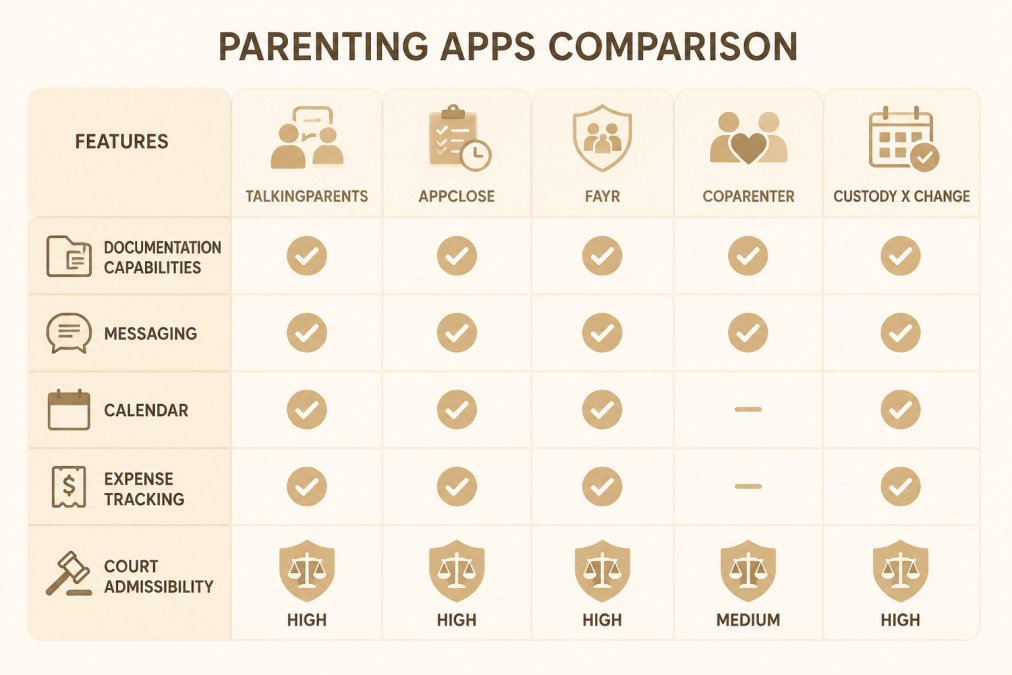
Document facts, not interpretations. Write: “At 5:15 p.m. on August 20, my ex arrived 45 minutes late for pickup. When I asked about the delay, he raised his voice and used profanity in front of our daughter. A witness in the parking lot was present.”
Use a parenting app designed for documentation. Apps like TalkingParents, AppClose, Fayr, coParenter, and Custody X Change create time-stamped, uneditable records of communication and incidents that are often admissible in court (peer-reviewed research).
Document:
- Every late or early arrival (with time)
- Hostile or threatening behavior
- Boundary violations
- Incidents involving your child
- Failure to follow parenting plan terms
- Substance use or safety concerns
- Threatening or harassing communication
Most parenting apps include messaging with timestamps, call recording, expense tracking, calendars with event documentation, and incident reporting, creating a comprehensive record that protects you.
Don’t use documentation as a weapon. Don’t screenshot hostile messages to prove your ex is awful. Quietly document everything and let the record speak for itself if needed in court.
Review your documentation monthly for patterns. Is your ex consistently late? Regularly violating communication boundaries? Are incidents escalating? This analysis helps you anticipate problems and see that patterns reflect your ex’s behavior, not something you’re doing wrong.
How to Implement the Parallel Parenting Framework
Parallel parenting is a structured approach where each parent operates independently in their own sphere, minimizing direct interaction and decision-making overlap. It works best when direct communication is hostile, when your ex won’t follow agreements, or when traditional co-parenting hasn’t worked.
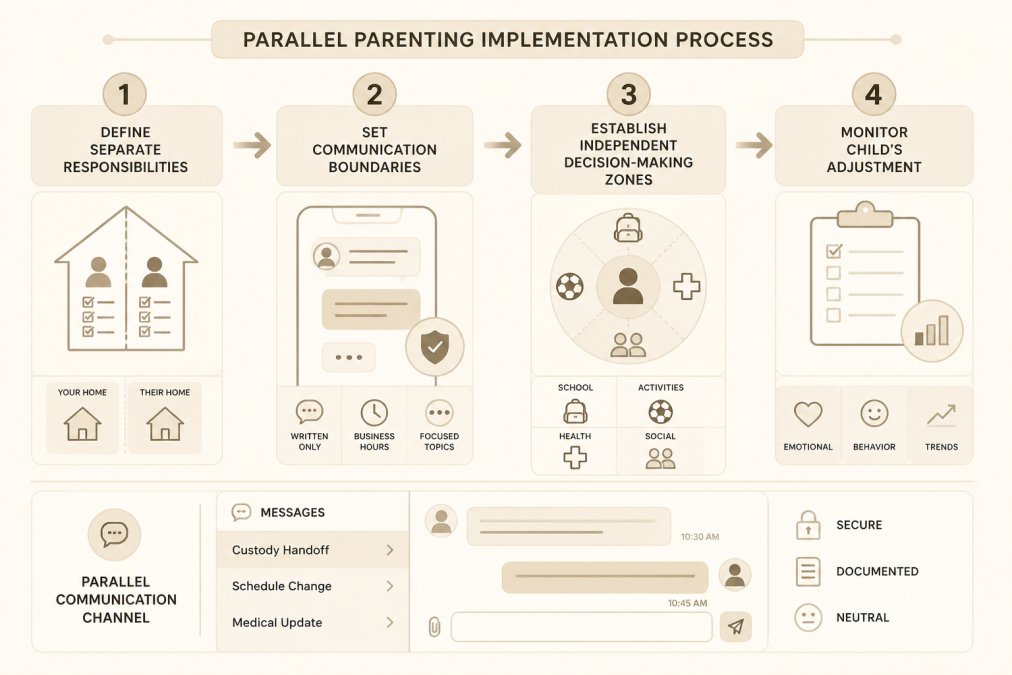
Step 1: Define Separate Responsibilities
Divide parenting responsibilities into clear domains. One parent handles all medical decisions, the other handles education. One manages activities, the other manages religious upbringing. Each parent has full autonomy in their domain without needing approval.
Your custody agreement should explicitly state: “Mother has sole decision-making authority for all medical decisions. Father has sole decision-making authority for all educational decisions.”
Step 2: Set Communication Boundaries
Parallel parenting requires minimal direct communication. Most happens through a parenting app, email, or neutral third party. Direct phone calls are reserved for emergencies only.
Each parent operates their household according to their own rules. Your child might have a 9 p.m. bedtime at your house and 10 p.m. at their other parent’s. That’s acceptable. Parallel parenting accepts you can’t control your ex’s parenting style, only your own.
Step 3: Establish Independent Decision-Making Zones
Create clear zones where each parent makes decisions independently. Medical decisions, educational choices, religious upbringing, extracurricular activities, and summer plans might each be assigned to one parent. When a decision falls into one parent’s zone, the other doesn’t get input or veto power.
This removes constant back-and-forth. You don’t wait for your ex’s approval to enroll your child in soccer or take them to the doctor.
Step 4: Monitor Your Child’s Adjustment
Watch for signs your child is struggling: anxiety about transitions, reluctance to spend time with either parent, behavioral changes, or complaints that one parent criticizes the other. If you notice these signs, parallel parenting may need adjustment or your child may benefit from therapy.
Parallel parenting isn’t permanent. As your child ages and your ex’s behavior stabilizes, you might transition back to collaborative co-parenting or maintain parallel parenting until adulthood.
Protecting your peace during custody handoffs isn’t selfish, it’s essential. When you’re calm, regulated, and boundaried, your child feels safer. When constantly triggered by your ex’s behavior, your child absorbs that anxiety. These seven strategies create structure around the most volatile moments of high-conflict co-parenting.
The goal isn’t perfect handoffs. The goal is handoffs where you remain in control of your emotions, where your child transitions smoothly, and where you don’t leave feeling drained or provoked. That’s peace. That’s what your child needs most.
Take the free 23-point assessment from After the Affair Series to identify which strategies will have the biggest impact on your specific situation. After the Affair Series provides structured toolkits for high-conflict co-parenting designed specifically for parents navigating betrayal and separation.
For more detailed guidance on implementing these strategies, including specific scripts for difficult conversations and how to explain custody transitions to children of different ages, explore After the Affair Series’s complete resource library. The work you’re doing to protect your peace protects your child’s future.
Frequently Asked Questions
How do I handle a high-conflict co-parent during custody exchanges when they refuse to follow the agreed-upon schedule?
Document every incident with dates, times, and what occurred. Keep your responses brief and factual, avoiding emotional reactions. Use written communication through a parenting app like TalkingParents or AppClose to create a permanent record. If violations continue, consult your attorney about enforcing the custody agreement through the court. Stay focused on your child’s stability rather than confronting the behavior in the moment.
What are the best practices for minimizing conflict during child custody handoffs?
Choose a neutral, public location for exchanges. Keep handoffs to 5-10 minutes maximum. Stick to a consistent schedule so both parents know exactly when and where to meet. Avoid discussing parenting decisions, finances, or relationship issues during the exchange. Use a buffer zone if possible, such as having a third party present or using a neutral drop-off location. Keep your tone neutral and business-like, focusing only on logistics related to the child’s immediate needs.
How can I document incidents that occur during custody exchanges for legal purposes?
Record specific details immediately after the exchange: date, time, location, who was present, what was said or done, and how it affected your child. Use a parenting app with built-in documentation features like Fayr or coParenter that time-stamp and store records automatically. Include context but remain factual and objective. Never editorialize or add emotional language. Keep copies in multiple formats. If incidents involve safety concerns, contact law enforcement and provide that report number in your documentation.
Is it better to do custody handoffs in public places, and what locations work best?
Yes, public locations significantly reduce conflict and provide natural accountability. Best options include police station parking lots (many departments offer supervised exchange areas), busy parking lots of shopping centers, school grounds during business hours, or neutral third-party exchange facilities if available in your area. Avoid exchanging at either parent’s home, which can escalate tension. Ensure the location is well-lit, has other people present, and is easily accessible. Consistency matters more than the specific location, so choose one and stick to it.
What communication scripts work best for high-conflict co-parenting situations?
Use the BIFF method: Brief, Informative, Friendly, Firm. Keep messages to 2-3 sentences maximum. Example: ‘Sarah has a soccer game Saturday at 10 a.m. I’ll pick her up at 9:45 a.m. as scheduled.’ Avoid explaining, defending, or justifying. Don’t ask open-ended questions or invite debate. Focus only on logistics and the child’s needs. Avoid sarcasm, blame language, or emotional appeals. Many parenting apps include AI filters that flag hostile language before you send, helping you stay neutral under stress.