TL;DR:
- Betrayal trauma involves complex symptoms like dissociation and hypervigilance, beyond ordinary heartbreak.
- Responses differ by gender, with women ruminating and men withdrawing, affecting recovery approaches.
- Hidden symptoms like betrayal blindness serve as protective mechanisms that can prolong healing if unrecognized.
When a partner’s infidelity comes to light, many people expect to feel sad or angry for a while and then move on. But what often happens is something far more disorienting: a cascade of psychological symptoms that feel more like a breakdown than a breakup. Betrayal trauma is defined as a psychological trauma caused by someone you depend on for support, and its symptoms go well beyond ordinary heartbreak. Understanding what these symptoms actually are, why they happen, and how they differ from person to person is the foundation of any real recovery. This guide exists to give you that clarity.
Table of Contents
- What is betrayal trauma and how does it work?
- The core symptoms of betrayal trauma
- Gender differences in betrayal trauma symptoms
- Hidden and adaptive symptoms: betrayal blindness
- Why most guides miss the deep reality of betrayal trauma
- Find your next step in betrayal trauma recovery
- Frequently asked questions
Key Takeaways
| Point | Details |
|---|---|
| Betrayal trauma is unique | Symptoms arise from violations of trust by those depended upon and often require specialized support. |
| Symptoms are complex | PTSD, depression, dissociation, and emotional numbness are prevalent and often misdiagnosed. |
| Perception intensifies impact | The severity of symptoms depends more on perceived betrayal than on objective events. |
| Gender patterns matter | Women and men show distinct symptom responses, influencing relational recovery. |
| Adaptive behaviors can hinder healing | Betrayal blindness and dissociation may protect relationships but delay true recovery. |
What is betrayal trauma and how does it work?
Not all trauma comes from strangers or accidents. Some of the most damaging psychological wounds come from the people we trust most. Betrayal trauma is unique because the person causing the harm is also the person you rely on for safety, love, and stability. That contradiction is what makes it so deeply destabilizing.
Betrayal trauma theory, developed by psychologist Jennifer Freyd in 1994, explains why the symptoms of this kind of trauma are so specific and often so confusing. The central idea is this: when you depend on someone for survival or emotional security, your mind may actually suppress or minimize the knowledge of their betrayal in order to keep the relationship functioning. Your brain is not broken. It is doing something adaptive, something designed to help you survive a situation where leaving feels impossible or unbearable.
This mechanism is why so many people describe feeling like they are in a fog after discovering infidelity. You might know what happened, but the full emotional weight of it does not land all at once. Some people describe carrying on with normal life, going to work, cooking dinner, laughing at something on television, while underneath there is this constant hum of something being profoundly wrong.
The betrayal trauma symptoms that follow a partner’s infidelity often look different from what people expect. Rather than clean, recognizable grief, they can appear as:
- Emotional numbness or sudden emotional flooding
- Difficulty concentrating or making decisions
- Unexplained physical symptoms like nausea, chest tightness, or exhaustion
- A sense of unreality, as if watching your life from outside your body
- Memory problems or difficulty retaining new information
- Intense vigilance around your partner’s behavior
“Betrayal trauma is a psychological trauma perpetrated by someone close and relied upon for support, leading to symptoms like dissociation to preserve the relationship.” — Freyd, as cited in Wikipedia’s overview
This is not weakness. It is your nervous system responding to an environment where trust has collapsed but the dependency remains. Understanding the mechanics behind your symptoms is the first step toward not being controlled by them.
The core symptoms of betrayal trauma
With betrayal trauma defined, we can break down its signature symptoms and see how research identifies patterns among those affected.
The research picture is clear and, frankly, sobering. High-betrayal trauma predicts more severe PTSD, depression, and dissociation than low-betrayal trauma, even when controlling for exposure to the traumatic event itself. That means two people can experience the same infidelity scenario, but the person who feels more deeply betrayed will suffer more severe psychological consequences. This is not a matter of being oversensitive. It is a measurable, documented outcome.
The core symptoms tend to cluster into several categories:
PTSD-type symptoms
These include intrusive thoughts about the affair, flashbacks triggered by ordinary things like a song or a smell, nightmares, and hypervigilance. You might find yourself constantly checking your partner’s phone or bracing for more bad news even when everything appears calm.
Depression and withdrawal
Many people experience a deep, heavy sadness that feels different from ordinary low mood. Loss of interest in things you used to enjoy, appetite changes, difficulty getting out of bed, and a pervasive sense that the future no longer makes sense are all common.
Dissociation
This is one of the least discussed but most common symptoms. Dissociation can range from mild detachment, feeling zoned out or emotionally flat, to more intense experiences of feeling like you are watching yourself from above or that reality is somehow not quite real. The mental health effects of dissociation are significant because they interfere with your ability to process what happened and make clear decisions.
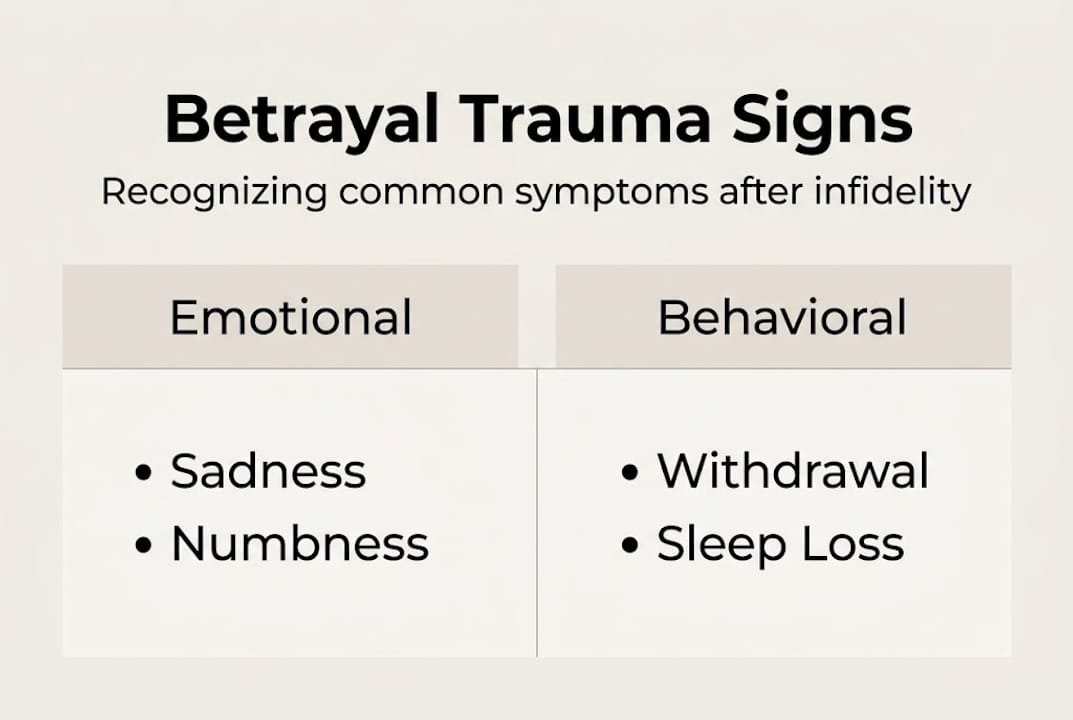
Sleep disruption
Racing thoughts at night, difficulty falling asleep, waking in the early hours with anxiety, and vivid or disturbing dreams are extremely common. Sleep deprivation compounds every other symptom, making emotional regulation even harder.
Here is a comparison of how betrayal trauma symptoms differ from ordinary relationship stress:
| Symptom area | Ordinary relationship stress | Betrayal trauma |
|---|---|---|
| Intrusive thoughts | Occasional worry | Constant, unwanted, disruptive |
| Sleep | Mild disruption | Chronic insomnia or nightmares |
| Emotional state | Sadness or frustration | Numbness alternating with flooding |
| Physical response | General tension | Nausea, chest pain, fatigue |
| Decision-making | Slightly impaired | Significantly clouded |
| Sense of reality | Intact | Dissociation common |
One important point that research keeps confirming: the subjective perception of betrayal matters more than the objective facts of the affair. Whether it was a one-night incident or a long-term relationship is less predictive of symptom severity than how deeply you feel the trust was broken. That is worth sitting with for a moment.
Gender differences in betrayal trauma symptoms
While everyone feels betrayal trauma differently, research shows distinct patterns between genders that shape both symptoms and recovery.
A 2024 analysis of gender differences in betrayal trauma found consistent patterns in how men and women respond to infidelity-related betrayal. Women tend to ruminate, replaying events repeatedly in an attempt to make sense of what happened. This hyperactivation of the attachment system means women are more likely to seek reassurance, ask repeated questions about the affair, and struggle with a sense of abandonment even when they remain in the relationship.
Men, by contrast, tend to suppress emotional processing and withdraw. This is not because they are less affected. The pain is just as real. But culturally and neurologically, men are more likely to internalize distress, pull back from connection, and experience symptoms through behavior rather than expressed emotion. Increased irritability, numbing through work or alcohol, and difficulty articulating what they are feeling are all common patterns.
Both responses lead to emotional dysregulation, a state where your emotional responses feel unpredictable and outside your control. But the long-term relational impacts differ significantly.
Women who hyperactivate attachment may become caught in an exhausting cycle of seeking closeness while simultaneously being flooded by fear and anger. This can feel overwhelming to both partners. Men who suppress and withdraw may appear to be handling things better, but unprocessed betrayal trauma tends to surface later as emotional detachment, sudden anger, or difficulty with future relationships.
How attachment styles influence these patterns is significant. Anxious attachment amplifies the hyperactivation response, while avoidant attachment strengthens the suppression response. Neither is a character flaw. Both are patterns shaped by early life experience that become more extreme under extreme stress.
Consider these behavioral contrasts:
- Women: frequent crying, seeking repeated reassurance, difficulty being alone, obsessive research about the affair
- Men: emotional flatness, increased work hours, substance use, social withdrawal, difficulty naming their feelings
- Both: sleep disruption, physical symptoms, difficulty concentrating, loss of interest in sex or intimacy
The relationship effects of these different coping styles can create a painful gap between partners even when both want to rebuild. Understanding your own response pattern, and your partner’s, is essential for navigating recovery without misreading each other’s behavior as indifference or aggression.

Hidden and adaptive symptoms: betrayal blindness
Beyond the visible symptoms, betrayal trauma can show up in hidden ways that are protective but also challenge healing.
One of the most striking concepts in betrayal trauma research is betrayal blindness. This is not a failure of perception. It is an active, unconscious strategy. Betrayal Trauma Theory explains that when someone depends on a relationship for survival or deep emotional security, the mind may suppress awareness of betrayal to preserve that dependency. Originally developed in the context of childhood abuse, the theory applies equally to intimate partner betrayal.
In practical terms, betrayal blindness can look like:
- Rationalizing away suspicious behavior even when evidence is clear
- Feeling confused about whether what happened was really “that bad”
- Noticing warning signs but finding yourself unable to act on them
- Feeling strangely detached from your own distress, as if it belongs to someone else
- Minimizing your emotional response or telling yourself you should be over it by now
These are not signs of stupidity or poor judgment. They are signs that your nervous system is trying to protect you from a truth that feels unsurvivable. The concept of betrayal blindness is crucial to understand because it explains why so many people spend months or even years not fully processing what happened to them.
Dissociation and avoidance serve similar functions. When the full reality of betrayal is too much to hold, the mind creates distance. You might find yourself feeling strangely calm when others expect you to be devastated, or going through the motions of normal life without feeling connected to any of it. This is not numbness from lack of caring. It is your brain’s protective response to overwhelming information.
What makes this complicated is that subjective perceived betrayal predicts PTSD, depression, and dissociation independently of the objective circumstances of the betrayal. In other words, if you feel deeply betrayed, your symptoms will be significant regardless of whether others think your situation “counts” as traumatic. Minimizing your own experience is itself a symptom of the trauma.
Pro Tip: If you keep finding yourself wondering whether you are overreacting, that self-doubt is worth exploring with a therapist. Minimizing your own experience is often one of the clearest signs that betrayal trauma is active.
Recognizing these hidden symptoms is not about dwelling in pain. It is about ending the confusion that keeps you stuck. When you understand why betrayal blindness exists and what it is protecting you from, you can start making more intentional choices about your healing.
Why most guides miss the deep reality of betrayal trauma
Most articles about recovering from infidelity focus on practical steps: communicate more, rebuild trust, consider couples therapy. That advice is not wrong, but it often skips over something critical. The symptoms of betrayal trauma are not just emotional reactions that can be managed with better communication skills. They are deeply rooted psychological responses that persist because they are driven by perceived betrayal, not just by events.
This is what the research keeps confirming. Perceived betrayal predicts PTSD, depression, and dissociation independently of objective measures. The depth of your suffering is not determined by the details of what happened. It is determined by how deeply your sense of reality, safety, and self were shattered.
In our experience working with people navigating infidelity recovery, the biggest gap is not in practical advice. It is in the failure to take symptoms seriously, both by clinicians and by the people experiencing them. Someone who appears to be “functioning fine” may be dissociating daily. Someone who seems obsessed or irrational may be experiencing classic hypervigilance rooted in unprocessed trauma.
True healing requires going back to the root: understanding what your symptoms are protecting you from, and why they developed. Betrayal trauma frameworks that acknowledge the adaptive nature of symptoms offer a much more compassionate and effective starting point than advice that simply tells you to “move on.” The path forward is through understanding, not around it.
Find your next step in betrayal trauma recovery
Recognizing betrayal trauma symptoms is a genuine act of courage. It means facing something painful with open eyes rather than letting confusion or self-doubt drive your decisions.
If you are ready to turn this understanding into structured action, we have built resources specifically for this moment. The infidelity recovery checklist gives you a clear, step-by-step framework to begin moving forward with intention. If you need something focused on the trauma itself, the trauma recovery checklist addresses the psychological and emotional layers directly. And when you are trying to understand where you are in the process, the stages of healing can help you name your experience and find the right support for your current phase. You do not have to navigate this alone, and you do not have to start from scratch.
Frequently asked questions
What are the most common symptoms of betrayal trauma after infidelity?
Common symptoms include intrusive thoughts, emotional numbness, dissociation, sleep disturbances, depression, and hypervigilance. Research confirms that high-betrayal trauma predicts more severe PTSD and depression than lower-betrayal experiences, even with similar exposures.
How is betrayal trauma different from other types of trauma?
Betrayal trauma is caused specifically by someone trusted and depended upon, making it uniquely destabilizing. As research outlines, psychological trauma from a trusted person often includes dissociation as a way to preserve the relationship rather than flee from the danger.
Why do some people minimize their symptoms or remain “blind” to betrayal?
Betrayal blindness is an unconscious adaptive response that protects you from a truth that feels unbearable when you still depend on the person who hurt you. This adaptive betrayal blindness can delay full awareness and, as a result, delay recovery if left unrecognized.
Do men and women react differently to betrayal trauma?
Yes, and meaningfully so. Research confirms that women ruminate and hyperactivate attachment while men tend to suppress emotion and withdraw, producing different long-term relational consequences that require different approaches to healing.
Recommended
- Betrayal Trauma Symptoms – After the Affair Series
- How to process emotional trauma after infidelity – After the Affair Series
- How to address betrayal trauma: steps for healing
- 7 Key Benefits of Therapy – After the Affair Series