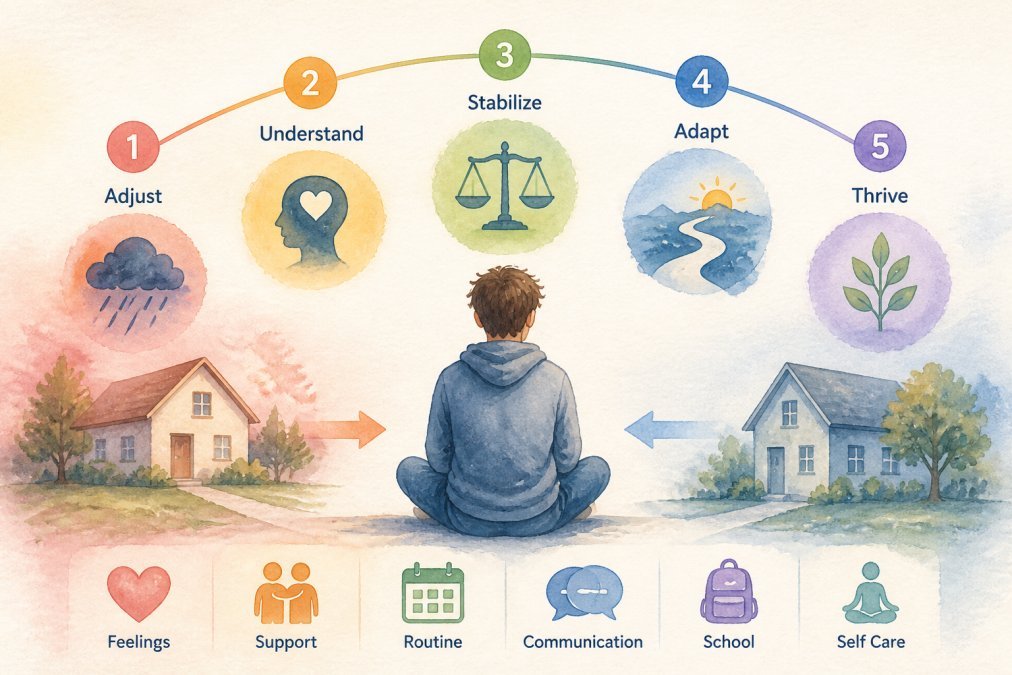
Discovering a partner’s affair doesn’t just break trust, it breaks your sense of reality. One of the first instincts many people feel is a desperate need to decide: stay or go, right now. But the question of whether you ‘should i leave after an affair‘ is rarely answered well in the first days or weeks. This article isn’t a yes-or-no guide. It’s a structured framework that helps you weigh the factors that actually matter, so the decision you make is yours, grounded in clarity rather than panic or pressure.
- Why There's No Single Right Answer to Leaving After an Affair
- Step 1: Stabilise Before You Decide, The Immediate Aftermath
- Step 2: Relationship Assessment, What Are You Actually Working With?
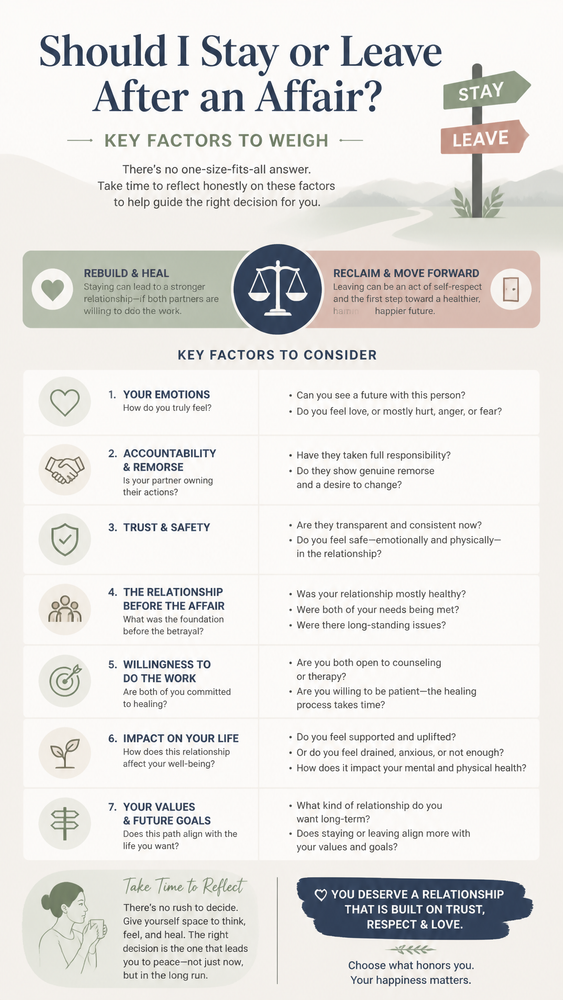
- Step 3: Affair Decision Making, Weighing the Key Factors
- Reconciliation Possibility: What the Recovery Process Actually Requires
- When Leaving Is the Healthiest Choice
- Professional Guidance: You Don't Have to Figure This Out Alone
Why There’s No Single Right Answer to Leaving After an Affair
Affairs are not all the same. A betrayed partner who discovers a long-term emotional affair, hidden for years, involving sustained deception and deep emotional investment, faces a very different decision than someone who learns of a one-night encounter during a period of acute relationship crisis. The context, the pattern, and the people involved shape what’s possible.
That’s why a single universal answer doesn’t exist. What you’re actually asking, underneath the surface question, is usually something more personal: How do I know what I actually want? That’s what this framework is designed to address. It won’t make the decision for you. It will help you see more clearly what you’re working with.
The factors worth weighing include the state of the relationship before the affair, your partner’s genuine response since discovery, your own values and boundaries around fidelity, and the practical reality of your shared life. Each section below takes one piece at a time.
Step 1: Stabilise Before You Decide, The Immediate Aftermath
Why the first weeks are the worst time to make permanent decisions
The acute trauma response after discovering infidelity is well documented in clinical literature. Intrusive thoughts, hypervigilance, emotional numbing, difficulty sleeping, and oscillating between rage and grief, these are not signs of weakness. They closely mirror post-traumatic stress responses, which is precisely why therapists caution strongly against making permanent relationship decisions in the immediate weeks after discovery.
Decisions made during this window tend to be regretted in both directions. Some people leave quickly and later wish they had allowed more time to process. Others reconcile immediately, suppress the trauma, and find it resurfaces destructively months later. Neither outcome is inevitable, but both are more likely when the decision comes from shock rather than clarity.
For guidance on getting through this phase day to day, the practical advice in managing the immediate aftermath of discovery is a useful companion to this framework.
What emotional stabilisation actually looks like
Stabilisation doesn’t mean feeling fine. It means reaching a point where you can think, not just react. Most affair recovery specialists suggest allowing a minimum of a few months before committing to a permanent decision either way. That window isn’t about waiting passively; it’s about getting individual support, establishing basic safety in your day-to-day functioning, and beginning to identify what you actually need, not just what the pain is demanding.
Individual counselling at this stage is valuable regardless of whether the couple eventually stays together or separates. A therapist gives you space to think without an audience and without the pressure of your partner’s emotions in the room.
Step 2: Relationship Assessment, What Are You Actually Working With?
Signs the relationship has a foundation worth rebuilding
Honest relationship assessment means looking at the partnership as it was before the affair, not through the lens of current pain, but with some attempt at accuracy. Ask yourself: was there genuine emotional intimacy before this? Did you share core values? Was there mutual respect in how you treated each other? Did both of you invest in the relationship, even imperfectly?
None of these questions require a perfect answer. No relationship is uniformly good. But if the honest answer to most of them is yes, and the affair represents a rupture in an otherwise meaningful partnership rather than the culmination of a long pattern of disregard, that’s a different starting point than a relationship that was already hollow.
Red flags that complicate reconciliation
Certain patterns make genuine recovery significantly harder. Repeated deception, either a pattern of affairs or sustained lying after discovery, signals that the problem is not the affair itself but something deeper in how your partner relates to honesty and to you. Lack of genuine remorse, minimising the impact on you, or immediately framing the affair as your fault are serious warning signs.
Coercive or controlling behaviour in the relationship, not just the affair, changes the calculus entirely. Reconciliation in that context can be unsafe, not just difficult. If any of these patterns are present, that’s important information for your decision.
Step 3: Affair Decision Making, Weighing the Key Factors
The cheating partner’s accountability and transparency
Affair recovery specialists widely observe that the quality of a cheating partner’s remorse is one of the strongest early predictors of whether a relationship can genuinely recover. The distinction matters: genuine accountability means your partner takes full ownership of the choice they made, demonstrates understanding of the harm caused, and acts consistently over time to rebuild trust. Damage control looks different, it’s primarily about managing your reaction and reducing their own discomfort.
Questions worth asking: Has your partner ended all contact with the affair partner, voluntarily and verifiably? Are they willing to be transparent, about their whereabouts, devices, and communications, without framing that transparency as punishment? Do their actions over weeks and months match what they’re saying?
Willingness to engage in couples therapy is itself a significant signal. A partner who refuses professional support is, in effect, asking you to do the hard work of recovery while they remain on the sidelines.

Your own needs, values, and limits
This side of the equation is just as important. Your core values around fidelity are real and valid. If betrayal represents a line you always knew you couldn’t cross in a relationship, that’s not a failure of forgiveness, it’s self-knowledge. Some people’s sense of self and safety is so fundamentally disrupted by infidelity that staying becomes a daily re-injury. That’s worth taking seriously.
Practical factors also belong in this framework honestly, not as excuses in either direction. Children, finances, shared housing, and interdependent lives are real considerations that affect the how of any decision, even if they shouldn’t be the sole reason to stay.
Reconciliation Possibility: What the Recovery Process Actually Requires
Reconciliation is not the same as returning to the relationship you had before the affair. The pre-affair relationship, for most couples, was not adequate protection against what happened, and attempting to simply resume it usually fails. What genuine recovery requires is building something different: a relationship with greater honesty, more explicit emotional investment, and new agreements about what each partner needs.
That process is genuinely hard, and it asks significant things of both partners. The betrayed partner must, over time, move toward rebuilding, not forgetting, but choosing to invest again. The cheating partner must sustain accountability and transparency long after the initial crisis has passed.
Couples who engage in structured therapy, such as Emotionally Focused Therapy (EFT) or the Gottman Method, consistently report better outcomes than those who attempt recovery without professional support. A meaningful proportion of couples who commit fully to this process reach relationship satisfaction comparable to before the betrayal. Evidence-based couples therapy after infidelity is the most reliably effective route when both partners are genuinely committed. If you’re already leaning toward staying, rebuilding trust after a partner cheats maps out what that process looks like in practice.
When Leaving Is the Healthiest Choice
Leaving after a partner cheats is not a failure. For many people, it is a decision made from self-respect and a clear understanding of their own limits, and that deserves to be said plainly.
Some situations make staying genuinely harmful. If your partner has continued to deceive you after discovery, leaving is not an overreaction. If the affair was accompanied by emotional abuse or control, reconciliation is unlikely to be safe. If your partner has shown no genuine remorse and no willingness to change, you are not obligated to keep trying. And if you know, after time, support, and honest reflection, that you cannot rebuild your sense of safety in this relationship, that is a sufficient reason.
If children are involved, the decision to leave does not end your responsibility to co-parent well. But staying in a relationship purely for children, when the environment is harmful or deeply unhappy for the adults, rarely serves children as well as people hope. A stable separated household is often healthier than a conflicted shared one.
Professional Guidance: You Don’t Have to Figure This Out Alone
This framework gives you a structure, but working through it alone, in the middle of acute pain, is genuinely difficult. A therapist or affair recovery counsellor helps you think without the noise of panic or the pressure of your partner’s needs in the room. They can help you distinguish what you actually want from what fear or guilt is telling you to do.
Individual therapy is valuable regardless of whether you and your partner reconcile. If you’re ready to explore support, affair recovery counselling in the UK is a practical starting point.
If you’re not yet ready for that step but want something concrete to help you think clearly, a free affair recovery assessment offers a structured, low-pressure way to gain clarity on where you stand and what you need next. The goal isn’t to push you toward a particular outcome, it’s to help you understand yourself well enough to make a decision you can actually stand behind.