Stonewalling after infidelity is almost always a shutdown response driven by emotional flooding and shame, not a calculated punishment. The immediate priority for both partners is safety first, then a named pause with a specific promise to return, usually within a short, practical break. That single agreement, spoken out loud and kept, does more to protect the recovery process than any argument either of you could win in the moment.
- What Stonewalling After Infidelity Actually Looks Like
- Why Stonewalling Follows Discovery of an Affair
- Boundary vs. Stonewalling: The Promise-to-Return Test
- The Second Wound: How Stonewalling Damages Recovery
- What the Betrayed Partner Can Do When Stonewalling Happens
- What the Stonewalling Partner Can Do to Stop Shutting Down
- When Stonewalling Needs Professional Support
- How Aftertheaffair’s Resources Map to This Process
- What Actually Matters Here, and What Gets Overstated
- Where to Start If Stonewalling Is Happening in Your Recovery
- FAQ
TL;DR:
- Stonewalling after infidelity is usually a physiological freeze or strategic withdrawal, often triggered by emotional flooding, shame, or attachment patterns.
- Recognizable signs include walking out mid-sentence, monosyllabic answers, physical withdrawal, and extended silence without explanation.
- Using a promise-to-return boundary with specific timing and accountability helps distinguish healthy limits from harmful walls, supporting repair.
- Prolonged stonewalling damages trust access, heightens abandonment fears, and predicts stalled recovery more than the original affair severity.
- Responding with structured scripts, self-soothing techniques, and seeking professional help when patterns persist can foster healing and restore communication channels.
What Stonewalling After Infidelity Actually Looks Like
Stonewalling is a verbal and emotional shutdown. The listener stops responding, disengages from eye contact, and withdraws from a conversation that needs to happen, usually right when the betrayed partner is trying to get answers or process what happened. It’s different from someone who’s simply tired or needs a minute. It’s a wall going up, and once it’s up, nothing gets through.
You’ll recognize it by the pattern, not just a single bad moment. Watch for these signals:
- Walking out mid-sentence, especially during questions about the affair
- One-word or monosyllabic answers (“Fine.” “Whatever.” “I don’t know.”) repeated across multiple attempts
- Physical withdrawal: turned away, arms crossed, eyes on a phone or a screen
- Refusing to name when or whether the conversation will continue
- Going quiet for hours or days without any check-in, explanation, or acknowledgment
Clinicians generally separate stonewalling into two distinct patterns, and telling them apart matters for how you respond. The first is nervous-system shutdown: a genuine physiological freeze where the person feels flooded and can’t access language or reasoning. The second is strategic withdrawal, where silence becomes a tool to avoid accountability, end an uncomfortable line of questioning, or regain a sense of control after being caught. Both look similar from the outside. Only one responds to co-regulation.
This distinction is not a technicality. A partner who is truly flooded needs breathing room and a structured way back into the conversation. A partner who is using silence strategically needs something else entirely: clear accountability and consequences for repeated dead-end withdrawals. Confusing the two often means the betrayed partner keeps offering compassion to a pattern that actually requires a boundary, or a spouse in a genuine freeze response, and mistaking that for calculated cruelty.
Why Stonewalling Follows Discovery of an Affair
Discovery of infidelity is one of the most physiologically overwhelming experiences either partner will go through, and that overwhelm is the engine behind most stonewalling. Dr. John Gottman’s research on flooding shows that when a person’s heart rate climbs past roughly 100 beats per minute during conflict, their body shifts into a fight, flight, or freeze state. Rational conversation becomes physically difficult. Words don’t come. The nervous system, not the mind, is running the show.
For the partner who had the affair, that flooding usually arrives wrapped in shame and guilt. Shame tells you something is fundamentally wrong with who you are; guilt tells you something is wrong with what you did. Both can trigger the same freeze or flee response Gottman describes, and shutting down becomes the path of least resistance. It’s not always a decision. Sometimes it’s the only thing the body knows how to do when the alternative feels unbearable.
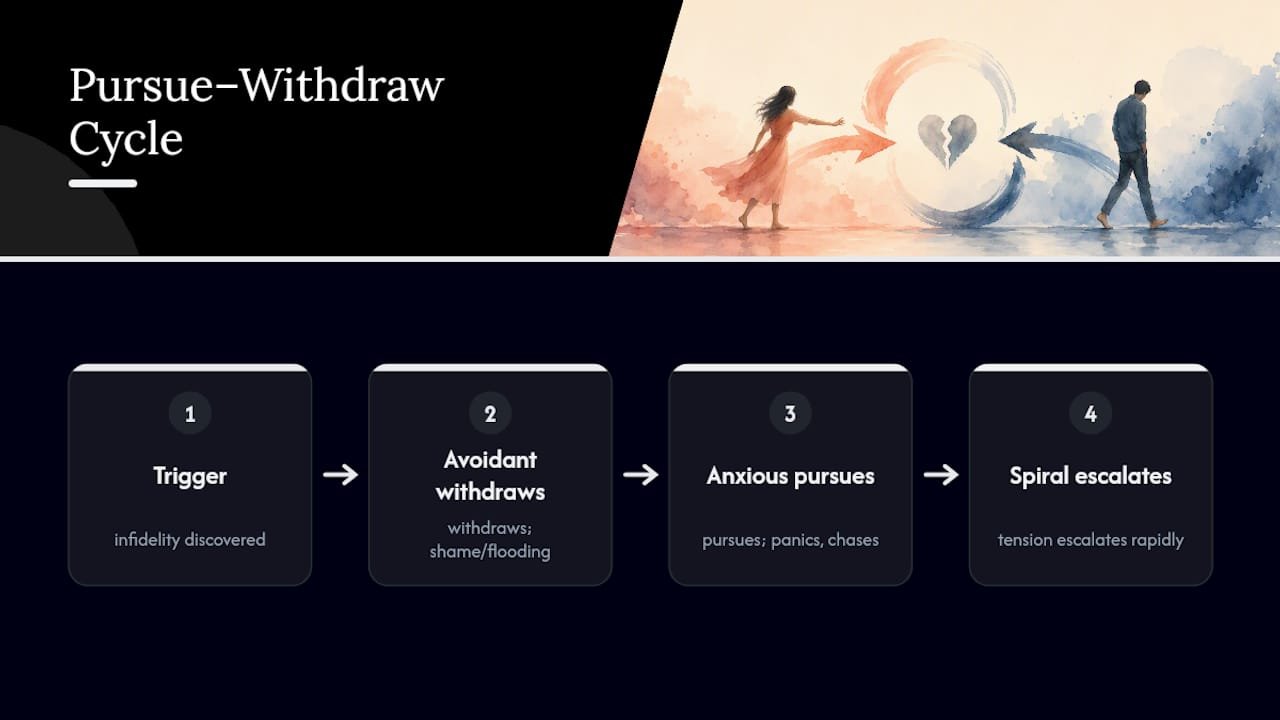
Attachment style shapes how this plays out too. Someone with an avoidant attachment pattern is more likely to withdraw and go quiet under threat, treating distance as a form of self-protection. Someone with an anxious attachment style tends to do the opposite, escalating, pursuing, and panicking at the first sign of disconnection. When a betrayed partner with an anxious pattern meets a stonewalling partner with an avoidant one, you get a pursuit and withdrawal cycle that can spiral fast: the more one chases for answers, the more the other retreats, and the more the retreat happens, the harder the other chases.
Pro Tip: If your heart rate feels like it’s climbing past a jog’s worth of exertion during a hard conversation, that’s your body telling you flooding has started. Naming it out loud (“I’m flooding, I need a break”) is more useful than pretending you’re fine.
None of this excuses stonewalling as a long-term pattern. But understanding the mechanism, flooding plus shame plus attachment wiring, helps both partners stop interpreting every shutdown as proof the relationship is doomed. Sometimes it’s proof the body needs 20 minutes before the mind can catch up.
Boundary vs. Stonewalling: The Promise-to-Return Test
The clearest way to separate a healthy boundary from stonewalling is a simple test: does the pause come with a promise to return? A real boundary functions like a speed bump. It slows things down but leaves the road open. Stonewalling functions like a wall, offering no pathway back at all.
A boundary that actually protects both people usually follows a four-part structure, adapted from guidance on setting healthy boundaries after infidelity:
- Describe the behavior factually, without accusation: “You’ve gone quiet twice tonight.”
- Name the thought behind it: “I start thinking you’re checking out of this conversation.”
- Name the feeling: “That leaves me anxious and shaky.”
- Request something specific and doable: “Can we agree on 20 minutes, then come back to this?”
That format works because it centers the boundary-setter’s own internal experience rather than issuing a demand about the other person’s behavior. It reads as self-care, not control, and that distinction tends to make partners far more receptive to hearing it.
A promise-to-return needs three concrete elements to actually work: a definitive time, a clear method for re-engagement, and explicit ownership of who initiates the return. Vague pauses collapse into stonewalling almost every time; specific ones rarely do.
Here are scripts that hold both truths at once, the need for space and the promise to come back:
- “I’m flooded right now and I don’t trust what I’d say. I need 20 minutes, and I’ll come find you when I’m ready.”
- “This is too much to process standing in the kitchen. Can we sit down at 8 tonight and keep going?”
- “I’m not walking away from you. I’m walking away from saying something I’ll regret. I’ll be back.”
Notice what’s missing from each: no “I don’t want to talk about this,” no disappearing without a timestamp. That difference is the entire boundary between protecting the relationship and abandoning it mid-conversation. Aftertheaffair’s guide on the role of boundaries after betrayal walks through more of these distinctions in detail, alongside worked examples of boundaries that hold up under real pressure.
The Second Wound: How Stonewalling Damages Recovery
Silence after betrayal rarely lands as neutral. For the betrayed partner, it often registers as a second betrayal, a fresh injury stacked directly on top of the first. The affair broke trust; the stonewalling that follows can feel like proof that trust was never coming back at all.
This happens because stonewalling strips away the one thing a betrayed partner needs most in the early weeks: access. Access to answers, access to their partner’s emotional state, access to some sense that the relationship is still a two-way street. When that access disappears behind a wall of silence, several things tend to happen at once:
- Abandonment fears intensify, especially for anyone with anxious attachment tendencies
- The betrayed partner starts filling silence with worst-case interpretations, since the brain fills gaps with fear when it isn’t given facts
- Willingness to stay open and vulnerable drops, because vulnerability toward someone who won’t engage feels unsafe
- Small disagreements start carrying the emotional weight of the original betrayal, since nothing ever got resolved
Recovery research and clinical practice consistently point to the same pattern: prolonged, repeated stonewalling predicts stalled or failed recovery far more reliably than the severity of the original affair itself. Couples can and do recover from serious betrayals. What they struggle to recover from is an ongoing communication shutdown that never gets named, addressed, or repaired. The affair is a single event. Stonewalling, left unaddressed, becomes the daily condition of the marriage.
Understanding the pattern is not the same as breaking it
You Can Explain Why This Happened. Can You Explain Why You’re Still Stuck In It?
Most people in affair recovery can narrate their entire situation with total clarity, the timeline, the triggers, the whole story, and still find themselves back in the same spiral by evening. Insight was never the missing piece. This free assessment shows you exactly where the gap actually is.
Take the Free Affair Recovery Clarity Check ->A few honest questions, a scored result, 4 minutes free
What the Betrayed Partner Can Do When Stonewalling Happens
You can’t force someone out of a shutdown, but you can change how you respond to it, and that response shapes whether the pattern gets worse or starts to heal. Start with what to say in the moment itself.
Try naming the impact without escalating: “When you go quiet, I feel like I’m losing you all over again. I need us to find a way to keep talking, even if it’s slower.” That’s different from “You always do this” or “Fine, walk away then,” both of which tend to deepen the shutdown rather than interrupt it. Ask directly for timing instead of guessing: “Can you tell me when you’ll be ready to come back to this?” A concrete answer, even a bad one, is more workable than silence with no endpoint.
A few things reliably make stonewalling worse, so it’s worth naming what to avoid:
- Following someone from room to room while they’re trying to disengage
- Shaming language (“What kind of person shuts down after what you did?”)
- Ultimatums delivered in the heat of the moment (“Talk now or we’re done”)
- Punishing a partner for taking a break they actually named and kept
None of this means you absorb the silence indefinitely. You’re allowed to set a boundary of your own: “I’ll give you the 20 minutes you asked for, but if we’re not back at this tonight, I need to know that too.” That’s not coercion. It’s you protecting your own nervous system while still leaving the door open for repair.
Self-care matters just as much as the scripts. Grounding practices, slow breathing, a short walk, texting a trusted friend, or writing down what you’re feeling before you say it out loud all reduce the odds you escalate a situation that’s already fragile. Some betrayed partners keep a short journal specifically for the moments between attempted conversations, which turns free-floating anxiety into something more contained. If stonewalling is a constant pattern rather than an occasional stumble, and your attempts to name it aren’t changing anything, that’s the signal to bring in outside help rather than keep absorbing it alone.
Pro Tip: Write your “in the moment” script down somewhere you can actually find it during a flooded conversation. Trying to remember calm language while your own heart rate is spiking is asking a lot of anyone.
Noticing the pattern is not the same as proving it
You Can Feel the Pattern. Can You Prove It to a Judge?
A diary of what happened reads as emotional venting. A structured, timestamped record reads as evidence. Most parents lose that distinction until it costs them. The free checklist shows you exactly what to document today, before the evidence window closes.
Get the Free Red Flag Checklist ->3 categories, 5 minutes, free
What the Stonewalling Partner Can Do to Stop Shutting Down
If you’re the one who goes quiet, the goal isn’t to force yourself to talk through the flooding. It’s to build a reliable way of stepping away and, critically, a reliable way back. Here’s how to actually build that capacity rather than just wishing you had it.
- Learn to recognize flooding as it starts. A racing heart, tight chest, or the sudden urge to leave the room are physical signals, not character flaws. Naming it out loud (“I’m flooding”) interrupts the shutdown before it fully takes over.
- Use a real self-soothing technique, not just distraction. Diaphragmatic breathing, a short walk, or splashing cold water on your face all lower physiological arousal faster than scrolling your phone does.
- Set a specific return time, every time. Twenty minutes is the benchmark Gottman’s research points to for the nervous system to return to baseline. Say it out loud: “I need some time, I’ll be back after I calm down.”
- Actually return. This is the step that separates a boundary from a wall. Come back even if you don’t have everything resolved. A short re-entry line works: “I’m back. I’m sorry for going quiet. I want to hear you for a few minutes.”
- Build daily practice outside the crisis moments. A brief nightly check-in, even five minutes, trains your capacity to stay present before a high-stakes conversation forces the issue.
- Accept accountability when the withdrawal was strategic, not physiological. If you’re honest with yourself that some of your silence has been about avoiding consequences rather than genuine overwhelm, that’s the moment to say so and bring in outside structure.
Working through structured exercises rather than trying to improvise this in the middle of a fight tends to work better for most people. Aftertheaffair’s workbook exercises for recovery include specific practices for building this kind of capacity between sessions, and a coaching resource on breaking impulsive relationship habits covers related ground on interrupting automatic withdrawal responses before they take hold.
Pro Tip: The “one-minute bridge” is a useful daily habit: even on a day with no conflict, spend sixty seconds telling your partner one true thing about how you’re doing. It keeps the muscle of returning to conversation from atrophying.
When Stonewalling Needs Professional Support
Some stonewalling responds to the scripts and self-soothing steps above. Some doesn’t, and recognizing the difference early saves both partners a lot of unnecessary suffering. A few signs point toward needing a clinician rather than more self-directed effort:
- Withdrawal that’s punitive rather than physiological, silence used deliberately to make a partner suffer
- Any threat to physical safety, including threats of self-harm during or after a shutdown
- Ongoing trauma symptoms in the betrayed partner: nightmares, intrusive images, panic responses to normal daily triggers
- Stonewalling that has lasted weeks with no change despite genuine attempts to name and address it
Individual, trauma-informed therapy tends to fit the partner doing the stonewalling, particularly when shame or an old attachment wound is driving the shutdown rather than the current relationship dynamic alone. Attachment-focused couples therapy fits better when the pattern is more clearly relational, a pursuit and withdrawal cycle that’s escalating between two people rather than rooted in one partner’s individual history.
Finding the right clinician matters more than finding the nearest one. Look for someone who specifically names infidelity or betrayal trauma as an area of focus, and come to the first session with a short written account of the pattern you’ve noticed, since flooded memory in session often loses detail that mattered outside of it. Aftertheaffair’s comparison of individual versus couples therapy after infidelity breaks down which path fits which situation in more depth.

How Aftertheaffair’s Resources Map to This Process
Aftertheaffair built its series around the reality that recovery from infidelity doesn’t happen in one conversation. It happens in stages, and stonewalling tends to show up differently depending on which stage a couple is actually in.
In the earliest days, when flooding is at its most intense and scripts are needed immediately, the survival-stage materials focus on exactly the kind of language covered above: naming a pause, setting a return time, and avoiding the shaming or coercive language that deepens a shutdown. As couples move past acute crisis into decision-making, the role of boundaries after betrayal guide and the accompanying boundary examples give more structured language for the harder, ongoing negotiations that stonewalling tends to interrupt.
Longer-term capacity-building, the daily check-ins and repair rituals that keep a partner from defaulting back into silence, lives in the transformation and growth stages of the series, supported by the workbook exercises built specifically for practice between sessions rather than crisis moments. The staged structure exists because a couple three days after discovery needs different tools than a couple eight months in, and treating both moments the same is one of the more common mistakes in generic relationship advice.
What Actually Matters Here, and What Gets Overstated
Most advice on stonewalling treats it as a single behavior with a single fix: give them space, or don’t let them get away with it. Neither extreme holds up. The research on flooding makes a strong case that a lot of stonewalling is genuinely physiological, not manipulative, and treating every shutdown as calculated cruelty punishes people for a stress response they didn’t choose.
But the opposite mistake, excusing every silence as “just flooding,” ignores the second pattern that shows up just as often after infidelity: strategic withdrawal used to dodge accountability. The promise-to-return test is the most useful tool in this entire topic precisely because it cuts through both extremes. It doesn’t ask whether the withdrawal is “valid.” It asks whether there’s a way back. If a partner can name a time and keep it, work with that. If they can’t or won’t, that’s a different problem, and it usually needs a therapist, not another round of patience.
— S.J.Howe
Where to Start If Stonewalling Is Happening in Your Recovery
If you’re in the middle of this right now, the fastest place to start is with structure, not more analysis. Aftertheaffair’s 7-step infidelity recovery checklist gives both partners a concrete, ordered sequence of actions for the first weeks after discovery, exactly the window when stonewalling tends to be at its worst and least understood. It’s built for couples who need something to do today, not another theory to read about.
For the longer arc, once the acute crisis has settled but the pattern of shutting down hasn’t fully resolved, the Relationship Growth After Infidelity resource walks through how to rebuild the daily habits of communication that stonewalling erodes. Between the two, you get an immediate action plan and a longer capacity-building path, which is exactly what this pattern actually requires. Start with the checklist tonight if you’re in crisis. Add the growth resource once you’re ready to work on the pattern itself, not just survive the next conversation.
Sources
- Conversational boundaries without stonewalling | The Gottman Institute
- After Your Partner Cheated: Setting healthy boundaries | Psychology Today
- Is It a Boundary, or Are You Stonewalling? | Therapy Brentwood
- Attachment theory — Wikipedia
This article is general information, not a substitute for advice from a qualified doctor. Consult a qualified healthcare professional about your own circumstances before acting on anything here.
FAQ
How do you communicate with someone who stonewalls?
Name the pattern without shaming it, ask for a specific return time instead of an open-ended break, and avoid following them or escalating while they’re shut down. If they can’t name a time or consistently break their word on returning, that points to a strategic pattern rather than genuine flooding, and it’s worth raising with a therapist.
What does it mean when a partner stonewalls you?
It usually means they’re physiologically flooded, ashamed, or both, and their nervous system has shifted into a freeze response rather than a deliberate choice to punish you. It can also signal strategic avoidance of accountability, particularly if the silence never comes with a promise to return.
Is it okay to stay together after cheating?
Many couples do stay together and rebuild a stronger relationship, but outcomes depend heavily on whether both partners actively engage in repair rather than default into silence or avoidance. Prolonged, unaddressed stonewalling is one of the stronger predictors of stalled recovery, regardless of how serious the original affair was.
How do you stop overthinking after being cheated on?
Grounding practices like slow breathing, journaling what you actually know versus what you’re fearing, and leaning on a trusted supporter all help interrupt the spiral silence tends to trigger. Structured tools, such as Aftertheaffair’s recovery checklist, give your mind a concrete sequence to follow instead of circling the same unanswered questions.
Willpower was never the problem
You’ve Said No Contact Before. What Made It Fail Last Time?
It usually isn’t willpower. It’s a loophole nobody accounted for, a second number, a mutual friend, a platform nobody thought to block. This free audit maps all 47 known workarounds so the boundary holds on its own, without relying on you to be strong enough every single time.
Get the Free Loophole Elimination Matrix ->47-point audit, instant download, free
Recommended
- How to know when infidelity recovery has stalled permanently
- After Cheated: Now What? – After the Affair Series
- Stay or Leave After Cheating – After the Affair Series
- How to Guide Clients After Infidelity for Healing – After the Affair Series