Finding reliable sources that curate infidelity recovery books with concrete exercises and phase-specific support is overwhelming when generic advice sites mix self-help lists with unfiltered user testimonials. Many hubs only offer paywalled courses, lack downloadable workbooks, or restrict practical tools and group support to regional participants, making it difficult to access step-by-step guidance tailored to different recovery stages. This comparison makes it clear which sources provide immediate crisis protocols, therapist-written manuals, structured group materials, and live clinician-led programs so you can match the right resources to your situation and format preference.
Table of Contents
- After the Affair Series
- Breaking Through Betrayal: And Recovering the Peace Within, 2nd Edition
- From Betrayal Trauma to Healing & Joy Workbook
- Affair Recovery
- Comparative Analysis: Infidelity Recovery Resources
After the Affair Series
At a Glance
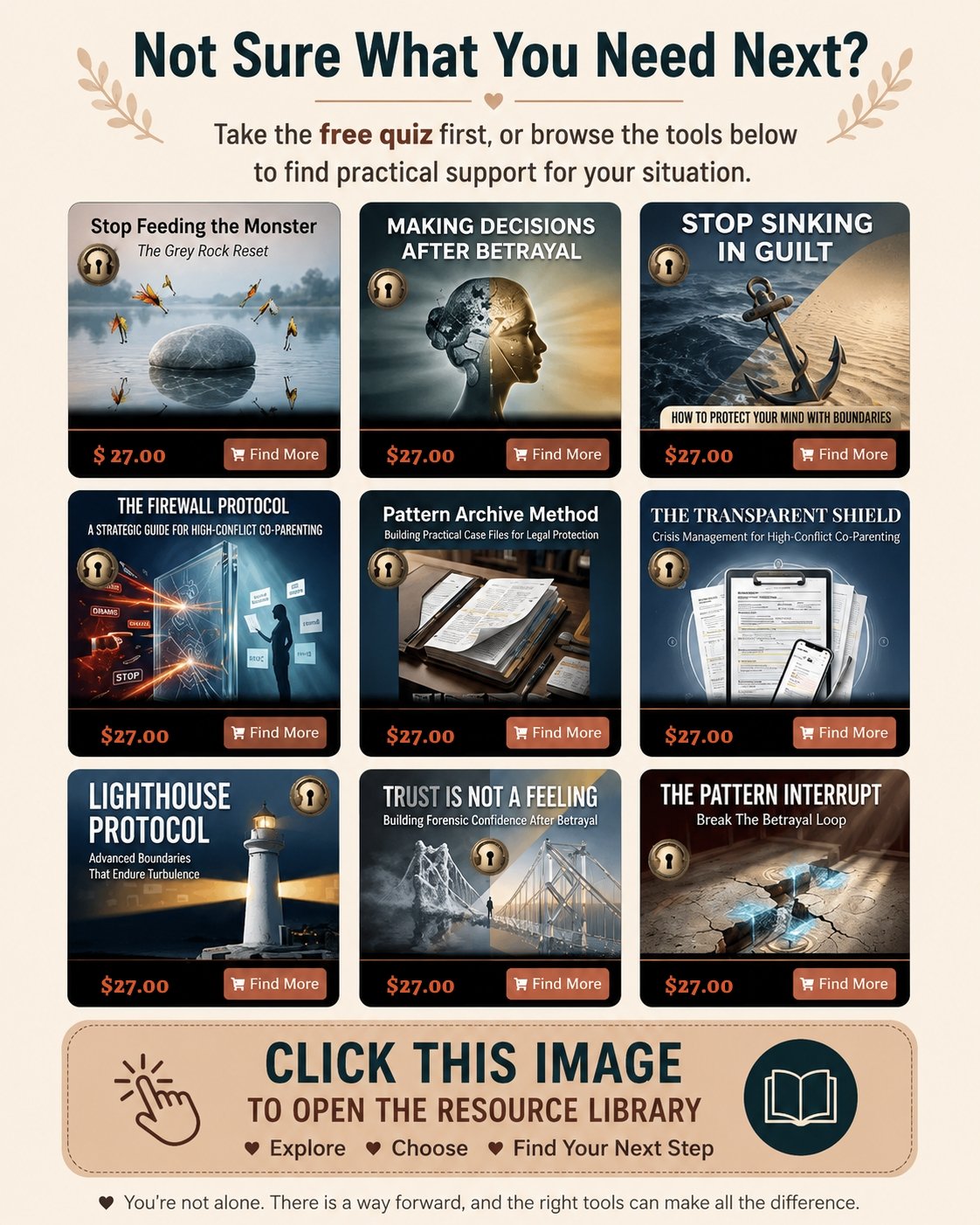
Includes immediate crisis protocols that cover the first 48 hours after discovery of betrayal. The Series pairs those protocols with ready-to-use scripts and assessment tools so you have concrete next steps when emotions are raw.
Core Features
- Structured, trauma-informed protocols mapped to different betrayal scenarios and recovery phases including survival, decision-making, transformation, and growth.
- Online courses that target specific situations such as co-parenting, managing triggers, and clarity-driven decision making.
- Assessment tools to help you classify the type and severity of the betrayal and pick the right protocol.
- Ready-to-use scripts for difficult conversations with children and co-parents to reduce anxiety and rehearse boundaries.
- Immediate crisis procedures for the first 48 hours after discovery, plus case studies and an FAQ library for common concerns.
The site describes an evidence-based, trauma-informed approach; I will refer to that approach below.
Key Differentiator
Staged protocols that move you from immediate stabilization into structured repair work are the core distinction. The Series lays out distinct steps for the first 48 hours, a decision phase, and longer-term trust rebuilding so you do not have to stitch together guidance from different sources.
Pros
- Step-by-step guidance: Detailed protocols reduce guesswork so you can act deliberately in the first days after discovery.
- Immediate crisis management tools: The 48-hour procedures give concrete actions to reduce overwhelm and keep you safer emotionally and practically.
- Evidence-informed approach above guides both short-term stabilization and longer-term work, which helps maintain continuity between courses and practical scripts.
- Practical scripts ease the hardest conversations, from telling children what happened to negotiating boundaries with a partner.
- Emphasis on long-term trust rebuilding and decision clarity means the material is useful whether you plan to separate or repair the relationship.
Cons
- Primarily digital resources only; the Series does not include in-person therapy sessions or physical books, so people who need face-to-face support will need to combine it with local therapy.
Who It’s For
People who have just discovered betrayal and need a structured, staged resource to manage immediate shock and plan next steps. Also for partners who want tool-based support for co-parenting conversations and for those seeking clarity before deciding to stay or leave.
Unique Value Proposition
Bundles that matter together. The Series combines 48-hour crisis protocols, assessment tools, and ready-to-use scripts into a single pathway that follows the same recovery logic from day one through longer-term rebuilding. That continuity reduces the friction of switching between advice sources when you are already under stress.
Real World Use Case
A betrayed partner follows the crisis protocol in the first two days to stabilize sleep and safety, uses the assessment tools to grade the betrayal, and then enrolls in the decision-making course to map options. Scripts are used during a calm family meeting to protect children from confusion.
Website: https://aftertheaffair.uk
Breaking Through Betrayal: And Recovering the Peace Within, 2nd Edition
At a Glance
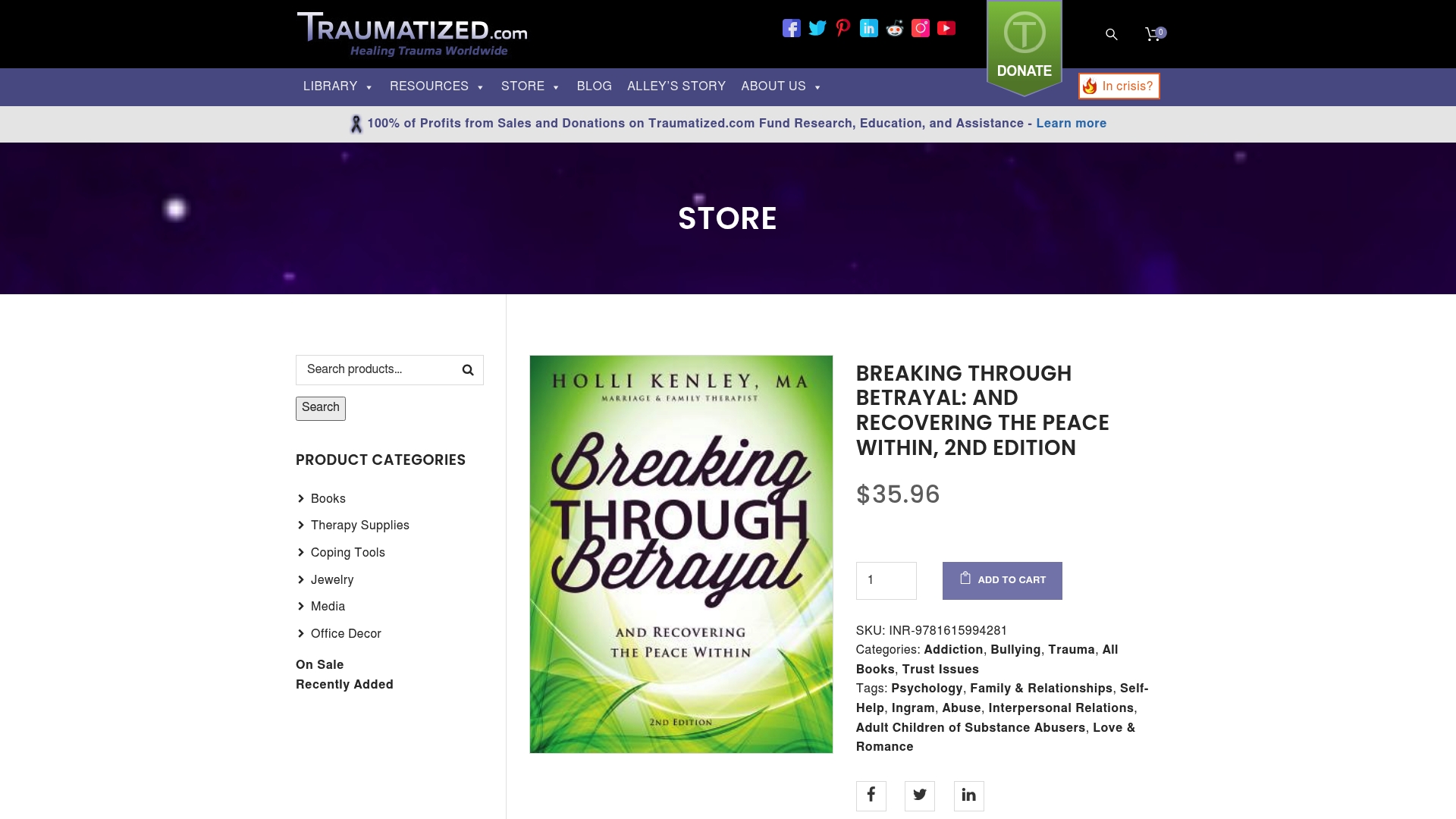
The second edition reframes relapse as self-betrayal and pairs that idea with a 6-part recovery process aimed at moving readers from self-betrayal to self-discovery. The book presents chapter-ending exercises so you can practice the steps as you read.
Core Features
- Structured recovery process that breaks healing into six sequential parts for clarity and practice.
- Focus on relapse framed as an internal betrayal and guidance on responding without shame.
- Chapter exercises designed for individual reflection and skill building.
- Exploration of multiple types of betrayal and their emotional and bodily impacts.
- Therapist authorship that leans on clinical experience rather than academic trials.
Key Differentiator
The defining angle is the combination of the relapse as self-betrayal frame with a six step method for self-discovery. That pairing shifts the work from pure coping strategies to identity repair. Compared with Aftertheaffair’s broader series and guided workbooks, this book is narrower and more suited to solo, reader-led recovery.
Pros
- Clear structure helps you track progress chapter by chapter rather than guessing next steps.
- Tackles relapse openly which reduces shame and normalizes setbacks during recovery.
- Practical exercises at the end of each chapter make abstract concepts usable the same day you read them.
- Holli Kenley’s status as a licensed marriage and family therapist gives clinical experience and practical language to complex feelings.
- The focus on self-discovery supports rebuilding trust in yourself, not only in relationships.
Cons
- The book relies on professional and personal insight and offers limited empirical validation or clinical trial data.
- Few third party reviews are cited, so external evaluation is sparse.
- No digital workbook, app, or interactive resources accompany the text, which limits practice support for people who prefer guided multimedia.
When It May Not Fit
If you want evidence from randomized trials or meta analyses this will not meet that requirement. If you need couple or family sessions with interactive therapist feedback, a standalone self-help book will feel incomplete. If you prefer an app or workbook with trackers and reminders, this is likely too traditional.
Who It’s For
People recovering from betrayal who want a compact, therapist authored manual to work through privately. Therapists can hand this to clients who need a readable framework between sessions. Caregivers seeking language to support a loved one will find clear exercises to recommend.
Real World Use Case
A survivor reads a chapter each week and completes the exercise at the end of the chapter. They journal responses and bring two pages to a therapy session to turn reading into targeted discussion. Over months the exercises map moments of relapse and clarify steps that restore self trust.
From Betrayal Trauma to Healing & Joy Workbook
At a Glance
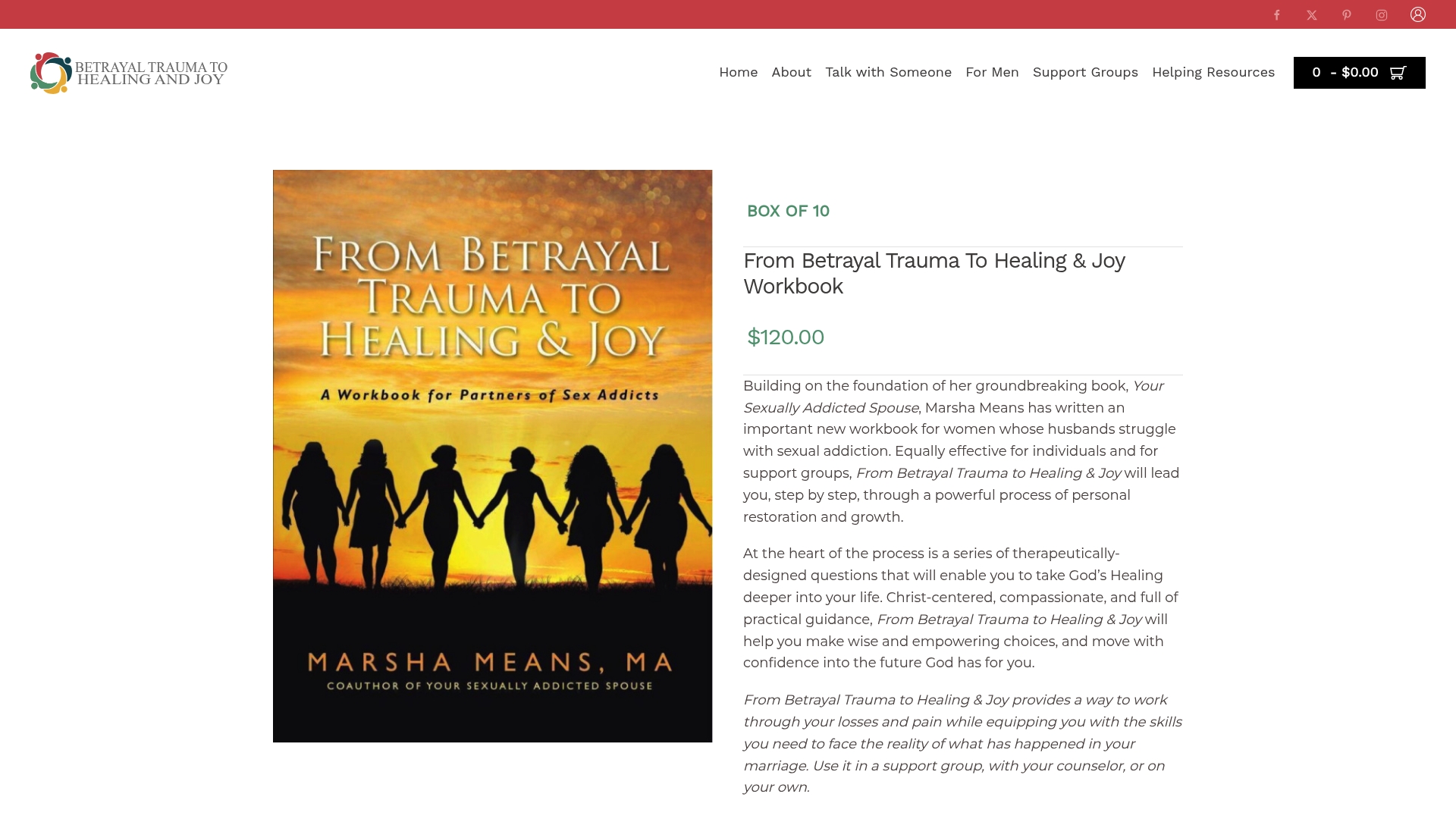
Sold as a box of 10 workbooks for $120, this workbook set is built to support group leaders and individual women working through betrayal trauma. It pairs guided questions with faith centered material and offers optional coaching resources referenced on the site.
Core Features
- Guided questions based on therapeutic principles to prompt reflection and emotional processing in session or at home.
- Practical exercises intended for emotional restoration, journaling, and decision making after betrayal.
- Box of 10 workbooks format that lets support groups purchase one kit rather than ten single copies.
- References to additional resources and coaching options for ongoing support as noted in product materials.
Key Differentiator
The workbook is expressly designed for women recovering from betrayal with a faith centered orientation and a structure that supports both group facilitation and solo use. That specific theological and therapeutic pairing narrows its focus compared with secular workbooks.
Pros
- Provides a clear session structure so group facilitators can run consistent weekly meetings without writing their own syllabus.
- The faith centered framing helps readers who want recovery resources that align with spiritually informed values and decision making.
- Practical prompts accelerate emotional processing by turning diffuse feelings into answerable questions you can discuss or journal about.
- Buying the set avoids repeated ordering logistics for small support groups and keeps materials uniform across participants.
- Reviews and product notes mention coaching options that supplement the printed material for deeper processing.
Cons
- Several pages referenced in the product description appear to contain broken links which may limit access to promised online supplements.
- The bundle price makes sense for groups but is less attractive for a single person who only needs one workbook.
- There is limited information about a digital edition or online delivery, which reduces accessibility for remote or international participants.
When It May Not Fit
If you need a single, low cost workbook, this box set is a poor fit. If your group operates fully online or requires an editable digital workbook, the current offering lacks clarity about online access and downloadable formats.
Who It’s For
Women recovering from betrayal trauma and partners of sex addicts who prefer faith informed recovery tools, plus support group facilitators who want ready made session materials. Not ideal for seekers of secular only resources or those needing immediate digital access.
Real World Use Case
A support group facilitator runs an eight week series using one workbook per participant. Each meeting opens with the same guided question, members journal between sessions, and the facilitator uses the exercises to structure homework and check ins.
Pricing
Priced at $120.00 for a box of 10 workbooks. That single figure is the vendor listed price and frames this offering as a small group purchase rather than a single user product.
Affair Recovery
At a Glance
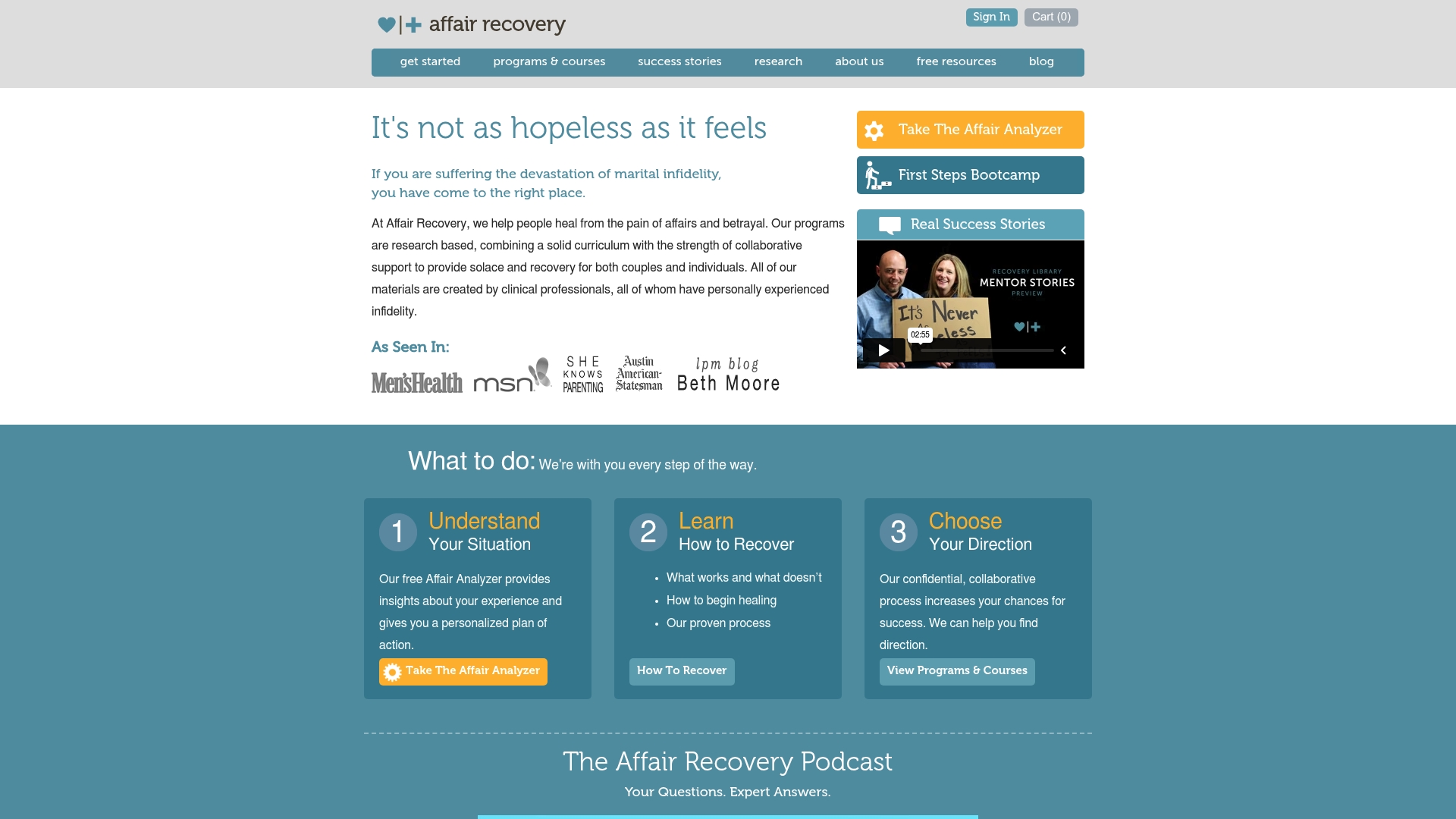
The Affair Analyzer provides a personalized assessment that informs which online course, support group, or in person weekend retreat will best fit a participant’s current needs.
Programs pair research-based curriculum with confidential community spaces and clinician-led intensives offered from Austin, Texas.
Core Features
- Affair Analyzer: a guided assessment that maps patterns of betrayal, then recommends specific course modules and retreat tracks.
- Online courses and virtual retreats built around staged learning, homework, and peer feedback.
- Confidential support groups and moderated community forums for ongoing peer support.
- In person weekend retreats in Texas with small-group work, clinician-led sessions, and practical rebuilding exercises.
Key Differentiator
Affair Recovery blends digital coursework and moderated peer support with short residential intensives led by clinicians who also have personal experience with infidelity recovery. That mix gives a diagnostic upfront via the Affair Analyzer and moves people quickly from assessment to concentrated, in person work. Compared with Aftertheaffair, Affair Recovery tilts more toward live intensives and a diagnostic assessment rather than a book series and longform self study.
Pros
- Offers programs for both betrayed and unfaithful spouses so couples can address both perspectives in parallel.
- The vendor reports high satisfaction and recommendation rates among participants, which shows consistent positive feedback across offerings.
- Long term access to digital resources means participants can revisit lessons and exercises after retreats end.
- Clinicians on staff combine professional training with lived experience of infidelity, which shapes group norms and session design.
- Multiple formats from short courses to weekend intensives let you pick intensity without switching providers.
Cons
- Programs are not intended as a substitute for individual therapy or crisis psychiatric care and will not address severe mental health conditions on their own.
- Retreats and program fees are not covered by insurance, so out of pocket cost can be a barrier for some people.
- Popular cohorts sell out quickly and there is no formal waitlist in place, which creates scheduling friction for people seeking immediate support.
When It May Not Fit
If you need ongoing clinical therapy for severe depression, suicidal thoughts, or complex PTSD, this offering is not a replacement for licensed individual care. Also, live retreats are concentrated in Texas so in person access is limited outside the region.
Who It’s For
Couples and individuals affected by infidelity who want a structured, clinician-led pathway that moves from assessment to group learning to concentrated retreat work. Best for people ready to engage in group settings and for those who can travel to Texas for an intensive.
Real World Use Case
A married couple completes the Affair Analyzer, enrolls in the recommended online modules, then attends the EMS Weekend intensive to address trust ruptures, learn communication protocols, and practice specific repair tasks under clinician supervision.
Pricing
Affair Recovery positions its site as informational; program and retreat fees vary by offering and are listed on registration pages. Retreats and courses require out of pocket payment and are not billed through insurance.
Website: https://affairrecovery.com
Comparative Analysis: Infidelity Recovery Resources
Navigating options for betrayal trauma recovery resources involves assessing various approaches crafted for distinct healing needs. Among the four highlighted offerings, notable contrasts arise in delivery formats, intervention structures, and thematic orientations.
Structured Protocols vs. Solo Frameworks
After the Affair Series excels with its staged protocols addressing immediate crisis management and longer-term rebuilding, leveraging digital resources for accessibility. In contrast, Breaking Through Betrayal provides a therapist-authored self-help book focused on identity repair through structured exercises. While the Series guides users step-by-step during early trauma recovery and relationship crossroads, the book is better suited for individuals seeking reflective, solo healing centered on self-discovery.
Digital Versatility vs. In-Person Engagement
The After the Affair Series offers exclusively digital tools such as scripts, assessments, and courses tailored to betrayal scenarios, maximizing convenience for remote users. Conversely, Affair Recovery incorporates live retreats in Texas, moderated peer forums, and clinician-led courses, which create opportunities for face-to-face interaction and community building. The emphasis on real-world engagement positions Affair Recovery as more effective for individuals and couples valuing in-person connection, albeit with geographic and schedule limitations.
Best Fit Scenarios
- After the Affair Series: Ideal for those requiring immediate stabilization protocols followed by structured, trauma-informed guidance extending across all phases of emotional recovery.
- Breaking Through Betrayal: Preferred for persons prioritizing self-led identity repair exercises within a clinically inspired framework and compact physical format.
- From Betrayal Trauma to Healing & Joy Workbook: Best suited for faith-centered group facilitators looking for practical, uniform session planning tools.
- Affair Recovery: Recommended for individuals and couples engaging in therapist-supported community healing, inclusive of tailored assessments and dynamic group exercises with in-person interaction.
Our Pick
Aftertheaffair.uk stands out for its exclusive focus on staged recovery with immediate crisis drills and continuity through assessment tools and trauma-informed online courses. While highly versatile, those desiring face-to-face settings or faith-aligned principles might find Affair Recovery or From Betrayal Trauma a stronger alignment. For digital-first convenience blending readiness and adaptability, After the Affair Series emerges as the recommended choice.
Betrayal Trauma Resources Comparison
Discover which betrayal trauma resource aligns best with your recovery needs, emphasizing the structured, trauma-informed protocol.
| Product Name | Core Feature or Use Case | Key Differentiator | Best For | Pricing | Notable Limitation |
|---|---|---|---|---|---|
| After the Affair Series | Trauma-informed recovery protocols and tools | Staged protocols for structured recovery | Immediate support post-betrayal discovery | Not disclosed | Available only as digital resources |
| Breaking Through Betrayal (2nd Edition) | Six-part recovery process for self-betrayal healing | Focus on relapse as self-betrayal | Individuals preferring therapist-authored books | Not disclosed | Limited empirical validation |
| From Betrayal Trauma to Healing & Joy Workbook | Faith-centered workbook for support groups | Structured for group facilitation | Support group leaders and faith-oriented individuals | $120 per set | Lack of clarity around online accessibility |
| Affair Recovery | Online courses and in-person weekend retreats | Guided assessment to tailored programs | Couples or individuals seeking clinician-led retreats | Not disclosed | Retreats not covered by insurance |
Find the Right Support for Betrayal Trauma Recovery
Betrayal trauma can leave you feeling emotionally shattered and uncertain about your next steps. The article highlights critical challenges such as managing immediate crisis moments, clarifying your decisions, and rebuilding trust after infidelity. If you are seeking clear guidance that aligns with these needs, Aftertheaffair offers structured, trauma-informed protocols designed to bring stability and growth across every phase of recovery.
Explore resources like:
- Concrete crisis steps for the first 48 hours
- Assessment tools to understand the nature and impact of betrayal
- Practical scripts for difficult conversations
Take control of your recovery with dependable support tailored for your unique situation. Visit the Essential Crisis Guides – After the Affair Series and Recovery Strategies – After the Affair Series to access these tools today.
Don’t let confusion or overwhelm dictate your path. Head to the Aftertheaffair Resource Library now and gain actionable steps to stabilize your emotions, make informed decisions, and move forward with confidence.
Frequently Asked Questions
What structured protocols does Aftertheaffair offer for betrayal trauma?
Aftertheaffair provides structured, trauma-informed protocols tailored to various betrayal scenarios and recovery phases. These protocols are designed to help users manage immediate crises with step-by-step guidance, particularly in the first 48 hours after discovering infidelity. Users can expect clear next steps to stabilize their emotional state and begin healing.
How does Aftertheaffair compare to Affair Recovery’s approach?
Affair Recovery excels with its Affair Analyzer, which provides a personalized assessment to determine the best course or retreat for individuals coping with infidelity. While Affair Recovery focuses on diagnostic assessments and intensive retreats, Aftertheaffair emphasizes staged protocols and readiness for longer-term recovery, making it ideal for users needing immediate and structured support following discovery.
What tools does Aftertheaffair provide for handling difficult conversations?
Aftertheaffair includes ready-to-use scripts aimed at easing challenging conversations with children and co-parents about the betrayal. These practical scripts allow users to rehearse boundaries and reduce anxiety when discussing sensitive topics, leading to healthier communication.
Can I access in-person therapy sessions through Aftertheaffair?
Aftertheaffair primarily offers digital resources and does not include in-person therapy sessions as part of its services. Users may need to seek additional local therapy if they require face-to-face support, especially for complex emotional needs.
What immediate actions does Aftertheaffair recommend in the first 48 hours after discovering betrayal?
Aftertheaffair outlines specific immediate crisis management tools to help individuals reduce overwhelm within the crucial first 48 hours. These actions focus on emotional stabilization and safety, offering a concrete plan to navigate the initial shock of betrayal.
Recommended
- Top 6 Trauma Healing Resources 2026
- Top 5 Trauma Healing Resources 2026
- Top 5 Self-Help Solutions for Betrayal 2026 – After the Affair Series
- Betrayal Trauma Hub – After the Affair Series