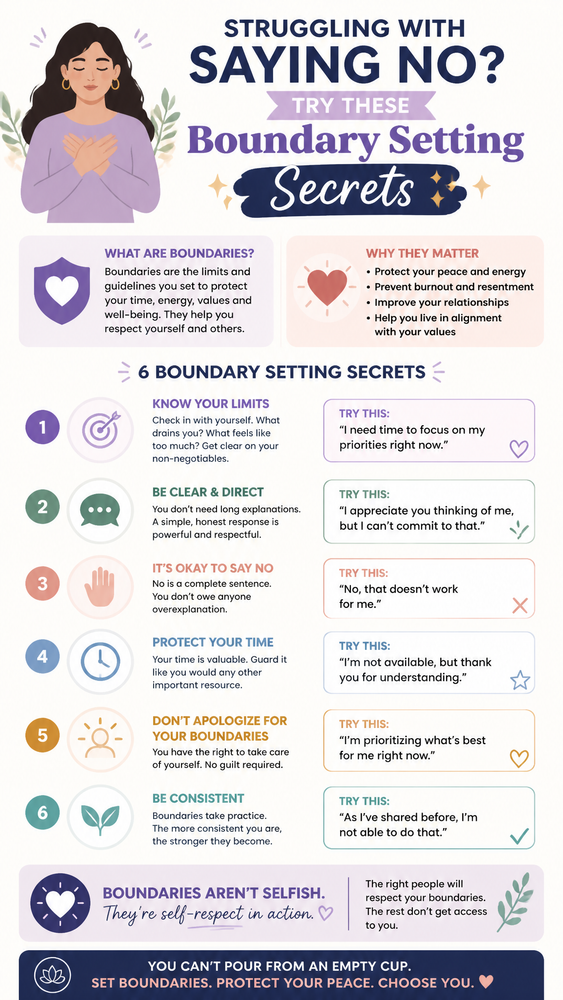
The most effective ways to set boundaries come down to four moves: know your limit, name it clearly using an “I” statement, state what you will do if it’s crossed, and follow through every time. That’s the whole framework of Mastering Your Boundaries. Everything else is delivery.
Here’s what it looks like in practice: “I need our conversations to stay calm. If voices get raised, I’ll step outside until things settle.” That’s a boundary. It tells the other person what you need and what you’ll do, without demanding they change who they are.
Mastering Your Boundaries is essential for maintaining healthy relationships and personal empowerment.
Pro Tip: Tone carries more weight than word choice. A calm, even voice signals confidence. Raising your pitch or rushing through the statement invites pushback. Slow down, make eye contact, and say it once.
- Key Takeaways from Mastering Your Boundaries
- What boundaries are — and what they aren’t
- Six types of boundaries you’ll actually use
- A step-by-step method for setting any boundary
- Ready-to-use scripts for common situations
- How to set limits with yourself
- Handling pushback, guilt, and repeated violations
- What practitioners say about why some limits work and others don’t
- When to get professional help
- FAQ
Key Takeaways from Mastering Your Boundaries
Consistent follow-through is the single most important factor in whether a personal limit becomes respected, regardless of how well it’s worded.
| Point | Details |
|---|---|
| Frame limits as your actions | Say what you will do, not what you need others to stop doing. |
| Keep statements brief | One clear sentence followed by silence is more effective than a long explanation. |
| Follow through every time | Acting on stated consequences is what trains people to take your limits seriously. |
| Use “I” statements | Starting with your own feelings reduces defensiveness and keeps the focus on your needs. |
| Aftertheaffair resources | The 7-step recovery checklist includes ready-to-use scripts and consequence-framing protocols for boundary work after betrayal. |
What boundaries are — and what they aren’t
A boundary is a communicated limit that defines what is acceptable to you and what action you will take if that limit is crossed. The critical word is “you.” Boundaries describe your behavior, not a demand that someone else change.
That distinction matters more than most people realize. When you frame a boundary as “you need to stop doing X,” you’ve handed control to the other person. When you frame it as “if X happens, I will do Y,” you stay in control regardless of how they respond. The Mayo Clinic’s guidance on setting limits captures this as the “law of relationships”: you cannot control others, only your own actions.
Three common misconceptions worth clearing up fast:
- Boundaries are not punishments. They protect your well-being, not retaliate against someone else’s behavior.
- Boundaries are not walls. They define what works for you in a relationship, not a refusal to engage.
- Boundaries are not selfish. University wellness research consistently frames clear limits as necessary for reducing burnout and protecting mental health.
Six types of boundaries you’ll actually use
Most people think of boundaries as physical, but the category that causes the most friction in daily life is usually emotional or time-based. Here’s a fast map of the core types with one concrete example each.
| Type | What it covers | Example |
|---|---|---|
| Physical | Personal space, touch, privacy | “I’m not comfortable with hugs from people I’ve just met.” |
| Emotional | What you’ll discuss, how you’ll be spoken to | “I won’t engage in conversations where I’m being yelled at.” |
| Time | Your schedule, availability, response windows | “I don’t take work calls after 6 PM.” |
| Digital/Communication | Texts, social media, contact frequency | “I check messages twice a day and won’t reply after 9 PM.” |
| Material/Financial | Lending money, possessions, shared expenses | “I don’t lend money to friends or family.” |
| Sexual | Consent, comfort, preferences | “I need to feel emotionally safe before being physically intimate.” |
The Cleveland Clinic’s guidance on healthy boundaries notes that short, concrete examples for each category help people express limits clearly rather than leaving them vague. Vague limits get tested. Specific ones hold.
For readers navigating digital boundaries after betrayal, the Aftertheaffair guide on social media limits after a digital affair goes deeper on that specific category.
A step-by-step method for setting any boundary
The most reliable process follows six steps: identify the need, communicate it clearly, use an “I” statement, name the consequence, follow through, then review. Mayo Clinic’s stepwise approach supports exactly this sequence as a way to reduce stress and improve relationships over time.
Know your need. Before you say anything, get specific. What behavior is crossing a line? What do you need instead? “I feel drained after long phone calls” is more useful than “I feel overwhelmed.”
Choose the right moment. Don’t set a boundary mid-argument. Wait for a calm moment when both of you can actually hear each other.
Use an “I” statement. Start with what you feel or need, not what the other person did. “I need quiet time after work” lands differently than “You never give me space.”
Name the consequence. This is the part most people skip. State what you will do, not what you want them to do. “If the conversation gets heated, I’ll take a 20-minute break and come back.”
Follow through. SimplyPsychology’s research summary is direct on this: consistent follow-through is the single most common factor in whether a boundary becomes respected. Fail to act once, and you’ve trained people to test you again.
Review and adjust. Boundaries aren’t permanent contracts. Ask yourself periodically whether the limit still fits the relationship and the situation.
Here’s how delivery style changes the outcome:
| Style | Tone | When to use | Typical outcome |
|---|---|---|---|
| Soft | Warm, tentative | New relationship, low-stakes situation | Opens dialogue; may invite negotiation |
| Assertive | Calm, clear, firm | Most everyday situations | Understood and usually respected |
| Firm | Direct, minimal explanation | Repeated violations, safety concerns | Closes negotiation; signals seriousness |
Ready-to-use scripts for common situations
Short scripts work better than long explanations. Healthline’s guidance on assertive boundary language confirms that firm but kind phrasing reduces defensiveness and makes limits easier to hear. Keep it brief. Say it once.
With a partner:
- Soft: “I’d really appreciate some quiet time when I get home. Could we catch up after dinner?”
- Assertive: “I need 30 minutes to decompress after work. I’ll be ready to talk after that.”
- Firm: “If we can’t have calm conversations, I’ll need to take space until we can.”
With family:
- Soft: “I love you, and I’d prefer we keep certain topics off the table at family dinners.”
- Assertive: “I won’t discuss my relationship choices at family events. I’m happy to talk about other things.”
- Firm: “If that topic comes up again, I’ll leave the gathering early.”
With friends:
- Soft: “I’ve been stretched thin lately. I may not always be available to talk things through.”
- Assertive: “I can’t be the person you call in crisis every week. I care about you and I also have limits.”
- Firm: “I need our friendship to feel balanced. If it continues to feel one-sided, I’ll need more distance.”
With a coworker or manager:
- Soft: “I want to do good work. I find I’m most effective when I’m not pulled into tasks outside my role.”
- Assertive: “I’m not able to take on additional projects right now. My current workload is at capacity.”
- Firm: “I’ve raised this before. If my workload isn’t adjusted, I’ll need to escalate to HR.”
For boundaries in the workplace that involve more complex dynamics, the framing stays the same: describe what you’ll do, not what you need others to stop doing.
Self-boundary phrases:
- “I don’t check email after 8 PM.”
- “I won’t make major decisions when I’m exhausted or emotionally flooded.”
- “I’ll take a 10-minute walk before responding to anything that makes me angry.”
How to set limits with yourself
External limits are only as strong as the internal ones backing them up. If you haven’t built personal structures around your own time, attention, and energy, you’ll find it much harder to hold limits with other people.
The highest-impact self-boundaries tend to be environmental, not motivational. Blocking your calendar for recovery time, turning on Do Not Disturb from 9 PM to 7 AM, and keeping your phone out of the bedroom are all structural changes that don’t rely on willpower. They work because the friction is built in.
A few tactics that hold up in practice:
- Calendar blocks. Treat your recovery time, exercise, or quiet hours as appointments. Don’t leave them as intentions.
- Micro-rules. “No devices at the dinner table” or “no work email before 9 AM” are simple enough to follow without negotiation.
- Accountability nudges. Tell one person your self-limit. The social layer makes it stickier.
- Ritualized check-ins. Once a week, ask yourself: where did I override my own limits this week, and why? The workbook exercises at Aftertheaffair include journal prompts designed for exactly this kind of self-audit.
Three journal prompts to try this week:
- What did I agree to this week that I didn’t actually want to do?
- Where did I feel resentment, and what limit had I failed to set?
- What would I need to say no to in order to feel okay by Friday?
Handling pushback, guilt, and repeated violations
Pushback is not a sign that your boundary was wrong. It’s often a sign that it was necessary. People who have benefited from your lack of limits will resist when those limits appear.
Research on relational boundaries supports keeping boundary statements brief and avoiding over-justification. The longer you explain, the more material you give someone to argue with.
Common pushback tactics and how to respond:
- Minimizing (“You’re overreacting”): “I hear that you see it differently. This is still my limit.”
- Guilt-tripping (“After everything I’ve done for you”): “I appreciate what you’ve done. This boundary stands.”
- Bargaining (“Just this once”): “I understand. The answer is still no.”
- Silent treatment: Don’t chase. Give it time and let your follow-through speak.
Red flags that a relationship may not respect limits long-term:
- The same boundary gets crossed repeatedly after being stated clearly
- You feel afraid to name a limit because of how the person will react
- Pushback escalates to threats, humiliation, or punishment
- You find yourself constantly shrinking to avoid conflict
If any of those feel familiar, that’s worth taking seriously. For readers dealing with repeated violations in a betrayal context, the Aftertheaffair resource on boundaries after serial cheating addresses the specific dynamics of high-conflict, repeated violations.
After a boundary is crossed, take care of yourself before re-engaging. That means physical grounding (a walk, water, breathing), not immediately re-litigating the conversation, and noting what happened so you can decide whether to escalate.
What practitioners say about why some limits work and others don’t
Delivery and follow-through determine whether a boundary holds, not the words alone. That’s the consistent finding across clinical and counseling resources.
Stanford Student Affairs frames trust, safety, and respect as the core outcomes of healthy limits, and notes that those outcomes depend on consistency over time, not a single well-worded statement.
Three delivery principles that practitioners return to repeatedly:
- Brevity signals confidence. A one-sentence boundary followed by silence is more powerful than a three-paragraph explanation. Over-explaining invites negotiation.
- Tone carries the message. A calm, even voice communicates that you mean what you say. Apologetic or rushed delivery signals that you’re open to being talked out of it.
- Body language must match. Crossed arms, looking away, or a rising pitch undercuts even the clearest words.
Poor delivery: “I’m sorry, I know this is a lot to ask, and I totally understand if it’s inconvenient, but I was kind of hoping maybe we could try not to bring up that topic?”
Effective delivery: “I’d prefer we don’t discuss that. If it comes up, I’ll change the subject.”
Same request. Completely different signal.

When to get professional help
Seek professional support when limits repeatedly fail despite clear communication, when you feel unsafe, or when the emotional weight of the situation is affecting your daily functioning.
Signs it’s time to reach out:
- You’ve stated a limit clearly more than once and it keeps getting crossed
- You feel afraid of the other person’s reaction when you try to set a limit
- You’re experiencing ongoing anxiety, sleep disruption, or emotional numbness related to the relationship
- The situation involves threats, coercion, or any form of abuse
- You want to set limits but feel paralyzed or don’t know where to start
A therapist or licensed counselor can help you identify what limits you actually need (not just the ones that feel “reasonable”), practice assertive communication in a safe space, and work through the guilt and fear that often come with setting limits for the first time. Couples therapy adds a structured space for both people to hear and negotiate limits with a neutral third party.
To find a therapist in the United States, Psychology Today’s therapist finder, the SAMHSA National Helpline (1-800-662-4357), and the American Association for Marriage and Family Therapy directory are all reliable starting points. For readers working through betrayal specifically, the Aftertheaffair guide on therapy’s role in recovery outlines what to expect from different therapeutic approaches.
A note from the editor
Setting a limit for the first time, especially after betrayal or a long pattern of not having any, can feel like you’re doing something wrong. That guilt is almost universal, and it’s worth naming directly: guilt is not evidence that you’ve made a mistake. It’s often evidence that you’ve finally done something right.
What I’ve seen in recovery work, and what the research consistently supports, is that people don’t fail at limits because they lack the right words. They fail because they don’t follow through. The script matters far less than what you do the first time the limit is tested.
Pro Tip: If you’re anxious about setting your first limit, start with a low-stakes situation. Practice with a coworker or a casual acquaintance before tackling the hardest relationship in your life. The skill builds with repetition.
Structured support for boundary-building after betrayal
Setting limits is harder when you’re also processing trauma. The emotional flooding, the fear of losing the relationship, the guilt of asking for anything at all — those aren’t obstacles to work around. They’re part of the work.
Aftertheaffair offers structured, evidence-informed resources built specifically for this. The 7-step infidelity recovery checklist includes ready-to-use boundary scripts, consequence-framing language, and step-by-step protocols for the most common high-conflict situations. It’s designed to be used alongside therapy or independently, and it gives you a concrete starting point when you’re not sure where to begin. If you’re a therapist looking for structured materials to use with clients, the client guidance resource covers the same frameworks in a practitioner-ready format.
Sources
- Mayo Clinic Q and A: Setting boundaries for your well-being – Mayo Clinic News Network
- The No BS Guide to Setting Healthy Boundaries in Real Life | Healthline
- Setting Boundaries: What Psychologists Actually Mean and How to Do It | Simply Psychology
- How To Set Boundaries in Healthy Ways | Cleveland Clinic
- Frontiers in Psychology article (2020) — research covering relational boundaries and related behaviors
This article is general information, not a substitute for advice from a qualified doctor. Consult a qualified healthcare professional about your own circumstances before acting on anything here.
FAQ
What’s the best way to set a boundary?
State what you will do if a limit is crossed, not what you want the other person to stop doing. Keep it brief, use an “I” statement, and follow through the first time it’s tested.
Why do I feel guilty after setting a limit?
Guilt after setting a limit is common, especially if you’ve spent a long time prioritizing others’ comfort over your own. It’s a feeling, not a signal that you did something wrong. It typically fades as follow-through builds confidence.
How do I set limits with someone who keeps ignoring them?
Restate the limit once, calmly and briefly, then act on the consequence you named. Repeated violations after clear communication are a sign the relationship may need professional support or greater distance.
Can I set limits at work without damaging my career?
Assertive, professionally framed limits, stated calmly and focused on workload or role clarity, are generally respected. Frame them around your capacity and output, not personal preferences, and document conversations where needed.
When should I see a therapist about boundary issues?
Seek professional help when limits repeatedly fail despite clear communication, when you feel afraid to name a limit, or when the emotional weight of the situation is affecting your sleep, focus, or daily functioning.
Recommended
- Boundaries That Actually Work – After the Affair Series
- Boundaries After Serial Cheating: What Works – After the Affair Series
- The Role of Boundaries Post-Affair in Real Recovery
- Role of boundaries after betrayal to rebuild trust – After the Affair Series