TL;DR:
- Harmful words in parenting, such as shaming, dismissing emotions, or labeling identities, damage a child’s self-esteem and trust. Replacing these phrases with validating, behavior-focused language fosters healthy emotional development and strengthens communication. Building trust requires honest, compassionate responses, especially during emotional dysregulation and challenging conversations.
Words are permanent in a child’s mind long after the moment passes. Knowing what should parents never say to their children is not about achieving perfect parenting. It is about recognizing that certain phrases, even ones spoken with good intentions, quietly chip away at a child’s sense of self, emotional safety, and ability to trust their own feelings. This guide breaks down the most common phrases harmful to children, why they cause damage at a psychological level, and exactly what to say instead so you can build stronger communication without starting from scratch.
Key takeaways
| Point | Details |
|---|---|
| Shame harms identity | Phrases that compare or label children damage self-esteem and teach internal shame that persists into adulthood. |
| Dismissing emotions backfires | Saying “You’re fine” or “Stop crying” delays emotional vocabulary and self-regulation in children. |
| Timing shapes impact | Emotional coaching works best after a child calms down, not during peak dysregulation. |
| Language separates behavior from identity | Addressing what a child did rather than who they are protects their sense of worth. |
| Alternatives exist for every harmful phrase | Every damaging phrase has a researched, practical replacement that validates feelings and guides behavior. |
What should parents never say to their children: the psychology behind the damage
Most parents do not intend to harm their children with words. The problem is that shaming phrases cause harm even when the intent behind them is to motivate, comfort, or correct. Understanding why that happens changes everything about how you approach tough moments.
There are three main categories of unhealthy phrases in parenting that consistently cause damage.
- Comparative shaming. Phrases like “Why can’t you be more like your sister?” pit your child against a sibling or peer and send one clear message: you are not enough as you are. Therapists strongly recommend separating the child from the behavior when addressing discipline, because comparisons attack identity rather than redirect behavior.
- Emotion invalidation. When you tell a child “Don’t be sad” or “There’s nothing to be scared of,” you are not soothing them. You are teaching them that their inner world is wrong or inconvenient. Labeling emotions non-judgmentally builds the metacognitive awareness children need to manage feelings throughout their lives.
- Identity labeling. Calling a child “lazy,” “dramatic,” or “a troublemaker” is not a description of behavior. It becomes a story the child tells about themselves. Shame-laden identity statements stick because children internalize labels and tone deeply, making that internal shame genuinely difficult to unlearn.
The difference between discipline that teaches and phrases that shame comes down to one question: does this statement address what my child did, or does it attack who my child is? Every phrase in the “never say” category crosses that line in some way.
Pro Tip: When you feel the urge to make a comparison to motivate your child, redirect that energy into describing the specific behavior you want to see. “I noticed you left your homework until bedtime. Let’s figure out a better plan together” is more effective and far less damaging.
Specific harmful phrases and why they hurt
Understanding the general categories is useful. Seeing the exact phrases and their impact is where real change begins. These are the most common things parents should avoid saying, with context on why each one causes harm.
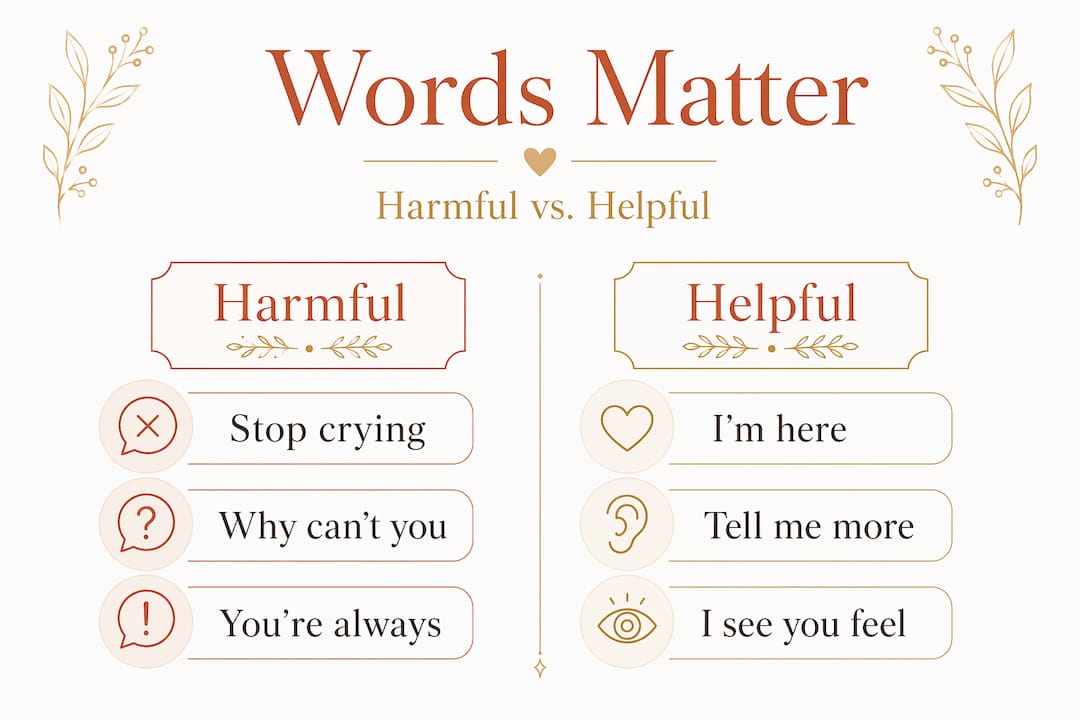
- “Stop crying.” This is one of the most common yet damaging phrases in parenting. Saying “stop crying” delays children’s development of emotional vocabulary because it attempts to end the emotion abruptly rather than process it. Tears are communication. Silencing them teaches children their feelings are a problem to be fixed, not understood.
- “You’re fine.” This phrase feels reassuring from a parent’s perspective, but it lands very differently on a child who does not feel fine. Dismissive comfort phrases like this one undermine a child’s emotional understanding and ability to trust their own perception of distress. A child who is repeatedly told they are fine when they are not will eventually stop telling you when something is wrong.
- “You’re such a disappointment.” Even said once in a moment of frustration, this phrase can leave a permanent mark. It does not point to a choice or action. It defines the child as a failure in their parent’s eyes. The impact is not short-term embarrassment. It feeds shame at the core of a child’s identity.
- “Because I said so.” This one shuts down a child’s natural curiosity and reasoning. While it can feel necessary in rushed moments, overusing it teaches children that authority does not require explanation and that their questions are not welcome. That pattern makes it significantly harder for them to come to you with real problems later.
- “You always do this” or “You never listen.” Absolute statements like these feel true in the moment but are rarely accurate. More importantly, they teach children that their behavior is a fixed pattern rather than something they can change. That framing removes motivation and builds a self-concept around failure.
“Naming what a child is feeling, rather than telling them to stop feeling it, is one of the most powerful things a parent can do. Emotions that are witnessed do not have to be suppressed.” Adapted from child psychology guidance on emotion labeling and self-regulation.
The research is consistent here. Negative words for children that dismiss or label do not just sting in the moment. They shape how children understand themselves, handle relationships, and regulate stress well into adulthood.
Practical alternatives that actually work
Knowing what not to say to kids is only half the picture. Parents also need concrete, realistic phrases they can actually remember and use under pressure. The good news is that the replacements are not complicated. They just require a small but intentional shift in framing.
Here is how the language changes:
- Instead of “Stop crying,” try: “I can see you’re really upset. I’m right here.” This brief acknowledgment validates the emotion without amplifying or dismissing it.
- Instead of “You’re fine,” try: “That looked really scary. Tell me what happened.” You are modeling that their experience is real and worth understanding.
- Instead of “Why can’t you be more like…,” try: “I know this is hard for you. What would help you right now?” This keeps the focus on the child in front of you.
- Instead of “Because I said so,” try: “I need you to do this because it keeps you safe. We can talk more about why later.” Boundaries stay intact. Curiosity is not punished.
The timing of your response matters as much as the words themselves. Emotion-directing statements like “Don’t be so sad” tend to backfire because they arrive when a child’s nervous system is flooded. The research from Psychology Today is clear: nonverbal calming cues are more effective than verbal reasoning during dysregulation. Get calm yourself first. Then label the emotion once your child begins to settle.
Pro Tip: Think of emotional coaching as a two-step process. Step one is co-regulation: get physically close, lower your voice, and breathe slowly. Step two is language: once your child starts calming, name what you saw. “You were so frustrated when that happened.” That sequence works. The reverse rarely does.
Quick reference: harmful vs. helpful phrases
| Harmful phrase | Why it hurts | Better alternative |
|---|---|---|
| “Stop crying” | Suppresses emotional processing | “I see you’re upset. I’m here with you.” |
| “You’re fine” | Dismisses real distress | “That looked hard. Tell me more.” |
| “Why can’t you be like…” | Attacks identity through comparison | “Let’s focus on what you need right now.” |
| “You’re a disappointment” | Creates core shame | “That choice wasn’t okay. Let’s talk about it.” |
| “You always/never do this” | Reinforces fixed negative self-concept | “This time it didn’t go well. What can we try differently?” |
Handling difficult conversations with confidence
Some conversations are harder than others. Talking to children about mistakes, family changes, online safety, or difficult emotions requires more than the right vocabulary. It requires an environment where children feel safe enough to be honest with you.
Government guidance supports this directly. Open, age-appropriate conversations about difficult topics including harmful online content are most effective when parents position themselves as the primary, trusted source of information rather than a source of judgment or punishment. That kind of trust is built or broken through everyday communication patterns, not just big talks.
A few practices that protect that trust:
- Avoid phrases that encourage secrecy. Telling a child “Don’t tell Dad about this” or “It’s our little secret” confuses their understanding of boundaries and authority. Research shows that encouraging secrets from parents undermines their sense of safety and makes it harder for them to recognize when something is genuinely wrong.
- Use open-ended prompts. Instead of “Did anything bad happen today?” try “What was the weirdest part of your day?” Children are far more likely to open up when the question does not feel like an investigation.
- Acknowledge before redirecting. If your child shares something difficult, resist the urge to immediately fix, lecture, or minimize. A simple “Thank you for telling me that. That took courage” keeps the door open.
If your family is navigating a particularly challenging transition, the guide on telling kids about family changes offers structured approaches for maintaining trust when the conversations feel impossibly hard.
My take: why the shift from correction to connection changed everything
I spent years thinking that firm, clear corrections were the most loving thing I could offer a child in a difficult moment. Efficiency felt kind. “Stop that, here’s what to do instead” seemed respectful of everyone’s time. What I eventually understood, both personally and through the work we do at Aftertheaffair, is that children do not experience correction as efficient. They experience it as rejection when it arrives without acknowledgment.
The shift that actually changed my approach was learning to recognize when a child’s behavior is emotional communication rather than deliberate defiance. Most of the time, it is. A child who “won’t stop crying” is not being manipulative. A child who “never listens” is often dysregulated, not oppositional. Once I started responding to the feeling underneath the behavior, the behavior itself became much easier to address.
Progress matters far more than perfection here. You will say the wrong thing sometimes. Every parent does. What matters is whether you go back and repair it. “I said that badly earlier, and I want to try again” is one of the most powerful sentences a parent can offer a child. It models exactly the kind of emotional honesty you are trying to build in them.
The balance between firmness and empathy is not a contradiction. Boundaries feel safer to children when they are delivered by a parent who also shows up for their feelings.
— S.J.Howe

Support for parents navigating emotional recovery
Parenting through emotional difficulty, whether that is a family crisis, relationship breakdown, or the aftermath of betrayal, puts real pressure on how you communicate with your children. At Aftertheaffair, we understand that the way you speak to your kids is often a direct reflection of how supported you feel as a parent.
Our infidelity recovery checklist offers a structured, step-by-step guide to rebuilding emotional stability so you can show up for your children with more consistency and less reactivity. For parents managing the deeper emotional fallout of betrayal, our guide on children’s stress after infidelity addresses how to acknowledge rather than dismiss what your child is carrying through a difficult time. Healing yourself and healing your communication with your children are not separate goals. They move together.
FAQ
What phrases are most harmful to say to a child?
The most harmful phrases are those that shame identity, dismiss emotions, or use absolute labels like “You’re always so dramatic” or “You’re a disappointment.” These teach children that their feelings are wrong and that their worth is conditional.
How does saying “You’re fine” hurt a child?
Dismissive phrases like “You’re fine” undermine a child’s trust in their own emotional experience. Over time, children learn to stop sharing distress because they expect it to be minimized.
When is the best time to talk to a child about their feelings?
Emotional coaching is most effective after a child has begun to calm down. During peak dysregulation, calm nonverbal cues work better than words or reasoning.
How can parents rebuild communication after saying something harmful?
Return to the moment honestly. Saying “I did not handle that well and I want to try again” models emotional accountability and repairs trust without undermining your authority as a parent.
Why do comparisons like “Be more like your sibling” cause lasting damage?
Recommended
Comparative phrases attack a child’s identity rather than a specific behavior. Children internalize these labels deeply, and the shame they create is significantly harder to undo than a corrected behavior.
- Communication Transition Mistakes – After the Affair Series
- What Not To Do When Co-Parenting – After the Affair Series
- How to Tell Kids About an Affair – After the Affair Series
- Age-Specific Scripts – After the Affair Series