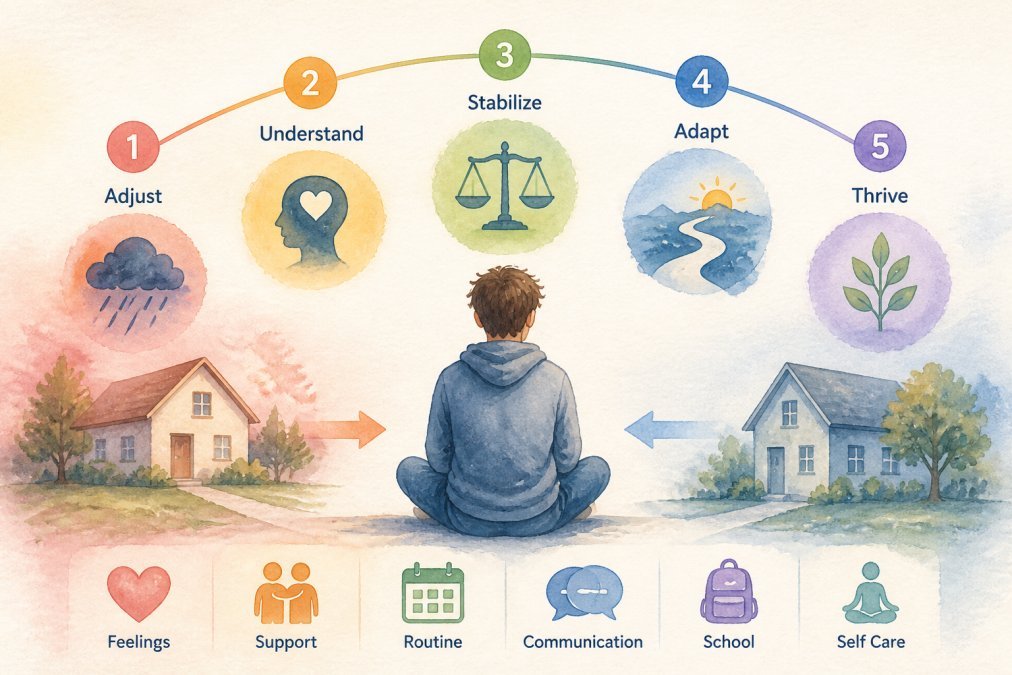
Choosing to reconcile does not switch off the trauma. Here is why — and what to do about it.
TL;DR:
A significant number of couples who experience infidelity choose to stay together. Many of those survivors find themselves in a painful, confusing position: they made the choice to reconcile, they are committed to the process, and they are still experiencing the full weight of betrayal trauma symptoms. Intrusive thoughts, hypervigilance, emotional flashbacks, physical symptoms. They expected these to reduce as the relationship stabilized. Instead, they are caught between their decision to rebuild and a nervous system that has not received the memo. This article explains why reconciliation and trauma recovery are parallel processes, not the same process — and what staying together after the affair actually requires for genuine healing to happen.
- Key Takeaways
- The Reconciliation Paradox
- Why Deciding to Stay Does Not Resolve the Trauma
- What Reconciliation Looks Like from the Nervous System's Perspective
- The Specific Challenges of Healing Inside the Relationship
- When Reconciliation Makes Trauma Worse
- What Genuine Reconciliation-Compatible Recovery Looks Like
- My Perspective
- FAQ
Key Takeaways
| Point | What this means for you |
|---|---|
| Reconciliation and trauma recovery are not the same process | Deciding to stay together is a relational decision. Healing from betrayal trauma is a neurological one. These move at different speeds. |
| Ongoing trauma symptoms do not mean the wrong decision was made | They mean the nervous system is injured and has not yet healed. |
| Recovery inside the relationship is possible but requires specific conditions | Safety, transparency, and a partner who understands the nature of the injury are all necessary. |
| Couples therapy is not enough on its own | The betrayed partner needs individual trauma-specific support alongside any relational work. |
| Pressure to “be over it” is one of the most damaging forces in reconciliation | It adds a second wound on top of the first. |
The Reconciliation Paradox
There is a painful irony at the heart of many reconciliation processes that nobody prepares survivors for.
You chose to stay. You made a considered decision, perhaps the hardest of your life, to try to rebuild something you value. And then you find yourself, weeks or months into that attempt, experiencing the same overwhelming symptoms that knocked you flat in the acute phase. The hypervigilance. The intrusive thoughts. The emotional flashbacks. The inability to sit in a room with your partner without a part of you scanning for danger.
And now there is a new layer: shame. Because you decided to stay, there is an implicit expectation — from yourself, sometimes from your partner, often from people around you — that the decision itself should produce some stability. That choosing to forgive means progressing toward feeling okay. That if you are still this symptomatic, you must be doing something wrong, or the decision was the wrong one, or you are somehow not fully committing to the process you said you wanted.
None of that is true. But the belief that it might be true is one of the most damaging forces in reconciliation recovery.
Why Deciding to Stay Does Not Resolve the Trauma
A decision to reconcile is a cognitive and relational choice. It belongs to the thinking, reasoning, values-oriented part of you that can assess the relationship, weigh what you know about your partner and yourself, and arrive at a position about what you want to try.
Betrayal trauma is not stored in that part of you. It is stored in the nervous system. In the body. In the amygdala’s threat detection settings, in the hippocampus’s unprocessed memories, in the HPA axis’s calibration to a persistent state of alert. These systems do not respond to decisions. They respond to experience, over time, consistently.
Telling your nervous system that you have decided to stay is like telling a bruise you have decided to stop being in pain. The decision is real. The bruise is also real. They operate in different registers.
This is why survivors in reconciliation processes frequently report what feels like a contradiction in their own experience: I love my partner and I want this to work, and I also cannot stop checking their phone. I believe they are trying, and my body still goes rigid when they walk into the room. I made a choice, and the choice does not seem to be having the effect I expected.
The choice is not failing. The nervous system is still injured. Those are two separate facts that need to be held simultaneously.
What Reconciliation Looks Like from the Nervous System’s Perspective
The nervous system does not know that the relationship is in recovery mode. It knows what it learned during the period of the affair and its discovery, and it is applying that learning to the current moment.
What it learned was: this relationship context is a source of threat. The person at the centre of my attachment is also a source of danger. I cannot use closeness as a signal of safety because closeness and danger arrived from the same source.
The nervous system is now being asked to revise that learning while still living inside the relationship that taught it. That is an enormously difficult task. It is possible — but it requires consistent, genuine safety signals over time, not a single decision or a period of good behaviour.
What counts as a safety signal to the nervous system is specific: transparency that does not require the survivor to ask for it, consistency between words and behaviour, a partner who can tolerate the symptoms of trauma without becoming defensive or withdrawing, and the absence of the specific conditions that created the original threat.
When these conditions are present, the nervous system can, gradually, begin to update. When they are absent — when there is renewed deception, or the partner’s guilt makes them unavailable, or the survivor’s symptoms are treated as an attack rather than an injury — the nervous system has no evidence that anything has changed.
The Specific Challenges of Healing Inside the Relationship
Recovering from betrayal trauma when you are still living in the relationship that produced it carries challenges that solo recovery does not.
The source of the injury is also the primary attachment figure. Ordinarily, when someone is injured, they withdraw from the source of the harm and move toward safety. In reconciliation, the person you are moving toward for comfort and support is also the person whose actions created the injury. Your nervous system is being asked to simultaneously process a threat and seek proximity to the threat source. That is an inherently complex situation, and it takes longer than recovery at a physical and emotional distance.
Every ordinary relational moment can become a trigger. A cancelled plan. A moment of distraction. A notification on a phone. These things carry a weight in the context of reconciliation that they would not carry otherwise. Managing the hypervigilance inside the day-to-day texture of a shared life is significantly harder than managing it from a position of separation.
The partner’s recovery process runs alongside yours, but differently. The partner who caused the harm is also going through something — guilt, shame, fear of losing the relationship, the work of understanding how they arrived at the choices they made. Their process is real and valid. It is also not the same as your trauma recovery, and the two processes have different needs that sometimes conflict. This requires careful navigation, and it is one of the strongest arguments for both individual therapy and couples support running in parallel.
The timeline pressure is intensified. When you are sharing a home and a life, there is an urgency to “getting back to normal” that is not present when partners are separated. That pressure — however understandable — tends to compress the recovery timeline in ways that are ultimately counterproductive.
When Reconciliation Makes Trauma Worse
It is important to say this clearly: there are circumstances in which attempting reconciliation actively deepens the trauma rather than providing a context for healing.
When there is continued deception. When the partner who caused the harm minimises the impact, refuses to take accountability, or makes the recovery process primarily about managing their own guilt. When the survivor’s symptoms are treated as an inconvenience or an attack. When the pressure to “move on” is so relentless that the survivor spends their energy managing the relationship rather than healing. When there is a pattern of repeated betrayal rather than a single episode.
In these circumstances, the nervous system cannot find the safety signals it needs to begin revising its threat assessment. The trauma deepens. The symptoms worsen. And the survivor is carrying not only the original injury but the additional burden of trying to heal inside a context that is actively impeding healing.
This does not mean reconciliation is wrong as a choice. It means reconciliation requires specific conditions from both partners, and those conditions need honest assessment.

What Genuine Reconciliation-Compatible Recovery Looks Like
Individual trauma therapy is non-negotiable. The betrayed partner needs therapeutic support that is specifically about their own trauma recovery, separate from the relational work. Couples therapy addresses the relationship. It does not address the nervous system injury in the individual. Both are necessary.
The partner who caused the harm needs to understand the trauma. Not just to feel guilty, but to genuinely understand what betrayal trauma is, what the symptoms mean, and what their role is in providing the consistent safety signals the nervous system needs. A partner who understands why the checking behaviour is a trauma response is in a fundamentally different position from one who experiences it as ongoing punishment.
Transparency needs to be proactive, not reactive. One of the most consistent findings in reconciliation research is that proactive transparency — the partner volunteering information rather than waiting to be asked — is significantly more effective at rebuilding safety than responsive transparency. The nervous system’s threat response is significantly reduced when it does not have to go looking for evidence.
Recovery needs to be explicitly named as a long process. Both partners need a realistic framework. Most research suggests meaningful recovery in reconciliation takes two to four years. That is not a discouraging timeline. It is an accurate one. And working within it, rather than against it, is what allows recovery to actually happen.
The betrayed partner’s needs take priority in the early phases. This is not a punitive arrangement. It is a clinical one. The injured person cannot heal if their needs are in competition with the needs of the person who caused the injury during the acute phase of recovery.
My Perspective
I want to say something directly to the people reading this who are in reconciliation and still suffering.
Your decision to stay was not wrong. Your ongoing trauma symptoms are not evidence that you made a mistake. They are evidence that your nervous system was seriously injured, and that injury does not resolve on the timeline that decisions are made.
What I see too often is survivors in reconciliation who have essentially decided to suffer in silence — because naming the ongoing trauma feels like threatening the reconciliation, or like an accusation against a partner who is genuinely trying, or like an admission that the decision to stay was naive. None of those beliefs is accurate. And the silence they produce tends to drive the unresolved trauma underground, where it builds rather than resolves.
Reconciliation that works — that actually produces a relationship that both people can live in honestly and with genuine closeness — is almost always reconciliation where the trauma was named, supported, and given real time. It does not come from managing symptoms until they eventually fade. It comes from treating them as the legitimate injuries they are.
You chose to stay. Now you need the support to actually heal. Both things are true, and neither cancels the other.
— S.J.Howe
FAQ
Why am I still so symptomatic even though I decided to reconcile? Because betrayal trauma is a nervous system injury, and nervous system injuries do not respond to decisions. They respond to consistent safety signals over time. Your decision to reconcile is real. The injury is also real. Both are true simultaneously.
How long will it take to feel okay inside the reconciled relationship? Research on reconciliation timelines suggests two to four years for meaningful recovery. That is a longer timeline than most people expect, and a more honest one than most sources provide. Working within that reality — rather than measuring your recovery against a shorter expectation — tends to reduce the additional shame that timeline pressure creates.
My partner thinks I should be over this by now. What do I do? Your partner’s expectation is understandable but not clinically accurate. Betrayal trauma does not resolve on a schedule set by the person who caused it. If this expectation is creating pressure that is making your symptoms worse, that needs to be addressed directly, either in couples therapy or in a direct conversation supported by accurate information about what betrayal trauma actually involves.
Is couples therapy enough, or do I need individual therapy too? Individual trauma-specific therapy alongside couples therapy is the recommended approach. Couples therapy addresses the relationship. It does not treat the individual trauma injury. Both are needed.
Can a relationship actually be good again after infidelity? Yes. Genuinely. Some relationships, after real work by both partners, describe a closeness and honesty that was not present before. That is not an argument for minimising what happened. It is an honest account of what is possible when both partners commit to the actual work, not just the idea of it.