Last Updated: July 14, 2026
- Understanding NPD in High-Conflict Co-Parenting
- Why Scripts for Co-Parenting With a Narcissist Matter
- The Gray Rock Method for Co-Parenting: Scripts and Examples
- BIFF Method Examples: Structured Communication Scripts
- Responding to Narcissistic Text Messages: Practical Scripts
- Co-Parenting Boundaries With a Narcissist: Scripts for Setting Limits
- Financial and Legal Milestone Scripts for Co-Parenting With a Narcissist
- Documentation and Digital Safety: Protecting Your Records
Understanding NPD in High-Conflict Co-Parenting
Narcissistic Personality Disorder creates communication challenges that standard co-parenting advice cannot address. When one parent exhibits narcissistic traits, need for control, lack of empathy, manipulative behavior, conventional approaches fail because they assume both parents want what’s best for the child and will respond reasonably to negotiation.
Research shows unstructured communication between narcissistic parents escalates conflict that directly harms children. Pre-written scripts remove the emotional reactivity narcissists exploit, replacing improvisation with language designed to de-escalate, protect your peace, and create documented records for legal purposes.
The most effective scripts don’t try to convince the narcissist or appeal to their better nature. They state facts, set boundaries, and refuse to engage in the emotional debate the narcissist craves.
Why Scripts for Co-Parenting With a Narcissist Matter
Improvisation fails because narcissists weaponize spontaneous conversation, twisting your words and creating emotional chaos. Scripts accomplish three goals simultaneously: protecting your emotional wellbeing, documenting interactions for legal purposes, and prioritizing the child’s stability.
Consistent, predictable communication reduces conflict escalation. When you respond to provocations with the same calm, factual language every time, the narcissist loses the emotional reward they seek and eventually stops trying certain manipulation tactics.
Scripts also prevent decision fatigue and create legally defensible communication records. Text-based communication creates unalterable records that reflect well on you while providing no ammunition for the narcissist.
The Gray Rock Method for Co-Parenting: Scripts and Examples
The Grey Rock method makes you as uninteresting as a grey rock, emotionally flat, factually minimal, and unrewarding to engage with. Narcissists feed on emotional reactions. If you provide no emotional response, no drama, and no material they can twist, the interaction loses its appeal.
How Gray Rock Works in Practice
Grey Rock operates on a simple principle: narcissists pursue emotional reactions because those reactions confirm their power over you. When you eliminate emotional content, you eliminate the reward. The method involves responding with minimal information, neutral tone, and factual statements only.
When the narcissist sends a provocative message, wait before responding (at least a few hours, ideally until the next day). Craft a response addressing only the factual matter, containing no emotional content and no information the narcissist can weaponize. Your tone should be neutral and professional, as if communicating with a business associate.
Grey Rock also means refusing to answer questions outside co-parenting scope. If the narcissist asks about your personal life, dating, or finances, you redirect: “That’s not relevant to [child’s name]’s schedule. Regarding Tuesday’s pickup…”
The power of Grey Rock is that it removes the narcissist’s primary tool: your emotional engagement. Without emotional fuel, they lose interest in provoking you.
Ready-to-Use Gray Rock Responses
Response to Provocative Personal Attack:
“I understand you’re upset. My focus is on [child’s name]’s schedule and wellbeing. The pickup time remains Tuesday at 3 PM.”
Response to Attempt to Engage You in Debate:
“That’s not something I can discuss. For [child’s name]’s soccer registration, we need to confirm the payment split by Friday.”
Response to Accusation or Gaslighting:
“I remember our conversation differently. Regardless, [child’s name] needs to be at the appointment at 2 PM on Saturday. I’ll pick them up at 1:45 PM.”
Response to Demand for Personal Information:
“That’s not relevant to our co-parenting arrangement. I can confirm [child’s name]’s medical appointment is scheduled for next Tuesday.”
Response to Threat or Intimidation:
“I’m documenting this conversation. Moving forward, let’s keep communication focused on [child’s name]. The custody schedule for spring break is as previously agreed.”
Response to Attempt to Involve Child in Conflict:
“[Child’s name] shouldn’t be involved in our communication. Please send messages directly to me. Regarding the field trip permission slip, it’s due Friday.”
BIFF Method Examples: Structured Communication Scripts
BIFF stands for Brief, Informative, Friendly, and Firm, a communication framework designed for high-conflict co-parenting. Unlike Grey Rock, BIFF aims for professional courtesy while maintaining absolute clarity about boundaries and decisions.
Breaking Down BIFF: Brief, Informative, Friendly, Firm
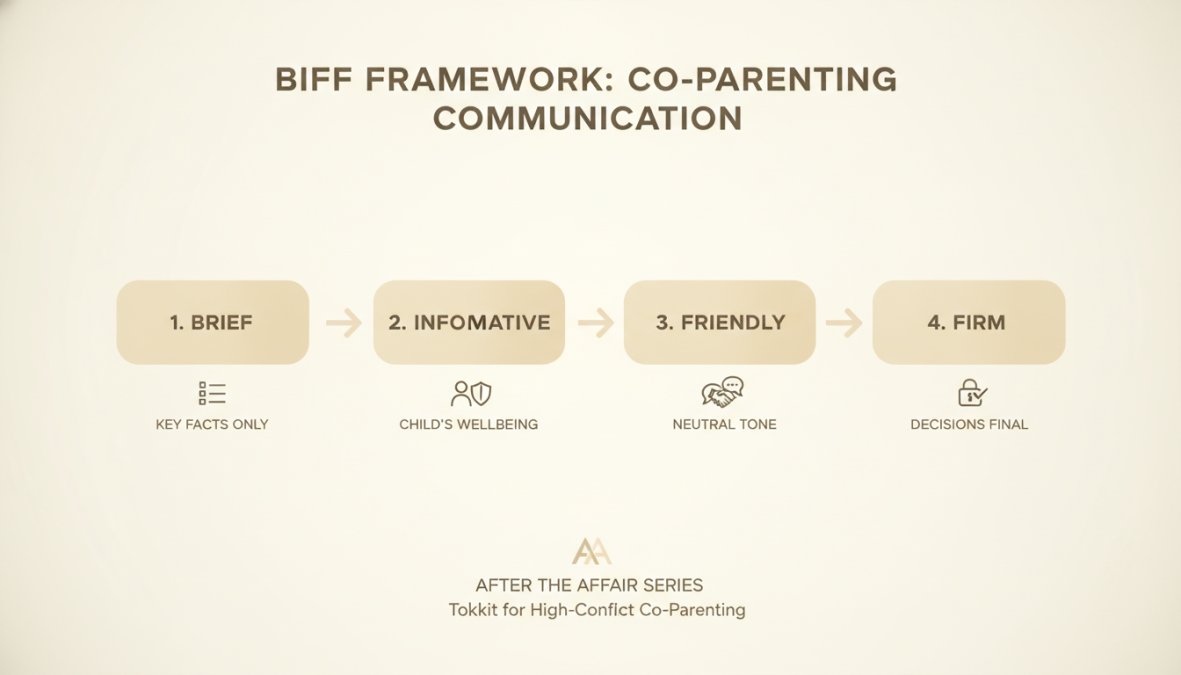
Brief means you don’t explain reasoning or provide unnecessary context. Informative means you include only information directly relevant to the child’s care, schedule, or wellbeing. Friendly means your tone is respectful and professional, never hostile or sarcastic. Firm means your statements are declarations, not requests.
A BIFF message: “Hi [Name], I’ve scheduled [child’s name]’s dental appointment for Tuesday at 2 PM with Dr. [dentist]. I’ll pick them up from school at 1:30 PM and have them back by 5 PM. Please confirm you received this message.”
10 BIFF Scripts for Common Co-Parenting Conflicts
Script 1: Responding to Request for Schedule Change
“I received your request to move next weekend’s custody exchange. The current schedule works for [child’s name] and me. If there’s a genuine emergency, let me know the specific situation and I’ll consider it.”
Script 2: Addressing Missed Payment
“The school tuition payment of $[amount] was due on the 15th. I’ve covered it this month. Going forward, your payment is due by the 10th of each month.”
Script 3: Responding to Criticism of Your Parenting
“I appreciate your perspective. I’m making decisions I believe are in [child’s name]’s best interest. I expect the same from you. Let’s focus on what [child’s name] needs.”
Script 4: Setting Boundary on Communication Frequency
“I can respond to messages about [child’s name]’s needs within 24 hours. Messages outside co-parenting topics won’t receive responses. For emergencies, call me directly.”
Script 5: Addressing Attempt to Involve Child in Conflict
“[Child’s name] told me you discussed our custody arrangement with them. That puts them in an uncomfortable position. Please keep adult matters between us.”
Script 6: Responding to Request for Extra Time
“I understand you’d like extra time this month. Our agreement is [specific schedule]. If you’d like to discuss a modification, we can address it through mediation.”
Script 7: Addressing Accusation About Child’s Wellbeing
“[Child’s name] is doing well. Their grades are [specific], they’re participating in [activity], and they’re healthy. If you have specific concerns, I’m happy to discuss them.”
Script 8: Responding to Financial Demand
“I’ve reviewed our agreement regarding [specific expense]. According to the terms, you’re responsible for [specific amount]. I expect payment by [date].”
Script 9: Setting Boundary on Personal Questions
“My personal life isn’t relevant to our co-parenting. What matters is that [child’s name] is safe, healthy, and thriving. Regarding [child-related topic], here’s what’s happening…”
Script 10: Responding to Threat or Intimidation
“I’m taking your message seriously and documenting it. Moving forward, I expect our communication to remain respectful. If you need to discuss [child’s name], I’m available during our scheduled contact times.”
Responding to Narcissistic Text Messages: Practical Scripts
Text-based communication is where most high-conflict co-parenting happens. It’s also where narcissists deploy sophisticated manipulation tactics because written messages create permanent records they can twist.
Handling Gaslighting and Manipulation Attempts
Script for Gaslighting Response:
“I remember our conversation differently. Regardless, [child’s name] needs to be at [location] at [time]. I’ll see you then.”
Script for Manipulation About Child’s Emotions:
“I understand [child’s name] is upset. I’m handling this in [child’s name]’s best interest. We can discuss [specific topic] when emotions are less high.”
Script for Accusation That You’re Alienating the Child:
“[Child’s name] and I have a healthy relationship. I support their relationship with you. If they’re expressing concerns, that reflects their own feelings, not anything I’ve said.”
Script for Attempt to Rewrite History:
“Our custody agreement states [specific term]. I have documentation of that. Let’s move forward based on what we actually agreed to.”
De-Escalation Scripts for Hostile Messages
Script for Insulting or Demeaning Message:
“I’m not going to engage with personal attacks. When you’re ready to discuss [child’s name], I’m available.”
Script for Threat or Intimidation:
“I’m documenting this message. I expect future communication to be respectful. If you need to discuss [child’s name], use appropriate language.”
Script for Accusation or Blame:
“I don’t agree with that characterization. My focus is on [child’s name]’s wellbeing. Let’s discuss what needs to happen this week.”
Script for Attempt to Provoke Argument About Past:
“I’m not rehashing past events. What matters now is [child’s name]. Can you confirm [specific co-parenting item]?”
Script for Emotional Manipulation:
“I understand this is difficult. My responsibility is to [child’s name]. I’m available to discuss their needs.”

Never respond to hostile messages immediately. Wait at least several hours, ideally until the next day. This prevents reactive language that the narcissist can use against you.
Co-Parenting Boundaries With a Narcissist: Scripts for Setting Limits
Narcissists test boundaries constantly because boundary-testing maintains control. Scripts for setting limits must be clear, non-negotiable, and consistently enforced.
Boundary-Setting Language That Works
Effective boundary-setting uses declarative statements (not questions), avoids apologetic language, and provides no room for negotiation.
Ineffective: “Would you be willing to pick up [child’s name] at 3 PM instead of 2 PM?”
Effective: “Pickup time is 3 PM. I’ll have [child’s name] ready.”
Ineffective: “I’m sorry you’re upset about the school choice.”
Effective: “I’ve made the school decision based on [child’s name]’s needs. The decision is final.”
Scripts for Refusing Unreasonable Requests
Script for Request to Change Core Schedule:
“Our custody schedule is set by our agreement. If you want to modify it, we’ll need to go through mediation. The current schedule stands.”
Script for Request for Unsupervised Time Beyond Agreement:
“The agreement specifies [custody terms]. I’m not comfortable changing that. If you’d like to discuss modifications, we can involve a mediator.”
Script for Request to Involve Child in Adult Matters:
“[Child’s name] won’t be involved in [adult topic]. That’s not appropriate. I need you to handle this directly with me.”
Script for Request to Reduce Child Support:
“Our child support agreement is [specific amount]. If you’re experiencing financial hardship, we can discuss it through our attorney or mediator.”
Script for Request to Violate Your Parenting Time:
“[Child’s name] is with me during my scheduled time. I’m not available for requests to change that. You’ll have them at the scheduled time.”
Script for Request for Personal Information or Access:
“I’m not sharing that information. It’s not relevant to [child’s name]’s care. If you have questions about [child’s name], I’m happy to answer them.”
Script for Request to Communicate Outside Agreed Channels:
“We’ve agreed to communicate about [child’s name] through [method]. I’m not available for [other method] conversations. Please use the agreed channel.”
Financial and Legal Milestone Scripts for Co-Parenting With a Narcissist
Financial and legal matters are where narcissistic co-parents escalate conflict most aggressively because money and legal authority represent power.
Scripts for Custody Schedule Changes
Script for Temporary Schedule Adjustment Request:
“I understand you need to adjust [specific date] due to [stated reason]. I can accommodate [specific alternative]. Please confirm by [date].”
Script for Permanent Schedule Modification Request:
“I received your request to change the custody schedule. Any permanent changes require mediation and potentially court approval. If you’d like to discuss modifications, let me know and I’ll contact our mediator.”
Script for Relocation Request:
“I understand you’re considering [relocation]. This significantly affects [child’s name]’s schedule and relationship with me. We’ll need to address this through legal channels. I’m not agreeing to any changes until we’ve consulted with our attorneys.”
Script for Emergency Schedule Change:
“I understand there’s an emergency with [specific situation]. I can adjust the schedule to [specific accommodation]. Once the emergency is resolved, we return to the standard schedule.”
Scripts for Discussing Child Support and Expenses
Script for Requesting Reimbursement for Shared Expense:
“[Child’s name] needed [specific item/service] costing $[amount]. According to our agreement, we split [specific expense category]. I’ve paid $[amount]. Please reimburse me by [date]. I’ll send you the receipt.”
Script for Addressing Late or Missed Payment:
“Your payment of $[amount] for [specific expense] was due on [date]. I haven’t received it. Please send payment by [date]. If this becomes a pattern, I’ll need to address it through our attorney.”
Script for Expense Beyond Agreed Sharing:
“I made the decision to [purchase/enroll in] [item/activity] for [child’s name]. This isn’t a shared expense under our agreement. I’m covering the full cost.”
Script for Dispute Over Shared Expense Amount:
“I received your objection to the $[amount] expense. I have documentation of the cost. We agreed to split [specific category]. If you dispute the amount, I can provide receipts. Otherwise, your share is $[amount], due by [date].”
Script for Child Support Modification Request:
“I received your request to modify child support. Our current agreement is [specific amount]. If your financial situation has changed significantly, we can discuss it through our attorney or mediator. Until then, the current amount remains due.”
Scripts for Court-Ordered Communication
Script for Court-Ordered Communication Reminder:
“I want to confirm that our communication is court-ordered to focus on [child’s name]’s wellbeing. I’m committed to keeping our exchanges professional and child-focused. I expect the same from you.”
Script for Violation of Court Order:
“Your message discusses [topic outside court order]. Our communication is court-ordered to address [specific topics only]. Please keep future messages within that scope.”
Script for Response to Court-Ordered Mediator:
“I’m committed to following the court’s direction regarding [specific issue]. I’m available for [mediation/communication] as scheduled. I expect [co-parent’s name] to participate fully and in good faith.”
Documentation and Digital Safety: Protecting Your Records
Documentation is your legal protection and evidence if conflict escalates to court. Digital safety ensures the narcissist can’t access, manipulate, or steal your records.
Best Practices for Written Communication
Written communication creates unalterable records. Every text message, email, and app message can be printed and presented as evidence.
Use email for important matters. Emails create timestamped records superior to text messages. For anything significant, custody changes, financial agreements, documentation of incidents, use email.
Keep copies of everything. Screenshot text messages and app messages immediately. Save emails. Create a folder (digital and physical) with all co-parenting communication. Date everything.
Use co-parenting apps when possible. Apps like TalkingParents and AppClose create permanent, searchable records that can’t be altered. Messages are timestamped and stored indefinitely.
Write as if a judge will read it. Every message should be professional, factual, and free of emotional language. Avoid sarcasm, insults, or anything that could be misinterpreted.
Keep messages brief and focused. Long messages give the narcissist more material to twist. Short, focused messages about specific topics are harder to misrepresent.
Document incidents in real time. If something happens that might be relevant later, the narcissist saying something inappropriate to the child, missing a custody exchange, making threats, document it immediately with date, time, what happened, and any witnesses.
Using Co-Parenting Apps for Legal Protection
Co-parenting apps create court-admissible records. TalkingParents offers unalterable message records, call recording, and expense tracking. Messages are timestamped and stored indefinitely. AppClose provides similar features: documented messaging, shared calendars, expense tracking, and the ability to add third-party caregivers. BestInterest uses AI to filter out hostility and tone-check messages before they’re sent.
| Co-Parenting App | Best For | Key Feature | Legal Documentation |
|---|---|---|---|
| TalkingParents | Comprehensive legal protection | Unalterable message records, call recording | Court-admissible, timestamped |
| AppClose | All-in-one coordination | Integrated messaging, calendar, expenses | Searchable archive, certified records |
| BestInterest | De-escalation and tone management | AI message filtering before sending | Records created, Solo Mode available |
| WeParent | General family coordination | Shared calendar, certified record-keeping | Certified for court documentation |
Using a co-parenting app creates a legal record, removes the temptation to communicate through personal text messages, and signals to the narcissist that you’re taking documentation seriously.
Co-parenting with a narcissist requires tools and language designed specifically for the dynamics at play. The scripts in this guide, from Grey Rock responses to BIFF communication to boundary-setting language, address the real challenges you face. These aren’t theoretical approaches; they’re tested language patterns that work because they remove the emotional material narcissists exploit.