TL;DR:
- Preparing for custody court with a narcissist requires gathering objective, well-organized evidence that proves your case with facts, not emotional appeals. Using court-approved communication apps and maintaining a calm, child-focused testimony enhances credibility and reduces manipulation opportunities. A detailed parenting plan and consistent documentation strengthen your position, helping protect your child’s welfare amidst high-conflict situations.
- How to prepare for custody court with a narcissist: build your evidence file first
- What communication strategy works against a narcissistic co-parent?
- How should you present your case in court?
- Why a detailed parenting plan reduces manipulation
- Key takeaways
- What i’ve learned watching parents walk into court unprepared
- FAQ
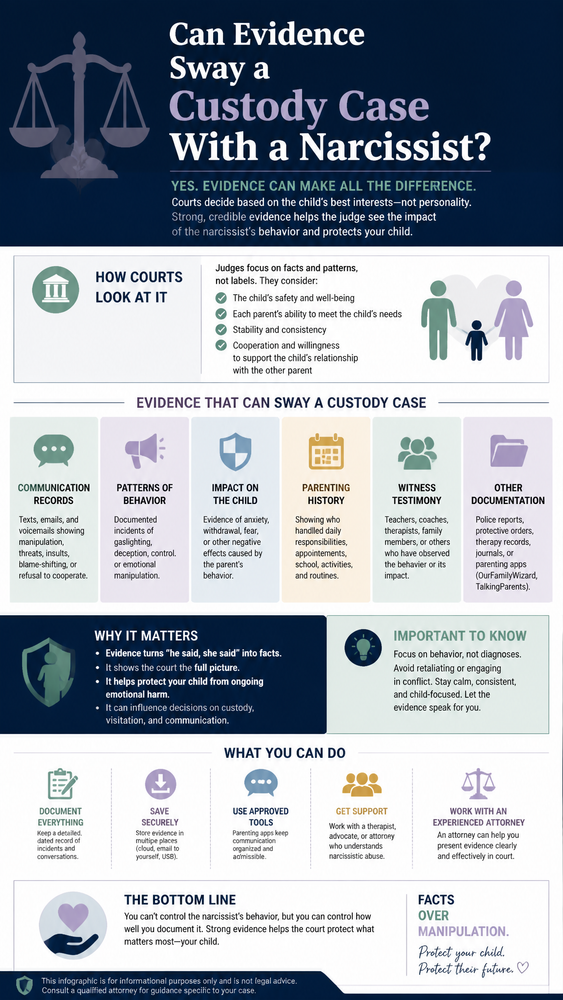
Preparing for custody court with a narcissist is defined by one core principle: objective evidence wins over emotional appeals. High-conflict custody cases involving narcissistic personality disorder, formally classified in the DSM-5, demand a specific legal strategy built on documentation, controlled communication, and child-focused testimony. Judges do not respond to labels. They respond to facts. This guide gives you the exact preparation framework used by family law attorneys and custody evaluators, so you walk into court with credibility, composure, and a case that speaks for itself.
How to prepare for custody court with a narcissist: build your evidence file first
The foundation of any successful custody case against a manipulative ex is a well-organized, objective evidence file. Written documentation creates a credible, timestamped record that courts value far more than emotional narratives. Start building this file the moment you know litigation is coming.
Your evidence file should contain five distinct categories:
- Incident log: Date, time, location, and a factual description of each concerning event. Write what happened, not how it made you feel.
- Communication records: Every text, email, and app message between you and your co-parent.
- School and medical records: Attendance records, teacher communications, and healthcare visits that reflect the child’s routine and welfare.
- Prior court orders: Any existing custody agreements, restraining orders, or court-issued directives.
- Financial records: Child support payments, missed contributions, or disputed expenses.
Pro Tip: Write incident log entries as if a stranger will read them. Use third-person, factual language. “Child was returned at 7:42 PM, 42 minutes late, without dinner” is far stronger than “He was late again and didn’t feed her.”
Separating these records into labeled binders or digital folders lets evaluators and attorneys review your concerns without sifting through disorganized stacks of paper. Custody evaluators prefer a concise structure: a concerns summary, a timeline, collateral contacts, and your proposed solutions. That format matches how evaluators actually work, and it makes your case easier to understand and harder to dismiss.
| Document Type | What to Include |
|---|---|
| Incident Log | Date, time, location, objective description of event |
| Communication Records | Screenshots, app exports, email threads with timestamps |
| School Records | Attendance, teacher notes, IEP or 504 documents |
| Medical Records | Visit summaries, prescription records, missed appointments |
| Court Orders | Prior custody agreements, modification requests, violations |
What communication strategy works against a narcissistic co-parent?
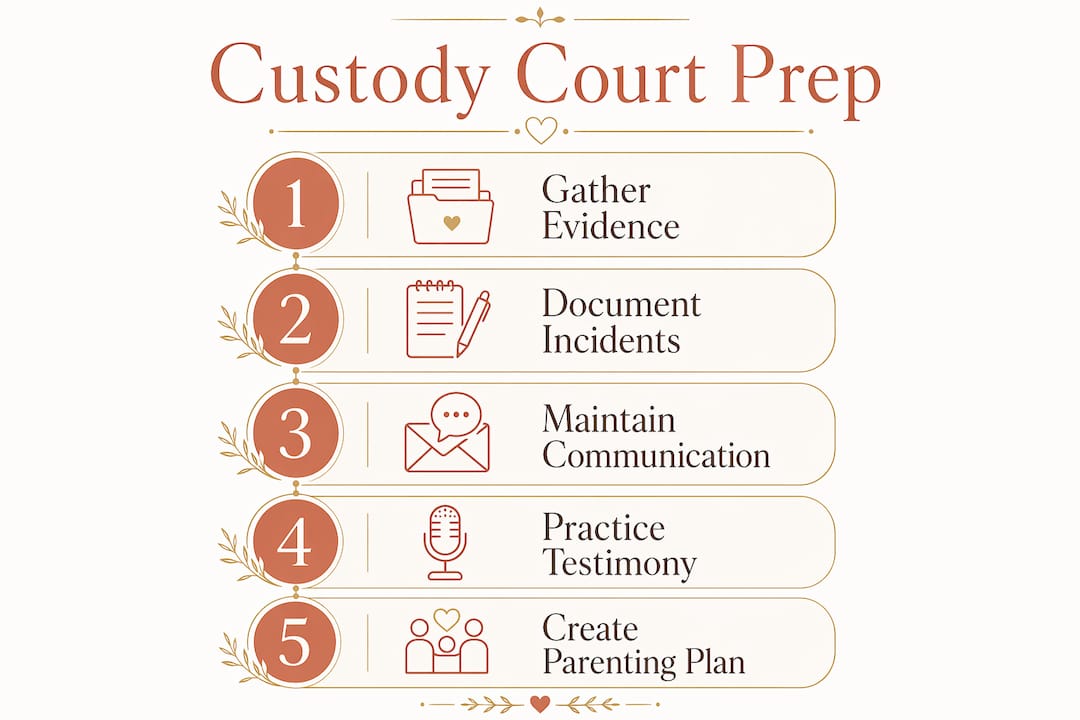
Switching to written-only communication is the single most effective step you can take before court. Apps like OurFamilyWizard provide timestamps and protect against manipulation by capturing written exchanges that courts accept as evidence. TalkingParents is another court-approved option that archives every message permanently and cannot be edited after sending.
The B.I.F.F. method, developed by family law attorney and mediator Bill Eddy, gives you a reliable template for every message you send:
- Brief: Keep messages to three sentences or fewer when possible.
- Informative: State only the facts relevant to the child.
- Friendly: Use a neutral, civil tone. No sarcasm.
- Firm: Do not invite debate or open-ended negotiation.
Avoid responding to bait. When a narcissistic co-parent sends a provocative message, the goal is to trigger a reaction that looks bad in court. Neutral messaging limits room for manipulation and escalation. If a message does not require a response related to the child’s welfare, you do not have to respond at all.
Document every refusal or non-cooperation. If your co-parent ignores a school pickup request or refuses to share medical information, note it in your incident log with the date and the exact message sent.
Pro Tip: After any phone or in-person conversation, send a brief follow-up message through your app: “Just to confirm our conversation today, pickup is Saturday at 10 AM at the school.” This creates a written record of verbal agreements and prevents later denial.
Calm, consistent communication is interpreted by courts as a sign of parental stability. Reactive, emotional responses suggest instability. Every message you send is potential evidence. Write accordingly.
How should you present your case in court?
Judges prioritize the child’s stability, routine, and concrete welfare above all else. Staying composed and presenting evidence tied to child impact enhances your credibility far more than any character attack on your co-parent.
Follow these steps when presenting testimony:
- Focus on behaviors, not diagnoses. Never call your co-parent a narcissist in court. Describe specific behaviors and their direct effect on your child. “On March 3rd, the child was returned without having eaten dinner and reported feeling scared” is more powerful than any personality label.
- Answer only what is asked. Volunteering extra information under cross-examination gives the opposing attorney material to work with. Answer the question. Stop. Wait for the next one.
- Prepare for baiting. Your co-parent’s attorney may try to provoke an emotional reaction. Avoid reacting visibly to insults or misrepresentations. Take a breath. Respond with facts.
- Tie every incident to child impact. The strongest preparation connects each behavioral incident to a specific outcome for the child. “The missed medical appointment resulted in a delayed diagnosis” lands harder than “He never follows through.”
- Bring organized documentation. Provide your attorney with a summarized concerns list, a chronological timeline, and collateral contacts such as teachers or pediatricians who can corroborate your account.
“Evaluators interpret repeated calm compliance and organized evidence as a proxy for parental stability and reliability.” — Family Court Research
Pro Tip: Practice your testimony out loud with your attorney before the hearing. Hearing your own words spoken aloud reveals where you sound emotional versus factual, and gives you time to adjust.
The most common courtroom mistake is over-explaining. Judges hear dozens of cases. Concise, organized, child-focused testimony is far more persuasive than a detailed account of every grievance you have accumulated over years.
Why a detailed parenting plan reduces manipulation
A vague parenting plan is an invitation for conflict. Detailed parenting plans with exact schedules reduce opportunities for a narcissistic co-parent to exploit ambiguity, create disputes, or claim misunderstandings.
Your plan should specify:
- Exact pickup and drop-off times and locations. “Saturday at 10:00 AM at the school parking lot” leaves no room for interpretation.
- Holiday and school break schedules. Alternate holidays by year and list specific start and end times.
- Decision-making protocols. Define who makes decisions about education, healthcare, and extracurricular activities, and how disagreements are resolved.
- Right of first refusal. This clause requires each parent to offer the other parent childcare before using a third party. It limits the narcissistic parent’s ability to use babysitters or new partners as a workaround.
- Communication method and response time. Specify that all co-parenting communication happens through OurFamilyWizard or TalkingParents within 24 hours.
| Vague Plan Language | Specific Plan Language |
|---|---|
| “Reasonable visitation” | “Every Saturday 10:00 AM to Sunday 6:00 PM” |
| “Parents will share holidays” | “Mother has Thanksgiving in odd years; Father in even years” |
| “Parents will communicate” | “All communication via OurFamilyWizard within 24 hours” |
| “Parent may arrange childcare” | “Right of first refusal applies for any absence over 4 hours” |
Filing for temporary orders early also sets clear boundaries during the legal process. Temporary orders clarify expectations and limit the narcissistic co-parent’s ability to unilaterally change routines while the case is pending. Ask your attorney about this option at your first meeting.
Key takeaways
Winning custody against a narcissist requires objective documentation, written communication, and child-focused testimony delivered with consistent composure.
| Point | Details |
|---|---|
| Build an evidence file first | Organize incident logs, communication records, and school and medical documents into labeled categories. |
| Use court-approved apps | OurFamilyWizard and TalkingParents create unalterable, timestamped records courts accept as evidence. |
| Focus testimony on child impact | Describe behaviors and their effects on the child, never diagnose or label the co-parent in court. |
| Demand specificity in the parenting plan | Exact times, locations, and protocols remove ambiguity that a narcissistic co-parent can exploit. |
| Stay composed under pressure | Courts read calm, consistent behavior as parental stability. Reactive responses undermine your credibility. |

What i’ve learned watching parents walk into court unprepared
The parents who struggle most in these cases are not the ones with the weakest evidence. They are the ones who walk in expecting the judge to see what they see. They believe that if they can just explain how manipulative their co-parent is, the court will understand. That is not how family court works.
Judges see high-conflict cases every week. What stands out is not the parent who describes the most grievances. It is the parent who arrives with a binder, speaks calmly, and ties every concern directly to the child’s welfare. I have seen parents with genuinely strong cases lose credibility in minutes by becoming visibly angry on the stand.
The emotional weight of dealing with a narcissistic co-parent is real. Seeking support from a trauma-informed therapist, such as those using the approaches outlined at Alvarado Therapy, can help you process the stress outside the courtroom so it does not spill into your testimony. Parallel parenting strategies, which minimize direct contact and rely on structured protocols, also reduce the daily friction that erodes your composure over time. Aftertheaffair has a detailed resource on parallel parenting with a narcissist that many readers have found grounding during this process.
The child’s welfare is the only north star that matters in that courtroom. Keep returning to it. Every document you organize, every neutral message you send, and every calm answer you give is an act of advocacy for your child.
— S.J.Howe
Support for the road ahead
Custody court is one chapter of a longer recovery. The emotional toll of co-parenting with a narcissistic ex does not end when the hearing does.
Aftertheaffair offers structured, evidence-informed resources for people navigating betrayal, family breakdown, and the complex aftermath of high-conflict relationships. Whether you are working through the trauma of a difficult separation or rebuilding your sense of self after years of manipulation, the infidelity recovery checklist provides a practical, step-by-step framework for healing that complements the legal work you are doing now. You can also explore guidance on choosing co-parenting communication tools to set up the right systems before your next court date.
FAQ
Should i call my co-parent a narcissist in court?
No. Judges focus on documented behaviors and their impact on the child, not personality diagnoses. Describe specific incidents and outcomes instead.
What app is best for communicating with a narcissistic co-parent?
OurFamilyWizard and TalkingParents are both court-approved options that create permanent, timestamped records courts accept as evidence.
How do i stay calm when my co-parent lies in court?
Prepare factual responses in advance with your attorney, and answer only what is asked. Avoiding visible reactions to baiting protects your credibility and prevents giving leverage to the opposing side.
What does a judge look for in a custody case?
Judges prioritize the child’s stability, routine, and welfare. Organized, child-focused evidence and calm, consistent behavior signal parental reliability to the court.
Should i request temporary orders before the final hearing?
Yes. Filing for temporary orders early sets clear boundaries and limits the narcissistic co-parent’s ability to change routines unilaterally while the case is pending.
Recommended
- Parallel Parenting With a Narcissist – After the Affair Series
- How to Emotionally Prepare Kids for Parenting Changes After Infidelity – After the Affair Series
- Gray Rock: Co-Parenting With a Narcissist or Toxic Ex-PR3 – After the Affair Series
- Co-Parenting Transition – After the Affair Series