Sex after an affair is one of the most searched, and least talked about, topics in affair recovery. If you’re here, you’re probably caught between wanting closeness and feeling like your body has forgotten how to trust. That tension is real, and it makes complete sense. Physical intimacy after betrayal isn’t just about sex; it carries grief, confusion, and the ever-present fear of being hurt again. This guide walks through why it feels so hard, what actually helps, and when to bring in professional support.
- Why Sex After an Affair Feels So Different
- The Timeline Nobody Tells You About
- Communication Strategies Before Getting Physical
- Gradual Reconnection: From Affection to Desire After an Affair
- When Flashbacks, Triggers, and Intrusive Thoughts Interrupt
- When to Seek Professional Support for Intimacy After Infidelity
If you’re still in the very early days, it may help to start with surviving the immediate aftermath of discovery before returning here.
Why Sex After an Affair Feels So Different
The emotional weight behind physical touch
Before an affair, sex was probably just sex, pleasure, connection, habit. After discovery, every touch carries a new charge. The same hands that held you can now trigger a flood of unwanted images. A kiss can feel like a test you’re not ready to take.
This isn’t weakness. It’s a completely normal response to a significant emotional injury. Betrayed partners often describe feeling like a stranger in their own relationship, as if the person in front of them is simultaneously the partner they love and the one who caused serious harm. Both things are true, and the body holds that contradiction.
Even the unfaithful partner can feel the shift. Guilt, shame, and the pressure to “make things right” can make initiating touch feel impossible too.
How betrayal rewires the body’s sense of safety
Research in trauma-informed couples therapy consistently shows that betrayed partners often experience symptoms closely resembling PTSD, including intrusive images during physical intimacy. The body doesn’t distinguish well between remembered danger and present reality. A scent, a position, a sound can pull the nervous system straight back to the moment of discovery.
Desire after an affair isn’t simply an emotional decision. The body has learned, at a deep level, that intimacy involves risk. Rebuilding that sense of safety is slow, non-linear work, and it has to happen before genuine desire can return.
Is it normal to feel no desire at all after discovering an affair? Completely. Many people feel nothing, or feel repulsion, for weeks or months. That’s not a sign the relationship is over. It’s a sign your nervous system is protecting you.
The Timeline Nobody Tells You About
There is no ‘right’ moment to try again
Some couples attempt physical reconnection within weeks of discovery. Others take a year or more. Both paths can lead to recovery. The idea that there’s a standard timeline for sex after an affair is a myth that causes real harm, because it makes people feel abnormal when they don’t match it.
What matters more than timing is readiness. Readiness is built from emotional intimacy, not from willpower or calendar dates. If the emotional ground isn’t stable, returning to sex tends to reopen wounds rather than heal them. Think of rebuilding trust after infidelity as the foundation, the physical layer comes later, once that base is firmer.
Pressure, from within and from a partner, can derail progress
A common pattern in couples counselling: one partner wants to resume sex quickly, often because it feels like proof the relationship is salvageable. The other feels pressured and shuts down further. That cycle, pursuit and withdrawal, can entrench avoidance over time if no one names it openly.
Internal pressure is just as damaging. Telling yourself “I should want this by now” is a fast way to create shame around something that needs patience. Desire after an affair follows its own schedule, and forcing it rarely ends well.
Communication Strategies Before Getting Physical
Having the conversation about fears and boundaries
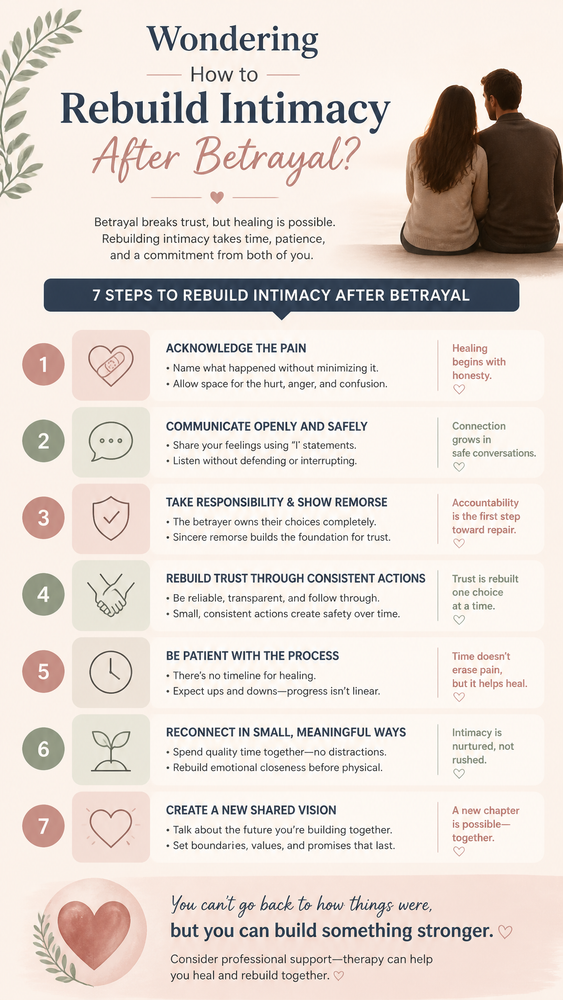
Before any physical reconnection, couples need explicit conversations, not assumptions. That means naming fears out loud: I’m scared I’ll picture her when we’re together. I’m worried you’re only doing this to keep me. I need to know I can stop at any point.
These conversations feel awkward. They’re meant to be had anyway. Some useful principles:
- Use “I” statements rather than “you” accusations. “I feel unsafe when…” lands differently than “You make me feel…”
- Name your fears specifically, not vaguely. Specific fears can be responded to; vague dread can’t.
- Agree on clear signals for pausing or stopping, and honour them immediately.
- Don’t make the conversation itself a performance of readiness. It’s okay to say “I’m not there yet” during the talk.
Physical affection after betrayal becomes safer when both partners know the rules of engagement. Not because rules kill spontaneity, but because they create a container that feels secure enough to try.
Using ‘check-in’ rituals to rebuild sexual trust after cheating
A structured daily check-in, five to ten minutes of uninterrupted conversation about how each person is feeling, does quiet but significant work over time. It builds the habit of honesty. It creates a rhythm that says: we talk about hard things here.
Some couples add a specific question before any physical intimacy: “How are you feeling right now? Is there anything I should know?” It sounds simple. In practice, it can be the difference between a moment of connection and a moment that triggers shutdown. Sexual trust after cheating is rebuilt in small, repeated acts of transparency, not in grand gestures.
Gradual Reconnection: From Affection to Desire After an Affair
Non-sexual touch as a bridge
A graduated approach is one of the most effective tools couples have for bedroom intimacy recovery. It means resisting the urge to jump to sex and instead rebuilding the entire physical vocabulary of the relationship from the ground up.
A rough progression looks like this:
- Non-sexual touch, hand-holding, a hand on the shoulder, sitting close. No expectation beyond presence.
- Affectionate touch, hugging, a kiss on the forehead, cuddling with clothes on. Still no sexual expectation.
- Sensual touch, massage, extended physical closeness, touching that is warm and intentional but not necessarily sexual.
- Sexual intimacy, when both partners feel genuinely ready, not just willing to try.
Skipping steps tends to backfire. The nervous system needs each stage to register as safe before it can relax into the next.

Rebuilding bedroom intimacy recovery at your own pace
Desire after an affair fluctuates. There will be good days, moments of genuine warmth and connection that feel like recovery is real. There will be hard days, where a flashback or a stray thought pulls you back to the worst moment. Both are normal.
The goal at this stage isn’t consistent desire. It’s consistent safety. When safety becomes reliable, desire tends to follow, sometimes slowly, sometimes in bursts. Couples who stay curious about each other through this process, rather than goal-focused, often find the reconnection more sustainable.
Can sexual intimacy actually become better after an affair? Research on couples who stay together after infidelity suggests a meaningful proportion go on to describe their relationship, including their sexual relationship, as deeper and more intentional than before. This outcome is real, not a myth. It typically requires sustained therapeutic work over many months, and it doesn’t happen by accident. But it does happen.
When Flashbacks, Triggers, and Intrusive Thoughts Interrupt
Many betrayed partners experience what clinicians describe as PTSD-like symptoms: intrusive images that arrive uninvited during sex, body-memory responses that hijack a moment of connection, or a sudden emotional crash with no obvious trigger. This is one of the most distressing and under-discussed parts of sex after an affair.
When it happens, the worst response is to push through. That trains the nervous system to associate sex with threat, which makes the next attempt harder.
Three grounding strategies that can help in the moment:
- Pause and name it. Simply saying “I’m having a moment, I need to pause” stops the spiral. You don’t have to explain everything; just stop the physical momentum.
- Anchor to the present. Press your feet flat on the floor. Notice five things you can see. Feel the weight of your body in the room. These sensorimotor anchors interrupt the trauma loop.
- Reconnect verbally before physically. After a flashback, a few minutes of calm talking, not about the affair, just ordinary connection, can help the nervous system reset before deciding whether to continue.
If these episodes are frequent or severe, that’s a clear signal for professional support. Some people find it helpful to be aware that deciding whether to stay or leave is also tied up in these moments, when the body keeps saying no, it’s worth sitting with what that means.
When to Seek Professional Support for Intimacy After Infidelity
Stuck patterns, where one partner always pursues and the other always withdraws, or where every attempt at physical connection ends in shutdown, don’t tend to resolve on their own. Neither does persistent avoidance that stretches across months with no movement.
These are signs to bring in a professional, not signs of failure.
Couples therapy approaches like EFT and Gottman are both evidence-based frameworks with strong track records in intimacy after infidelity. Emotionally Focused Therapy (EFT) works specifically with attachment and the emotional cycles that drive pursue-withdraw patterns. The Gottman Method provides structured tools for communication and rebuilding friendship alongside desire. Neither is a quick fix, but both give couples a structured path when self-guided recovery stalls.
Esther Perel, whose book The State of Affairs (2017) has become a reference point in affair recovery, argues that infidelity shatters the story a couple tells about themselves, and that rebuilding physical intimacy requires first rebuilding narrative safety, not just emotional goodwill. That framing is useful: intimacy after infidelity is partly about rewriting the shared story into one where closeness is possible again.
If you’re in the UK and ready to take that step, affair recovery counselling in the UK can connect you with therapists who specialise in this exact territory.
Sex after an affair is hard. It’s also navigable, with honesty, patience, and often some outside support. AfterTheAffair.uk exists to offer that support at every stage, from the first raw days to the slow, careful work of rebuilding closeness. Explore the broader affair recovery hub to find resources matched to where you are right now.