Discovering infidelity is one of the most destabilising experiences a person can face in a relationship. The question that follows, can we survive this?, rarely has a simple answer. But knowing the signs your marriage can survive infidelity helps cut through the fog of shock and grief, and gives you something concrete to assess rather than just feel. A meaningful proportion of couples who experience infidelity choose to stay together, and a significant subset of those report relationship satisfaction comparable to, or even exceeding, pre-affair levels when structured support is in place. This article sets out the evidence-based indicators that distinguish marriages that recover from those that don’t. If you’re still in acute shock, start with managing the immediate aftermath of discovery before working through these signs.
- Why Some Marriages Recover After Infidelity, and Others Don't
- Sign 1: The Unfaithful Partner Takes Full Accountability
- Sign 2: Both Partners Are Willing to Do the Work
- Sign 3: Open, Honest Communication Has Been Re-established
- Sign 4: The Affair Is Truly Over and Boundaries Are in Place
- Sign 5: There Is Still an Underlying Foundation Worth Rebuilding
- What to Do If You Recognise These Signs in Your Marriage
Why Some Marriages Recover After Infidelity, and Others Don’t
Recovery is possible, but it is not automatic. What separates couples who rebuild from those who separate is not the severity of the betrayal alone, it is whether specific conditions are present in the aftermath. Those conditions are identifiable, and many of them are things both partners can actively choose. The sections below walk through the clearest ones.
Sign 1: The Unfaithful Partner Takes Full Accountability
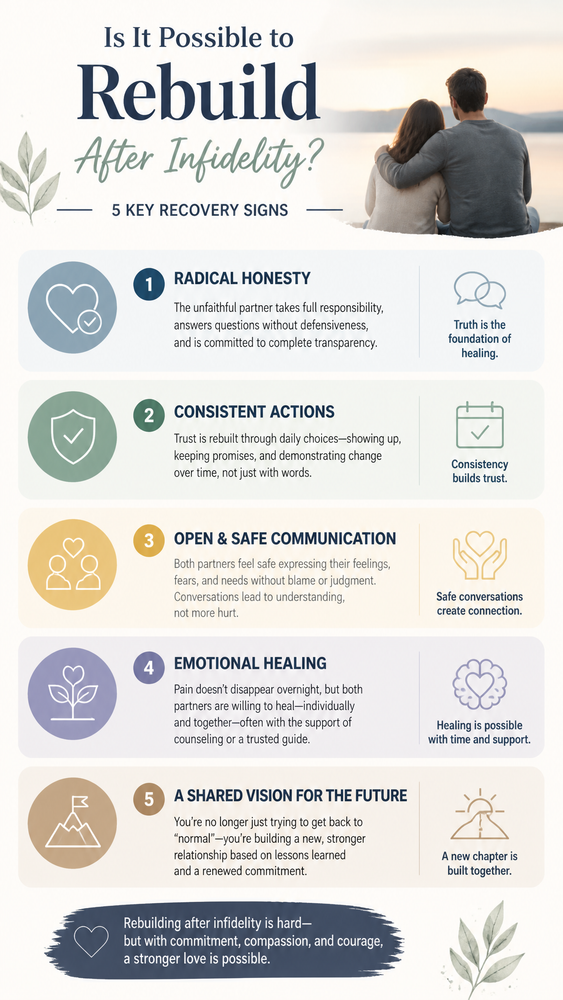
Of all the factors that predict successful reconciliation, accountability from the person who had the affair is the most consistently cited. Without it, recovery stalls before it begins.
What genuine accountability looks like
Genuine accountability means the unfaithful partner owns the decision to betray, fully, without minimising or deflecting. It sounds like: “I chose to do this. It was wrong. You are not responsible for that choice.” It is sustained across weeks and months, not delivered once and then withdrawn when the hurt partner keeps asking questions. Crucially, it means tolerating the hurt partner’s pain, anger, grief, repeated questions, without becoming defensive or shutting the conversation down.
The difference between remorse and regret
Regret is about consequences: “I’m sorry I got caught” or “I’m sorry this happened.” Remorse is about impact: “I understand what I did to you, and I take responsibility for it.” The distinction matters enormously in recovery after infidelity. Remorse drives behaviour change; regret tends to produce surface-level apologies that erode trust further when the pattern repeats. If the unfaithful partner expresses genuine remorse and backs it up with consistent action, that is a strong positive signal.
Sign 2: Both Partners Are Willing to Do the Work
Surviving infidelity in a marriage is not a one-person project. If only the hurt partner is carrying the effort, reading every book, attending therapy alone, tracking every trigger, the imbalance itself becomes another wound. Mutual willingness to engage is a reliable indicator of recovery potential.
Willingness to enter couples therapy
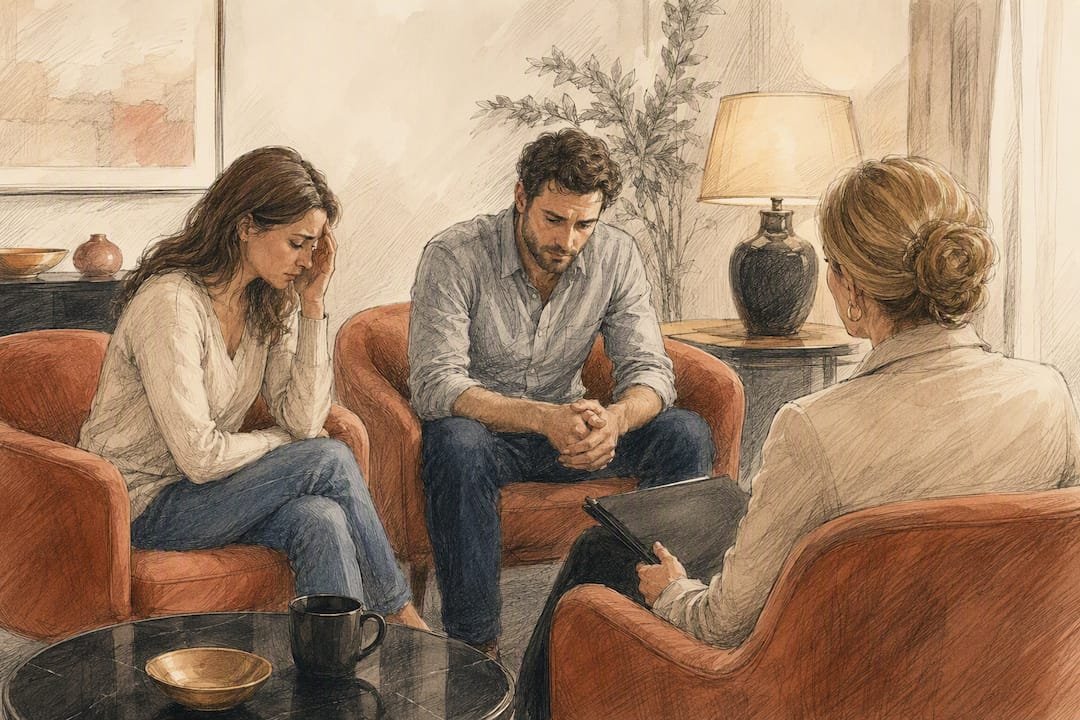
Evidence-based couples therapy after infidelity is one of the most reliable tools available for affair recovery. Emotionally Focused Therapy (EFT), developed by Sue Johnson, works by rebuilding attachment security between partners, helping them move from a cycle of anger and withdrawal to one of genuine emotional responsiveness. EFT outcome studies show significant gains in attachment security after a full course of treatment. The Gottman Method, drawing on John Gottman’s decades of couples research, provides structured frameworks for processing betrayal, rebuilding trust, and repairing emotional connection. Both approaches are available through qualified UK therapists. If both partners are willing to enter this process, that willingness itself is meaningful.
Commitment to the process, not just the outcome
Many couples enter therapy hoping it will quickly confirm that everything will be fine. Real recovery is slower and less linear than that. The positive sign is not that both partners feel hopeful, it’s that both partners are willing to show up even when it is hard. Gottman’s research identifies “turning toward” bids for emotional connection, choosing to engage rather than withdraw, as a core predictor of relationship survival, including after betrayal. That orientation, practised consistently, is what drives actual rebuilding.

Sign 3: Open, Honest Communication Has Been Re-established
Infidelity is almost always preceded by a period of emotional distance or avoidance, conversations that didn’t happen, needs that went unspoken. Recovery requires replacing that pattern with something fundamentally different.
The hurt partner’s need for answers is legitimate and should be treated as such. Questions like “Where were you?”, “How long did it go on?”, and “Did you love them?” are not attacks, they are the hurt partner’s attempt to reconstruct reality after it was shattered. A marriage that can survive infidelity is one where those questions can be asked and answered honestly, even when the answers are painful.
The key behavioural indicator is whether difficult conversations can happen without stonewalling, where one partner shuts down, goes silent, or leaves the room. Stonewalling signals emotional flooding, and while it is understandable, chronic stonewalling blocks the transparency that recovery depends on. Couples who can return to hard conversations, even after taking breaks to regulate, demonstrate the resilience that successful reconciliation requires.
Sign 4: The Affair Is Truly Over and Boundaries Are in Place
This is non-negotiable. Recovery cannot begin while the affair is ongoing or while contact with the affair partner continues. If the unfaithful partner has ended the affair completely, has no contact with the affair partner, and is willing to maintain that position, including being transparent about it, that is a prerequisite for any of the other signs to matter.
In the early stages of recovery, transparency tools like location-sharing and open access to devices are often proposed. These should be understood as time-limited trust-rebuilding measures, not permanent surveillance or punishment. The positive sign is not that such measures are demanded, but that the unfaithful partner offers or accepts them voluntarily, because they understand why the hurt partner needs that reassurance right now. That voluntary transparency signals genuine commitment to rebuilding rather than just avoiding further conflict.
Agreed-upon boundaries going forward, about friendships with people of the opposite sex, about travel, about communication habits, also indicate that both partners are taking the vulnerability of the relationship seriously.
Sign 5: There Is Still an Underlying Foundation Worth Rebuilding
Recovery is significantly more likely when a couple can point to something real that existed before the affair, not an idealised version of their marriage, but genuine strengths that were actually present. Psychotherapist Esther Perel, in The State of Affairs: Rethinking Infidelity, argues that an affair can sometimes act as a wake-up call that prompts couples to build a more intentional and honest relationship than the one that preceded it, but only when both partners choose to engage with that possibility.
Shared history and values
Couples who share children, deep common values, long history, or a sense of partnership that extended well beyond the romantic, shared projects, community, family, have raw material to work with. This isn’t about using children as a reason to stay in an unhealthy relationship. It is about recognising that a shared life, built over years, represents a real foundation, not just inertia.
Emotional connection that predates the betrayal
If both partners can recall periods of genuine closeness, safety, and happiness in the marriage, not just in early infatuation, but at points across its history, that memory is meaningful. It means the connection was real, and that it can potentially be rebuilt. When one or both partners struggle to identify any period of genuine happiness or closeness, that is an important signal in the other direction, and one worth exploring honestly, perhaps with the support of a framework for deciding whether to leave after an affair.
What to Do If You Recognise These Signs in Your Marriage
Recognising these signs is the beginning, not the end. Hope matters, but consistent action is what actually drives rebuilding trust after infidelity. Recovery after infidelity typically unfolds over one to two years when couples engage seriously with structured support. There is no shortcut, but there is a path.
Three concrete next steps:
1. Seek professional support. A therapist trained in EFT or the Gottman Method gives you tools that self-help resources alone cannot replicate. Both modalities are available through qualified practitioners across the UK.
2. Use a structured self-assessment. Couples who map both their relationship strengths and the specific conditions of the betrayal report greater clarity about whether to stay or leave, which itself reduces the paralysis that often follows discovery. A free relationship assessment can give you a clearer picture of where you stand.
3. Start with the practical roadmap. If you are still in the early stages and feel overwhelmed, your first steps after a partner’s affair breaks down what to focus on and in what order.
The signs your marriage can survive infidelity are not guarantees, they are indicators. What they tell you is that the conditions for recovery are present. What happens next depends on what both of you choose to do with that.