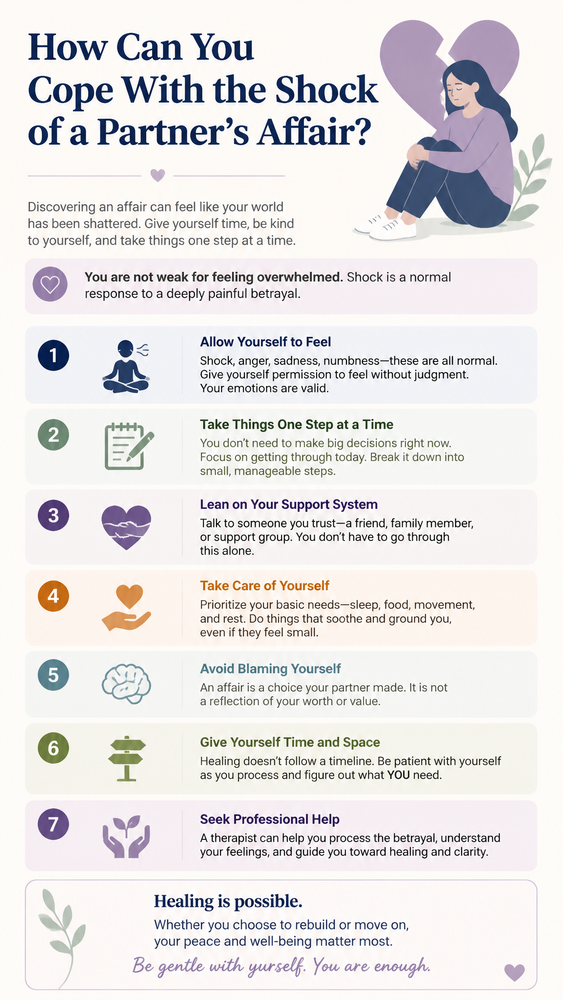
If your partner had an affair, what now? That question might be the only thought you can hold right now, and the fact that you’re reading this means you’re in one of the most disorienting moments a person can experience. What you’re feeling is not an overreaction. It is not weakness. Discovery is a genuine psychological rupture, and the hours and days ahead do not require you to have answers, they require you to survive them safely. Remember, when your Partner Had Affair, it changes everything.
- The First Hours: Surviving the Initial Shock of Finding Out About Infidelity
- Managing the First Days After Discovering an Affair
- First Steps After Infidelity: What You Actually Need to Know
- Emotional Regulation Techniques When Everything Feels Out of Control
- Should You Stay or Go? Why You Don't Have to Decide Yet
- When to Seek Professional Support After Infidelity
Understanding the impact of when your Partner Had Affair can help guide your next steps. This guide gives you a clear, step-by-step action plan for the immediate period after finding out about infidelity. It won’t rush you toward any decision. It will help you get through tonight, and then tomorrow.
The First Hours: Surviving the Initial Shock of Finding Out About Infidelity
Why Your Body and Mind React So Extremely
Betrayal trauma sits at the intersection of relationship crisis and post-traumatic stress. Infidelity specialists describe discovery as a psychological rupture, the world you thought you were living in no longer exists, which is why the shock can feel physical as well as emotional.
Your body responds to this as a threat. Heart racing, nausea, shaking, an inability to think straight, these are acute stress responses, not signs you’re falling apart. Many people alternate between cold numbness and explosive rage within the same hour. That emotional oscillation is not instability; it’s the psyche’s way of processing something too large to absorb all at once.
You may find yourself replaying details on a loop, unable to eat, unable to sit still. This is normal. It is a crisis state, and it will not feel this extreme forever.
The One Thing You Should Not Do Right Now
Do not make irreversible decisions in the first 24–48 hours.
That means: do not pack your bags and leave permanently, do not post publicly about what happened, and do not contact the affair partner. Partners who act on those impulses within the first week, for entirely understandable reasons, consistently report regretting the speed of those decisions later, regardless of how the relationship eventually turns out.
This is not about protecting your partner. It is about protecting yourself. Decisions made in a crisis state rarely reflect what you actually want. Give yourself 48 hours before you do anything that cannot be undone.
Managing the First Days After Discovering an Affair
Create Physical and Emotional Safety First
Think of this stage as crisis triage, not permanent planning. Before any conversation about the relationship, your body needs basic functioning:
- Sleep. Even broken sleep matters. If you can’t sleep, lie down with a podcast or familiar film, give your nervous system rest.
- Food and water. Eat something, even if you have no appetite. Shock depletes your physical resources fast.
- Alcohol. Avoid drinking heavily. It removes the thin layer of regulation you still have and increases the chance of doing something you’ll regret.
- Company. Don’t be alone for long stretches if you can help it. You don’t have to talk, just having someone physically present reduces the intensity of acute distress.
At After the Affair UK, the betrayed partners who make the most progress in early recovery are those who prioritise basic sleep, safety, and one trusted confidant before attempting any relationship decisions.
Who You Tell Matters
Confiding in someone can feel urgent and relieving. Choose that person carefully. Well-meaning friends and family will often take a firm position, “leave immediately,” “forgive and forget”, before you’ve had space to think. Those positions, once stated out loud, can be hard to walk back and can add pressure at exactly the wrong time.
For these first days, aim for one person who will listen without pushing an agenda. A close friend who can sit with uncertainty, a sibling who won’t immediately call your partner, or a therapist are all good options. Wider disclosure can come later, when you’re in a better position to manage others’ reactions.
First Steps After Infidelity: What You Actually Need to Know
Questions You’re Entitled to Ask
You have every right to seek information about what happened. Understanding the basic facts, how long, the nature of the relationship, whether it is ongoing, is legitimate. Knowing the facts often reduces the wild speculation that makes distress worse.
Some questions help: when did it start, is it over, are there practical implications you need to know about?
Some questions don’t help in week one: reading through every message, demanding hourly accounts of every interaction, asking for graphic detail. That kind of information tends to create intrusive imagery that extends the trauma rather than resolving it. You can revisit more detailed conversations with a therapist present later, where the information can be processed safely.
Information You Can Safely Gather Now
Sexual health is one practical priority that is easy to overlook when you’re overwhelmed. If there has been sexual contact outside the relationship, getting tested is a straightforward act of self-care, not an accusation, not a statement about the relationship’s future, just a sensible step. The NHS sexual health services can help you find local testing quickly and confidentially.
Beyond that, note anything you need for immediate practical stability: finances, childcare arrangements, work commitments. You are not planning your future right now, you are just making sure tomorrow is manageable.
Emotional Regulation Techniques When Everything Feels Out of Control
When the spiral starts, the racing thoughts, the physical agitation, the sense that you cannot breathe, you need something concrete to do. These techniques are practical and grounded in trauma-informed research.
1. Grounding (5-4-3-2-1)
Name 5 things you can see, 4 you can touch, 3 you can hear, 2 you can smell, 1 you can taste. This interrupts the anxiety loop by anchoring you in the present moment. It sounds simple because it is, and it works.
2. Box breathing
Breathe in for 4 counts, hold for 4, breathe out for 4, hold for 4. Repeat four times. This activates the parasympathetic nervous system, the part of your body that counters the panic response. It takes under two minutes and you can do it anywhere.
3. Journalling
Write without editing. Not a letter to your partner, not a structured account, just whatever is in your head, on paper, for ten minutes. Getting thoughts out of a loop and onto a page reduces their intensity. It also creates a record that may be useful in therapy later.
For more practical tools across the weeks ahead, the guide to surviving the immediate aftermath of discovery goes deeper into what this phase actually looks like day by day.
Should You Stay or Go? Why You Don’t Have to Decide Yet
This is the question screaming in the background of everything else. And it is not one you need to answer this week.
Ambivalence after discovering an affair is not weakness, it is the only honest response to an enormously complicated situation. Feeling simultaneously furious, heartbroken, and unable to imagine life without your partner is not contradiction; it is reality. Both things can be true at once.
The decision to leave or to try to rebuild is significant enough to deserve your full capacity, not the version of you running on two hours of sleep and raw shock. Most people who navigate infidelity well, in either direction, give themselves time before committing to a path.
When you’re ready to think it through more clearly, a framework for deciding whether to stay or go can help you examine both sides without pressure. For those who do choose to rebuild, there are evidence-based strategies for rebuilding trust that make that process navigable. Neither path has to be chosen today.
When to Seek Professional Support After Infidelity
Some situations need professional support urgently, not eventually, now.
Seek immediate help if you are experiencing:
- Thoughts of harming yourself or not wanting to be alive
- An inability to function at all, work, childcare, basic self-care, for more than a few days
- Children who are visibly distressed or exposed to conflict between you and your partner
- Any risk of domestic violence or coercive behaviour
In these situations, contact your GP, call 116 123 to reach the Samaritans, or go to your nearest A&E if you are in immediate danger.
For most people, the starting point is individual therapy, support for you, focused on your experience, before any conversation about the relationship. Couples counselling is a valid option but works best when both people have some individual stability first. Couples therapy after infidelity is different from standard couples counselling and is worth seeking from a specialist.
If you’re in the UK, affair recovery counselling in the UK can connect you with therapists who specialise specifically in infidelity, which matters, because not all therapists are trained to handle the complexity of betrayal trauma.
Not sure where to start? The free affair recovery assessment gives you a personalised starting point based on where you actually are right now. It takes a few minutes and costs nothing. When you’re in acute distress, having one clear next step is often all you need to move forward rather than freeze.
You don’t have to have this figured out. You just have to get through today.