TL;DR:
- An affair involves secret behavior that breaches the boundaries of a committed relationship. Different types of infidelity, such as physical, emotional, digital, micro-cheating, and financial, carry unique emotional impacts and recovery challenges. Recognizing the specific breach helps determine the healing process and the most effective recovery approach.
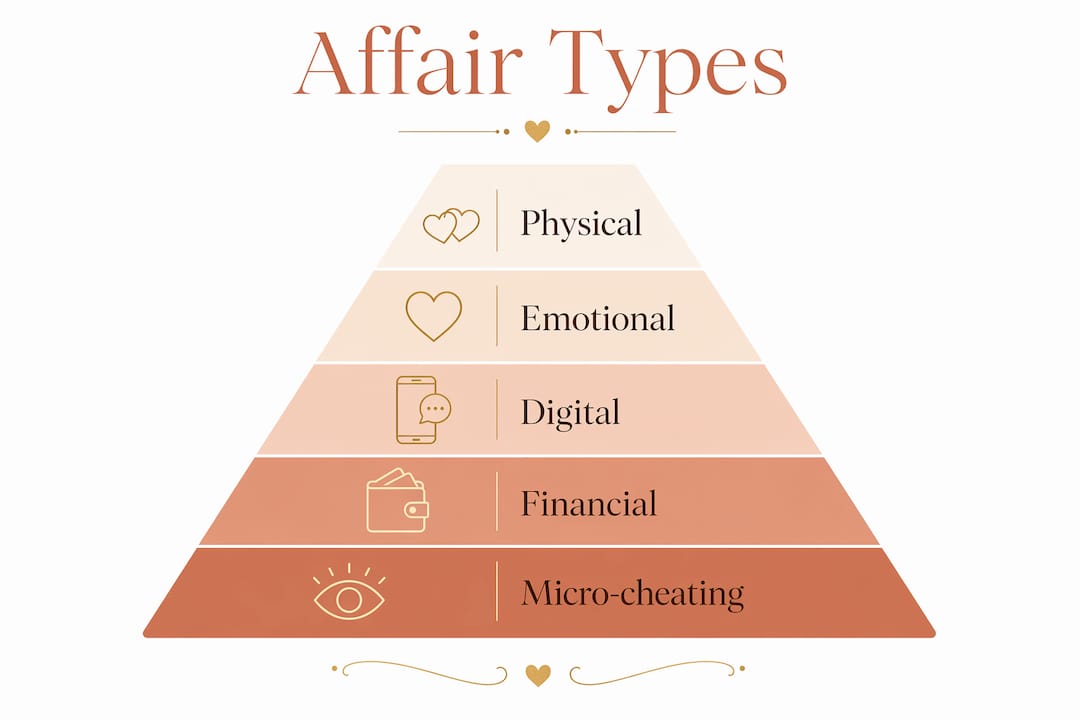
- Explaining types of affairs: the five core categories
- What is a physical affair and how does it affect trust?
- How emotional affairs differ and why they can be harder to heal from
- What constitutes digital and micro-cheating in modern relationships?
- What are financial and other gray-area betrayals considered affairs?
- How do different types of affairs impact emotional healing and recovery?
- Key Takeaways
- Why the type of affair matters more than most people realize
- Aftertheaffair resources for your next step in recovery
- FAQ
- Recommended
An affair is defined as any secret relationship or behavior that violates the agreed boundaries of a committed partnership. Experts classify infidelity into five core categories: physical, emotional, digital, micro-cheating, and financial betrayal. Each type carries a distinct emotional weight, and explaining types of affairs clearly is the first step toward understanding what actually happened in your relationship. Aftertheaffair recognizes that recovery looks different depending on which kind of betrayal occurred. Knowing the difference between a one-night physical encounter and a months-long emotional connection shapes how you grieve, what questions you ask, and how you begin to heal.
Explaining types of affairs: the five core categories
Experts classify affairs broadly into physical, emotional, digital, micro-cheating, and financial betrayals. Every category shares one defining feature: secrecy. The betrayal is not always about sex. It is about the breach of an agreement, spoken or unspoken, that forms the foundation of your relationship. Understanding the definition of affair types matters because the category shapes the emotional injury and, by extension, the path to recovery.
What is a physical affair and how does it affect trust?
A physical affair is defined as sexual contact outside the primary relationship, ranging from a single encounter to an ongoing sexual relationship. Physical infidelity triggers acute trauma responses tied to breaches of sexual trust and bodily integrity. The betrayed partner often experiences intrusive thoughts, hypervigilance, and a shattered sense of physical safety within the relationship.
Physical affairs are the most commonly recognized form of infidelity. They are also the most concrete, which means the betrayed partner has less room for doubt but often more immediate shock. The secrecy surrounding a physical affair typically involves lying about whereabouts, unexplained absences, and emotional distancing at home.
Common signs of a physical affair include:
- Unexplained changes in sexual behavior or frequency
- Increased secrecy around phones, schedules, or finances
- Emotional withdrawal or unusual irritability at home
- Unfamiliar scents, receipts, or unexplained time gaps
- Defensive reactions to ordinary questions about the day
Pro Tip: If you are in the early days of discovery, resist the urge to gather every detail immediately. Trauma responses make information processing harder. Give yourself permission to learn the facts in stages.
Recovery from a physical affair is painful, but the boundaries of the betrayal are usually clear. That clarity, while devastating, can actually support the grieving process because you know what you are mourning.
How emotional affairs differ and why they can be harder to heal from
An emotional affair is defined as a deep emotional connection with someone outside the primary relationship, without physical contact. Emotional affairs cause pervasive, long-lasting damage, comparable to slow radiation poisoning rather than a single acute injury. The damage spreads quietly through the relationship before it is ever detected.
The distinction between emotional infidelity as a behavior and an emotional affair as a structured relationship matters clinically. Emotional infidelity as a behavior might be a pattern of flirtatious texting. An emotional affair is a sustained, secret bond where intimacy, vulnerability, and emotional energy are redirected away from the primary partner. That redirection is the injury.
What makes emotional affairs particularly hard to heal from is their ambiguity. The betrayed partner often hears, “Nothing physical happened,” which can invalidate their pain. But an emotional affair extracts intimacy from the primary relationship and deposits it elsewhere, unlike a platonic friendship, which adds to a person’s life without subtracting from the partnership.
“The hardest part of an emotional affair is that the betrayed partner often feels they are grieving something they cannot fully name. The relationship was real. The loss is real. The injury is real. The absence of a physical act does not reduce any of that.”
Signs of an emotional affair often include:
- Your partner becomes secretive about a specific friendship
- They share personal problems with that person before telling you
- They compare you unfavorably to the other person
- They become defensive or dismissive when you raise concerns
- They light up around that person in a way they no longer do with you
Pro Tip: When processing an emotional affair, focus on the boundary that was crossed, not just the person involved. Identifying the specific breach, such as sharing intimate details or prioritizing another person’s emotional needs over yours, gives you something concrete to address in recovery.
Healing after an emotional affair requires naming what was lost, even when the loss feels abstract. That process takes longer than most people expect.
What constitutes digital and micro-cheating in modern relationships?
Digital affairs include sexting, secret dating app use, parasocial relationships, and AI chatbot interactions that simulate emotional or sexual intimacy. These forms of infidelity complicate traditional definitions because no physical meeting occurs, yet the secrecy and emotional investment are real. The defining factor is not the medium. It is the deception.
Micro-cheating sits one level below a full digital affair. Micro-cheating involves subtle behaviors that cross relationship boundaries without reaching affair status on their own. Individually, each act seems minor. Cumulatively, they erode trust and often function as a gateway to more serious infidelity.
Common digital and micro-cheating behaviors include:
- Maintaining a secret social media account or hidden contact list
- Sending flirtatious messages while hiding the phone screen
- Liking or commenting on someone’s posts in a pattern that feels intentional
- Sharing personal relationship problems with an online contact
- Using an AI chatbot for emotional or sexual conversations kept secret from a partner
| Behavior | Micro-cheating or full digital affair? |
|---|---|
| Secret texting with emotional content | Micro-cheating, escalating risk |
| Active use of a dating app while partnered | Full digital affair |
| Hiding a friendship from a partner | Micro-cheating |
| Sustained online emotional relationship | Full digital affair |
| Flirtatious comments kept secret | Micro-cheating |
The emotional impact of digital betrayals is real and measurable. Partners who discover secret online relationships report the same feelings of shock, shame, and grief as those who discover physical affairs. The medium does not soften the injury.
What are financial and other gray-area betrayals considered affairs?
Financial betrayals involve secret money transfers, hidden spending, or financial support given to a third party without a partner’s knowledge. These betrayals count as infidelity because they involve deception and a violation of mutual agreements, even when no physical or emotional intimacy is present. The secrecy itself is the breach.
Gray-area betrayals are the least discussed category of infidelity, but they cause significant relationship damage. Couples benefit from defining their unique relationship boundaries, because what counts as cheating varies widely between partnerships. A behavior one couple considers harmless may represent a serious violation in another.
Examples of gray-area betrayals include:
- Secretly paying another person’s bills or debts
- Hiding purchases or financial accounts from a partner
- Giving emotional or financial resources to an ex without disclosure
- Making major financial decisions that affect both partners without discussion
- Maintaining a secret friendship that involves regular gift-giving
The common thread across all gray-area betrayals is the decision to hide. When a person chooses secrecy over transparency, they are placing the relationship outside the boundary of honesty. That choice, regardless of the specific behavior, is what defines the betrayal.
How do different types of affairs impact emotional healing and recovery?
Recovery from infidelity is not a single process. It varies significantly by affair type, duration, level of secrecy, and the values of the betrayed partner. Approximately 65% of women report emotional infidelity as more painful, while men more commonly report physical infidelity as more distressing. That difference matters because it shapes what each person needs to grieve and what questions they need answered.
Emotional affairs’ ambiguity complicates grieving, prolongs healing, and makes it harder to establish clear boundaries going forward. Physical affairs, while acutely traumatic, often have a clearer endpoint. Digital and financial betrayals frequently require rebuilding trust in areas the betrayed partner had never thought to monitor.
Factors that affect recovery difficulty include:
- Duration of the affair: longer affairs cause deeper attachment injuries
- Level of secrecy: elaborate deception compounds the trauma
- Whether the affair partner was known to the betrayed partner
- The betraying partner’s willingness to be accountable
- The betrayed partner’s attachment style and prior trauma history
Pro Tip: Identify which specific value was most violated by the affair type. Was it physical safety, emotional exclusivity, financial trust, or honesty? Naming that value gives you a starting point for rebuilding, whether alone or with a partner.
Structured recovery efforts that address the specific affair type, the emotional impact, and the attachment injuries involved produce better outcomes than generic approaches. Knowing what kind of betrayal occurred is not just academic. It is the foundation of effective healing. Considering individual or couples therapy early in recovery gives you a structured space to process the specific injury you experienced.
Key Takeaways
Understanding the type of affair that occurred is the single most important factor in identifying what was lost, what needs to be grieved, and what recovery approach will actually work.
| Point | Details |
|---|---|
| Affairs are defined by secrecy | Every affair type, from physical to financial, is defined by deception rather than the act itself. |
| Emotional affairs cause prolonged damage | Emotional infidelity redirects intimacy from the primary relationship and often takes longer to heal than physical affairs. |
| Digital and micro-cheating are real betrayals | Secret online relationships and subtle boundary violations cause the same grief as physical affairs. |
| Gender affects pain perception | Women more commonly report deeper pain from emotional affairs; men more commonly report greater distress from physical ones. |
| Recovery must match the affair type | Tailored healing approaches that address the specific breach and attachment injury produce better outcomes. |
Why the type of affair matters more than most people realize
People often come to me fixated on the details of what happened. Who was it? How many times? Did they feel something? Those questions are natural, and they deserve honest answers. But in my experience, the most important shift in recovery happens when someone stops asking “what did they do” and starts asking “what did this take from me.”
The clinical distinction between an emotional affair as a relationship structure and emotional infidelity as a behavior is not just academic. It changes what you grieve. A person who lost emotional exclusivity needs to mourn something different from a person who lost physical fidelity. Treating both the same way in recovery is like treating a broken arm and a concussion with the same protocol.
I have also seen how financial betrayals get dismissed. Partners say, “At least they didn’t sleep with anyone.” But the discovery that someone secretly redirected shared resources to another person, especially over months or years, produces a specific kind of devastation. It raises questions about every financial decision the couple ever made together. That is not a minor injury.
The most useful thing you can do right now is name the specific boundary that was crossed. Not the person. Not the act. The boundary. Setting boundaries after infidelity is not about punishment. It is about rebuilding a relationship with yourself first, so you know what you actually need going forward. That clarity is where real recovery begins. And if you are also managing the legal and mental health dimensions of this, maintaining your mental health through that process deserves the same attention as the emotiojnal work.
— S.J.Howe
Aftertheaffair resources for your next step in recovery
Knowing the type of affair you experienced is the beginning, not the end. What comes next is understanding how to move through the specific grief, anger, and confusion that follows each kind of betrayal.
Aftertheaffair offers structured, evidence-informed resources built specifically for people at this stage. The 7-step infidelity recovery checklist gives you a clear starting point, whether you are in the first days of discovery or months into trying to make sense of what happened. For those ready to look further ahead, the relationship growth guide addresses how trust is rebuilt, step by step, after any type of betrayal. These resources are grounded in clinical frameworks and written for real people, not textbook cases.
FAQ
What is the most common type of affair?
Physical affairs are the most commonly reported form of infidelity, though emotional and digital affairs are increasingly recognized as equally damaging. Experts classify all affair types by the presence of secrecy and a breach of relationship agreements.
Can an emotional affair be just as painful as a physical one?
Research shows emotional affairs often cause deeper and longer-lasting damage than physical ones. They redirect intimacy away from the primary relationship, which many betrayed partners describe as a more personal violation than a purely sexual act.
What counts as micro-cheating?
Micro-cheating involves subtle behaviors that cross relationship boundaries without constituting a full affair, such as secret texting, hiding a friendship, or sharing personal problems with someone outside the relationship. Cumulatively, these behaviors erode trust and can escalate.
Does financial betrayal count as infidelity?
Financial betrayal counts as infidelity when it involves secrecy and a violation of mutual agreements, such as secretly transferring money to a third party. The deception, not the act itself, defines it as a breach of trust.
How does the type of affair affect recovery?
Recovery difficulty varies by affair type, duration, and the specific values violated. Emotional affairs require more nuanced healing due to their ambiguity, while physical affairs, though acutely traumatic, often have clearer boundaries that support the grieving process.
Recommended
- How to Recognize Each Type of Affair – After the Affair Series
- Recognize the Affair Type – After the Affair Series
- Exit Affair – What to Do Next – After the Affair Series
- 7 Types of Infidelity-Healing & Recovery – After the Affair Series