TL;DR:
- Rebuilding trust after an affair involving workplace proximity demands complete honesty, boundary enforcement, and professional support. It takes 18 to 24 months of sustained effort for meaningful recovery, with daily triggers requiring trauma-informed coping strategies. Changing jobs or restructuring work relationships may be necessary when boundaries cannot be maintained to foster healing.
- How to rebuild trust: the prerequisites
- What structural boundaries does the unfaithful partner need to enforce?
- What coping strategies help the betrayed partner manage daily triggers?
- Which communication habits actually rebuild trust in this situation?
- When should couples consider a job change or structural move?
- Key Takeaways
- What I’ve learned about healing when the threat doesn’t leave the building
- Structured recovery resources from Aftertheaffair
- FAQ
- Recommended
Rebuilding trust when the affair partner is at work is one of the most demanding forms of infidelity recovery. Between 31% and 44% of affairs begin with coworkers, which means this situation is far more common than most people realize. The good news is that recovery is possible. Therapists and researchers agree that couples who commit to 18–24 months of sustained effort and engage professional support have up to three times higher success rates than those who go it alone. What makes workplace proximity uniquely difficult is that the threat feels ongoing. Every workday is a potential trigger. This article gives you the specific protocols, coping strategies, and communication habits that actually move the needle. Remember, the affair partner is at work, which adds layers to the rebuilding process.
How to rebuild trust: the prerequisites
Before any trust rebuilding can begin, two things must be true. The affair must be completely over, and both partners must agree on what “professional only” contact means going forward.
A partial ending, where emotional intimacy continues under the cover of work, destroys any chance of recovery. The unfaithful partner must cut all personal contact with the affair partner. That means no private texts, no casual lunches, and no social conversations that go beyond what a job requires.
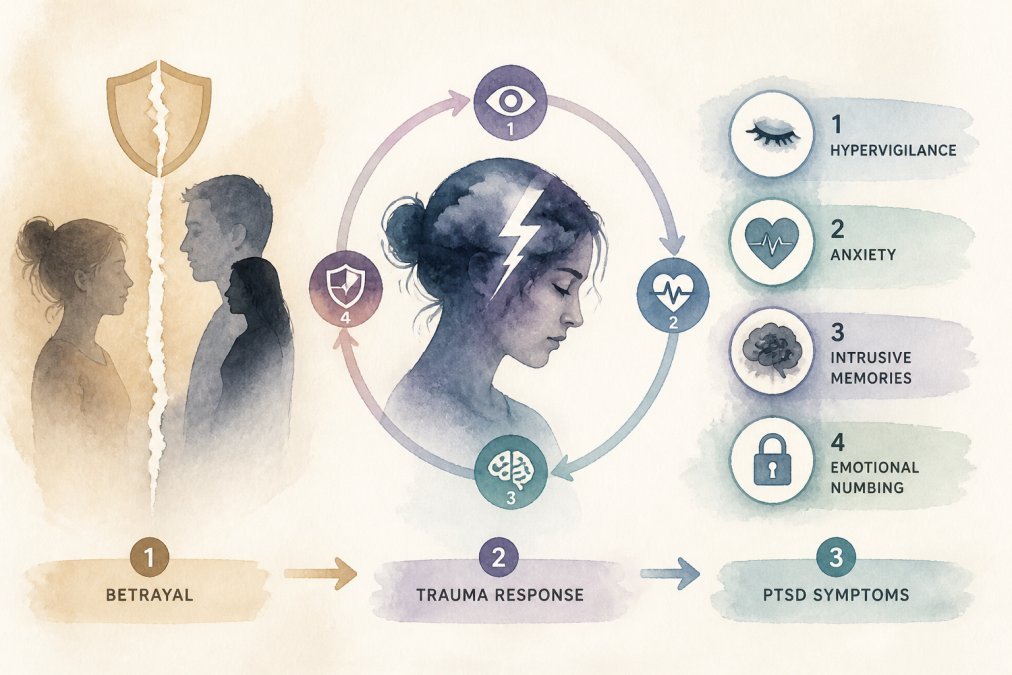
The second prerequisite is understanding how trauma works in this context. When the betrayed partner knows the affair partner is physically present in their spouse’s daily environment, the nervous system stays on alert. Identifying physical triggers such as a tight chest, racing heart, or sudden dread helps both partners recognize trauma responses rather than react to them as personal attacks.
Here is what must be in place before structured trust rebuilding can work:
- Complete cessation of the affair. No ambiguity. No “we’re just friends now.” The affair is over in every form.
- Agreed definition of professional contact. Both partners define what counts as acceptable work interaction and write it down if needed.
- Proactive transparency as a default. The unfaithful partner reports any workplace contact before being asked, not after.
- Commitment to professional support. Couples therapy is not optional in this scenario. The complexity of workplace proximity requires a trained third party.
- Realistic timeline expectations. Daily anxiety is normal and typically takes 6–12 months to begin declining with consistent honesty and boundary enforcement.
What structural boundaries does the unfaithful partner need to enforce?
The unfaithful partner carries the primary responsibility for reducing risk at work. This is not a shared burden. It belongs to the person who broke the trust.
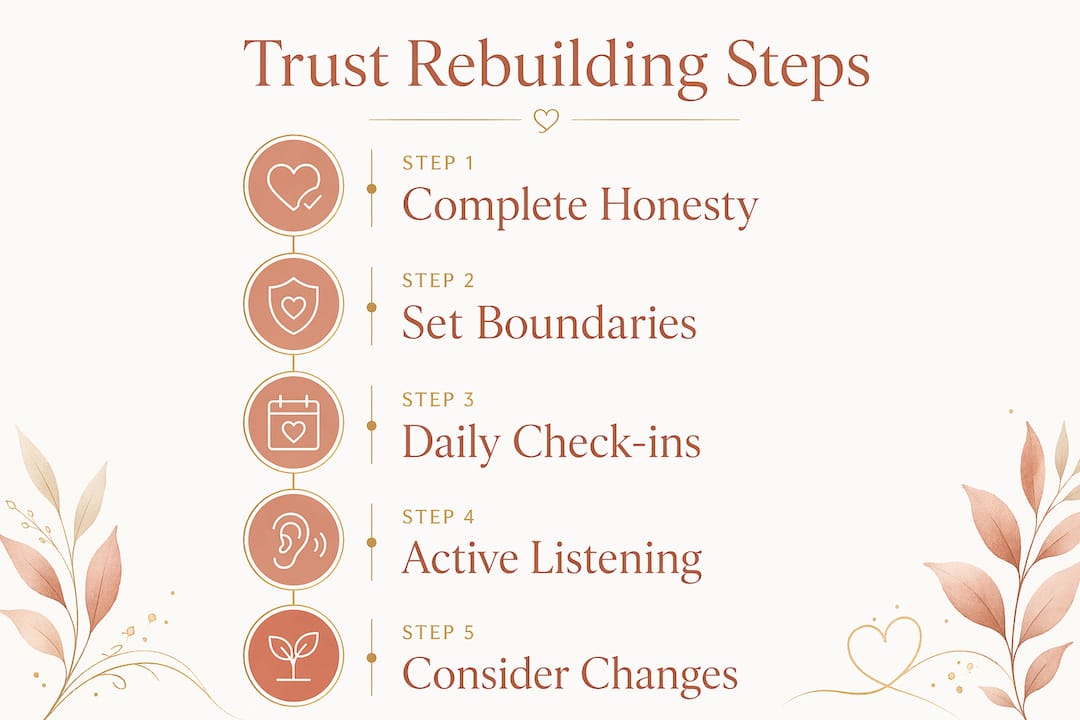
Concrete boundary enforcement means more than good intentions. It means changing daily behaviors in ways the betrayed partner can observe and verify. Structured professional boundaries include no private conversations, no shared travel, no closed-door meetings, and minimal contact beyond what the job strictly requires.
Here is a numbered framework for enforcing those boundaries:
- Limit all contact to work tasks only. Respond to work emails or messages professionally and briefly. Do not engage in personal conversation.
- Eliminate private settings. No one-on-one meetings with the door closed. No shared rides, shared meals, or after-work events that include the affair partner.
- Report every interaction proactively. Tell your partner about any contact before they ask. Include the context, the content, and the duration. This is not surveillance. It is the foundation of rebuilding trust after infidelity.
- Advocate for structural separation. Request a team transfer, a department change, or a different schedule. If the workplace culture makes boundaries impossible to maintain, changing jobs is a legitimate and sometimes necessary step.
- Communicate with management carefully. Privacy matters, but healing matters more. The unfaithful partner can request reassignment without disclosing the full reason. Framing it as a need for professional growth or a change in team dynamics is often sufficient.
Pro Tip: Keep a brief daily log of any contact with the affair partner at work. Share it with your partner each evening. This simple habit replaces suspicion with evidence and reduces the need for repeated reassurance conversations.
The betrayed partner should never have to ask for this information. When the unfaithful partner volunteers it consistently, trust rebuilds through observable action rather than promises.
What coping strategies help the betrayed partner manage daily triggers?
The betrayed partner faces a specific kind of ongoing stress. Knowing the affair partner is physically nearby, possibly interacting with your spouse right now, keeps the nervous system in a near-constant state of threat. That is a trauma response, not an overreaction.
Effective coping strategies for infidelity in this context focus on nervous system regulation first. You cannot think your way out of a trauma response. You have to work through the body.
- Name the trigger before reacting. When anxiety spikes, pause and identify what set it off. “My partner just left for work” is a trigger. Naming it reduces its power.
- Use grounding techniques in the moment. The 5-4-3-2-1 method (name five things you see, four you can touch, three you hear, two you smell, one you taste) interrupts a spiral before it escalates.
- Use structured language to ask for reassurance. A phrase like “I’m feeling triggered right now and need to hear that you’re committed to us” is more effective than an accusation or a demand. It gives the unfaithful partner something concrete to respond to.
- Seek therapy that specializes in betrayal trauma. General counseling is helpful, but a therapist trained in trauma and betrayal recovery understands the specific nervous system dynamics at play.
- Track your progress, not just your pain. Keep a private journal noting moments when anxiety was lower than expected. Over months, this record becomes evidence that healing is happening.
Pro Tip: Schedule a brief daily check-in with your partner at a set time, such as 6:00 PM each evening. Knowing that a structured conversation is coming reduces the urge to monitor or interrogate throughout the day.
Both partners must regulate triggers to avoid reactive conflict. When the betrayed partner can name a trigger and the unfaithful partner can respond with empathy rather than defensiveness, emotional safety begins to form.
Which communication habits actually rebuild trust in this situation?
Communication is where trust either grows or collapses. In workplace affair scenarios, the standard advice to “talk more” is not enough. The content and timing of communication matter as much as the frequency.
The single most powerful communication habit is proactive disclosure. Sharing details of unavoidable workplace encounters before being asked prevents the suspicion cycle from taking hold. When the betrayed partner hears information first from their partner rather than discovering it later, the brain registers safety instead of threat.
| Communication habit | Why it works |
|---|---|
| Proactive disclosure of work contact | Prevents suspicion and demonstrates voluntary transparency |
| Daily schedule sharing | Reduces uncertainty and the need for surveillance behaviors |
| Real-time location updates during work events | Provides reassurance without requiring the betrayed partner to ask |
| Structured evening check-ins | Creates a predictable space for processing emotions safely |
| Empathic response to triggers | Builds emotional safety and reduces conflict escalation |
Avoiding defensiveness is equally critical. When the betrayed partner raises a concern about the affair partner at work, the unfaithful partner’s instinct to explain or minimize is understandable but damaging. A response like “I hear that you’re scared. Here’s what actually happened” is far more effective than “You need to trust me.” Consistent, committed actions repeated over time are what the nervous system ultimately responds to, not verbal reassurances.
Therapy-facilitated communication practices, including active listening and validation exercises, accelerate this process. Learning to communicate after an affair in a structured way reduces the chance that difficult conversations become destructive ones.
When should couples consider a job change or structural move?
A job change is not a failure. In many cases, it is the most direct path to healing. The question is not whether it would help but whether the cost of staying outweighs the cost of leaving.
Consider a structural move when any of these conditions apply:
- Daily close contact is unavoidable. If the unfaithful partner and the affair partner share a team, a desk area, or regular meetings, maintaining meaningful boundaries becomes nearly impossible.
- A power imbalance exists. If the affair partner is a supervisor or a direct report, the professional relationship creates ongoing vulnerability that boundaries alone cannot neutralize.
- The workplace culture reinforces the risk. Social events, after-hours gatherings, or a culture of close personal relationships at work make strict professional boundaries harder to sustain.
Changing jobs removes the constant exposure that keeps the nervous system in threat mode. Structural separation is not about punishment. It is about creating the conditions where healing can actually happen. When the unfaithful partner initiates this move without being pressured, it sends a clear signal: the relationship matters more than the job.
When an immediate job change is not financially possible, the unfaithful partner can pursue interim steps. Requesting a schedule change, a desk reassignment, or a different project team reduces daily contact while longer-term options are explored. A therapist can help both partners weigh the options and manage expectations around the timeline.
Key Takeaways
Rebuilding trust when the affair partner is still at work requires proactive transparency, enforced professional boundaries, and consistent behavioral proof sustained over months, not days.
| Point | Details |
|---|---|
| Proactive transparency is non-negotiable | The unfaithful partner must report all work contact before being asked, every time. |
| Structural boundaries reduce daily risk | No private meetings, shared travel, or personal conversations with the affair partner. |
| Triggers are trauma responses, not overreactions | Grounding techniques and structured language help the betrayed partner regulate anxiety. |
| Communication habits replace suspicion | Daily check-ins and schedule sharing reduce the need for surveillance behaviors. |
| Job changes accelerate healing | When close contact is unavoidable, structural separation is a legitimate and often necessary step. |
What I’ve learned about healing when the threat doesn’t leave the building
S.J.Howe
The hardest cases I’ve encountered are not the ones where the affair was dramatic. They are the ones where the affair partner still sends a calendar invite every Monday morning.
What I’ve found, working through these situations, is that promises mean almost nothing at this stage. The betrayed partner’s nervous system does not respond to “I love you” or “it’s over.” It responds to evidence. Repeated, boring, unglamorous evidence. The unfaithful partner who texts “just had a five-minute project update with her, nothing personal” at 10:15 AM is doing more for the relationship than any grand gesture ever could.
The other thing I’ve noticed is that the betrayed partner often underestimates how much their own regulation matters. Waiting in a state of high anxiety all day, then interrogating at the door, creates a dynamic that exhausts both people and stalls recovery. Learning to manage the stages of healing rather than just endure them changes the entire trajectory.
Healing with workplace proximity is a marathon run on a track where the obstacle is still visible. That is genuinely hard. But couples who commit to the behavioral work, get professional support, and give the process real time do recover. The rebuilding trust timeline is longer than most people want. It is also real.
— S.J.Howe
Structured recovery resources from Aftertheaffair
Knowing what to do and actually doing it under daily stress are two different things. Aftertheaffair provides structured, evidence-informed resources built specifically for this kind of recovery.

The 7-step infidelity recovery checklist gives you a clear sequence to follow when the path forward feels unclear. For couples working through the specific challenges of workplace proximity, the relationship growth guides on the Aftertheaffair site offer practical frameworks for communication, boundary setting, and emotional repair. These resources are designed to complement professional therapy, not replace it, and they meet you wherever you are in the process.
FAQ
How long does it take to rebuild trust when the affair partner is at work?
Recovery from infidelity typically takes 18–24 months of consistent effort. Workplace proximity extends the timeline because daily exposure keeps the nervous system in a threat state longer.
What counts as “professional only” contact with the affair partner?
Professional contact means task-related communication only, with no private conversations, no shared meals, no closed-door meetings, and no personal messages. Any interaction beyond job requirements crosses the boundary.
Should the unfaithful partner change jobs to help with healing?
A job change is advisable when close daily contact is unavoidable or when the workplace structure makes meaningful boundaries impossible to maintain. The unfaithful partner initiating this move signals genuine commitment to recovery.
What are the best coping strategies for infidelity when triggers happen at work?
Grounding techniques, structured reassurance language, and a scheduled daily check-in with your partner are the most effective immediate tools. Therapy specializing in betrayal trauma provides the deeper support needed for sustained recovery.
Does proactive transparency really make a difference in trust rebuilding?
Yes. Sharing workplace contact details before being asked breaks the suspicion cycle and gives the betrayed partner’s nervous system evidence of safety rather than threat.
Recommended
- How to Cope When Your Spouse Works With Their Affair Partner
- Ways to Rebuild Trust After Betrayal: Real Steps That Work
- Rebuilding Trust Timeline – After the Affair Series
- Does rebuilding trust prevent future affairs? Evidence & tips