TL;DR:
- Most marriages initially survive infidelity, but true recovery needs full disclosure, professional therapy, and years of accountability. Therapy methods like the Gottman and Emotionally Focused Therapy succeed in about 70-75% of cases, emphasizing honesty and consistent effort. Psychological trauma often persists, requiring long-term healing and deliberate relationship rebuilding.
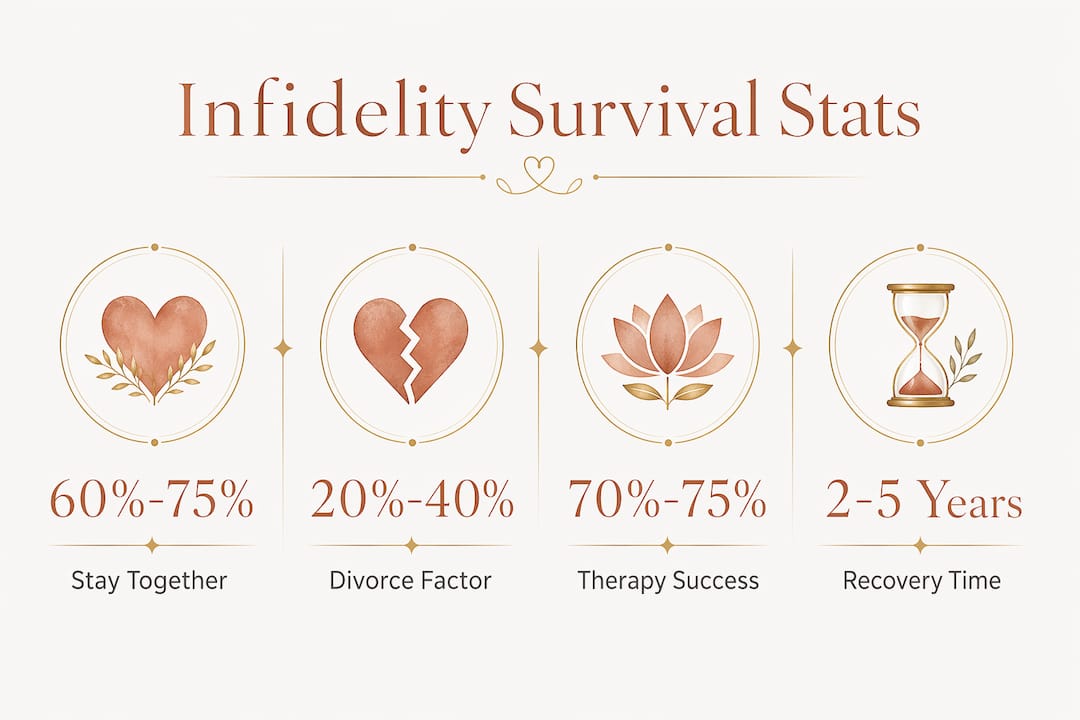
Between 60% and 75% of couples remain together after discovering an affair, which is far higher than most people expect. That figure comes from long-term data on how many marriages actually survive infidelity, and it challenges the widespread assumption that cheating automatically ends a marriage. The clinical term for what these couples pursue is “affair recovery,” a structured process that goes well beyond simply staying together. Whether a marriage survives in a meaningful way depends on factors like full disclosure, professional support, and the unfaithful partner’s genuine accountability. The statistics on infidelity and divorce tell one story. What happens inside those surviving marriages tells another.
How many marriages actually survive infidelity?
Research shows that 60%–75% of couples stay together after an affair is discovered. That survival rate is higher than popular culture suggests, but staying together and genuinely recovering are two different things.
Long-term data also shows that 20%–40% of divorces involve infidelity as a contributing factor. That means a significant share of couples who initially stay together eventually separate, often because the underlying damage was never properly addressed.
One finding that surprises many people: 56% of men and 34% of women who cheat describe their marriages as “happy” or “very happy” at the time of the affair. Infidelity does not only happen in broken marriages. Situational factors and personal vulnerabilities often play a larger role than marital unhappiness alone.
What the numbers actually mean
The raw survival rate is encouraging, but it needs context. Couples who stay together without addressing the betrayal tend to experience chronic resentment, emotional distance, and repeated crises. Staying in the same house is not the same as rebuilding a marriage.
The couples who report genuine recovery, meaning restored trust and relationship satisfaction comparable to non-infidelity couples, are the ones who engage in structured therapeutic work. The data on infidelity recovery success rates consistently points to professional support as the clearest dividing line between couples who heal and those who simply endure.
| Outcome | What the data shows |
|---|---|
| Couples who stay together initially | 60%–75% of all couples post-discovery |
| Divorces involving infidelity | 20%–40% of all divorces |
| Five-year divorce rate with full disclosure | Approximately 43% |
| Five-year divorce rate with secrecy | Approximately 80% |
| Couples reaching recovery in therapy | 70%–75% success rate |
How does therapy improve infidelity recovery success rates?
Therapeutic interventions produce measurably better outcomes than unaided recovery. The Gottman Method and Emotionally Focused Therapy are the two most researched approaches for affair recovery, and both show 70%–75% success rates in moving couples from acute distress to genuine healing. That is a meaningful number. It means the majority of couples who commit to structured therapy do recover.
Recovery typically takes 2–5 years, not months. The process is non-linear, with an acute crisis phase lasting 1–6 months followed by a longer period of gradual rebuilding. Couples who expect to feel “back to normal” within a year often interpret normal setbacks as signs of failure.
The role of full disclosure
Full disclosure of the affair is the strongest single predictor of long-term survival. Couples who disclose fully have a 43% divorce rate at five years. Couples who withhold details face a divorce rate near 80% over the same period. That gap is stark. Partial honesty does not protect the betrayed partner. It prolongs the trauma and destroys the foundation therapy needs to work.
Structured therapy accelerates healing in another measurable way. By six months into therapy, relationship satisfaction among infidelity couples aligns with couples in therapy for other issues. The initial distress is higher, but the trajectory improves quickly when both partners are engaged.
Here is a practical sequence that reflects how effective therapy typically unfolds:
- Crisis stabilization. The first 1–6 months focus on stopping the bleeding: no contact with the affair partner, basic safety, and establishing ground rules for communication.
- Full disclosure. The unfaithful partner provides a complete, honest account. This is painful but clinically necessary.
- Trauma processing. The betrayed partner works through PTSD symptoms, often in individual therapy alongside couples work.
- Accountability and remorse. The unfaithful partner demonstrates consistent, genuine remorse over time, not as a one-time apology.
- Rebuilding. Both partners work toward a new relationship, not a restoration of the old one.
Pro Tip: Ask any couples therapist you consider whether they have specific training in infidelity recovery. General couples therapy and affair-specific therapy are not the same thing. The Gottman Method and Emotionally Focused Therapy both have certified practitioners you can search for by specialty.
What psychological challenges do betrayed spouses face?
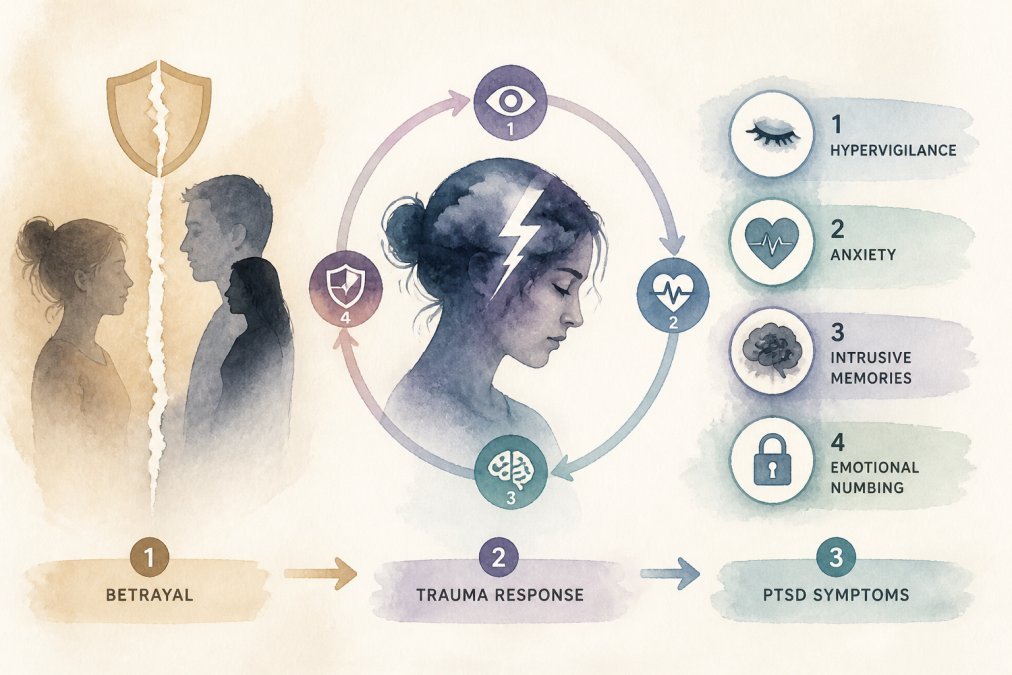
The impact of cheating on marriage extends well beyond hurt feelings. Between 30% and 60% of betrayed spouses show clinically significant symptoms of PTSD, depression, or anxiety after discovery. A 2019 study found that 45% of young adults showed probable PTSD symptoms specifically related to partner infidelity. These are not mild reactions. They are clinical-level responses to a genuine trauma.
Common symptoms include intrusive thoughts, hypervigilance, emotional numbness, and sudden intense distress triggered by reminders of the affair. These triggers can last for months or years. A song, a location, or a date on the calendar can send a betrayed partner back into acute crisis even when the relationship is otherwise progressing.
“Recovery from infidelity is not a straight line. Betrayed partners often describe feeling fine for weeks, then being floored by a trigger they did not see coming. That is not regression. That is how trauma heals.”
Some betrayed partners also develop trauma bonding or complex trauma responses, particularly when the affair was long-term or involved repeated deception. These patterns require individual therapeutic attention, not just couples work.
Self-care during this period is not optional. Sleep, physical movement, and social connection all directly affect the nervous system’s ability to process trauma. Betrayed partners who neglect their own wellbeing tend to have longer, harder recoveries regardless of what their partner does.
What practical steps rebuild trust after infidelity?
Trust rebuilds through repeated reliable behavior over time, not through a single conversation or gesture. That principle is central to every evidence-based recovery model. The rebuilding trust timeline is measured in years, not weeks, and both partners need to understand that from the start.
The unfaithful partner’s role is specific and non-negotiable. Recovery depends fundamentally on that partner showing full accountability, authentic remorse, and a sustained willingness to rebuild. Quick apologies and impatience with the betrayed partner’s grief are the most common reasons couples stall.
Here are the behaviors that research and clinical practice consistently identify as most effective:
- Radical transparency. The unfaithful partner shares location, passwords, and communication openly, not because they are forced to, but because they understand why it matters.
- Consistent follow-through. Saying what you will do and doing it, every time, is how trust is rebuilt at the behavioral level.
- Tolerating the betrayed partner’s pain. The unfaithful partner must sit with their partner’s grief without becoming defensive or asking for the process to speed up.
- Building a new relationship. Recovery is not a return to the past but a construction of something new, with greater honesty and deliberate communication.
- Celebrating small progress. Recognizing incremental improvements prevents both partners from feeling that the work is pointless.
Some couples report post-traumatic growth after infidelity, where the crisis forces necessary changes that produce a stronger, more honest relationship than existed before. This is not guaranteed, but it is a real and documented outcome.
Pro Tip: When a setback hits, name it out loud together. Say “this is a setback, not a failure.” Recovery progress commonly feels like two steps forward and one step back. Normalizing that pattern prevents couples from catastrophizing normal parts of the process.
Key Takeaways
Most marriages survive infidelity initially, but genuine recovery requires full disclosure, structured therapy, and sustained accountability from the unfaithful partner over a 2–5 year period.
| Point | Details |
|---|---|
| Survival rate after discovery | 60%–75% of couples initially stay together after an affair is found. |
| Full disclosure is critical | Couples who disclose fully face a 43% five-year divorce rate vs. 80% with secrecy. |
| Therapy works | The Gottman Method and Emotionally Focused Therapy achieve 70%–75% recovery success rates. |
| Psychological impact is serious | 30%–60% of betrayed spouses develop clinically significant PTSD, depression, or anxiety. |
| Recovery takes years, not months | The healing process typically spans 2–5 years and is non-linear by nature. |
What the statistics miss about surviving infidelity
By S.J.Howe
The numbers are useful, but they do not capture what I have seen in the couples who actually make it through. The ones who recover are not the ones who loved each other most or had the best marriages before the affair. They are the ones who were willing to be brutally honest, even when honesty was painful and inconvenient.
What strikes me most is how often the unfaithful partner underestimates what accountability actually requires. A single apology is not accountability. Accountability is showing up, day after day, tolerating your partner’s pain without making it about your own guilt. Most people are not prepared for how long that takes.
The other thing the statistics cannot show is what a recovered relationship actually feels like. The couples I have worked with who reach genuine recovery describe something qualitatively different from what they had before. Not better in a simple sense, but more honest, more deliberate, and more real. That outcome is not available to every couple. But it is available to more couples than most people believe.
— S.J.Howe
Aftertheaffair resources for rebuilding after betrayal
If you are in the middle of this and the statistics feel abstract, structured guidance makes a real difference.
Aftertheaffair offers the 7 Steps Infidelity Recovery Checklist, a practical, evidence-informed tool that walks you through the recovery process in a clear sequence. The site also provides the full After the Affair book series, covering every phase from the first months of crisis through long-term relationship growth after infidelity. Whether you are the betrayed partner trying to understand your own reactions, or the unfaithful partner trying to understand what genuine accountability looks like, these resources give you a framework that therapy alone often cannot provide in the early stages.
FAQ
What percentage of marriages survive infidelity?
Research shows that 60%–75% of couples remain together after an affair is discovered. However, genuine recovery, meaning restored trust and relationship satisfaction, requires structured effort and typically takes 2–5 years.
Does couples therapy actually help after cheating?
Yes. Approaches like the Gottman Method and Emotionally Focused Therapy achieve 70%–75% success rates in moving couples from acute distress to genuine recovery. Structured therapy produces significantly better outcomes than unaided recovery.
How long does it take to rebuild trust after infidelity?
Trust rebuilds through consistent, reliable behavior over time, with most research pointing to a 2–5 year recovery window. The process is non-linear, and setbacks are a normal part of healing rather than signs of failure.
What happens if the unfaithful partner hides details of the affair?
Couples who withhold any aspect of the affair face a divorce rate near 80% within five years, compared to approximately 43% for couples who disclose fully. Full disclosure is the strongest single predictor of long-term survival.
Can infidelity actually make a marriage stronger?
Some couples report post-traumatic growth after infidelity, where the crisis forces honest communication and relationship changes that produce a stronger bond than existed before. This outcome is documented but not guaranteed, and it requires both partners to commit fully to the recovery process.
Recommended
- Can a Marriage Survive Infidelity? Statistics, Recovery, and Hope
- Will a Married Partner Leave Their Spouse? A Realistic Guide – After the Affair Series
- Can My Marriage Survive When Your Spouse Works With Their Affair Partner
- Top marriage healing strategies to rebuild trust after infidelity