
Last Updated: July 19, 2026
- Understanding What Healthy Boundaries Mean With a Toxic Ex
- The No Contact Rule With a Toxic Ex: When and How to Implement It
- Identifying Manipulative Behaviors and Setting Firm Rules
- Scripts for Setting Boundaries With an Ex: Practical Communication Templates
- Co-Parenting With a Toxic Ex: Boundaries That Protect Your Children
- Managing Emotional Triggers and Protecting Your Mental Health
- Healing From a Toxic Relationship: Self-Care and Moving Forward
- Common Mistakes When Creating Boundaries With a Toxic Ex
- Frequently Asked Questions
Creating boundaries with a toxic ex is one of the hardest things you’ll ever do, not because setting limits is complicated, but because your ex will likely resist them, test them, and try to make you feel guilty for having them. The difference between boundaries that hold and boundaries that crumble comes down to preparation, consistency, and knowing exactly what to say when your ex pushes back.
This guide walks you through seven proven steps for creating boundaries with a toxic ex, from understanding what healthy boundaries actually look like, to managing the emotional toll, to protecting your children if you’re co-parenting.
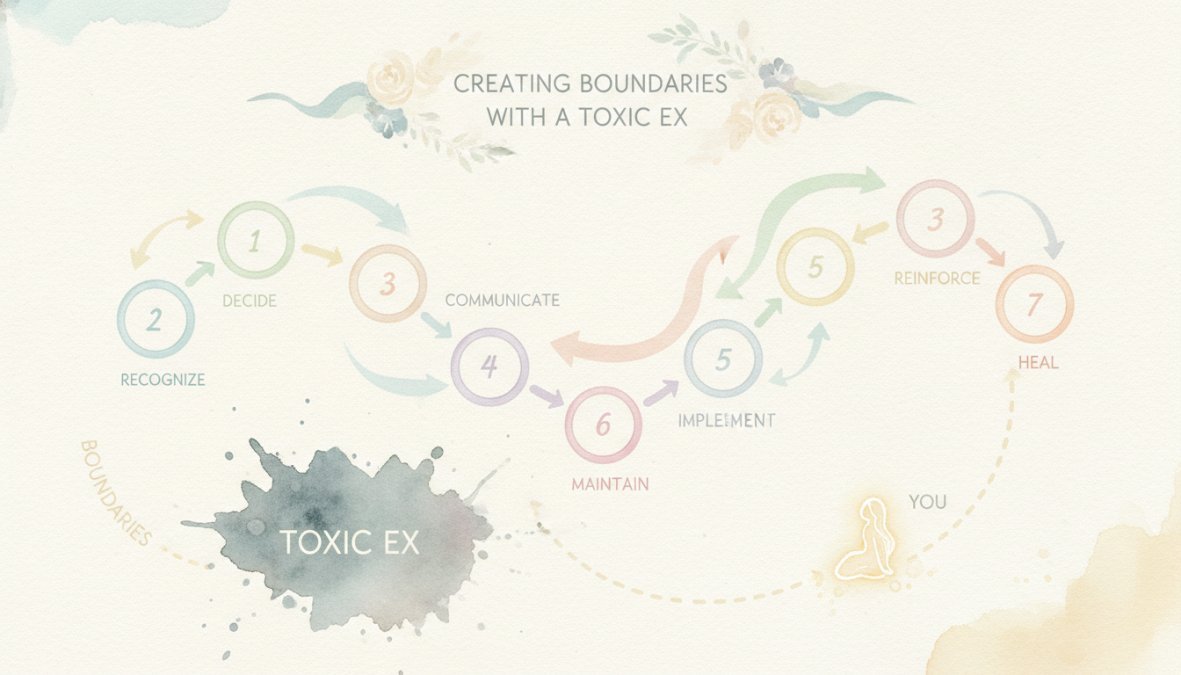
Understanding What Healthy Boundaries Mean With a Toxic Ex
A healthy boundary is a clear, firm limit you set on what you will and won’t accept in your interactions with your ex. It’s not punishment. It’s not about winning. It’s about protecting your mental health, your time, and your peace.
With a toxic ex, boundaries are non-negotiable because without them, the person will consume your emotional energy indefinitely. A toxic ex typically exhibits patterns of manipulation, anger, blame-shifting, or refusal to respect basic limits. They may contact you at all hours, bring up old grievances during logistics conversations, or use your children to maintain control.
The key insight most people miss: boundaries aren’t about changing your ex’s behavior. They’re about controlling your own response to it. You can’t make your ex stop being difficult. You can only decide what you’ll tolerate and what you won’t.
Healthy boundaries with a toxic ex include clear communication rules, emotional detachment during interactions, consequences when boundaries are crossed, documentation of all contact, refusal to engage in arguments, protection of your inner circle, and separation of logistics conversations from personal matters.
The strongest boundary is one you’re willing to enforce consistently, even when your ex escalates. If you set a boundary you won’t actually maintain, your ex learns that your limits are negotiable.
The No Contact Rule With a Toxic Ex: When and How to Implement It
Complete no contact means zero communication with your ex for a defined period, typically 30 to 90 days minimum. No texts, calls, emails, social media, or third-party contact.
No contact works because it breaks the cycle of emotional engagement. Every interaction, even a negative one, reinforces your ex’s sense of connection to you. Research from Psychology Today on toxic relationships emphasizes that no contact is one of the most effective ways to break unhealthy attachment patterns and allow yourself to heal.
Complete No Contact vs. Limited Contact for Co-Parenting
If you have children, complete no contact isn’t always realistic. In those cases, limited contact, sometimes called “parallel parenting,” becomes your strategy.
Limited contact means communication happens only through a designated app like OurFamilyWizard or Talking Parents, conversations focus exclusively on children and logistics, responses are brief and businesslike, and all communication is documented automatically.
Many people try limited contact but slip into old patterns, answering personal questions or responding emotionally. The moment you do that, you’ve broken the boundary. Your ex learns they can still reach you if they push the right buttons.
A common mistake is treating limited contact as an opportunity to “be civil” or “show your ex you’re the mature one.” Limited contact isn’t friendship. It’s a business transaction about your children.
Identifying Manipulative Behaviors and Setting Firm Rules
Before you can set boundaries, you need to recognize the specific manipulation tactics your ex uses. Manipulation can look like concern, humor, or reasonable requests.
Common Manipulation Tactics and Red Flags
Justification and explanation-seeking. Your ex asks why you made a decision or why you won’t do what they want. The goal is to get you defending yourself. Once you start explaining, you’ve opened a negotiation.
Guilt and obligation. “You’re keeping the kids from me.” “You’re being selfish.” These statements create pressure to prove you’re not the bad person they’re painting you as.
Intermittent reinforcement. Sometimes your ex is nice, sometimes awful. This unpredictability keeps you emotionally hooked, hoping for the nice version.
Hoovering. Sudden contact after silence, love-bombing, or appeals to nostalgia. “I miss you.” The goal is to suck you back in.
Triangulation. Involving your children, mutual friends, or family members in the conflict. “Your daughter thinks you’re being unfair.”
Gaslighting. Denying things that happened or making you question your own memory. “That never happened.” “You’re being dramatic.”
The firm rules you set should directly counter these patterns. If your ex uses justification-seeking, your rule is: “I don’t explain my decisions. They’re final.” If they use guilt, your rule is: “I’m not responsible for your feelings about my boundaries.”
Scripts for Setting Boundaries With an Ex: Practical Communication Templates
When you set a boundary, use clear, simple language. No emotion. No justification. No room for negotiation.
Script for establishing a communication rule:
“Going forward, all conversations about the kids happen through [app/email]. I’m not available for phone calls about logistics. If it’s an emergency, you can call, but I won’t engage in other topics.”
Script for refusing to engage in an argument:
“I’m not going to discuss this. My decision is made. If you have questions about the kids’ schedule or needs, I’m available for that conversation.”
Script for setting a response-time boundary:
“I respond to messages within 24 hours during weekdays. I don’t check messages on weekends. If it’s a genuine emergency involving the children, call [your number].”
Script for refusing to justify your decisions:
“I’ve made my decision. I’m not going to explain it or debate it. This is what’s happening.”
Script for addressing repeated boundary violations:
“I’ve told you multiple times that [boundary]. If this happens again, I’m [consequence: blocking, involving a mediator, going through your lawyer]. This is your warning.”
The Grey Rock Method: Becoming Emotionally Detached
The Grey Rock method is a tactical approach to interaction with a toxic ex. You become as uninteresting as a grey rock: boring, unresponsive, and unrewarding to engage with.
When you use Grey Rock, you respond in short, flat sentences, don’t share personal information, don’t show emotion, and keep responses to logistics only.
Example of Grey Rock in action:
Ex: “You’re ruining the kids’ lives by keeping them away from me.”
Grey Rock response: “The schedule is set. I’ll have them ready at 3 p.m. on Friday.”
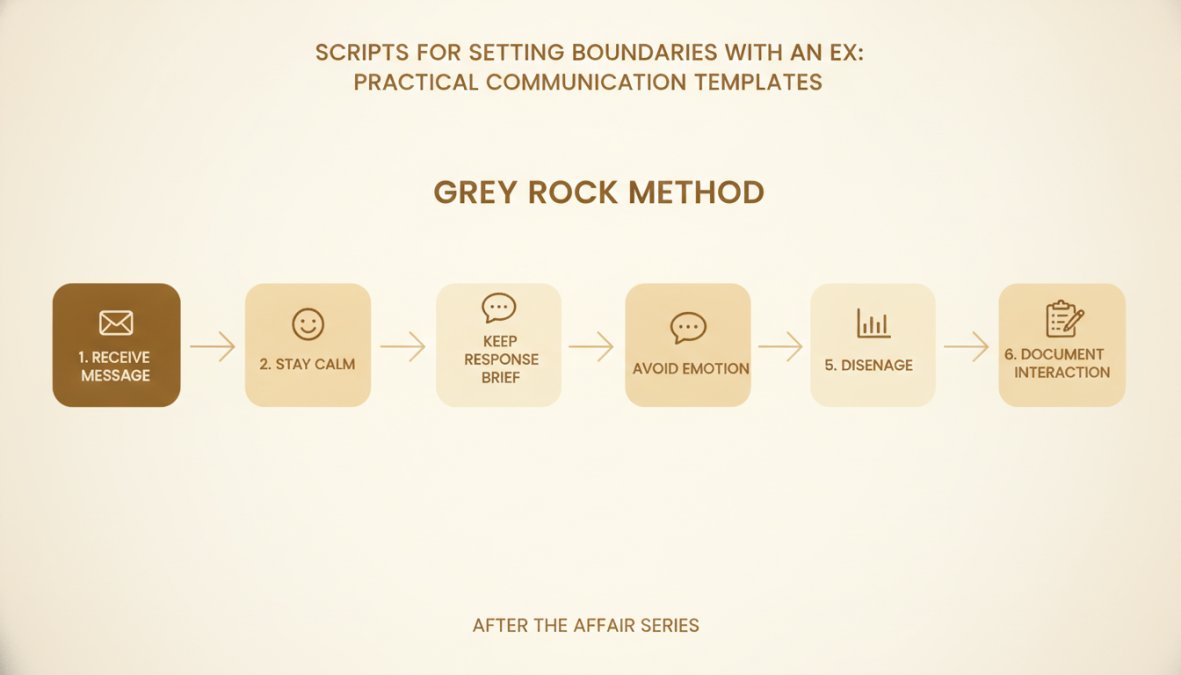
The Grey Rock method works because it removes the reward. Your ex gets no emotional reaction, no argument, no explanation. Over time, they stop trying.
Grey Rock isn’t coldness, it’s strategic disengagement. You’re simply refusing to participate in the dynamic your ex wants to create.
Co-Parenting With a Toxic Ex: Boundaries That Protect Your Children
Co-parenting with a toxic ex requires boundaries that shield your children from conflict while maintaining their relationship with their other parent.
Research from American Psychological Association on high-conflict co-parenting shows that children exposed to ongoing parental conflict experience measurable increases in anxiety, depression, and behavioral problems.
Core co-parenting boundaries:
Never discuss the other parent negatively with your children, don’t use children as messengers, keep exchanges brief and child-focused, don’t ask children about the other parent’s personal life, never put children in the middle of decisions, maintain consistent rules across both homes when possible, and shield children from legal matters and adult conflict.

Documentation, Digital Communication, and Privacy Rules
Documentation is your legal and emotional protection. Every interaction should be recorded and stored safely.
What to document: All communication with your ex, missed pickups or late returns, concerning behavior or statements made to your children, violations of agreements, and dates and times of concerning incidents.
Digital communication best practices:
Use a co-parenting app like Talking Parents or OurFamilyWizard rather than text or email. These apps timestamp everything and are admissible in court if needed. For topics that don’t require immediate response, email creates a written record and gives you time to craft a measured response. Avoid phone calls unless absolutely necessary, and follow up with a text summarizing what was discussed.
Privacy rules:
Don’t share your ex’s personal information with children, don’t allow your ex access to your social media or personal accounts, don’t share photos of your children beyond what’s necessary for logistics, change passwords if your ex has them, be cautious about what you post on social media, and don’t discuss your dating life or finances with your ex.
Managing Emotional Triggers and Protecting Your Mental Health
Setting boundaries with a toxic ex will trigger you. Your ex will likely escalate, test your limits, or use tactics designed to provoke an emotional response.
Common triggers include accusations or blame, criticism of your parenting, threats of legal action, sudden niceness, involving your children in conflict, bringing up past hurts, and refusing to respect your stated boundaries.
Your job is to recognize these triggers before they hijack your nervous system. When you feel the urge to respond emotionally, respond to the boundary instead.
Managing triggers in the moment:
- Pause. Don’t respond immediately.
- Identify the trigger. What button did they push?
- Remember your boundary. What did you decide you wouldn’t tolerate?
- Respond according to your boundary, not your emotion.
- Document the interaction.
- Take care of yourself afterward through exercise, journaling, or talking with a trusted friend.
Many people find it helpful to write out their emotional response first, then delete it. This lets your nervous system discharge without damaging your boundaries.
Build a support network that understands your situation: a therapist, trusted friend, support group, or coach. These people help you process the emotional impact without pulling you back into engagement with your ex.
Healing From a Toxic Relationship: Self-Care and Moving Forward
Boundaries protect you in the present. Healing allows you to move forward without carrying the relationship’s weight into your future.
Healing isn’t linear. Some days you’ll feel strong and clear. Other days, old pain will surface. Both are normal.
Self-care practices that support healing:
Therapy to process the relationship and build emotional resilience, physical activity to discharge stress, time with people who affirm your worth, journaling to process emotions, setting personal goals unrelated to your ex, limiting contact with people who side with your ex, and giving yourself permission to grieve what you lost.
Healing also means recognizing patterns. What drew you to this person? What made it hard to leave? What patterns do you want to avoid in future relationships? This work isn’t about blame. It’s about understanding yourself more deeply so you can make different choices.
Common Mistakes When Creating Boundaries With a Toxic Ex
Mistake 1: Setting boundaries you won’t enforce. If you say “I won’t respond to messages after 8 p.m.” and then respond at 9 p.m., you’ve taught your ex that your boundaries are negotiable.
Mistake 2: Over-explaining or justifying. The moment you explain why you set a boundary, you’ve invited negotiation. Boundaries don’t require justification. They require enforcement.
Mistake 3: Trying to be reasonable with someone who isn’t. A toxic ex responds to consequences, not logic or fairness.
Mistake 4: Mixing limited contact with friendship. You can’t be friendly and maintain firm boundaries. Keep limited contact strictly transactional.
Mistake 5: Letting guilt override your boundaries. Your ex will say your boundaries are mean or unfair. These are manipulation tactics. Your boundaries are acts of self-preservation.
Mistake 6: Not documenting everything. If you ever end up in court, your documentation is your evidence. Screenshot messages, save emails, and note dates and times of incidents.
Mistake 7: Expecting your ex to respect your boundaries without consequences. Boundaries without consequences are just suggestions. There must be a consequence: blocking them, involving a mediator, or going through a lawyer.
Creating boundaries with a toxic ex is one of the most important acts of self-protection you can take. It’s also one of the hardest, because your ex will resist, and because part of you may still hope they’ll change. They won’t. But you can change how you respond to them, and that changes everything.
Frequently Asked Questions
What are specific examples of boundaries I should set with a toxic ex?
Clear boundaries include: communication only through written channels (text or co-parenting apps), no discussions about personal matters unrelated to children, no surprise visits, specific pickup/drop-off times and locations, no criticism of your parenting or personal life, and no contact outside scheduled communication windows. Document all agreements in writing. The key is making rules explicit and non-negotiable, especially if your ex displays manipulative or abusive behavior. Boundaries vary based on whether you share children or have ongoing financial ties.
How do I use the no contact rule with a toxic ex when we have children together?
True no contact is impossible with co-parenting, so implement ‘limited contact’ instead: communicate exclusively through a co-parenting app or email, restrict topics to child-related logistics only, use scripted responses, and maintain emotional detachment. Set clear response-time expectations (e.g., 24-48 hours) and never engage in debates about personal matters. This creates a documented trail and removes emotional engagement, the goal of healthy boundaries. Many parents find co-parenting platforms invaluable for enforcing these limits while protecting children’s wellbeing.
What should I do if my ex refuses to respect the boundaries I’ve set?
Document every violation meticulously: save messages, record dates and times of unwanted contact, and note any abusive or manipulative behavior. If violations escalate or involve harassment, consult legal counsel about restraining orders or modified custody arrangements. In the meantime, reinforce boundaries by not responding to off-topic messages, blocking unwanted contact methods, and using only official communication channels. Stay consistent, inconsistent enforcement signals that boundaries are negotiable. Your mental health and your children’s emotional safety depend on firm enforcement, not negotiation.
How can I protect my digital privacy and security from a toxic ex?
Change all passwords immediately and enable two-factor authentication on email, banking, and social media accounts. Review privacy settings to restrict what your ex can see. Use a co-parenting app instead of personal texting for child-related communication, it creates automatic documentation and keeps your personal phone private. Consider a separate email for co-parenting correspondence. If your ex has shown controlling or stalking behavior, review location-sharing settings and consider a security audit. Document any attempts to access your accounts or monitor your activity, as this may be relevant if legal action becomes necessary.