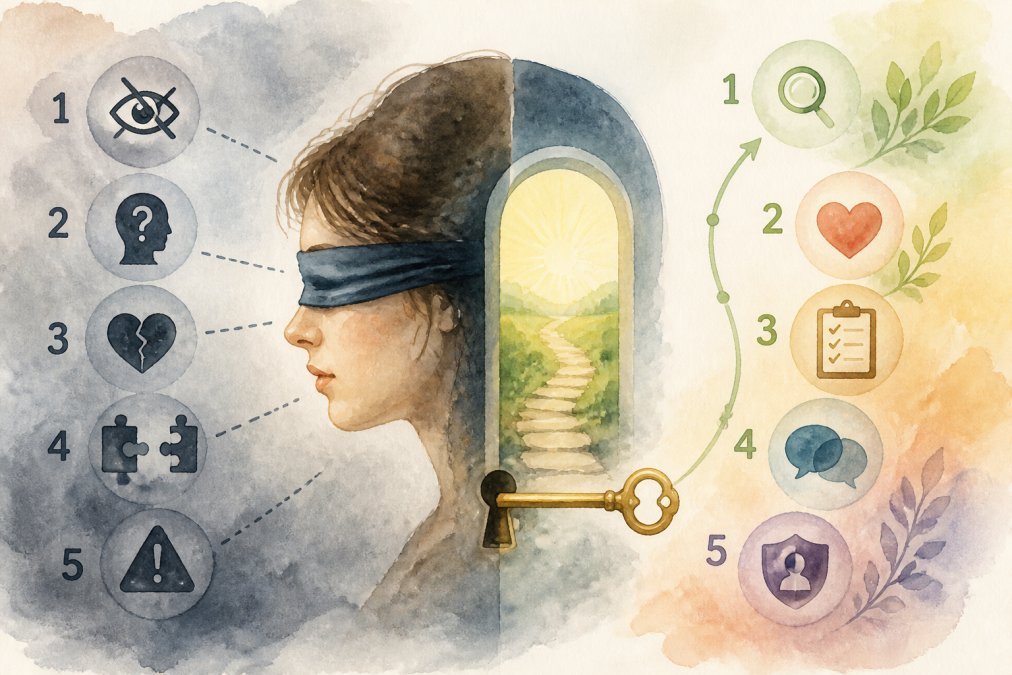
“At least they didn’t sleep with them.” It’s one of the first things betrayed partners tell themselves after discovering an affair that stayed emotional rather than physical. It’s meant to be comforting. Often, it isn’t. Many people find that the pain of emotional infidelity cuts just as deep, sometimes deeper, than a physical betrayal would have. Understanding the real difference between an emotional affair and a physical affair matters, not so you can rank your pain, but so you can name what actually happened and find a way through it.
- What Counts as an Emotional Affair vs a Physical Affair?
- Is an Emotional Affair Worse Than a Physical One?
- Emotional Infidelity Signs: How to Tell What You're Dealing With
- 'Fog' Affairs: When Emotional and Physical Infidelity Blur Together
- Betrayal Trauma and the Type of Affair: Does Recovery Differ?
- How to Heal From an Emotional Affair: Your Next Steps
What Counts as an Emotional Affair vs a Physical Affair?
A physical affair is the version most people picture when they hear the word “affair”: sexual or romantic physical contact with someone outside the relationship. It’s the type of infidelity that’s easiest to define and, in some ways, easiest to explain to friends and family. There’s a clear act, a clear boundary crossed.
An emotional affair is less visible but no less real. It’s built on secrecy, emotional intimacy, and a redirection of attention and vulnerability away from a primary partner and toward someone else, without physical contact necessarily ever happening.
Emotional Affair Definition: The Boundaries That Get Crossed
If you’re asking what counts as an emotional affair, look at three things: secrecy, emotional priority, and boundary erosion.
Secrecy is usually the clearest marker. If your partner is hiding messages, deleting conversations, or downplaying how often they speak to someone, that secrecy itself is doing damage, regardless of what’s actually being said.
Emotional priority means your partner starts turning to someone else first, for support, for excitement, for validation, for the details of their day, rather than to you. Boundary erosion is the gradual creep: what began as friendly chat slides into flirtation, then into a kind of intimacy that would feel inappropriate if a partner watched it happen.
Physical vs Emotional Cheating: Where the Lines Blur
Physical vs emotional cheating sounds like a simple binary, but real relationships rarely respect the line so neatly. A physical affair almost always carries emotional weight, too. Even a one-off physical encounter usually involves some level of secrecy and, often, a growing emotional pull toward the other person as the affair continues.
Meanwhile an emotional affair can involve behaviour, like private jokes, physical closeness that stops just short of sex, or affectionate touch, that sits uncomfortably close to a physical betrayal. This is exactly why so many people arrive here unsure whether their situation “counts.” If it feels like a betrayal, it’s worth treating it as one.
Is an Emotional Affair Worse Than a Physical One?
This is the question almost everyone asks after discovery, and it’s the wrong question, though an understandable one. Is an emotional affair worse than a physical one? Clinically, the more useful framing is that they’re different, not that one ranks above the other.
Why Emotional Infidelity Can Feel More Devastating
Emotional affairs strike directly at the attachment bond: the sense that your partner is your primary source of emotional safety and connection. A physical affair, especially a brief or opportunistic one, can sometimes be separated from that bond in a partner’s mind. An emotional affair is much harder to separate, because it’s built from the same ingredients as the primary relationship: conversation, trust, being known.
Emotional affairs also tend to unfold over a longer period. Longer time frames often mean longer stretches of deception, more accumulated small lies, and more moments the betrayed partner has to mentally revisit and reinterpret once the truth comes out. Therapists who work with couples after infidelity often note that emotional affairs can take longer to fully disclose and longer to rebuild trust from. The boundaries were blurry, and the betrayed partner struggles to pinpoint exactly when the line was crossed.
The Psychological Overlap Between Both Types of Betrayal
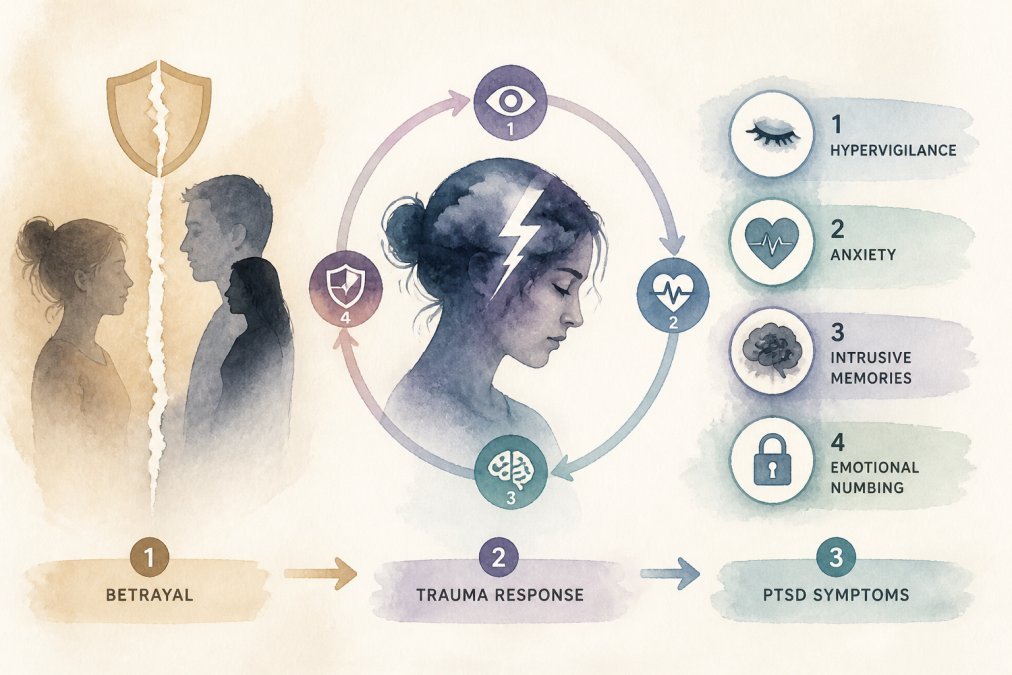
Regardless of type, the injury that follows discovery looks remarkably similar. Betrayal trauma researchers describe infidelity discovery as producing symptoms clinically similar to PTSD: intrusive thoughts, hypervigilance, a shattered sense of safety. Whether the affair was emotional or physical doesn’t change that. Your nervous system doesn’t grade the affair on a technicality before it reacts.
This is best understood as betrayal trauma as a psychological injury rather than a simple hurt feeling. Framed that way, the “which is worse” debate matters less than recognising that both types of infidelity can cause a genuine trauma response requiring real support to heal from.
Emotional Infidelity Signs: How to Tell What You’re Dealing With
If you suspect something is happening but can’t put your finger on it, a pattern of behaviour is usually more telling than any single incident.
Did My Partner Have an Emotional Affair? Key Red Flags
Common emotional infidelity signs include:
- Secrecy about one specific person: hidden messages, a locked phone, a name that never comes up naturally anymore.
- Emotional withdrawal: less sharing about their day, less curiosity about yours, a sense of distance you can’t quite explain.
- Defensiveness: disproportionate irritation or anger when you ask innocent questions about a friendship or colleague.
- Comparison: subtle or overt remarks that measure you against the other person.
- Prioritised availability: they’re quick to reply to this person, slower and more distracted with you.
- Changed routines: new excuses to be near someone, new topics they suddenly know a lot about.
None of these alone proves an affair. Together, over weeks or months, they form a pattern worth taking seriously.
Emotional Affair With No Physical Contact: Why It Still Counts
An emotional affair with no physical contact can still be a full-blown affair. The absence of sex doesn’t cancel out the secrecy, the redirected intimacy, or the broken trust. A common presentation in couples counselling is the “work spouse” scenario: two colleagues share every detail of their day, seek each other out for emotional support, and gradually stop confiding in their actual partner, with no physical contact ever occurring. By the time it’s discovered, the betrayed partner is often just as devastated as if there had been.
On aftertheaffair.uk, the recurring pattern in reader stories is that betrayed partners initially minimise emotional affairs, telling themselves “at least they didn’t sleep together,” and then feel blindsided months later by how deeply the secrecy and emotional withdrawal actually wounded them.
‘Fog’ Affairs: When Emotional and Physical Infidelity Blur Together
Not every affair fits neatly into one category. Many begin as an emotional connection that slowly develops into something physical. Others start as a purely physical encounter that unexpectedly develops emotional depth and attachment. Counsellors sometimes describe these as “fog” affairs, situations where the emotional and physical elements are so intertwined that trying to draw a clean line between them isn’t just difficult, it’s unhelpful.
If you’re trying to categorise your own situation and finding it doesn’t fit cleanly into “emotional” or “physical,” that’s common, not a sign you’re missing something. What matters more than the label is understanding what drove it in the first place. Understanding the psychology behind why partners have affairs can help make sense of how a friendship or connection turned into a fog affair, and why the type of infidelity matters less than the impact it’s had on your relationship.
Betrayal Trauma and the Type of Affair: Does Recovery Differ?
Once the shock starts to settle, most people’s next question shifts from “what happened” to “can we come back from this.”
Can You Recover From an Emotional Affair?
Yes. Can you recover from an emotional affair? The evidence from couples counselling practice is that recovery is possible, and the process looks broadly similar regardless of whether the affair was emotional, physical, or both. Trust is rebuilt the same way in every case: through transparency, consistent behaviour over time, honest accountability from the partner who strayed, and space for the betrayed partner to process what happened without being rushed.
What can differ is the starting point. Emotional affairs often involve murkier boundaries, so couples sometimes spend longer establishing exactly what happened and agreeing on what counts as a boundary going forward, before the deeper trust-rebuilding work can properly begin.
Emotional Affair Recovery UK: What Professional Support Looks Like
For emotional affair recovery UK couples and individuals often look toward, professional support usually falls into two forms: individual therapy for the betrayed partner to process trauma symptoms, and couples counselling to rebuild the relationship itself, when both partners want to try.
Structured, evidence-based couples therapy approaches like EFT and the Gottman Method are commonly used in UK infidelity counselling because they give couples a concrete framework, rather than leaving trust-rebuilding to chance. Emotional affair therapy UK options increasingly include specialist infidelity counsellors, not just general relationship counsellors. That matters because affair recovery involves specific dynamics, like disclosure, transparency agreements, and trauma responses, that generic couples work doesn’t always address well.
Professional support is worth seeking sooner rather than later if you notice ongoing intrusive thoughts, difficulty functioning day to day, or if conversations between you and your partner keep circling without progress. You don’t need to wait for a crisis point to reach out.
How to Heal From an Emotional Affair: Your Next Steps
Working out whether what you’re facing was an emotional affair, a physical one, or a fog affair that was both is genuinely useful. It helps you name what happened and stop second-guessing your own reaction. But the label itself isn’t the destination. It’s the starting point for the harder, more important work of healing.
If you’re the betrayed partner right now, the most immediate priority is managing the immediate aftermath of discovery, because the first days and weeks after finding out are often the most disorienting. From there, a roadmap through the stages of affair recovery can help you understand what typically comes next and why healing rarely moves in a straight line.
Alongside that, practical coping strategies for betrayed partners can help you manage the day-to-day symptoms: the intrusive thoughts, the sleeplessness, the hypervigilance, while the bigger recovery process unfolds. And if you’re still unsure exactly what you’re dealing with, whether it truly qualifies as an affair, how serious it is, or what to do first, a free assessment to clarify your situation can help you get a clearer picture before you decide your next move.
Whatever type of betrayal you’re facing, it’s real, and it deserves a real path forward, not just a label.