Discovering a partner’s affair doesn’t just break trust. It shatters the story you thought you were living. In the days and weeks that follow, many people search for a roadmap: a clear sequence of affair recovery stages that tells them what comes next and when the pain will end. The hard truth is that no such clean roadmap exists. What does exist is a well-recognised set of stages, each with its own emotional texture, and a realistic understanding that the path between them loops, doubles back, and refuses to follow a schedule.
- Why Affair Recovery Doesn't Follow a Straight Line
- The Core Affair Recovery Stages, and What Each One Actually Feels Like
- Relationship Recovery Timeline: How Long Does Each Stage Take?
- Setbacks Are Part of the Process: Triggers and Regression
- Recovery Milestones: How to Know You're Actually Making Progress
- When to Seek Professional Support for Affair Recovery
Why Affair Recovery Doesn’t Follow a Straight Line
Most people expect grief to work like a staircase, each step taking you further from the pain and closer to healing. Affair recovery rarely works that way. It’s more like a coastline: you move forward, then a wave pulls you back, then you advance again, further than before.
Affair recovery specialists, including therapists trained in Emotionally Focused Therapy (EFT), consistently describe the process as cyclical rather than linear. Partners often revisit grief and anger repeatedly before reaching integration. That recycling is a sign of processing, not stagnation. Sue Johnson’s work on attachment and betrayal trauma reinforces this: the nervous system doesn’t “complete” a trauma and file it away. It revisits it until it feels safe.
Setbacks aren’t evidence you’ve failed or that your relationship is beyond repair. They’re evidence that something real happened, and your mind and body are doing their job. Holding that frame is genuinely difficult, but it’s also the foundation that makes sustained recovery possible.
The Core Affair Recovery Stages, and What Each One Actually Feels Like
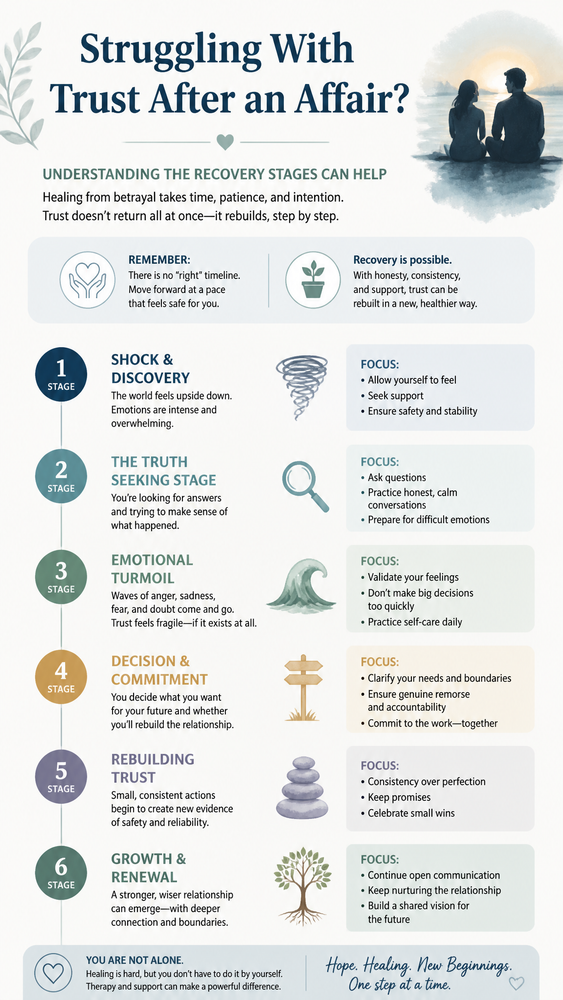
Stage 1: Crisis and Shock, Surviving Discovery
The moment of discovery, whether confronted directly, found by accident, or confessed to, triggers a neurological shock response. Thoughts race or go blank. Appetite disappears. Sleep becomes impossible or constant. Some people describe feeling physically ill; others describe a strange numbness, as if watching themselves from a distance.
This stage is about survival, not analysis. The betrayed partner is trying to establish basic facts: what happened, how long, with whom. The person who had the affair is often oscillating between guilt, defensiveness, and fear of the relationship ending. Neither partner is operating from their rational brain.
Managing the immediate aftermath of discovery requires specific strategies, because the choices made in this early window can either create conditions for recovery or close them off entirely.
Stage 2: Emotional Flooding and Grief, Processing the Betrayal
Once the initial shock begins to lift, emotion floods in. Anger, humiliation, profound sadness, obsessive replaying of the affair, these are all normal features of this stage. The betrayed partner may alternate between wanting to know every detail and being overwhelmed by the details they already know.
Grief here isn’t just about the affair. It’s about the relationship you thought you had, the future you planned, and sometimes your sense of identity. The person who had the affair may be in their own version of this stage, grieving the affair relationship, their self-image, or the damage they caused, though at a very different rhythm to their partner.
This is the stage where couples are most out of sync. One partner may want to talk constantly; the other may shut down to cope. That mismatch is one of the most common sources of additional rupture during recovery.
Stage 3: Decision Point, Stay, Leave, or Pause
At some point, and it rarely comes as cleanly as the word “point” implies, each partner has to reckon with what they want to do with the relationship. This stage is often excruciating because it demands clarity at a time when emotional flooding makes clarity almost impossible.
How to approach the decision to stay or go is one of the most searched questions in this space, and for good reason. There’s no universally right answer. Some couples need to separate temporarily to think clearly. Others choose to stay provisionally, committing to a period of rebuilding before making a final decision.
What matters here is that the decision is made consciously, not just by default, where one partner simply endures because leaving feels too hard.
Stage 4: Active Rebuilding, Recovering Trust and Intimacy
If both partners choose to stay, the work of rebuilding begins. This is the most sustained and demanding stage. Trust doesn’t return on its own; it has to be earned through consistent, verifiable transparency over time. John Gottman’s research is precise on this point: recovery is not a return to the previous relationship, but the construction of an entirely new one. The goal is transformation, not restoration.
Evidence-based strategies for rebuilding trust provide structure for this stage, because good intentions alone aren’t enough. Practical transparency, accountability, and renegotiated boundaries all need to be actively built. So does physical connection; rebuilding physical intimacy during recovery is often complicated by triggers, shame, and changed dynamics that take careful work to move through.
Stage 5: Integration, Finding a New Normal
Integration doesn’t mean forgetting, and it doesn’t mean the affair stops mattering. It means the event has been absorbed into a larger, more complex story, one where the relationship (or the individual, if the couple separated) has genuinely changed.
Couples who reach integration often describe their relationship as deeper, more honest, and more deliberate than before, though they’re also clear they’d never have chosen this path. For some, integration means a healthy, conscious decision to part ways. For others, it means a relationship built on a more honest foundation. Both are valid outcomes.
Relationship Recovery Timeline: How Long Does Each Stage Take?
There’s no honest answer that comes with a precise number of months. What’s widely observed in clinical practice is that the acute crisis phase typically lasts weeks to a few months, emotional flooding can persist for a year or more, and full integration, where the affair no longer defines daily life, usually takes two to five years.
Those ranges are wide because every situation is different. Expecting to be “over it” in six months is one of the most common and damaging assumptions people bring into this process.
Factors That Speed Up or Slow Down the Healing After Infidelity Stages
Several variables shape the relationship recovery timeline:
- Affair type. A long-term emotional affair with deep attachment typically takes longer to process than a short-term physical one, though this isn’t universal.
- Remorse and accountability. When the person who had the affair takes full responsibility, without minimising or blaming, the betrayed partner has a foundation to work from. Without it, healing stalls.
- Attachment history. People with prior experiences of abandonment or betrayal often find their nervous system responds more intensely. This isn’t a weakness; it’s context.
- Professional support. Couples who engage structured therapeutic support, rather than relying on time alone, consistently show shorter crisis phases and more durable trust repair. Researchers who specialise in infidelity, including Snyder, Baucom, and Gordon, support this finding across the clinical literature.
Setbacks Are Part of the Process: Triggers and Regression
A betrayed partner may feel relatively stable at six months, then be floored by an anniversary, a song, or a passing comment, cycling back into acute grief. This is a recognised pattern in betrayal trauma recovery, not a sign the relationship is failing.
Infidelity triggers work by activating the same threat response the brain registered at discovery. They don’t distinguish between past and present danger. A smell, a location, a phrase, any sensory input associated with the affair can pull someone back into Stage 1 or 2 without warning.
Understanding how infidelity triggers pull you back into earlier stages matters, because unmanaged triggers are the most common reason couples feel they’re going backwards when they’re actually just encountering the non-linear nature of this process.
The important reframe: regression isn’t failure. It’s an indication that a specific piece of the trauma hasn’t been fully processed yet. The goal isn’t to avoid triggers, it’s to build the capacity to move through them without the relationship rupturing each time.
Recovery Milestones: How to Know You’re Actually Making Progress
Because progress in affair recovery is so non-linear, measuring it by pain reduction alone is unreliable. A better approach is tracking behavioural and emotional milestones across each stage.
Early-stage milestones include: being able to sleep, eat, and function at a basic level; having a first honest conversation about what happened without it ending in shutdown or explosion; and agreeing, even provisionally, on some shared understanding of next steps.
Mid-recovery milestones include: the betrayed partner having longer stretches of stability between triggers; the person who had the affair demonstrating transparency consistently without being asked; both partners beginning to discuss the future rather than only the past.
Later milestones include: being able to acknowledge the affair without it destabilising the entire day; experiencing moments of genuine connection or warmth; and, for couples rebuilding, beginning to construct shared meaning around what happened and what changed.
Signs your relationship has the foundations to recover can help you assess where you are more objectively, particularly when the emotional noise makes it hard to see clearly.
When to Seek Professional Support for Affair Recovery
Self-help resources, honest conversation, and time can carry some couples a meaningful distance. But several patterns signal that professional support has become necessary rather than optional.
Seek help when: intrusive thoughts or flashbacks are so frequent they’re interfering with daily functioning; one or both partners are unable to have any conversation about the affair without escalating to crisis; the person who had the affair continues to minimise, blame, or obscure details; there are signs of depression, anxiety, or PTSD-level symptoms in either partner; or the couple has been cycling in the same painful loop for many months without movement.
Evidence-based approaches include Emotionally Focused Therapy, which works directly with attachment injury and is well-researched for betrayal trauma; the Gottman Method’s Trust Revival approach, which offers structured protocols for infidelity specifically; and individual trauma-focused therapy for betrayed partners whose symptoms need dedicated attention.
Couples therapy options including EFT and the Gottman Method can help you understand what each approach involves before you commit to a direction.
If you recognise yourself in any of these patterns, stuck in one of the stages, cycling through setbacks, or simply unable to find a way forward on your own, specialist affair recovery counselling in the UK is available from practitioners who understand this specific territory. Getting support isn’t a sign that your relationship is beyond saving. It’s the most direct route through the stages to something better on the other side.