
Last Updated: August 9, 2026
- Regain Control after a Breakup. Why You React Impulsively to Your Ex
- Step 1: Identify Your Personal Triggers
- Step 2: Master the Pause, The Foundation of Self-Regulation
- Step 3: Use Mindfulness Exercises for Emotional Triggers
- Step 4: Scripts for Setting Boundaries With Your Ex
- Step 5: How to Stop Texting Your Ex, Digital Boundaries
- No Contact Rule Benefits and How to Enforce It
- What to Do After an Impulsive Reaction
- Bringing It Together: Your Action Plan
- Frequently Asked Questions
Regain Control after a Breakup. Why You React Impulsively to Your Ex
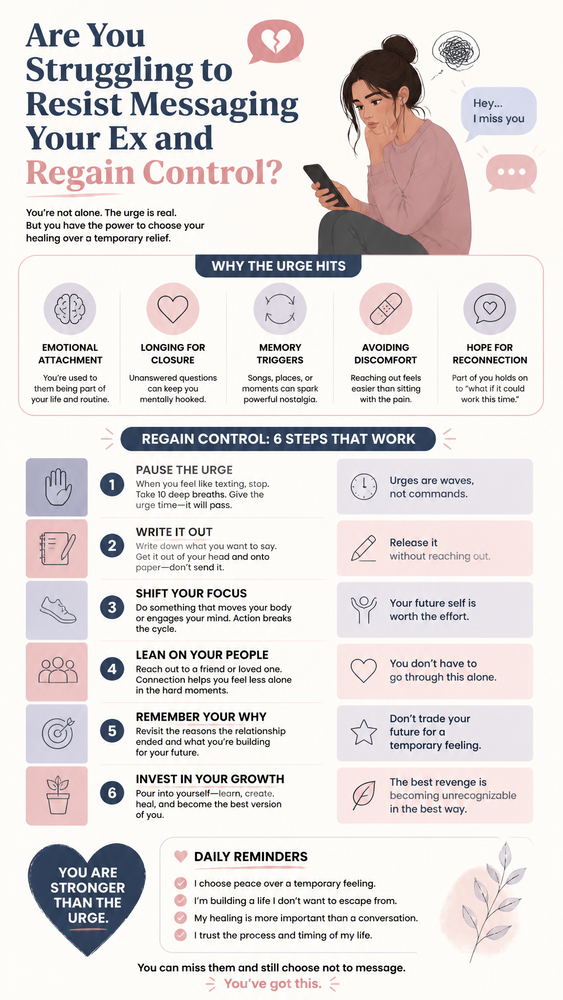
When you see a message from your ex, your nervous system fires before your conscious mind registers what’s happening. After betrayal, your brain has been rewired by trauma. The discovery of infidelity creates neural pathways that treat your ex as both a source of pain and a source of answers. You want clarity, understanding, and control. These impulses feel urgent because your nervous system is in hypervigilance, searching for resolution that logic tells you won’t come.
The neurobiology of emotional triggers after betrayal
Betrayal activates your amygdala, the brain’s threat-detection center. It doesn’t distinguish between physical and emotional danger. When something reminds you of them, a song, their name in your phone, your amygdala floods your system with stress hormones. Adrenaline and cortisol spike. Your prefrontal cortex, responsible for rational decision-making, goes offline.
This is not a character flaw. This is neurobiology. Your body is responding exactly as it should to perceived threat. The problem is that the threat (emotional pain) doesn’t require the response your system is offering (immediate contact with the source of pain).
The urge to contact your ex peaks within 10-20 minutes of activation. Your job is not to eliminate the urge, it’s to outlast it. Most people don’t realize the impulse has an expiration date.
Common impulsive patterns and what they signal
The Confrontation Impulse: You craft the perfect message to make them see the impact of their actions. This signals you’re seeking validation from someone who cannot provide it.
The Hoovering Check: You send a casual message like “How are you?” to test if they still care. This signals loneliness and the fantasy that reconnection might ease your pain.
The Rage Response: You send angry messages you later regret. This signals unprocessed betrayal, with anger masking deeper hurt.
The Bargaining Attempt: You reach out with evidence of how much you’ve changed, hoping they’ll reconsider. This signals you’re still negotiating with someone who has already made their choice.
The Late-Night Contact: Alcohol, exhaustion, or vulnerability lower your defenses. This signals you need better boundary enforcement during vulnerable hours.
Each pattern serves a function in your mind and promises something your rational brain knows is false. Recognizing which pattern dominates your behavior helps you interrupt it at the source.
Step 1: Identify Your Personal Triggers
Stopping impulsive reactions begins with precision. A trigger is not the ex themselves, it’s the specific situation, message, or emotional state that activates the impulse to contact them.
Situational triggers vs. emotional states
Situational triggers are external: seeing their car, hearing their name, noticing their social media activity, or encountering a shared location.
Emotional state triggers are internal: loneliness, self-doubt, stress, or moments questioning whether you made the right decision. A situational trigger only activates the impulse if your emotional state is vulnerable. On a confident day, the same trigger might not move you. On an isolated day, a minor trigger can feel overwhelming.
Creating your personal trigger log
For 7-10 days, track every impulse to contact your ex:
- What happened right before the urge?
- What were you feeling?
- What time of day?
- What did you want to accomplish?
- Did you contact them?
After 7-10 days, patterns emerge. You’ll notice certain emotional states (tired, lonely, stressed) combine with certain situations (late evening, after seeing their social media) to create your highest-risk windows.
Your triggers are not random. They follow a pattern. Once you identify the pattern, you can build interventions around it instead of fighting the impulse in the moment.
Step 2: Master the Pause, The Foundation of Self-Regulation
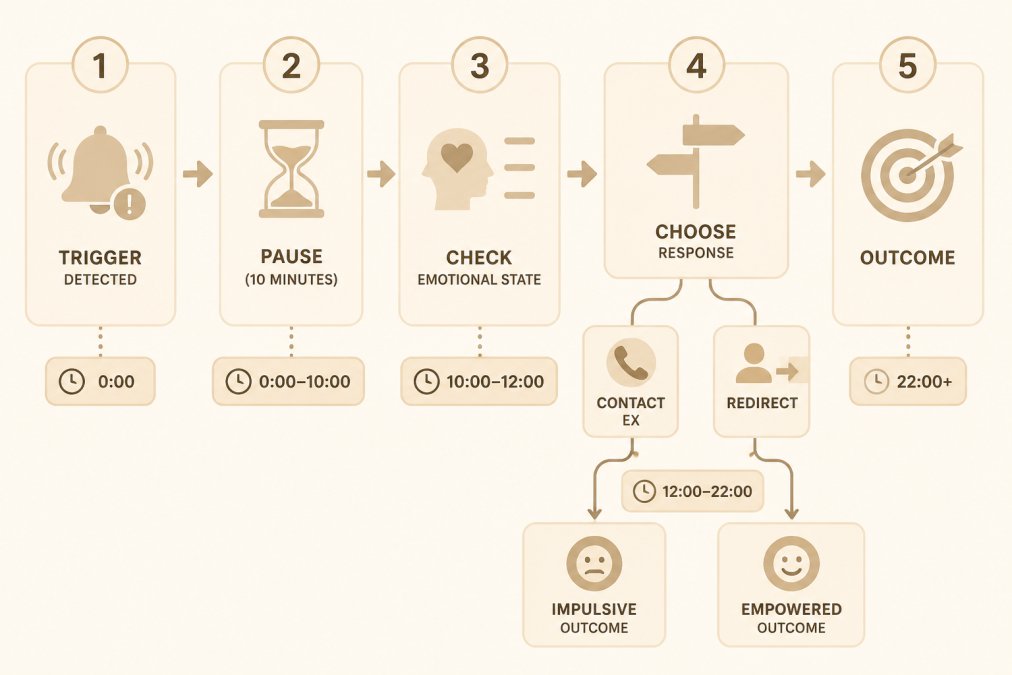
The pause is the space between impulse and action. In that space, you have choice. The urge to contact your ex will peak and then subside, typically lasting 10-20 minutes. If you can create a pause extending beyond that window, the impulse loses its power and your rational brain comes back online.
The 10-minute rule and why it works
When you feel the impulse to contact your ex, commit to waiting 10 minutes before acting. Set a timer. During those 10 minutes, do not check your phone or draft the message. Research shows that the intensity of an emotional impulse typically peaks within 10-15 minutes and then declines. By minute 10, your amygdala has begun to calm and your prefrontal cortex is coming back online. Most people find they no longer want to contact their ex by this point.

Physical grounding techniques to interrupt the impulse
When the impulse rises, your nervous system is activated. Physical grounding techniques interrupt this response by anchoring you to the present moment.
The 5-4-3-2-1 Grounding Technique: Name 5 things you can see, 4 things you can touch, 3 things you can hear, 2 things you can smell, 1 thing you can taste. This forces your attention into the present moment.
Cold Water Activation: Splash cold water on your face or hold ice in your hand. The cold triggers the vagus nerve, activating your parasympathetic nervous system and shifting your body out of fight-or-flight.
Progressive Muscle Relaxation: Tense each muscle group for 5 seconds, then release, starting with your toes and working up to your head. This interrupts physical tension and signals safety to your nervous system.
The goal is to interrupt the automatic response long enough for your rational brain to catch up.
Step 3: Use Mindfulness Exercises for Emotional Triggers
Mindfulness teaches you to observe your thoughts and emotions without acting on them. For stopping impulsive reactions to your ex, it helps you notice the impulse and let it pass without following it.
Urge surfing: Riding the wave without acting
Urge surfing is a mindfulness technique where you observe an urge like a wave: it builds, reaches a peak, and subsides. If you try to fight it, you exhaust yourself. If you ride it, you survive it.
When the impulse to contact your ex arises:
Notice it without judgment. “I’m having the thought that I should text them.” Just observation.
Locate it in your body. Where do you feel the impulse? Tightness in your chest? Restlessness in your hands?
Watch it change. Don’t act. Just observe. The impulse will intensify, plateau, and decline over 10-20 minutes.
Notice what comes after. Once the impulse subsides, what’s left? Often sadness, loneliness, or doubt. The impulse was an attempt to escape these feelings.
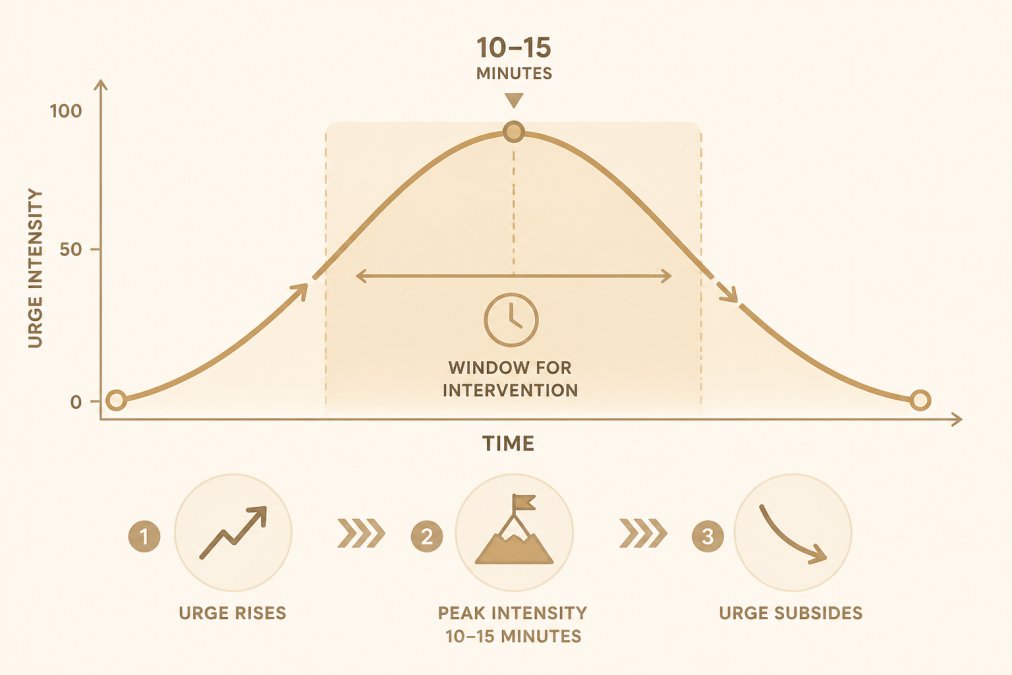
Urge surfing works because it removes the struggle. You stop fighting the impulse and start observing it.
Breathwork and nervous system regulation
Your breath is the bridge between your conscious mind and your nervous system. When you control your breath, you regulate your nervous system.
Box Breathing (4-4-4-4): Inhale for 4 counts, hold for 4 counts, exhale for 4 counts, hold for 4 counts. Repeat for 2-3 minutes. This signals safety to your nervous system.
Extended Exhale Breathing: Inhale for 4 counts, exhale for 6-8 counts. The longer exhale activates the vagus nerve and shifts you into parasympathetic dominance.
When you slow your breathing, you lower your heart rate and blood pressure. Your amygdala calms and your prefrontal cortex comes back online. The impulse becomes a thought you can observe rather than an action you must take.
If you’re in [acute emotional distress](/emotional-volatility-after-betrayal/) and breathing exercises feel insufficient, reach out to a therapist or crisis line. Grounding techniques are tools, not substitutes for professional help when you’re in crisis.
Step 4: Scripts for Setting Boundaries With Your Ex
If you share children or must maintain some contact, you need a way to communicate that protects your emotional wellbeing while meeting practical necessities. Boundary-setting scripts provide pre-planned responses so you don’t improvise from an emotional place.
The Gray Rock Method in practice
The Gray Rock Method is a communication technique where you become as uninteresting as a gray rock. You provide only factual, unemotional information. You do not share feelings, ask personal questions, or engage in debate. When you offer nothing but facts, they have nothing to work with and the interaction becomes unrewarding.
How to apply it:
- Respond to logistics only (children’s schedules, financial matters, legal requirements)
- Use neutral language: “The pickup is at 6 PM on Friday” not “I can’t believe you’re late again”
- Do not answer personal questions about your life or feelings
- Keep responses brief: 1-2 sentences maximum
- Use email or text for important matters (creates documentation and reduces real-time emotional reactivity)
Sample scripts for common scenarios
Scenario: They text asking how you’re doing
IMPULSIVE RESPONSE: “I’m struggling because of what you did. I can’t sleep. I feel betrayed every day.”
GRAY ROCK RESPONSE: “I’m managing. Let me know if there’s something you need regarding the kids.”
Scenario: They want to “talk things through”
IMPULSIVE RESPONSE: “Fine. Maybe if you actually listen this time, you’ll understand what you did to me.”
GRAY ROCK RESPONSE: “I’m not available for that conversation. If there’s something about the kids or logistics we need to discuss, I’m open to that.”
Scenario: They’re trying to make you jealous
IMPULSIVE RESPONSE: “I see you’re already with someone else. That was fast. I guess our relationship meant nothing to you.”
GRAY ROCK RESPONSE: No response. Do not acknowledge. Do not engage.
Step 5: How to Stop Texting Your Ex, Digital Boundaries
Texting your ex is the most common impulsive reaction. It feels private and offers the illusion of control. Stopping impulsive texting requires removing friction from the impulse while creating friction around the alternative behavior.
Removing friction from impulsive contact
Delete their contact. Not blocking, deleting. This means you have to type their number or search for them, creating a pause. By the time you’ve typed their number, the impulse may have passed.
Remove them from social media. Unfollow, mute, or unfriend. Do not check their profile.
Turn off notifications from shared apps. If you use a co-parenting app, turn off notifications so you’re not constantly reminded of them.
Change your phone’s home screen. If their photo is your lock screen, change it.
Set “Do Not Disturb” during high-risk hours. If you’re most likely to text late at night or after drinking, put your phone in Do Not Disturb from 9 PM to 7 AM.
Redirect the urge: Alternative actions to take instead
The impulse to text your ex is energy. You can redirect it.
Text a trusted friend instead. Tell them: “I’m having an urge to text my ex. Can we talk for 10 minutes?”
Write the message but don’t send it. Open a note on your phone. Write the message fully. Then close it. Do not send.
Move your body. Go for a walk, do pushups, dance, or take a cold shower. Physical movement interrupts the neural pattern.
Do something requiring both hands and attention. Cook, paint, play an instrument, or build something.
The key is having a pre-planned alternative. Over time, the neural pathway to the alternative becomes stronger than the pathway to texting your ex.
No Contact Rule Benefits and How to Enforce It
The no contact rule is simple: zero communication with your ex except when legally or practically required (co-parenting communication through a structured app, legal matters through attorneys).
Why no contact accelerates emotional healing
When you maintain contact with your ex, even “just checking in,” you interrupt the healing process. Healing requires distance and time without reminders. Research shows that continued contact delays adjustment. Each interaction reactivates the attachment system, constantly re-bonding and re-breaking. No contact also removes the possibility of false hope. As long as you’re in contact, part of you maintains the fantasy that reconciliation might happen. No contact kills the fantasy and forces you to grieve and rebuild.
Managing slip-ups and post-impulse recovery
You will slip up. One text does not undo your progress, it’s a data point, not a verdict.
When you slip up:
Do not spiral. One text is not failure.
Examine what triggered it. What emotional state were you in? What could you have done differently?
Recommit immediately. Do not use one slip-up as permission for another.
Increase your support. If you’re slipping frequently, you need more external support, more therapy, more time with friends, or more structured boundaries.
Adjust your environment. If you slip up in certain contexts, change those contexts.
No contact is not punishment. It’s protection. You’re protecting your nervous system from repeated activation and your healing process from interruption.
What to Do After an Impulsive Reaction
Despite your best efforts, you will sometimes act on the impulse. When this happens, the work is post-impulse recovery.
Immediately after contact:
Stop the escalation. Do not send a follow-up message or call again. Stop.
Tell someone. Call a trusted friend or therapist. Shame thrives in silence.
Write about it. Spend 10 minutes writing about what triggered you, what you felt, what you hoped would happen, and what actually happened.
Do not wait for a response. Your ex may not respond or may respond with anger. This doesn’t change what you need to do next: recommit to no contact.
Adjust your intervention. The technique that worked last time didn’t work this time. What do you need to change?
Each impulsive reaction is data. You’re training yourself to recognize triggers earlier, interrupt them faster, and execute alternatives more consistently.
Bringing It Together: Your Action Plan
Stopping impulsive reactions to your ex is a skill. It requires practice, feedback, and adjustment.
This week:
- Identify your top 3 triggers
- Practice one grounding technique daily
- Delete their contact or mute their social media
Next week:
- Start urge surfing when the impulse arises
- Draft Gray Rock scripts for your most common interactions
- Establish a 10-minute rule for any impulse to contact
Ongoing:
- Track slip-ups and learn from them
- Increase your support system (therapy, trusted friends, structured resources)
- Celebrate small wins: moments when you felt the impulse and didn’t act
The After the Affair Series provides a complete framework for this work, including structured scripts, trigger-tracking tools, and step-by-step guidance for high-conflict situations. The platform is designed for people who have already decided to separate or are in the process of deciding, people who need immediate, practical support for managing the hardest moments.
If you’re still in the fog about whether to stay or leave, that clarity work comes first. But once you’ve made that decision, these tools help you protect your peace and your children’s wellbeing through the transition.
Frequently Asked Questions
Why do I feel the urge to reach out to my ex when I’m upset?
When you’re emotionally dysregulated after betrayal, your brain seeks the familiar source of connection, even if that person caused the pain. This is a stress response, not a sign you should reconcile. Your nervous system is trying to regulate through contact. Recognizing this as a symptom, not a truth about what you want, is the first step to stopping impulsive reactions to your ex. The urge will fade if you pause and use grounding techniques instead.
How long does it take to stop feeling triggered by your ex?
Emotional triggers typically diminish within 3-6 months of consistent no contact and self-regulation practice, though intensity decreases much faster, often within weeks. The timeline depends on how long you were together, the depth of betrayal, and how consistently you practice the pause and mindfulness techniques. You won’t stop feeling triggered overnight, but you’ll gain the ability to notice the trigger without acting on it. This is the real goal: not eliminating feelings, but controlling your behavioral response.
What should I do if I’ve already sent an impulsive message to my ex?
Post-impulse recovery is critical. First, do not send a follow-up message explaining, apologizing, or trying to fix it. One message is a slip; multiple messages compound the problem. Second, document what triggered the impulse and review your personal trigger log to prevent the same situation. Third, reach out to your accountability partner or support system immediately to process the emotional aftermath. Finally, recommit to your no contact boundaries. A single slip doesn’t erase your progress, consistency moving forward does.
Can these techniques work if my ex is genuinely hostile and unpredictable?
Yes. The techniques in this guide, the pause, urge surfing, boundary scripts, and no contact, are specifically designed for high-conflict situations where your ex refuses to communicate reasonably. In fact, hostile exes make these tools even more necessary. The Gray Rock Method and structured scripts are most effective precisely when dealing with someone unpredictable. Your goal isn’t to change your ex’s behavior; it’s to control your own impulses so you don’t escalate conflict or give them ammunition. These frameworks protect you regardless of their behavior.
The work of stopping impulsive reactions to your ex is the work of reclaiming agency. For months or years, your ex had power over your emotions and your choices. This work returns that power to you. It’s not quick. It’s not always comfortable. But it is absolutely worth doing.
Start with one step. Master the pause. Everything else builds from there.